Performance and community
Some brief reflections
Graham Jeffery
Double-edged discourses
• Community as slippery – invoked by policymakers and developers, inherently
‘defensive/exclusionary’ but also as a space of hope, solidarity and possibility?
• Spectacle and performance – living in an increasingly spectacularised/mediatized
society – constant recuperation of performance and spectacle to serve powerful
interests
• Foregrounds the politics of performance – in whose interest(s) are ‘community
performances’ taking place?
• Arguably, all performances are community performances – values, aesthetics,
representation, institutions, economics etc
• Double-edged narratives of regeneration, poverty and development: Markers of
disposability/obsolescence but also sites of opportunity – for whom?
Giroux and public pedagogy
• Histories of critical public performance practice and
community education
• The politics of public space – how is this secured,
defended, contested?
• How places are enacted and performed – both in the
everyday (see, e.g. Alan Read’s work on theatres of
everyday life) and through the rituals of art-making –
working in public – ‘special occasions’
• Ethics, agency, power and representation are all
important – as well as the ability to translate, mediate,
produce, dialogue – skills and principles together…
Principles
• Spatial agency and social agency: creative
methods which build active involvement and
participation
• Fran Tonkiss: ‘space at the margins, and room for
manoeuvre in the cracks & geographies of urban
power,…minor practices, ordinary audacities and
little anti-utopias that nevertheless create
material spaces of hope.... Such spaces may
matter most when...prospects are most bleak’
Spaces of possibility and hope?
• Under what circumstances?
• Connective approaches and the relationships
between the arts, activism and social change
• Artists working in public/across sectors/between
organisations – brokering, bridge-building etc – as
intermediaries/ambiguous actors/agents
provocateurs
• Complex politics of funding – question of
community arts relationship with the state (and
private sectors) has not really been addressed
since Owen Kelly (1984)
Odd Numbers – mythmaking in Milton
• Storytelling, ritual, play
• A place without much visible heritage (cf.
Govan..)
• High deprivation, and all the problems of power
and representation of poverty-stricken
communities
• Reverse archaeologies?
• Intergenerational practice
• Inviting people into a participative, performed
space
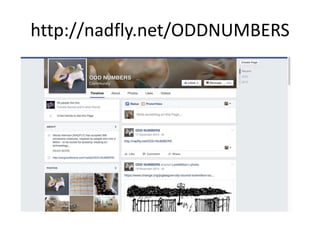
http://nadfly.net/ODDNUMBERS
Future research agendas
• Connecting performance/practice perspectives with
the sociologies, histories and geographies of contested
spaces and places – as well as with architecture/urban
design/planning
• Critical interventionist/public arts practices as a
catalyst for changing perceptions, challenging power
structures and revealing/uncovering identities and
histories
• The value of small gestures/small projects versus the
complexities of macro-social struggles – Harvey’s
‘spaces of hope’ and the ‘insurgent architect’
www.generalpraxis.org.uk
www.twitter.com/grahamjeffery
www.twitter.com/RemakingSociety
Graham.Jeffery@uws.ac.uk

Performance & Community: some brief reflections

  • 1.
    Performance and community Somebrief reflections Graham Jeffery
  • 2.
    Double-edged discourses • Communityas slippery – invoked by policymakers and developers, inherently ‘defensive/exclusionary’ but also as a space of hope, solidarity and possibility? • Spectacle and performance – living in an increasingly spectacularised/mediatized society – constant recuperation of performance and spectacle to serve powerful interests • Foregrounds the politics of performance – in whose interest(s) are ‘community performances’ taking place? • Arguably, all performances are community performances – values, aesthetics, representation, institutions, economics etc • Double-edged narratives of regeneration, poverty and development: Markers of disposability/obsolescence but also sites of opportunity – for whom?
  • 3.
    Giroux and publicpedagogy • Histories of critical public performance practice and community education • The politics of public space – how is this secured, defended, contested? • How places are enacted and performed – both in the everyday (see, e.g. Alan Read’s work on theatres of everyday life) and through the rituals of art-making – working in public – ‘special occasions’ • Ethics, agency, power and representation are all important – as well as the ability to translate, mediate, produce, dialogue – skills and principles together…
  • 4.
    Principles • Spatial agencyand social agency: creative methods which build active involvement and participation • Fran Tonkiss: ‘space at the margins, and room for manoeuvre in the cracks & geographies of urban power,…minor practices, ordinary audacities and little anti-utopias that nevertheless create material spaces of hope.... Such spaces may matter most when...prospects are most bleak’
  • 5.
    Spaces of possibilityand hope? • Under what circumstances? • Connective approaches and the relationships between the arts, activism and social change • Artists working in public/across sectors/between organisations – brokering, bridge-building etc – as intermediaries/ambiguous actors/agents provocateurs • Complex politics of funding – question of community arts relationship with the state (and private sectors) has not really been addressed since Owen Kelly (1984)
  • 6.
    Odd Numbers –mythmaking in Milton • Storytelling, ritual, play • A place without much visible heritage (cf. Govan..) • High deprivation, and all the problems of power and representation of poverty-stricken communities • Reverse archaeologies? • Intergenerational practice • Inviting people into a participative, performed space
  • 7.
  • 8.
    Future research agendas •Connecting performance/practice perspectives with the sociologies, histories and geographies of contested spaces and places – as well as with architecture/urban design/planning • Critical interventionist/public arts practices as a catalyst for changing perceptions, challenging power structures and revealing/uncovering identities and histories • The value of small gestures/small projects versus the complexities of macro-social struggles – Harvey’s ‘spaces of hope’ and the ‘insurgent architect’
  • 9.