Reinventing higher education for a networked age Graham Jeffery Reader, School of Creative and Cultural Industries
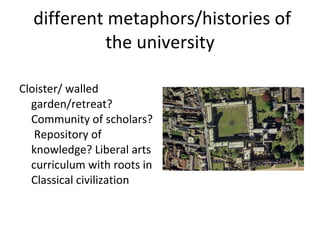
different metaphors/histories of the university Cloister/ walled garden/retreat? Community of scholars?  Repository of knowledge? Liberal arts curriculum with roots in Classical civilization
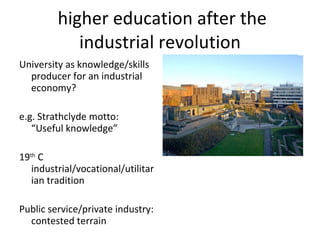
higher education after the industrial revolution University as knowledge/skills producer for an industrial economy? e.g. Strathclyde motto:  “Useful knowledge” 19 th  C industrial/vocational/utilitarian tradition Public service/private industry: contested terrain
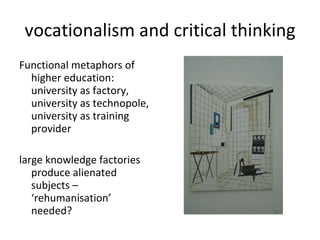
vocationalism and critical thinking Functional metaphors of higher education:  university as factory, university as technopole, university as training provider large knowledge factories produce alienated subjects – ‘rehumanisation’ needed?
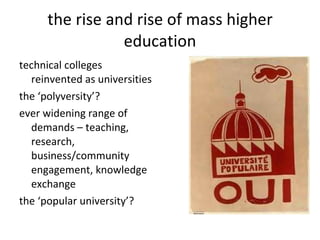
the rise and rise of mass higher education technical colleges reinvented as universities the ‘polyversity’? ever widening range of demands – teaching, research, business/community engagement, knowledge exchange the ‘popular university’?
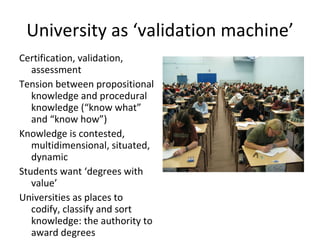
University as ‘validation machine’ Certification, validation, assessment Tension between propositional knowledge and procedural knowledge (“know what” and “know how”) Knowledge is contested, multidimensional, situated, dynamic Students want ‘degrees with value’ Universities as places to  codify, classify and sort knowledge: the authority to award degrees
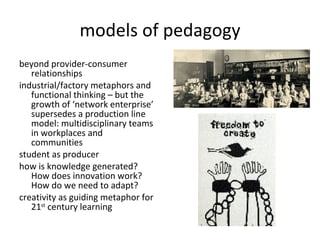
models of pedagogy beyond provider-consumer relationships industrial/factory metaphors and functional thinking – but the growth of ‘network enterprise’ supersedes a production line model: multidisciplinary teams in workplaces and communities student as producer how is knowledge generated? How does innovation work? How do we need to adapt? creativity as guiding metaphor for 21 st  century learning
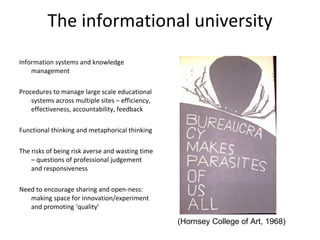
The informational university Information systems and knowledge management Procedures to manage large scale educational systems across multiple sites – efficiency, effectiveness, accountability, feedback Functional thinking and metaphorical thinking The risks of being risk averse and wasting time – questions of professional judgement and responsiveness Need to encourage sharing and open-ness: making space for innovation/experiment and promoting ‘quality’ (Hornsey College of Art, 1968)
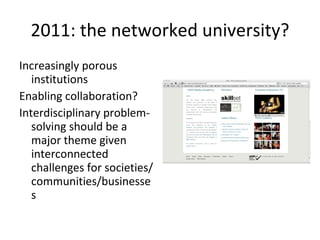
2011: the networked university? Increasingly porous institutions  Enabling collaboration?  Interdisciplinary problem-solving should be a major theme given interconnected challenges for societies/communities/businesses
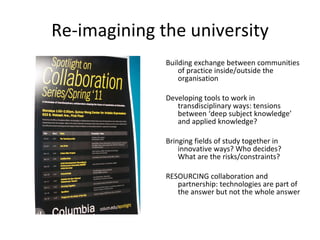
Re-imagining the university Building exchange between communities of practice inside/outside the organisation Developing tools to work in transdisciplinary ways: tensions between ‘deep subject knowledge’ and applied knowledge?  Bringing fields of study together in innovative ways? Who decides? What are the risks/constraints?  RESOURCING collaboration and partnership: technologies are part of the answer but not the whole answer
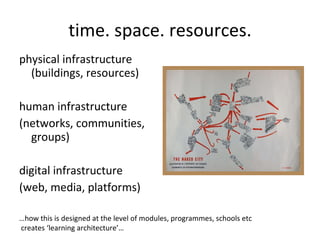
time. space. resources. physical infrastructure (buildings, resources) human infrastructure  (networks, communities, groups) digital infrastructure (web, media, platforms) … how this is designed at the level of modules, programmes, schools etc creates ‘learning architecture’…
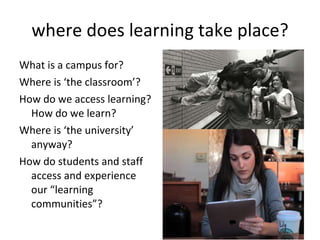
where does learning take place? What is a campus for? Where is ‘the classroom’? How do we access learning?How do we learn? Where is ‘the university’ anyway? How do students and staff access and experience our “learning communities”?
the relational university? ‘ Quality’ in education boils down to the quality of relationships between members of the learning community: –  trust, confidence, support, communication, good systems, good resources, good use of time.  Relational forms of knowledge construction (Bernstein, Illich, etc.) Return to  ethical  questions about purpose/value
www.twitter.com/UWScreative uwscreative.wordpress.com www.uwsmediaacademy.com generalpraxis.blogspot.com

Reinventing higher education for a networked age

  • 1.
    Reinventing higher educationfor a networked age Graham Jeffery Reader, School of Creative and Cultural Industries
  • 2.
    different metaphors/histories ofthe university Cloister/ walled garden/retreat? Community of scholars? Repository of knowledge? Liberal arts curriculum with roots in Classical civilization
  • 3.
    higher education afterthe industrial revolution University as knowledge/skills producer for an industrial economy? e.g. Strathclyde motto: “Useful knowledge” 19 th C industrial/vocational/utilitarian tradition Public service/private industry: contested terrain
  • 4.
    vocationalism and criticalthinking Functional metaphors of higher education: university as factory, university as technopole, university as training provider large knowledge factories produce alienated subjects – ‘rehumanisation’ needed?
  • 5.
    the rise andrise of mass higher education technical colleges reinvented as universities the ‘polyversity’? ever widening range of demands – teaching, research, business/community engagement, knowledge exchange the ‘popular university’?
  • 6.
    University as ‘validationmachine’ Certification, validation, assessment Tension between propositional knowledge and procedural knowledge (“know what” and “know how”) Knowledge is contested, multidimensional, situated, dynamic Students want ‘degrees with value’ Universities as places to codify, classify and sort knowledge: the authority to award degrees
  • 7.
    models of pedagogybeyond provider-consumer relationships industrial/factory metaphors and functional thinking – but the growth of ‘network enterprise’ supersedes a production line model: multidisciplinary teams in workplaces and communities student as producer how is knowledge generated? How does innovation work? How do we need to adapt? creativity as guiding metaphor for 21 st century learning
  • 8.
    The informational universityInformation systems and knowledge management Procedures to manage large scale educational systems across multiple sites – efficiency, effectiveness, accountability, feedback Functional thinking and metaphorical thinking The risks of being risk averse and wasting time – questions of professional judgement and responsiveness Need to encourage sharing and open-ness: making space for innovation/experiment and promoting ‘quality’ (Hornsey College of Art, 1968)
  • 9.
    2011: the networkeduniversity? Increasingly porous institutions Enabling collaboration? Interdisciplinary problem-solving should be a major theme given interconnected challenges for societies/communities/businesses
  • 10.
    Re-imagining the universityBuilding exchange between communities of practice inside/outside the organisation Developing tools to work in transdisciplinary ways: tensions between ‘deep subject knowledge’ and applied knowledge? Bringing fields of study together in innovative ways? Who decides? What are the risks/constraints? RESOURCING collaboration and partnership: technologies are part of the answer but not the whole answer
  • 11.
    time. space. resources.physical infrastructure (buildings, resources) human infrastructure (networks, communities, groups) digital infrastructure (web, media, platforms) … how this is designed at the level of modules, programmes, schools etc creates ‘learning architecture’…
  • 12.
    where does learningtake place? What is a campus for? Where is ‘the classroom’? How do we access learning?How do we learn? Where is ‘the university’ anyway? How do students and staff access and experience our “learning communities”?
  • 13.
    the relational university?‘ Quality’ in education boils down to the quality of relationships between members of the learning community: – trust, confidence, support, communication, good systems, good resources, good use of time. Relational forms of knowledge construction (Bernstein, Illich, etc.) Return to ethical questions about purpose/value
  • 14.