1 What are OLEs? 2 What are the features of OLEs?
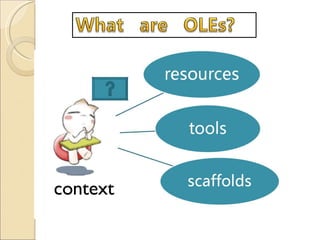
context
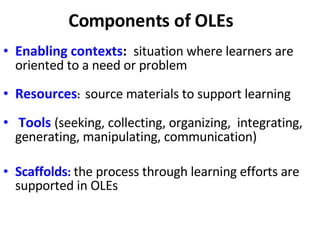
Components of OLEs Enabling contexts :  situation where learners are  oriented to a need or problem  Resources :  source materials to support learning  Tools  (seeking, collecting, organizing,  integrating, generating, manipulating, communication) Scaffolds :   the process through learning efforts are  supported in OLEs
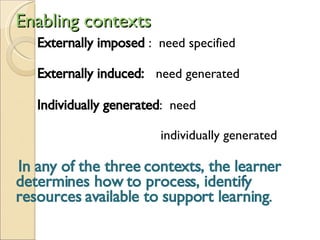
Enabling contexts Externally imposed  :  need specified Externally induced:  need generated Individually generated :  need  individually generated In any of the three contexts, the learner determines how to process, identify resources available to support learning .
Tools
Electronic media :  database, computer tutorial, video etc. Print media:  text-books, original source documents, journal articles Humans experts :  parents, teachers, peers Resources
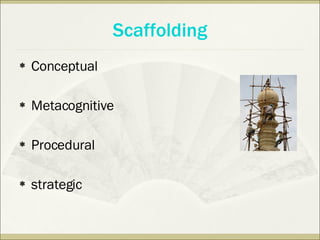
Scaffolding Conceptual Metacognitive Procedural strategic
What are the features of OLEs?
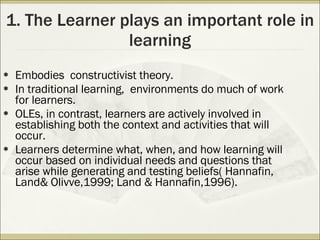
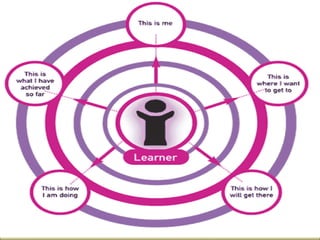
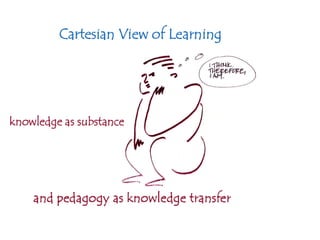
1. The Learner plays an important role in learning Embodies  constructivist theory. In traditional learning,  environments do much of work for learners. OLEs, in contrast, learners are actively involved in establishing both the context and activities that will occur. Learners determine what, when, and how learning will occur based on individual needs and questions that arise while generating and testing beliefs( Hannafin, Land& Olivve,1999; Land & Hannafin,1996).
 
Learners are intrinsically motivated,  Responsibility for the learning would be increased. Web 2.0 not only  provides students with a variety of tools to seek ,collect and organize information ,but also manipulation and communication tools , so that students can determine how and when to employ them
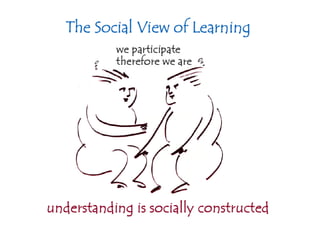
Learning, in OLEs, is a process of social negotiation among participants in any activity. Learning, from this perspective, is dialogue, a process of internal as well as social negotiation
 
 
OLEs are designed to assist the learners in the process of  angling, or considering multiple perspectives during learning process. Varied perspectives from teachers, experts, or peers can be coordinated to form a knowledge base from which learners evaluate and negotiate varied sources of meaning (Hill & Land, 1998)
Web 2.0 tools  like blogger, wiki help students to have social learning with others. Students can evaluate their understanding, clarify areas of uncertainty or confusion, and improve their grasp of the material by collaborative work and discussion in which multiple perspectives are involved.  Take Wiki for example,  learners can easily review the history of an article and contributors’ ongoing discussion. They can also contribute their beliefs and understanding to the topic in Wiki.
Prior or everyday experiences are important in learning process As Hannafin stated, personal beliefs experiences and conceptual schema support the current , as well as provide the foundation for new understanding. reshape and revise ongoing theories in-action  influence the choices learners make in the environments, and the types of goals they set.
. OLEs often utilize problem contexts that are accessible to learners’ everyday experiences. Personal understanding evolves through hands-on ,concrete experiences involving realistic problem posed or induced through OLEs. ( example)
The importance of technology scaffolding OLEs heavily rely on technology. Learners construct, evaluate ,interpret and revise their understanding with the help  of technology. OLEs provides learners with  abundant available source materials and tools (processing tools, communication tools, etc),through which  learner have opportunities to amplify and extend cognitive capabilities.
OLEs may include human and/or technological partnerships OLEs often provide the conceptual scaffolding and means (resources, tools) to promote personal and individual reflection. Individuals can be guided during learning if designs are situated in authentically complex contexts and proper guidance is provided (Pea, 1993; White & Horwitz, 1987).
OLEs environments provide the opportunity to engage higher-order processes, test on-going hypotheses, and construct and revise physical models of concepts under study. In combination with guidance and facilitation of the learning process, technology can serve as a “more capable peer” (Salomon et al., 1989, p. 621). CSILE (Scardamalia et al., 1989)
Web2.0 tools, featuring the interaction of users, could effectively help learners to evaluate ,contribute and get guidance to deepen their understanding.  
We strongly believe that OLEs are important and can be utilized well in our educational practice. OLEs are highly interactive and engaging situations for both learners and instructors. .
Final thoughts What are the  criteria for selecting the resources?  *In OLEs ,What kind of technology and tools in Web2.0 can be used to reach their true potential in assisting  students in evolved thinking?
Thank you for listening!

Open Learning Environment

  • 1.
  • 2.
    1 What areOLEs? 2 What are the features of OLEs?
  • 3.
  • 4.
    Components of OLEsEnabling contexts : situation where learners are oriented to a need or problem Resources : source materials to support learning Tools (seeking, collecting, organizing, integrating, generating, manipulating, communication) Scaffolds : the process through learning efforts are supported in OLEs
  • 5.
    Enabling contexts Externallyimposed : need specified Externally induced: need generated Individually generated : need individually generated In any of the three contexts, the learner determines how to process, identify resources available to support learning .
  • 6.
  • 7.
    Electronic media : database, computer tutorial, video etc. Print media: text-books, original source documents, journal articles Humans experts : parents, teachers, peers Resources
  • 8.
  • 9.
    What are thefeatures of OLEs?
  • 10.
    1. The Learnerplays an important role in learning Embodies constructivist theory. In traditional learning, environments do much of work for learners. OLEs, in contrast, learners are actively involved in establishing both the context and activities that will occur. Learners determine what, when, and how learning will occur based on individual needs and questions that arise while generating and testing beliefs( Hannafin, Land& Olivve,1999; Land & Hannafin,1996).
  • 11.
  • 12.
    Learners are intrinsicallymotivated, Responsibility for the learning would be increased. Web 2.0 not only provides students with a variety of tools to seek ,collect and organize information ,but also manipulation and communication tools , so that students can determine how and when to employ them
  • 13.
    Learning, in OLEs,is a process of social negotiation among participants in any activity. Learning, from this perspective, is dialogue, a process of internal as well as social negotiation
  • 14.
  • 15.
  • 16.
    OLEs are designedto assist the learners in the process of angling, or considering multiple perspectives during learning process. Varied perspectives from teachers, experts, or peers can be coordinated to form a knowledge base from which learners evaluate and negotiate varied sources of meaning (Hill & Land, 1998)
  • 17.
    Web 2.0 tools like blogger, wiki help students to have social learning with others. Students can evaluate their understanding, clarify areas of uncertainty or confusion, and improve their grasp of the material by collaborative work and discussion in which multiple perspectives are involved. Take Wiki for example, learners can easily review the history of an article and contributors’ ongoing discussion. They can also contribute their beliefs and understanding to the topic in Wiki.
  • 18.
    Prior or everydayexperiences are important in learning process As Hannafin stated, personal beliefs experiences and conceptual schema support the current , as well as provide the foundation for new understanding. reshape and revise ongoing theories in-action influence the choices learners make in the environments, and the types of goals they set.
  • 19.
    . OLEs oftenutilize problem contexts that are accessible to learners’ everyday experiences. Personal understanding evolves through hands-on ,concrete experiences involving realistic problem posed or induced through OLEs. ( example)
  • 20.
    The importance oftechnology scaffolding OLEs heavily rely on technology. Learners construct, evaluate ,interpret and revise their understanding with the help of technology. OLEs provides learners with abundant available source materials and tools (processing tools, communication tools, etc),through which learner have opportunities to amplify and extend cognitive capabilities.
  • 21.
    OLEs may includehuman and/or technological partnerships OLEs often provide the conceptual scaffolding and means (resources, tools) to promote personal and individual reflection. Individuals can be guided during learning if designs are situated in authentically complex contexts and proper guidance is provided (Pea, 1993; White & Horwitz, 1987).
  • 22.
    OLEs environments providethe opportunity to engage higher-order processes, test on-going hypotheses, and construct and revise physical models of concepts under study. In combination with guidance and facilitation of the learning process, technology can serve as a “more capable peer” (Salomon et al., 1989, p. 621). CSILE (Scardamalia et al., 1989)
  • 23.
    Web2.0 tools, featuringthe interaction of users, could effectively help learners to evaluate ,contribute and get guidance to deepen their understanding.  
  • 24.
    We strongly believethat OLEs are important and can be utilized well in our educational practice. OLEs are highly interactive and engaging situations for both learners and instructors. .
  • 25.
    Final thoughts Whatare the criteria for selecting the resources? *In OLEs ,What kind of technology and tools in Web2.0 can be used to reach their true potential in assisting students in evolved thinking?
  • 26.
    Thank you forlistening!