Ross
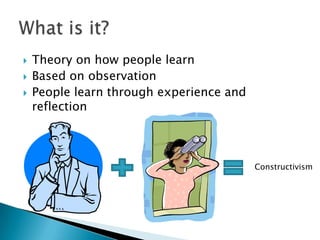
   Theory on how people learn
   Based on observation
   People learn through experience and
    reflection


                                          Constructivism
   Jean Piaget
   Jerome Bruner
   Lev Vygotsky
   John Dewey
   Developed cognitive learning theory
   4 Cognitive Stages
    ◦   1.   Sensorimotor
    ◦   2.   Preoperational
    ◦   3.   Concrete Operational
    ◦   4.   Formal Operational
   Ideas of adaptation, assimilation, and
    accommodation
   Focused on development of children
   Believes in an active, or participatory, learning
    process
   Learning occurs through mental modeling
    and association
   Believes the key to learning is through
    discovery
   Developed social cognition
   Emphasis on social development and culture
   Idea of a zone of proximal development
   Collaborative Learning – being able to
    understand a concept with assistance from
    other people (such as a teacher)
   Father of American Education
   Education is a social process
   Learning should include realistic examples
   Learning must come from a student’s want to
    learn, not from a need to learn
   Student-directed learning
   Active process
   Idea of constructing knowledge rather than
    acquiring it
   Differs from person to person
   People bring in their experiences and cultural
    factors
   Students assess how they are gaining
    knowledge
   Teachers help construct knowledge
   Teachers act as guides
   Technology cultivates student learning and
    understanding through:
    o Online research (databases,
       web sites)
    o Microsoft programs (word,
       excel, PowerPoint)
   Constructivism is important for applied
    mathematics
    (Trigonometry, Calculus, Statistics)
   Constructivism is important, but must not be
    heavily relied on
   A balanced learning experience comes from
    multiple theories and instructional practices
   Teachers Discovering Computers: Integrating
    technology in a connected world (7th edition)
   http://www.learning-
    theories.com/constructivism.html
   http://www.thirteen.org/edonline/concept2cl
    ass/constructivism/index.html

Constructivism pp

  • 1.
  • 2.
    Theory on how people learn  Based on observation  People learn through experience and reflection Constructivism
  • 3.
    Jean Piaget  Jerome Bruner  Lev Vygotsky  John Dewey
  • 4.
    Developed cognitive learning theory  4 Cognitive Stages ◦ 1. Sensorimotor ◦ 2. Preoperational ◦ 3. Concrete Operational ◦ 4. Formal Operational  Ideas of adaptation, assimilation, and accommodation  Focused on development of children
  • 5.
    Believes in an active, or participatory, learning process  Learning occurs through mental modeling and association  Believes the key to learning is through discovery
  • 6.
    Developed social cognition  Emphasis on social development and culture  Idea of a zone of proximal development  Collaborative Learning – being able to understand a concept with assistance from other people (such as a teacher)
  • 7.
    Father of American Education  Education is a social process  Learning should include realistic examples  Learning must come from a student’s want to learn, not from a need to learn  Student-directed learning
  • 8.
    Active process  Idea of constructing knowledge rather than acquiring it  Differs from person to person  People bring in their experiences and cultural factors
  • 9.
    Students assess how they are gaining knowledge  Teachers help construct knowledge  Teachers act as guides  Technology cultivates student learning and understanding through: o Online research (databases, web sites) o Microsoft programs (word, excel, PowerPoint)
  • 10.
    Constructivism is important for applied mathematics (Trigonometry, Calculus, Statistics)  Constructivism is important, but must not be heavily relied on  A balanced learning experience comes from multiple theories and instructional practices
  • 11.
    Teachers Discovering Computers: Integrating technology in a connected world (7th edition)  http://www.learning- theories.com/constructivism.html  http://www.thirteen.org/edonline/concept2cl ass/constructivism/index.html