“We are digital!”
what it means to be an
academic in the post-digital age
Digifest, Anglia Ruskin University, September 2016
Andrew Middleton
Head of Academic Practice & Learning Innovation, Sheffield Hallam University
@andrewmid
Backchannel
Please have your devices ready
(or check who is connected near you)
We will co-produce a ‘take away’ on the
Social Open Learning Environment
using
#ARU_digiMe
My ecology
• From Photography -> Music -> Art -> Archives -> Tech ->
Learning
• Media Enhanced Learning Special Interest Group (MELSIG)
• Digital Voices – learner-generated digital audio for learning
• Smart Learning – learner-generated context of smart
devices
• #BYOD4L – social media for learning
• Personal Learning Network – knowledge, co-produce, trust,
feedback
• Learning Spaces – the digital Hybrid Learning Space
idea thinking
boundary crossing
RICH DIGITAL
MEDIA
USER
GENERATED
MEDIA
BYOD
MOBILE
LEARNING
OPENNESS
SOCIAL
LEARNING
Network
Social Open Learning Ecology
disrupts Models of
Formal of Delivery
disrupts
One-to-Many model
disrupts
Dependency on Text
disrupts
Provided
Content model
disrupts
Provided
“Classroom"
model
disrupts
Provided
Technology
model
++
+
+
+
SOLE
+
the disruptive digital
Google Jockey
• Google Jockey?
• 3 minutes only!
• Everyone to have a ‘good enough’ understanding
• Have you got a sense of what it is? How?
• 2 more minutes!
• Take a position – think about what it might mean
• I want you to be confident and ready to defend or attack
what is suggests
• From a standing start… the basis for learning
Stop watch
The digital hybrid learning space: ubiquity and pervasion
Paradigm shift or tipping point
• No longer a ‘technology as deficit’ discourse
• but… digital fluency through ubiquitous and pervasive behaviour
• Ubiquity = enabled everywhere (‘everyware’)
• Pervasive = in everything we do
Learning ecology: lifewide and lifelong learning identity
“an open system, dynamic and
independent, diverse, partially
self-organizing, and adaptive.”
- John Seely Brown (1999, p.3)
“the set of contexts found in
physical or virtual spaces that
provide opportunities for
learning,”
- Barron (2006, p. 195)
“an environment that fosters
and supports the formation of
communities and networks.
- George Siemens (2003)
“an individual’s …processes and
contexts, relationships,
networks, interactions, tools,
technologies and activities
[providing] …opportunities and
resources for learning,
development and
achievement.“
- Norman Jackson (2016, p.2)
Learning isn’t a simple transaction
It’s an outcome of context
1.
2.
3.
4.
Learning ecology: lifewide and lifelong learning identity
Digital lifewide
“… valuing and recognising
learning and development
gained through life experience,
universities and colleges can
greatly enhance individuals'
preparedness for learning
through the rest of their life.”
- (Redecker et al., 2011)
Agility
FluencyCapabilities
Literacies
Digital
Dynamism: currency and authenticity
Given Context Generated
Discover Knowledge Make
Process
Meta
Based on Anderson & Krathwohl’s Revised Blooms Taxonomy (2001)
Learning with knowledge in a changing context
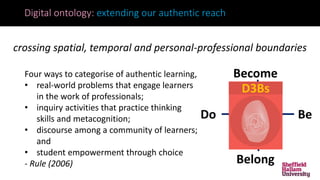
Digital ontology: extending our authentic reach
crossing spatial, temporal and personal-professional boundaries
Four ways to categorise of authentic learning,
• real-world problems that engage learners
in the work of professionals;
• inquiry activities that practice thinking
skills and metacognition;
• discourse among a community of learners;
and
• student empowerment through choice
- Rule (2006)
Be
Belong
Do
Become
D3Bs
Active Classroom
• Learner-centred
• Contextualise and concrete (John Seely Brown)
• Authentic and inductive (not seductive/reductive)
• Work that matters to the student (Jerome Bruner)
• Disrupted formality (experiential)
• Connected, boundless and risky
• Adaptable
• Functional space - responsive furniture, technology
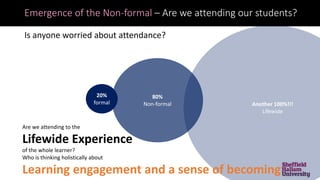
Emergence of the Non-formal – Are we attending our students?
Is anyone worried about attendance?
20%
formal
80%
Non-formal Another 100%!!!
Lifewide
Are we attending to the
Lifewide Experience
of the whole learner?
Who is thinking holistically about
Learning engagement and a sense of becoming
Backchannel: the digital and you
Backchannel: #ARU_digiMe
The next slides ask you to create to a resource together using
twitter
Format: #ARU_digiMe {number} {response}
Later… review the twitter feed for the hashtag to construct
Storify narratives based on our collective ideas
(also… generating a PLN)
@andrewmid
Lifewide =
Teaching
Learning
Research
Home
Voluntary
Leisure
Twitterfall
1. User-generated media disrupts Provided Content model
• User-Producer – ‘Prosumer’
• Learner-generated content
• Learner-generated context
and co-production
• “We make, therefore we are”
Backchannel: #ARU_digiMe 1
What do you make digitally?
• The world of Google and Youtube…
• Digital Storytelling
• Note making and sharing
• PALS Facebook groups - Honeychurch
• Tweet chats – #LTHEchat, RONC Revision Group
• Collaborative writing - MELSIG
• Wiki projects - AllAboutLinguistics
• TeachMeAnatomy
2. BYOD disrupts Provided Technology model
• Ubiquitous, so pervasive
• Apps
• Browser
• Connectivity
• Autonomy
Backchannel: #ARU_digiMe 2
How has your tablet changed
your habits or those of your
students?
• Smart Learning and MELSIG book
• Whiteboarding
• Backchannel
• BYOD4L (5 day open activity
running again in 16-20th Jan 17)
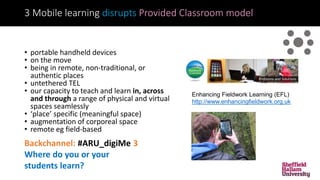
3 Mobile learning disrupts Provided Classroom model
• portable handheld devices
• on the move
• being in remote, non-traditional, or
authentic places
• untethered TEL
• our capacity to teach and learn in, across
and through a range of physical and virtual
spaces seamlessly
• ‘place’ specific (meaningful space)
• augmentation of corporeal space
• remote eg field-based
Backchannel: #ARU_digiMe 3
Where do you or your
students learn?
Enhancing Fieldwork Learning (EFL)
http://www.enhancingfieldwork.org.uk
4 Open learning disrupts models of formal delivery
Cronin (2014) after Alec Couros
Backchannel: #ARU_digiMe 4
Define what network means to
you
• Much more than MOOCs
• Much more than OER
(content)
• Content or community?
• PLEs and PLNs
4Rs (Wiley) Reuse, Revise, Remix,
Redistribute (5.Retain)
Content focussed…
5 Social learning network disrupts One-to-Many model
• Socially inclusive – CoP, d3Bs, collegiality
• Lifewide and lifelong – the whole student
• Media neutral – across media space not because of it
• Learner-centred – promoting self-regulation
• Co-operative – working alongside (more than
collaborative)
• Open and accessible - spatial, temporal and social
openness
• Authentically situated – connecting learning, social and
professional networks
Backchannel: #ARU_digiMe 5
Where do you or your
students learn?
5Cs: Connect, Collaborate, Communicate, Curate,
Create
(Nerantzi & Beckingham)
Social Media for Learning Framework (Beckingham &
Middleton)
6 Rich digital media disrupts dependence on text
• Beyond text
• Video
• Screencasts
• Photographs
• Images
• Audio
Backchannel: #ARU_digiMe 6
How do you or your
studentsuse media other
than text now?
Media Hopper – University of Edinburgh
Democratising the use of media in learning and teaching
Audio Briefing, Audio Feedback, Audio Summaries,
Student Audio Notes– versatile, personal, clear, timely
user-generated, process notes
Whiteboarding – grabbing whiteboard workings, group
narrated, mindmaps
Middleton (2016) Reconsidering the role of recorded audio as a
rich, flexible and engaging learning space
Class play-listing (co-constructed) YouTube
channel ‘video social bookmarking’
“I’d like to start the lecture each week by
showing one of our videos and writing
responses to it on Twitter. We’ll create a
course playlist of selected videos and our
challenge is to build up our viewing figures
over the semester.” - tutor
RICH DIGITAL
MEDIA
USER
GENERATED
MEDIA
BYOD
MOBILE
LEARNING
OPENNESS
SOCIAL
LEARNING
NETWORK
Social Open Learning Environment
disrupts Models of
Formal of Delivery
disrupts
One-to-Many model
disrupts
Dependency on Text
disrupts
Provided
Content model
disrupts
Provided
“Classroom"
model
disrupts
Provided
Technology
model
++
+
+
+
SOLE
+
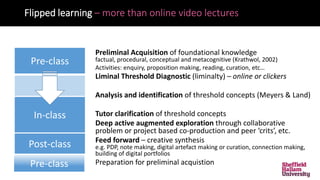
Flipped learning – more than online video lectures
Preliminal Acquisition of foundational knowledge
factual, procedural, conceptual and metacognitive (Krathwol, 2002)
Activities: enquiry, proposition making, reading, curation, etc…
Liminal Threshold Diagnostic (liminalty) – online or clickers
Analysis and identification of threshold concepts (Meyers & Land)
Tutor clarification of threshold concepts
Deep active augmented exploration through collaborative
problem or project based co-production and peer ‘crits’, etc.
Feed forward – creative synthesis
e.g. PDP, note making, digital artefact making or curation, connection making,
building of digital portfolios
Preparation for preliminal acquistion
Pre-class
In-class
Post-class
Pre-class
Open Educational Relationships [OERs]: rethinking the 5 Rs?
Actively being open in your practice to others engaging with you, being open to network
possibilities including repositioning of your practice, assuming others are open.
Reuse
Acknowledging in your practice the (potential) benefit from a repositioning or re-
contextualisation of your practice in critical (positive) ways or expansion of network
connections.
Revise
Incorporating, adding meaning to and multiplying knowledge by using the work of
others to generate new ideas, develop and value networks through continual
engagement in different spaces.
Remix
The expectation of divergence, that networked nodes redirect trains of thought.
Awareness, consideration and negotiation of risks associated with sharing your practice
and navigating different networks and spaces. Recognition that connection also means
disconnection.
Redistribute Ecology of connected open scholarship facilitating the growth and exchange of
knowledge beyond the original network/connections/spaces, offering kindness and
support in the exchange/network/space
Retain
Inspired by the work of Catherine Cronin, Frances Bell, Maha Bali, Bonnie Stewart, Martin Weller, Dave Cormier and others
whose work include critical perspectives on openness, digital scholarship, networked identities/practices and connected learning.
Middleton & Jensen, 2016
A layer ‘bridging’ or
connecting experience of
learning across formal/non-
formal spaces
Emergence of the Non-formal: Augmented Learning Space
Finding the digital
Formal
experience
Facilitating…
Dominant non-formal experience
Augmented experience
Permeable interstice
Independent, autonomous learning
Self-direction (UG) towards self-determination (PG)
Enquiry, Problem and Project-based active learning
Social, Open Learning Ecology and PLNs
Social Networking, social media, audio,
video, gameful learning, etc, etc
What it means to be an academic in the post-digital age
• 5Rs of Open Educational Practice (OEP) or Relationships OER2 mean
being open in practice and seeing learning as open-ended and
authentic
• SOLE – disruptive convergence means understanding the implications
of the whole picture
• Augmented layer – there is a digital hybrid space that connects the
lifewide learning ecologies of our students and ourselves
• Connections and Content are in tension
Thank you
“We are digital!”
Digifest, Anglia Ruskin University, September 2016
Andrew Middleton
Head of Academic Practice & Learning Innovation, Sheffield Hallam University
@andrewmid

We are digital!

  • 1.
    “We are digital!” whatit means to be an academic in the post-digital age Digifest, Anglia Ruskin University, September 2016 Andrew Middleton Head of Academic Practice & Learning Innovation, Sheffield Hallam University @andrewmid
  • 2.
    Backchannel Please have yourdevices ready (or check who is connected near you) We will co-produce a ‘take away’ on the Social Open Learning Environment using #ARU_digiMe
  • 3.
    My ecology • FromPhotography -> Music -> Art -> Archives -> Tech -> Learning • Media Enhanced Learning Special Interest Group (MELSIG) • Digital Voices – learner-generated digital audio for learning • Smart Learning – learner-generated context of smart devices • #BYOD4L – social media for learning • Personal Learning Network – knowledge, co-produce, trust, feedback • Learning Spaces – the digital Hybrid Learning Space idea thinking boundary crossing
  • 4.
    RICH DIGITAL MEDIA USER GENERATED MEDIA BYOD MOBILE LEARNING OPENNESS SOCIAL LEARNING Network Social OpenLearning Ecology disrupts Models of Formal of Delivery disrupts One-to-Many model disrupts Dependency on Text disrupts Provided Content model disrupts Provided “Classroom" model disrupts Provided Technology model ++ + + + SOLE + the disruptive digital
  • 5.
    Google Jockey • GoogleJockey? • 3 minutes only! • Everyone to have a ‘good enough’ understanding • Have you got a sense of what it is? How? • 2 more minutes! • Take a position – think about what it might mean • I want you to be confident and ready to defend or attack what is suggests • From a standing start… the basis for learning Stop watch
  • 6.
    The digital hybridlearning space: ubiquity and pervasion Paradigm shift or tipping point • No longer a ‘technology as deficit’ discourse • but… digital fluency through ubiquitous and pervasive behaviour • Ubiquity = enabled everywhere (‘everyware’) • Pervasive = in everything we do
  • 7.
    Learning ecology: lifewideand lifelong learning identity “an open system, dynamic and independent, diverse, partially self-organizing, and adaptive.” - John Seely Brown (1999, p.3) “the set of contexts found in physical or virtual spaces that provide opportunities for learning,” - Barron (2006, p. 195) “an environment that fosters and supports the formation of communities and networks. - George Siemens (2003) “an individual’s …processes and contexts, relationships, networks, interactions, tools, technologies and activities [providing] …opportunities and resources for learning, development and achievement.“ - Norman Jackson (2016, p.2) Learning isn’t a simple transaction It’s an outcome of context 1. 2. 3. 4.
  • 8.
    Learning ecology: lifewideand lifelong learning identity Digital lifewide “… valuing and recognising learning and development gained through life experience, universities and colleges can greatly enhance individuals' preparedness for learning through the rest of their life.” - (Redecker et al., 2011) Agility FluencyCapabilities Literacies Digital
  • 9.
    Dynamism: currency andauthenticity Given Context Generated Discover Knowledge Make Process Meta Based on Anderson & Krathwohl’s Revised Blooms Taxonomy (2001) Learning with knowledge in a changing context
  • 10.
    Digital ontology: extendingour authentic reach crossing spatial, temporal and personal-professional boundaries Four ways to categorise of authentic learning, • real-world problems that engage learners in the work of professionals; • inquiry activities that practice thinking skills and metacognition; • discourse among a community of learners; and • student empowerment through choice - Rule (2006) Be Belong Do Become D3Bs
  • 11.
    Active Classroom • Learner-centred •Contextualise and concrete (John Seely Brown) • Authentic and inductive (not seductive/reductive) • Work that matters to the student (Jerome Bruner) • Disrupted formality (experiential) • Connected, boundless and risky • Adaptable • Functional space - responsive furniture, technology
  • 12.
    Emergence of theNon-formal – Are we attending our students? Is anyone worried about attendance? 20% formal 80% Non-formal Another 100%!!! Lifewide Are we attending to the Lifewide Experience of the whole learner? Who is thinking holistically about Learning engagement and a sense of becoming
  • 13.
    Backchannel: the digitaland you Backchannel: #ARU_digiMe The next slides ask you to create to a resource together using twitter Format: #ARU_digiMe {number} {response} Later… review the twitter feed for the hashtag to construct Storify narratives based on our collective ideas (also… generating a PLN) @andrewmid Lifewide = Teaching Learning Research Home Voluntary Leisure Twitterfall
  • 14.
    1. User-generated mediadisrupts Provided Content model • User-Producer – ‘Prosumer’ • Learner-generated content • Learner-generated context and co-production • “We make, therefore we are” Backchannel: #ARU_digiMe 1 What do you make digitally? • The world of Google and Youtube… • Digital Storytelling • Note making and sharing • PALS Facebook groups - Honeychurch • Tweet chats – #LTHEchat, RONC Revision Group • Collaborative writing - MELSIG • Wiki projects - AllAboutLinguistics • TeachMeAnatomy
  • 15.
    2. BYOD disruptsProvided Technology model • Ubiquitous, so pervasive • Apps • Browser • Connectivity • Autonomy Backchannel: #ARU_digiMe 2 How has your tablet changed your habits or those of your students? • Smart Learning and MELSIG book • Whiteboarding • Backchannel • BYOD4L (5 day open activity running again in 16-20th Jan 17)
  • 16.
    3 Mobile learningdisrupts Provided Classroom model • portable handheld devices • on the move • being in remote, non-traditional, or authentic places • untethered TEL • our capacity to teach and learn in, across and through a range of physical and virtual spaces seamlessly • ‘place’ specific (meaningful space) • augmentation of corporeal space • remote eg field-based Backchannel: #ARU_digiMe 3 Where do you or your students learn? Enhancing Fieldwork Learning (EFL) http://www.enhancingfieldwork.org.uk
  • 17.
    4 Open learningdisrupts models of formal delivery Cronin (2014) after Alec Couros Backchannel: #ARU_digiMe 4 Define what network means to you • Much more than MOOCs • Much more than OER (content) • Content or community? • PLEs and PLNs 4Rs (Wiley) Reuse, Revise, Remix, Redistribute (5.Retain) Content focussed…
  • 18.
    5 Social learningnetwork disrupts One-to-Many model • Socially inclusive – CoP, d3Bs, collegiality • Lifewide and lifelong – the whole student • Media neutral – across media space not because of it • Learner-centred – promoting self-regulation • Co-operative – working alongside (more than collaborative) • Open and accessible - spatial, temporal and social openness • Authentically situated – connecting learning, social and professional networks Backchannel: #ARU_digiMe 5 Where do you or your students learn? 5Cs: Connect, Collaborate, Communicate, Curate, Create (Nerantzi & Beckingham) Social Media for Learning Framework (Beckingham & Middleton)
  • 19.
    6 Rich digitalmedia disrupts dependence on text • Beyond text • Video • Screencasts • Photographs • Images • Audio Backchannel: #ARU_digiMe 6 How do you or your studentsuse media other than text now? Media Hopper – University of Edinburgh Democratising the use of media in learning and teaching Audio Briefing, Audio Feedback, Audio Summaries, Student Audio Notes– versatile, personal, clear, timely user-generated, process notes Whiteboarding – grabbing whiteboard workings, group narrated, mindmaps Middleton (2016) Reconsidering the role of recorded audio as a rich, flexible and engaging learning space Class play-listing (co-constructed) YouTube channel ‘video social bookmarking’ “I’d like to start the lecture each week by showing one of our videos and writing responses to it on Twitter. We’ll create a course playlist of selected videos and our challenge is to build up our viewing figures over the semester.” - tutor
  • 20.
    RICH DIGITAL MEDIA USER GENERATED MEDIA BYOD MOBILE LEARNING OPENNESS SOCIAL LEARNING NETWORK Social OpenLearning Environment disrupts Models of Formal of Delivery disrupts One-to-Many model disrupts Dependency on Text disrupts Provided Content model disrupts Provided “Classroom" model disrupts Provided Technology model ++ + + + SOLE +
  • 21.
    Flipped learning –more than online video lectures Preliminal Acquisition of foundational knowledge factual, procedural, conceptual and metacognitive (Krathwol, 2002) Activities: enquiry, proposition making, reading, curation, etc… Liminal Threshold Diagnostic (liminalty) – online or clickers Analysis and identification of threshold concepts (Meyers & Land) Tutor clarification of threshold concepts Deep active augmented exploration through collaborative problem or project based co-production and peer ‘crits’, etc. Feed forward – creative synthesis e.g. PDP, note making, digital artefact making or curation, connection making, building of digital portfolios Preparation for preliminal acquistion Pre-class In-class Post-class Pre-class
  • 22.
    Open Educational Relationships[OERs]: rethinking the 5 Rs? Actively being open in your practice to others engaging with you, being open to network possibilities including repositioning of your practice, assuming others are open. Reuse Acknowledging in your practice the (potential) benefit from a repositioning or re- contextualisation of your practice in critical (positive) ways or expansion of network connections. Revise Incorporating, adding meaning to and multiplying knowledge by using the work of others to generate new ideas, develop and value networks through continual engagement in different spaces. Remix The expectation of divergence, that networked nodes redirect trains of thought. Awareness, consideration and negotiation of risks associated with sharing your practice and navigating different networks and spaces. Recognition that connection also means disconnection. Redistribute Ecology of connected open scholarship facilitating the growth and exchange of knowledge beyond the original network/connections/spaces, offering kindness and support in the exchange/network/space Retain Inspired by the work of Catherine Cronin, Frances Bell, Maha Bali, Bonnie Stewart, Martin Weller, Dave Cormier and others whose work include critical perspectives on openness, digital scholarship, networked identities/practices and connected learning. Middleton & Jensen, 2016
  • 23.
    A layer ‘bridging’or connecting experience of learning across formal/non- formal spaces Emergence of the Non-formal: Augmented Learning Space Finding the digital Formal experience Facilitating… Dominant non-formal experience Augmented experience Permeable interstice Independent, autonomous learning Self-direction (UG) towards self-determination (PG) Enquiry, Problem and Project-based active learning Social, Open Learning Ecology and PLNs Social Networking, social media, audio, video, gameful learning, etc, etc
  • 24.
    What it meansto be an academic in the post-digital age • 5Rs of Open Educational Practice (OEP) or Relationships OER2 mean being open in practice and seeing learning as open-ended and authentic • SOLE – disruptive convergence means understanding the implications of the whole picture • Augmented layer – there is a digital hybrid space that connects the lifewide learning ecologies of our students and ourselves • Connections and Content are in tension
  • 25.
    Thank you “We aredigital!” Digifest, Anglia Ruskin University, September 2016 Andrew Middleton Head of Academic Practice & Learning Innovation, Sheffield Hallam University @andrewmid

Editor's Notes

  • #2 <a href="http://www.freepik.com/free-photos-vectors/background">Background vector designed by Freepik</a> Designed by Freepik The digital learning space has been understood as something ‘other’ and virtual, and therefore not real – a space set apart from our physical spaces with its particular challenges and opportunities. Drawing upon case studies from current research into innovative academic practice and future learning spaces, this keynote will consider our roles as academics in the ‘post-digital’ age (52 Group, 2009). Here the digital is pervasive, technologies are ubiquitous and content is accessible and dynamic. We will consider the digital space not only as an extension to the physical space, but as a dimension of a seamlessly integrated learning world which can liberate and enrich the ways our students and graduates learn, live and work now and into the future. This world view of a connected lifewide and lifelong learning space suggests that the roles of the academic and the university are being disrupted by knowledge and content that is dynamic, open and authentic; technology that is provided by the learner and the worker; classrooms that are boundless, mobile and site specific; learning that is networked rather than hierarchical; and, media that is rich and user-generated. In all this disruption, what is certain is that learning can be vibrant, social, and rich in experience and that the role of the agile academic is even more essential than ever. We will consider what it means to extend our digital reach to cross spatial, temporal and personal-professional boundaries. We will identify challenges to wellbeing and personal security, and we will reveal possibilities for actively engaging our students in learning that matters, wherever they are. Underpinning this, we will review the digital competencies we need to ensure that we are agile and ready to sustain the supportive and guiding relationships that define learning and teaching at university.
  • #4 http://www.iconsdb.com/orange-icons/light-bulb-2-icon.html
  • #5 User-generated content disrupts provided content model disrupts Provided Technology model BYOD disrupts Provided Technology model Mobile learning disrupts Provided “Classroom" model Open learning disrupts models of formal of delivery Social learning network disrupts One-to-Many model Rich digital media disrupts dependency on text as the dominant academic form What happens when we start to bring some of these innovative ideas together? It is not about adding ideas – it is about multiplying. The multiplier effect – 1+1=3 AND one thing leads to another, proliferation and exponential growth in impact Either, Noticing connections, or Making connections
  • #7 The digital learning space has been understood as something ‘other’ and virtual, and therefore not real – a space set apart from our physical spaces with its particular challenges and opportunities. Drawing upon case studies from current research into innovative academic practice and future learning spaces, this keynote will consider our roles as academics in the ‘post-digital’ age (52 Group, 2009). Here the digital is pervasive, technologies are ubiquitous and content is accessible and dynamic. We will consider the digital space not only as an extension to the physical space, but as a dimension of a seamlessly integrated learning world which can liberate and enrich the ways our students and graduates learn, live and work now and into the future. This world view of a connected lifewide and lifelong learning space suggests that the roles of the academic and the university are being disrupted by knowledge and content that is dynamic, open and authentic; technology that is provided by the learner and the worker; classrooms that are boundless, mobile and site specific; learning that is networked rather than hierarchical; and, media that is rich and user-generated. In all this disruption, what is certain is that learning can be vibrant, social, and rich in experience and that the role of the agile academic is even more essential than ever. We will consider what it means to extend our digital reach to cross spatial, temporal and personal-professional boundaries. We will identify challenges to wellbeing and personal security, and we will reveal possibilities for actively engaging our students in learning that matters, wherever they are. Underpinning this, we will review the digital competencies we need to ensure that we are agile and ready to sustain the supportive and guiding relationships that define learning and teaching at university.
  • #8 John Seely Brown (1999, p.3) defined the concept of ecology as being about “shaping chaos” and meaning “an open system, dynamic and independent, diverse, partially self-organizing, and adaptive.” For Barron (2006, p. 195) learning ecology is useful for understanding the complexity and significance of learning spaces. It is the “set of contexts found in physical or virtual spaces that provide opportunities for learning,” which may include formal, informal, and non-formal settings. Jackson (2016, p.2) explains that, “an individual’s learning ecology comprises their processes and contexts, relationships, networks, interactions, tools, technologies and activities that provide them with opportunities and resources for learning, development and achievement." Siemens (2003), in relation to Connectivism, describes a learning ecology as an environment that fosters and supports the formation of communities and networks. This situates Connectivism in a context of lifewide and lifelong learning, unbounded by time or place, but given the context of network. It is key to Cormier’s expression of Rhizomatic learning in which socially situated learners find their ways through complex, multidimensional and unique learning contexts. --------------------------- The digital learning space has been understood as something ‘other’ and virtual, and therefore not real – a space set apart from our physical spaces with its particular challenges and opportunities. Drawing upon case studies from current research into innovative academic practice and future learning spaces, this keynote will consider our roles as academics in the ‘post-digital’ age (52 Group, 2009). Here the digital is pervasive, technologies are ubiquitous and content is accessible and dynamic. We will consider the digital space not only as an extension to the physical space, but as a dimension of a seamlessly integrated learning world which can liberate and enrich the ways our students and graduates learn, live and work now and into the future. This world view of a connected lifewide and lifelong learning space suggests that the roles of the academic and the university are being disrupted by knowledge and content that is dynamic, open and authentic; technology that is provided by the learner and the worker; classrooms that are boundless, mobile and site specific; learning that is networked rather than hierarchical; and, media that is rich and user-generated. In all this disruption, what is certain is that learning can be vibrant, social, and rich in experience and that the role of the agile academic is even more essential than ever. We will consider what it means to extend our digital reach to cross spatial, temporal and personal-professional boundaries. We will identify challenges to wellbeing and personal security, and we will reveal possibilities for actively engaging our students in learning that matters, wherever they are. Underpinning this, we will review the digital competencies we need to ensure that we are agile and ready to sustain the supportive and guiding relationships that define learning and teaching at university.
  • #9 (Redecker et al., 2011) she says, “By equipping [students] with tools that enhance their self-awareness, by encouraging attitudes that view life experiences as opportunities for learning and development and by valuing and recognising learning and development gained through life experience, universities and colleges can greatly enhance individuals' preparedness for learning through the rest of their life.” The development of Massive Open Online Courses (MOOCs) and Open Education more generally offer great promise for innovation in this area. (Redecker et al., 2011) she says, “By equipping [students] with tools that enhance their self-awareness, by encouraging attitudes that view life experiences as opportunities for learning and development and by valuing and recognising learning and development gained through life experience, universities and colleges can greatly enhance individuals' preparedness for learning through the rest of their life.” The development of Massive Open Online Courses (MOOCs) and Open Education more generally offer great promise for innovation in this area. The digital learning space has been understood as something ‘other’ and virtual, and therefore not real – a space set apart from our physical spaces with its particular challenges and opportunities. Drawing upon case studies from current research into innovative academic practice and future learning spaces, this keynote will consider our roles as academics in the ‘post-digital’ age (52 Group, 2009). Here the digital is pervasive, technologies are ubiquitous and content is accessible and dynamic. We will consider the digital space not only as an extension to the physical space, but as a dimension of a seamlessly integrated learning world which can liberate and enrich the ways our students and graduates learn, live and work now and into the future. This world view of a connected lifewide and lifelong learning space suggests that the roles of the academic and the university are being disrupted by knowledge and content that is dynamic, open and authentic; technology that is provided by the learner and the worker; classrooms that are boundless, mobile and site specific; learning that is networked rather than hierarchical; and, media that is rich and user-generated. In all this disruption, what is certain is that learning can be vibrant, social, and rich in experience and that the role of the agile academic is even more essential than ever. We will consider what it means to extend our digital reach to cross spatial, temporal and personal-professional boundaries. We will identify challenges to wellbeing and personal security, and we will reveal possibilities for actively engaging our students in learning that matters, wherever they are. Underpinning this, we will review the digital competencies we need to ensure that we are agile and ready to sustain the supportive and guiding relationships that define learning and teaching at university.
  • #10  The digital learning space has been understood as something ‘other’ and virtual, and therefore not real – a space set apart from our physical spaces with its particular challenges and opportunities. Drawing upon case studies from current research into innovative academic practice and future learning spaces, this keynote will consider our roles as academics in the ‘post-digital’ age (52 Group, 2009). Here the digital is pervasive, technologies are ubiquitous and content is accessible and dynamic. We will consider the digital space not only as an extension to the physical space, but as a dimension of a seamlessly integrated learning world which can liberate and enrich the ways our students and graduates learn, live and work now and into the future. This world view of a connected lifewide and lifelong learning space suggests that the roles of the academic and the university are being disrupted by knowledge and content that is dynamic, open and authentic; technology that is provided by the learner and the worker; classrooms that are boundless, mobile and site specific; learning that is networked rather than hierarchical; and, media that is rich and user-generated. In all this disruption, what is certain is that learning can be vibrant, social, and rich in experience and that the role of the agile academic is even more essential than ever. We will consider what it means to extend our digital reach to cross spatial, temporal and personal-professional boundaries. We will identify challenges to wellbeing and personal security, and we will reveal possibilities for actively engaging our students in learning that matters, wherever they are. Underpinning this, we will review the digital competencies we need to ensure that we are agile and ready to sustain the supportive and guiding relationships that define learning and teaching at university.
  • #11 The digital learning space has been understood as something ‘other’ and virtual, and therefore not real – a space set apart from our physical spaces with its particular challenges and opportunities. Drawing upon case studies from current research into innovative academic practice and future learning spaces, this keynote will consider our roles as academics in the ‘post-digital’ age (52 Group, 2009). Here the digital is pervasive, technologies are ubiquitous and content is accessible and dynamic. We will consider the digital space not only as an extension to the physical space, but as a dimension of a seamlessly integrated learning world which can liberate and enrich the ways our students and graduates learn, live and work now and into the future. This world view of a connected lifewide and lifelong learning space suggests that the roles of the academic and the university are being disrupted by knowledge and content that is dynamic, open and authentic; technology that is provided by the learner and the worker; classrooms that are boundless, mobile and site specific; learning that is networked rather than hierarchical; and, media that is rich and user-generated. In all this disruption, what is certain is that learning can be vibrant, social, and rich in experience and that the role of the agile academic is even more essential than ever. We will consider what it means to extend our digital reach to cross spatial, temporal and personal-professional boundaries. We will identify challenges to wellbeing and personal security, and we will reveal possibilities for actively engaging our students in learning that matters, wherever they are. Underpinning this, we will review the digital competencies we need to ensure that we are agile and ready to sustain the supportive and guiding relationships that define learning and teaching at university.
  • #12 student-centred - involving the learner working co-operatively (i.e. alongside peers in a supportive relationship) and collaboratively (i.e. with peers addressing assigned problems together) with the facilitation of their teacher; authentic and inductive- using real world situations and methods to provide context, meaning and structure to activities and tasks; boundless - involving open-ended problems creating challenging, creative and rewarding experiences that connect with other domains; adaptable - the learning community adapts the space physically and digitally over the period of study to support its changing pattern and stages; connected – supporting learning relationships and knowledge within the space, aligned to the space (e.g. services), and external contexts (e.g. learning networks, work, public sphere); functional – incorporating furniture and digital technologies that respond seamlessly to the needs of the learning community (i.e. personal and provided technologies interoperate; chairs and tables are light, robust and reconfigurable; audio visual facilities, network connectivity and storage meet the challenging demands of active user-producers).
  • #14 User-generated content disrupts provided content model BYOD disrupts Provided Technology model Mobile learning disrupts Provided “Classroom" model Open learning disrupts models of formal of delivery Social learning network disrupts One-to-Many model Rich digital media disrupts dependency on text as the dominant academic form
  • #15 User-generated content disrupts provided content model BYOD disrupts Provided Technology model Mobile learning disrupts Provided “Classroom" model Open learning disrupts models of formal of delivery Social learning network disrupts One-to-Many model Rich digital media disrupts dependency on text as the dominant academic form
  • #16 User-generated media disrupts provided content model BYOD disrupts Provided Technology model Mobile learning disrupts Provided “Classroom" model Open learning disrupts models of formal of delivery Social learning network disrupts One-to-Many model Rich digital media disrupts dependency on text as the dominant academic form
  • #17 Mobile meaning portable handheld devices; on the move being in remote, non-traditional, or authentic places; untethered learning with technologies our capacity to teach and learn in, across and through a range of physical and virtual spaces seamlessly something that makes the formal spaces we use more valuable, independently and socially;  Mobility as something that makes the informal spaces we use more valuable, independently and socially User-generated content disrupts provided content model disrupts Provided Technology model BYOD disrupts Provided Technology model Mobile learning disrupts Provided “Classroom" model Open learning disrupts models of formal of delivery Social learning network disrupts One-to-Many model Rich digital media disrupts dependency on text as the dominant academic form
  • #18 Cronin, C. (2014). Networked learning and identity development in open online spaces. Proceedings of the 9th International Conference on Networked Learning 2014, Edited by: Bayne S, Jones C, de Laat M, Ryberg T & Sinclair C.. Available online at: http://www.lancaster.ac.uk/fss/organisations/netlc/past/nlc2014/abstracts/pdf/cronin.pdf User-generated content disrupts provided content model disrupts Provided Technology model BYOD disrupts Provided Technology model Mobile learning disrupts Provided “Classroom" model Open learning disrupts models of formal of delivery Social learning network disrupts One-to-Many model Rich digital media disrupts dependency on text as the dominant academic form
  • #19 User-generated content disrupts provided content model disrupts Provided Technology model BYOD disrupts Provided Technology model Mobile learning disrupts Provided “Classroom" model Open learning disrupts models of formal of delivery Social learning network disrupts One-to-Many model Rich digital media disrupts dependency on text as the dominant academic form
  • #20 Middleton, A. (2016). Reconsidering the role of recorded audio as a rich, flexible and engaging learning space. Research In Learning Technology, 24. doi:http://dx.doi.org/10.3402/rlt.v24.28035 User-generated content disrupts provided content model disrupts Provided Technology model BYOD disrupts Provided Technology model Mobile learning disrupts Provided “Classroom" model Open learning disrupts models of formal of delivery Social learning network disrupts One-to-Many model Rich digital media disrupts dependence on text as the dominant academic form
  • #21 User-generated content disrupts provided content model disrupts Provided Technology model BYOD disrupts Provided Technology model Mobile learning disrupts Provided “Classroom" model Open learning disrupts models of formal of delivery Social learning network disrupts One-to-Many model Rich digital media disrupts dependence on text as the dominant academic form What happens when we start to bring some of these innovative ideas together? It is not about adding ideas – it is about multiplying. The multiplier effect – 1+1=3 AND one thing leads to another, proliferation and exponential growth in impact Either, Noticing connections, or Making connections
  • #23 David Wiley has 5 Rs so I added Retain- see http://opencontent.org/blog/archives/3221 “Retain – the right to make, own, and control copies of the content” – that is so masculine! So we could simplify it as…? Reuse –Pro-actively open to connection in practice Revise – Pro-actively open to revision of context Remix – Pro-actively open to collaboration and collegial scholarship Redistribute - Pro-actively facilitating connections that precipitate further growth/learning/knowledge Retain – Pro-actively open to re-interpretation, multiplication and divergent ‘knowledges’ Kathrine: I am not clear what this means: “Awareness, consideration and negotiation of risks associated with sharing your practice and navigating different networks and spaces. Recognition that connection also means disconnection.“ – is it the rhizomatic divergent point? Wiley: The 5Rs of Openness – Retain – the right to make, own, and control copies of the content – Reuse – the right to use the content in a wide range of ways (e.g., in a class, in a study group, on a website, in a video) – Revise – the right to adapt, adjust, modify, or alter the content itself (e.g., translate the content into another language) – Remix – the right to combine the original or revised content with other open content to create something new (e.g., incorporate the content into a mashup) – Redistribute – the right to share copies of the original content, your revisions, or your remixes with others (e.g., give a copy of the content to a friend)
  • #26 <a href="http://www.freepik.com/free-photos-vectors/background">Background vector designed by Freepik</a> Designed by Freepik The digital learning space has been understood as something ‘other’ and virtual, and therefore not real – a space set apart from our physical spaces with its particular challenges and opportunities. Drawing upon case studies from current research into innovative academic practice and future learning spaces, this keynote will consider our roles as academics in the ‘post-digital’ age (52 Group, 2009). Here the digital is pervasive, technologies are ubiquitous and content is accessible and dynamic. We will consider the digital space not only as an extension to the physical space, but as a dimension of a seamlessly integrated learning world which can liberate and enrich the ways our students and graduates learn, live and work now and into the future. This world view of a connected lifewide and lifelong learning space suggests that the roles of the academic and the university are being disrupted by knowledge and content that is dynamic, open and authentic; technology that is provided by the learner and the worker; classrooms that are boundless, mobile and site specific; learning that is networked rather than hierarchical; and, media that is rich and user-generated. In all this disruption, what is certain is that learning can be vibrant, social, and rich in experience and that the role of the agile academic is even more essential than ever. We will consider what it means to extend our digital reach to cross spatial, temporal and personal-professional boundaries. We will identify challenges to wellbeing and personal security, and we will reveal possibilities for actively engaging our students in learning that matters, wherever they are. Underpinning this, we will review the digital competencies we need to ensure that we are agile and ready to sustain the supportive and guiding relationships that define learning and teaching at university.