Social Media and
Professional
Development

Building your personal
learning network with social
media
Crystal Rose
MNWE Conference
April 5, 2013
Bloomington, MN
                               Icons by Lokas Software
We will talk about…
• Overview of professional development in a
  tech-driven culture
• Overview of social media tools
  ▫ Micro blogging
  ▫ RSS Feeds
  ▫ Social community platforms
• Implications for teachers
• Discussion
Questions to Consider
• What does professional development look like in
  a tech-driven culture?

• How can novice teachers effectively make the
  transition from student to teacher?

• How can social media contribute to building
  effective support networks for (novice) teachers?
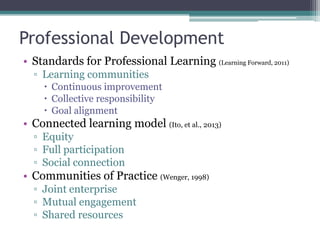
Professional Development
• Standards for Professional Learning (Learning Forward, 2011)
  ▫ Learning communities
     Continuous improvement
     Collective responsibility
     Goal alignment
• Connected learning model (Ito, et al., 2013)
  ▫ Equity
  ▫ Full participation
  ▫ Social connection
• Communities of Practice (Wenger, 1998)
  ▫ Joint enterprise
  ▫ Mutual engagement
  ▫ Shared resources
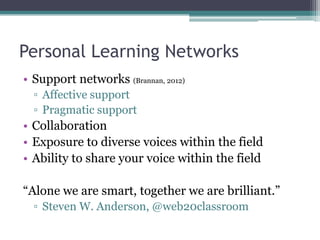
Personal Learning Networks
• Support networks (Brannan, 2012)
  ▫ Affective support
  ▫ Pragmatic support
• Collaboration
• Exposure to diverse voices within the field
• Ability to share your voice within the field

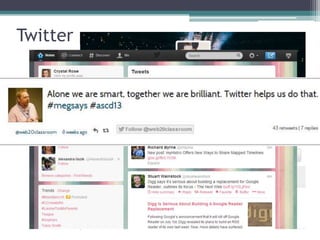
“Alone we are smart, together we are brilliant.”
  ▫ Steven W. Anderson, @web20classroom
Social Media Tools
• What are the benefits of using this tool?

• What are the drawbacks to using this tool?

• How can this tool help build my personal
  learning network?
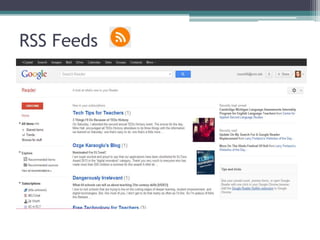
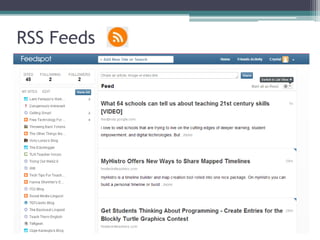
RSS Feeds
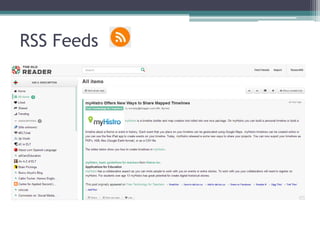
RSS Feeds
RSS Feeds
Microblogging
Twitter
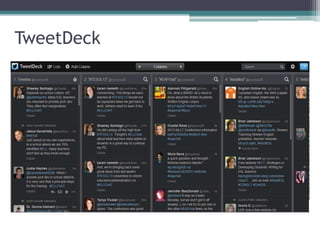
TweetDeck
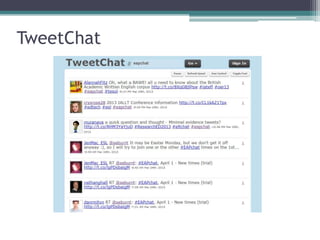
TweetChat
Social Community Platforms
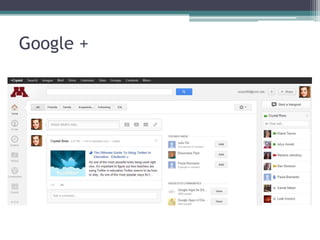
Google +
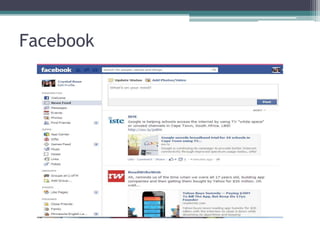
Facebook
A typical day…
• Read RSS feed of subscriptions
  ▫ Open most interesting articles in new window
  ▫ Save and tag posts of interest via Diigo
  ▫ Share interesting posts via sharing tabs in reader
• Post interesting articles/posts on Twitter,
  Facebook, and Google +
  ▫ Use relevant hashtags on Twitter
• Read Twitter posts & engage in
  discussion/retweet posts of interest
What I’ve learned…
• People want to share their ideas.

• People want to share your ideas.

• Not all ideas are worth sharing.

• Not every idea is directly transferrable to the
  classroom, but a lot are.

• These are just tools, the value is in how you use
  them to meet your needs.
Challenge to educators…
• Educate yourselves
 ▫ Ask colleagues how they use social media in their
   professional lives
 ▫ Seek information about creating your online
   presence
• Don’t be afraid of making mistakes
 ▫ Spend some time observing how social media is
   being used by others (lurking is ok!)
 ▫ Sign up for a new tool and try it out. If it’s not for
   you, stop using it.
• Engage with online contacts
Discussion
• What might be some benefits of using social
  media to facilitate personal learning networks in
  your educational setting?

• What might be some challenges to using social
  media to facilitate personal learning networks in
  your educational setting?
“Social Media is simply a conduit for
connections...When educators are connected
to other educators the natural discussion is
education.”

 ▫ Tom Whitby, @tomwhitby
References
• Brannan, D., Bleistein, T. (2012). Novice ESOL Teachers’ Perceptions of
  Social Support Networks. TESOL Quarterly, 46(3).

• Ito, Mizuko, Kris Gutiérrez, Sonia Livingstone, Bill Penuel, Jean Rhodes,
  Katie Salen, Juliet Schor, Julian Sefton-Green, S. Craig Watkins. (2013).
  Connected Learning: An Agenda for Research and Design. Irvine, CA:
  Digital Media and Learning Research Hub.

• Learning Forward. (2011). Standards for Professional Learning. Oxford,
  OH.

• Wenger, E. (1998). Communities of Practice: Learning as a social system.
  Systems Thinker, 9(5).

Social media and professional development

  • 1.
    Social Media and Professional Development Buildingyour personal learning network with social media Crystal Rose MNWE Conference April 5, 2013 Bloomington, MN Icons by Lokas Software
  • 2.
    We will talkabout… • Overview of professional development in a tech-driven culture • Overview of social media tools ▫ Micro blogging ▫ RSS Feeds ▫ Social community platforms • Implications for teachers • Discussion
  • 3.
    Questions to Consider •What does professional development look like in a tech-driven culture? • How can novice teachers effectively make the transition from student to teacher? • How can social media contribute to building effective support networks for (novice) teachers?
  • 4.
    Professional Development • Standardsfor Professional Learning (Learning Forward, 2011) ▫ Learning communities  Continuous improvement  Collective responsibility  Goal alignment • Connected learning model (Ito, et al., 2013) ▫ Equity ▫ Full participation ▫ Social connection • Communities of Practice (Wenger, 1998) ▫ Joint enterprise ▫ Mutual engagement ▫ Shared resources
  • 5.
    Personal Learning Networks •Support networks (Brannan, 2012) ▫ Affective support ▫ Pragmatic support • Collaboration • Exposure to diverse voices within the field • Ability to share your voice within the field “Alone we are smart, together we are brilliant.” ▫ Steven W. Anderson, @web20classroom
  • 6.
    Social Media Tools •What are the benefits of using this tool? • What are the drawbacks to using this tool? • How can this tool help build my personal learning network?
  • 7.
  • 8.
  • 9.
  • 10.
  • 11.
  • 12.
  • 13.
  • 14.
  • 15.
  • 16.
  • 17.
    A typical day… •Read RSS feed of subscriptions ▫ Open most interesting articles in new window ▫ Save and tag posts of interest via Diigo ▫ Share interesting posts via sharing tabs in reader • Post interesting articles/posts on Twitter, Facebook, and Google + ▫ Use relevant hashtags on Twitter • Read Twitter posts & engage in discussion/retweet posts of interest
  • 18.
    What I’ve learned… •People want to share their ideas. • People want to share your ideas. • Not all ideas are worth sharing. • Not every idea is directly transferrable to the classroom, but a lot are. • These are just tools, the value is in how you use them to meet your needs.
  • 19.
    Challenge to educators… •Educate yourselves ▫ Ask colleagues how they use social media in their professional lives ▫ Seek information about creating your online presence • Don’t be afraid of making mistakes ▫ Spend some time observing how social media is being used by others (lurking is ok!) ▫ Sign up for a new tool and try it out. If it’s not for you, stop using it. • Engage with online contacts
  • 20.
    Discussion • What mightbe some benefits of using social media to facilitate personal learning networks in your educational setting? • What might be some challenges to using social media to facilitate personal learning networks in your educational setting?
  • 21.
    “Social Media issimply a conduit for connections...When educators are connected to other educators the natural discussion is education.” ▫ Tom Whitby, @tomwhitby
  • 22.
    References • Brannan, D.,Bleistein, T. (2012). Novice ESOL Teachers’ Perceptions of Social Support Networks. TESOL Quarterly, 46(3). • Ito, Mizuko, Kris Gutiérrez, Sonia Livingstone, Bill Penuel, Jean Rhodes, Katie Salen, Juliet Schor, Julian Sefton-Green, S. Craig Watkins. (2013). Connected Learning: An Agenda for Research and Design. Irvine, CA: Digital Media and Learning Research Hub. • Learning Forward. (2011). Standards for Professional Learning. Oxford, OH. • Wenger, E. (1998). Communities of Practice: Learning as a social system. Systems Thinker, 9(5).