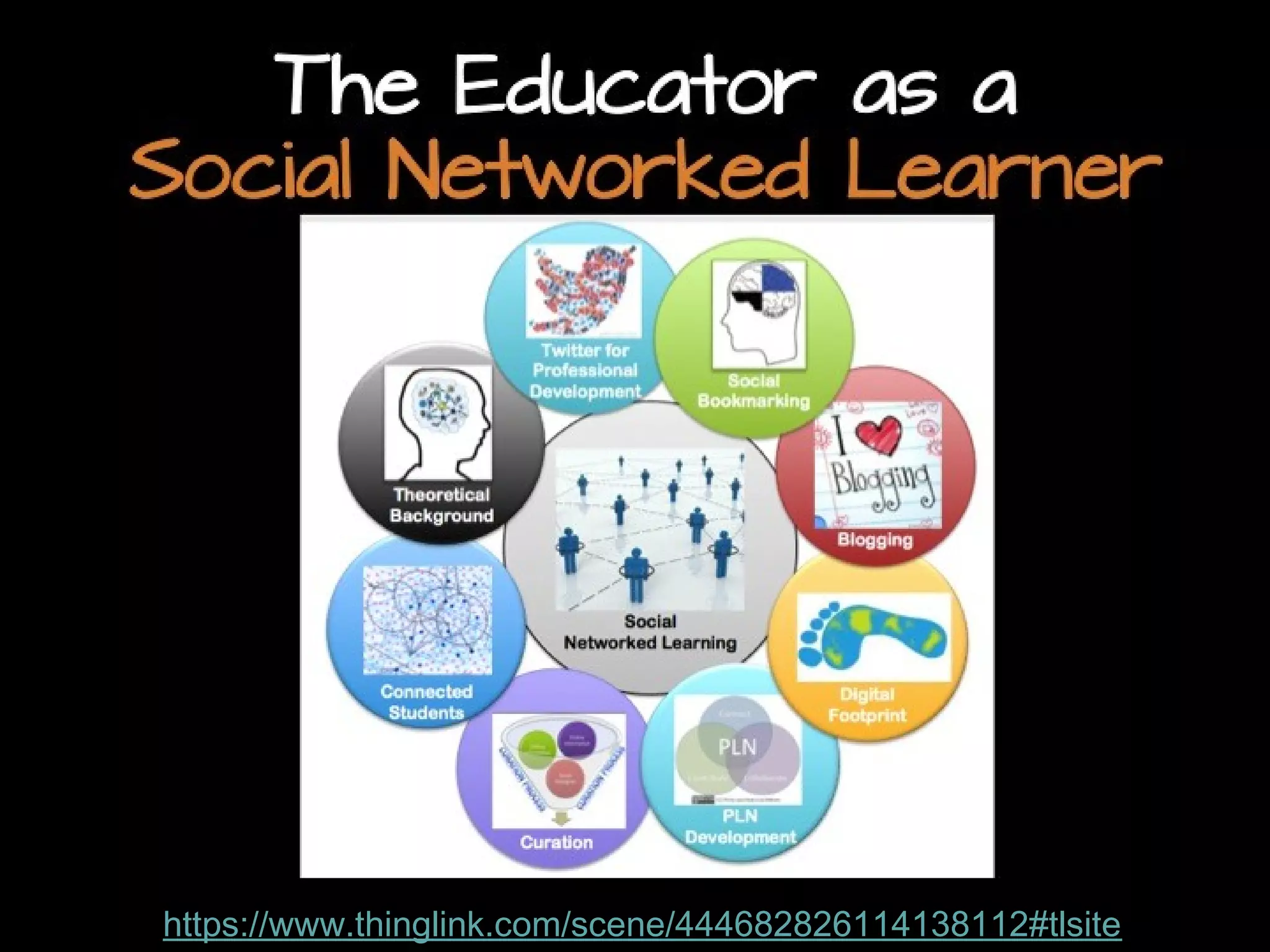



The Educator as a
Social Networked Learner

https://www.thinglink.com/scene/444682826114138112#tlsite
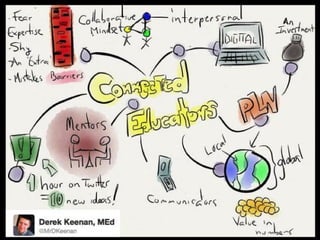
http://www.flickr.com/photos/krossbow/2050060728/
The Connected Educators initiative’s mission is to help
educators thrive in a connected world. Such
environments are envisioned in th 2010
National Educational Technology Plan. Connected
Educators pursues this mission through seeking to
understand and promote educators learning and
collaborating through online communities of practice and
social networks.
http://connectededucators.org/about-connected-educators-mission-goals/
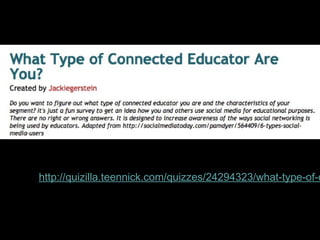
http://quizilla.teennick.com/quizzes/24294323/what-type-of-connected-educator-are-you
http://www.youtube.com/watch?v=mDy8wz46zT0
Networks for Sharing
Workshop Information
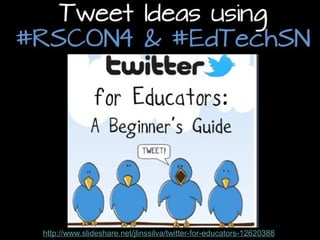
Tweet Ideas using
#RSCON4 & #EdTechSN

http://www.slideshare.net/jlinssilva/twitter-for-educators-12620388
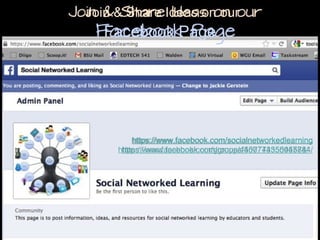
https://www.facebook.com/socialnetworkedlearning
https://www.facebook.com/groups/450774355045784/
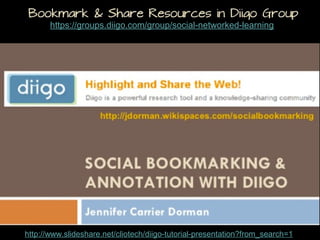
Bookmark & Share Resources in Diigo Group

https://groups.diigo.com/group/social-networked-learning

http://www.slideshare.net/cliotech/diigo-tutorial-presentation?from_search=1
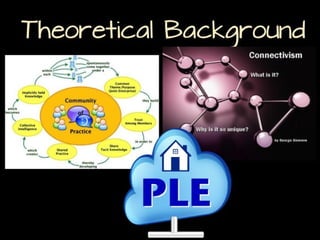
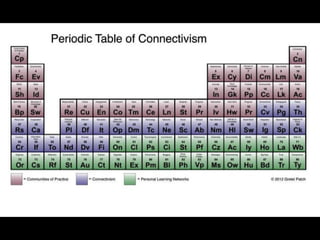
You will be exploring communities of practice, connectivism,
and personal learning networks. Understanding these
concepts, philosophies, and ways of thinking provide a
foundation for social networking. It can help you use social
networks strategically and with intention. It helps inform your
actions so you can use networks for engaged, participatory
learning.
Use one of following to demonstrate your understanding of
these concepts: a slide show or Glog of images, an audio cast
of sounds, a video of sights, a series of handrawn and scanned
pictures, a mindmap of images, a mathematical formula, a
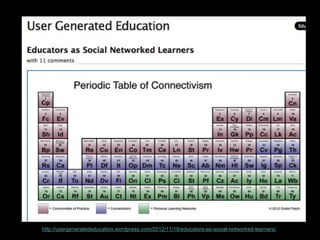
periodic chart of concepts.
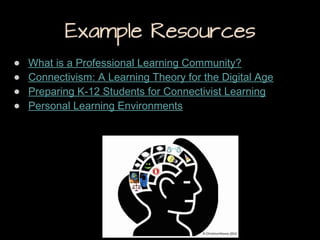
Example Resources
●
●
●
●

What is a Professional Learning Community?
Connectivism: A Learning Theory for the Digital Age
Preparing K-12 Students for Connectivist Learning
Personal Learning Environments
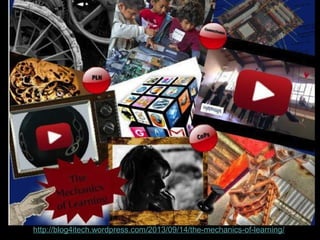
http://blog4itech.wordpress.com/2013/09/14/the-mechanics-of-learning/
Social Media for
Professional Development
Twitter and Facebook might soon replace traditional
professional development for teachers. Instead of
enduring hours-long workshops a few times a year,
teachers could reach out to peers on the Internet in
real time for advice on things like planning a lesson,
overcoming classroom management problems, or
helping students with disabilities. (
Can Twitter replace traditional professional development?)
Social Media for
Professional Development
Educators really can’t afford to NOT be on Twitter. Our
educational landscape is changing very rapidly. Our
students are using this technology every day, and as
educators we must continually be growing and finding
new ways to learn and to reach our students. When
used correctly, Twitter can really become a catalyst in
transforming your classroom, your school, and your
teaching.
(http://www.texasprincipal.org/index.php/texas-principals-education-help-support-team/entry/twitter-a-necessity-for-educators-in-2012)
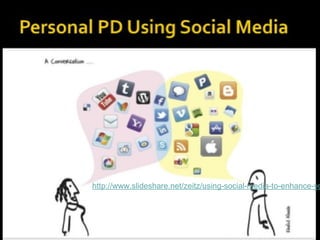
http://www.slideshare.net/zeitz/using-social-media-to-enhance-your-personalprofessional-development
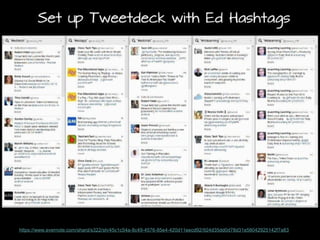
Set up Tweetdeck with Ed Hashtags

I found using a twitter client like tweet deck completely transforms the way I use twitter.
https://www.evernote.com/shard/s322/sh/45c1c54a-8c49-4576-85e4-420d11eecd92/924d35dd0d78d31e58042925142f7a83
Educational Hashtags - Find Five

The Unofficial Guide to
Educational Hashtags
http://goo.gl/4CVDW
Not only is Twitter a conversation, it is a global conversation
where people—with common interests—come together to
exchange information in 140 characters or less. The fact that
the conversations are short does not mean that they are not
powerful. The bits and pieces offered like hors d’oeuvres can
take you anywhere and nowhere. They are what you make them.
They are bits and pieces of brain candy.

More importantly, my brain also learned that you cannot hoard
your Twitter findings, you must share them! Like @ariannahuff
said, “It’s not just about consuming content, but sharing it,
passing it on, and adding to it.”
http://blog4itech.wordpress.com/2013/09/21/bits-and-pieces-serendipity-twitter/
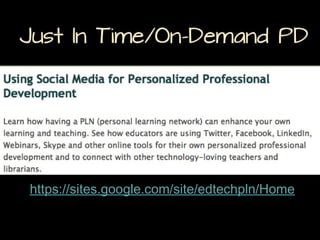
Just In Time/On-Demand PD

https://sites.google.com/site/edtechpln/Home
Attend Live Webinars
http://www.futureofeducation.com/

ive.
ttp://l
h

c

/
0.com
m2
ssroo
la

http:
//

hom
e.ed
web
.net/

http://connectedlearning.tv/opening-new-pathways-opportunities
Participate in

Tweet Chats

TweetChat Schedule:
http://tweetreports.com/twitter-chat-schedule/
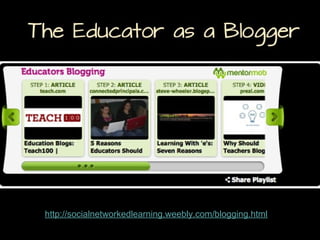
The Educator as a Blogger

http://socialnetworkedlearning.weebly.com/blogging.html n
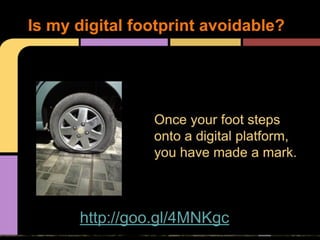
Positive Digital Footprint and
Reputation Management Plan
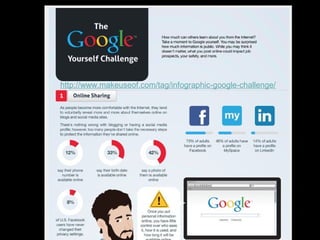
http://www.makeuseof.com/tag/infographic-google-challenge/
http://www.slideshare.net/macfam6/my-digital-footprint-and-pln
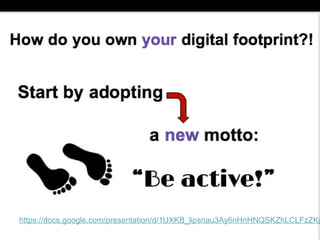
https://docs.google.com/presentation/d/1UXKB_lipsnau3Ay6nHnHNQSKZhLCLFzZKj5zHJg3s3A/present#slide=id.p
http://goo.gl/4MNKgc
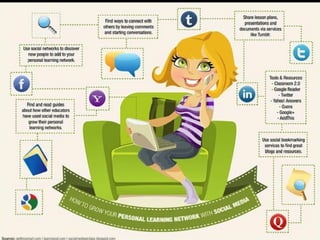
Personal Learning Network
Development and Diagrams
Based on your grade-level and content
area interests, find five online
communities to join. This will assist you
in expanding your network and provide
you with increased awareness of the
social networks. There are lots of
options: Linkedin, Google+ Groups,
Flickr, Goodreads, Instagram, Nings,
MOOCs.
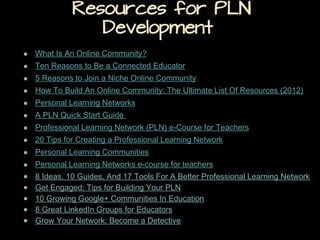
Resources for PLN Development
http://socialnetworkedlearning.weebly.com/pln-development.html
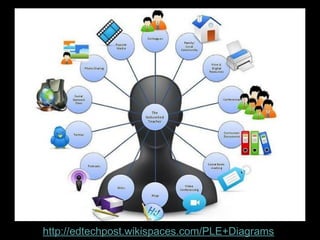
Create a PLE Diagram to
Reflect Your Communities
http://edtechpost.wikispaces.com/PLE+Diagrams
This experience has allowed me to look at
the communities in a new light. Before, I
simply used them for their entertainment
value. Little did I know that they would
become the basis for my new way of
learning. Each day I am amazed by what I
find.
Andi
This assignment, has made me realize just how much
I have not been truly using the Internet and all its
tools and resources to its ability. It is like when you
bite into a candy thinking that there is yummy
goodness in the middle only to find out that the
middle is actually hollow and the candy just had a
thick shell. But it also has allowed me to immerse
myself into resources, tools, and communities that I
might never thought of using/joining and broadening
my network for the better. Christina
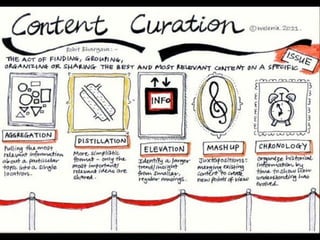
Content Curation
1. helps create information filters
2. contributes to online communities
http://vimeo.com/38524181
http://www.slideshare.net/corinnew/reenvisioning-modern-pedagogyeducators-as-curators-11879841
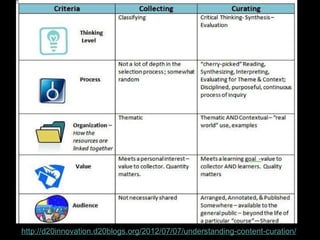
http://d20innovation.d20blogs.org/2012/07/07/understanding-content-curation/
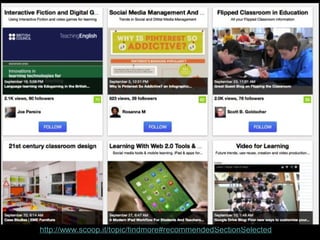
http://www.scoop.it/topic/findmore#recommendedSectionSelected
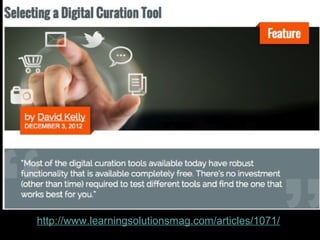
http://www.learningsolutionsmag.com/articles/1071/
http://gettingsmart.com/2012/08/3-free-cool-tools-curate-content/
Curating is hard work. To come up with a list of
acceptable resources involved a lot of filtering, sifting,
and otherwise weeding out. It’s a tough job, but
somebody’s got to do it. That somebody is me – and
lots of educational technology professionals like me who
take pride in their work. We do the hard stuff so you
don’t have to. The end result is a resource I feel is
substantial, helpful, and contributes to the greater good
of knowledge.
http://gretelpatch.wordpress.com/2012/10/14/behind-the-scenes-of-nets%E2%80%A2s-k-5-curriculum-integrationcuration-a-reflection/
Social Networked Learning as
an Instructional Strategy
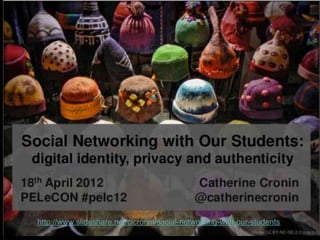
http://www.slideshare.net/cicronin/social-networking-with-our-students
Create a Basic Social Media Policy for
Your Classroom
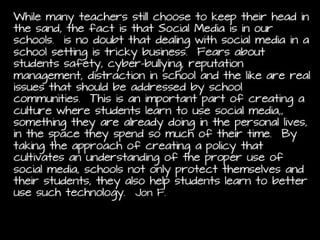
While many teachers still choose to keep their head in the sand, the
fact is that Social Media is in our schools. is no doubt that dealing
with social media in a school setting is tricky business. Fears about
students safety, cyber-bullying, reputation management, distraction
in school and the like are real issues that should be addressed by
school communities. This is an important part of creating a culture
where students learn to use social media,, something they are
already doing in the personal lives, in the space they spend so much
of their time. By taking the approach of creating a policy that
cultivates an understanding of the proper use of social media,
schools not only protect themselves and their students, they also
help students learn to better use such technology. Jon F.
(How to Create Social Media Guidelines for Your School)
For your final project, you'll be formulating,
outlining, proposing your very own minicurricular unit. Creating your own minicurricular unit for your final project will provide
you with the opportunity to synthesize and
apply the social networking skills and strategies
you learned throughout the course.
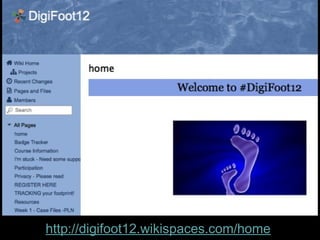
http://digifoot12.wikispaces.com/home
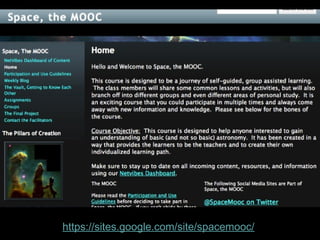
https://sites.google.com/site/spacemooc/
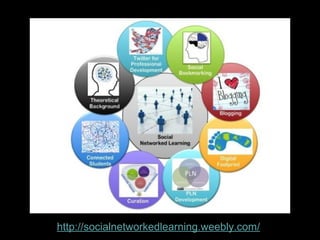
http://socialnetworkedlearning.weebly.com/
http://usergeneratededucation.wordpress.com/2012/11/18/educators-as-social-networked-learners/
http://usergeneratededucation.wordpress.com/2013/08/11/studentreflections-from-a-social-networked-learning-course/

Educators as Social Networked Learners