Presenter – Dr Salman Kareem 
Final Year Resident 
Department of Psychiatry 
ACME , Pariyaram
 Defining social cognition in schizophrenia 
 What domains of social cognition 
 Neurobiology of social cognition 
 What is social cognition’s relationship with positive 
symptoms (eg, paranoia), negative symptoms, and 
disorganization? 
 What is the functional significance of social cognition? 
Does it behave as a mediator? 
 Social cognition and the course of schizophrenia: does 
itpredate the illness or occur early in the illness? Are the 
impairments trait like? 
 Treatment interventions
 The Measurement and Treatment Research to Improve 
Cognition in Schizophrenia (MATRICS) project 
 understanding the nature and extent of cognitive 
dysfunction in schizophrenia 
 facilitate the development of treatments that will 
hopefully improve this debilitating aspect of 
schizophrenia (Barch, 2005).
 seven cognitive domains 
 speed of processing, 
 working memory, 
 attention/vigilance, 
 verbal learning and memory, 
 visual learning and memory, 
 reasoning and problem solving, 
 social cognition 
 (Green and Nuechterlein, 2004).
 Social cognition is defined as 
“the mental operations underlying social 
interactions, which include the human ability to perceive 
the intentions and dispositions of others” (Brothers, 
1990, p. 28). 
 how people think about themselves and others in the 
social world.
 primary domains (constructs) of social cognition: 
 emotion perception, 
 Theory of Mind (ToM), and 
 Attributional style 
 social perception, social knowledge (social schema)
Neuro Biology 
 network of neural structures is critically involved in 
processing social stimuli (Adolphs, 2001; Brothers, 1990; 
Phillips et al., 2003). 
 These models focus on regions of the occipital and 
temporal cortices such as the Fusiform Gyrus (FG) and 
Superior Temporal Sulcus (STS) which underlie face 
processing (Haxby, Hoffmann and Gobbini, 2000; Winston, 
Henson, Fine-Goulden, and Dolan, 2004) 
 amygdala which plays a critical role in detecting threat, 
recognizing emotions, and making complex social 
judgments (Adolphs et al., 1994; Adolphs et al., 
 1998; Amaral et al., 2003; Winston et al., 2002)
Emotional processing 
 Identifying emotions 
 Facilitating emotions 
 Understanding emotions 
 Managing emotions 
 Affect perception – a domain of emotion processing 
that is frequently measured in schizophrenia research.
emotion perception 
 In regard to emotion perception (eg, identifying 
emotion displayed in various facial expressions or tone 
of voice), the following conclusions can be drawn 
 First, individuals with schizophrenia display deficits 
compared with nonclinical control participants. 
 Second, these deficits are more severe relative to 
individuals with other psychiatric disorders such as 
depressive disorder (unless psychotic features are 
present). 
• Edwards et al, Hellewell and Whittaker,Kohler and Brennan, and Mandal 
et al
 Third, the greatest deficits are evident in the 
perception of negative emotions (compared with 
positive emotions). 
 Fourth, the deficit in emotion perception is stable over 
time, although evidence suggests that individuals in 
remission may outperform individuals in an acute 
phase of the disorder.
 Fifth, individuals with schizophrenia perform worse 
trying to ‘‘read between the lines’’ (ie, identifying what 
a given individual is thinking or feeling) but are less 
impaired on more concrete social judgments (ie, 
identifying what a person is wearing or doing). 
 Sixth, many individuals with schizophrenia display 
restricted visual scanning and spend less time 
examining salient facial features during emotion 
perception tasks.
 Finally, impairments in emotion perception are 
present early in the course of illness.
Theory of Mind 
 “ToM is defined as the ability to attribute mental states 
(including beliefs, intentions, desires, and goals) to the 
self and others.” 
 includes understanding false beliefs, hints, intentions, 
deception, metaphor, irony, and faux pas.
 Over 30 studies have been conducted on ToM in 
schizophrenia, leading to the following conclusions . 
 In general, individuals with schizophrenia exhibit 
deficits in ToM relative to non ill and psychiatric 
controls. 
 The bulk of research supports the conclusion that this 
impairment in schizophrenia is a trait deficit. 
- Brune and Harrington et al
 First-degree relatives of individuals with schizophrenia 
who also score high on schizotypy have impaired ToM, 
lending support for ToM as a potential endophenotype 
for schizophrenia. 
 ToM deficits are present in both IP and OP samples, 
are not accounted for by deficits in general cognitive 
functioning, and are not uniquely associated with any 
specific symptom type (eg, paranoia). 
 The etiology of ToM deficits in schizophrenia remains 
unclear, in part because the genesis of normal ToM is 
still vague.
Attributional bias 
 Attributional style refers to explanations people 
generate regarding the causes of positive and negative 
events in their lives. 
 individuals with -paranoia or persecutory delusions. 
 Such individuals tend to blame others rather than 
situations for negative events, an attributional style 
known as a personalizing bias.’ 
 persons with Scz tends to focus on hostile 
attributional biases or the tendency to attribute hostile 
intentions to others actions
 Individuals with persecutory delusions may of course 
have other social cognitive biases such as the tendency 
to ‘‘jump to conclusions’’ and to demonstrate a 
‘‘confirmation bias’’ (that is, seeking confirmatory 
evidence for a belief rather than disconfirmatory 
evidence).
 2 factors prevent individuals with persecutory 
delusions from correcting their bias in the face of 
disconfirming situational information: 
 a strong need for closure (ie, an intolerance of 
ambiguity) and 
 impairments in ToM. 
 Associationship seen between need for closure and 
persecutory delusions and between deficits in ToM 
and personalizing attributions
 Individuals with persecutory delusions may of course 
have other social cognitive biases such as the tendency 
to ‘‘jump to conclusions’’ and to demonstrate a 
‘‘confirmation bias’’ (ie, seeking confirmatory evidence 
for a belief rather than disconfirmatory evidence).
 Social perception 
 Definition: The ability to understand and appraise social 
roles, rules, and context. 
 Involves using verbal and nonverbal cues in order to 
make inferences about a social situation 
 May be central to functioning in a social context, ie, 
facilitating interactions with people in social settings 
or establishing relationships 
 Can involve making critical appraisals, such as 
judgments of trustworthiness in other people
 Social knowledge 
 Definition: Refers to representational templates of social 
situations or awareness of the roles, rules, expectations 
and goals that govern social situations. 
 Can be declarative, comprising facts and abstract 
concepts (eg, social scripts) or procedural (eg, rules, 
skills, and strategies) processes.
 Relationships among social cognitive constructs and 
negative symptoms are less clear. 
 negative symptoms that involve reduced emotional 
experience (ie, anhedonia) or expression (ie, affective 
flattening) might be more associated with the 
development or maintenance of social cognition 
deficits.
 Social cognitive deficits appear to be key determinants 
of daily functioning in schizophrenia, including 
instrumental actions, interpersonal functioning, and 
vocational achievement.
 social cognition involves the interface of emotional and 
cognitive processing, whereas neurocognitive processing is 
relatively affect-neutral 
 In contrast, negative symptoms could spring from a similar 
affective processing dysfunction as social cognitive 
impairments.. 
 failed empathy or mental simulation of others’ cognitive-affect 
states (a putatively social cognitive phenomenon) 
may underlie ToM deficits and also foster the extinction of 
social reinforcement, leading to increased negative 
symptoms. 
 .
 Empirically, studies using statistical modeling 
techniques and matched task designs have concluded 
that social cognition is best understood as related to, 
but distinct from, neurocognition and negative 
symptoms. 
 This distinction is also observed at the neural level 
because activation circuitry for social cognition vis-à-vis 
neurocognition and negative symptoms are 
relatively independent
Functional Outcome 
 Impairments in daily functioning of schizophrenic patients 
are related to both social and non-social cognitive domains 
(Couture et al., 2006, 2011). 
 However, when social and non-social skills are analyzed 
together, they are better predictors of functional outcome 
(Couture et al., 2011). 
 This means that social and non-social domains have an 
independent influence on the everyday performance of 
these patients. 
 Further, several studies show that social cognition has a 
mediator effect between neuro-cognition and functional 
outcome (Couture et al., 2006; Bae et al., 2010;Schmidt et 
al., 2011b).
 Social and non-social cognition are associated with functional 
outcome when they are studied separately, but when they are 
analyzed together, non-social cognition reduces or loses its 
association with functional outcome. That is, it is possible that 
the impact of non-social cognitive impairment in daily 
functioning occurs through social cognitive impairments. 
 Hence, it has been proposed that social cognition is a more 
proximal factor in the causal mechanism leading to real world 
performance. 
 For example, to develop interpersonal relationships, alterations 
in theory of mind have stronger influence than memory 
alterations. However, memory impairment can influence theory 
of mind performance which in turn influences the ability to 
develop interpersonal relationships.
Mediator/Trait 
 life history stable trait that precedes, and even predicts, the 
illness onset. 
 Using a videotape recording of a cohort of children having lunch, 
a study showed that alterations of social behavior were the most 
significant predictors of those children who developed 
schizophrenia in adulthood, even more so than neuro-motor 
deficits (Schiffman et al., 2004). 
 Moreover, individuals at ultra-high or family risk for psychosis 
present social cognition alterations, especially in theory of mind 
(Chung et al., 2008;Anselmetti et al., 2009; Eack et al., 
2010; Gibson et al., 2010; Kim et al., 2011a). 
 These alterations can predict the psychotic conversion (Chung et 
al., 2008; Anselmetti et al., 2009; Eack et al., 2010;Gibson et al., 
2010; Kim et al., 2011a
 Consistent results were obtained in a study comparing 
social skills in prodromal, first episode, and chronic 
patients, as well as in a longitudinal one of first 
episode patients (Green et al., 2012; Horan et al., 2012). 
Together, these studies show that social alterations are 
a stable trait across the illness.
Treatment Implications 
 Recent studies shows that it has a relationship with 
functional outcomes (eg, social skills, community 
functioning). 
 This, in turn, has inspired researchers to examine 
whether social cognition can be improved because 
social cognition may be an important target for 
pharmacological and psychosocial treatments.
 Interestingly, there has been little support for atypical 
medications improving social cognition in 
schizophrenia because the one large adequately 
powered study found that neither quetiapine nor 
risperidone resulted in improved emotion perception 
among 289 individuals with schizophrenia.
 antipsychotic drugs of either class demonstrate little 
reliable effect upon social cognition. There is a 
modicum of support for the use of oxytocin as an 
adjunct to antipsychotic drugs (Katarzyna Kucharska-Pietura • Ann 
Mortimer , CNS Drugs (2013) 27:335–343)
 Thus, there has been growing interest in psychosocial 
treatments as a means of improving social cognition. 
 Psychosocial treatment programs use a variety of 
techniques to ameliorate social cognitive deficits, from 
‘‘targeted’’ interventions that focus on a specific skill 
(eg, asking clients to imitate others’ facial expressions 
to improve emotion perception) to those that target 
integrative social cognitive abilities via viewing 
videotapes and role-playing. 
 .
 While there is growing evidence that social cognition 
can be improved, future research needs to determine 
whether improvements in social cognition generalize 
to other social cognitive domains as well as as to 
behaviors
The Take Home Points 
 Social cognition consists of multiple domains, 
including affect perception expression, theory of 
mind, attributional styles, and social knowledge. 
 Social cognition is not just a subset of neurocognition, 
it is a truly separable domain. 
 Deficits in social cognition may explain the most or all 
of the relationship between neurocognition and social 
outcomes. 
 Treating social cognitive deficits has the potential to 
improve social outcomes, but these treatments are still 
early in their development stages.
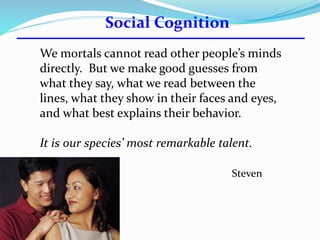
We mortals cannot read other people’s minds 
directly. But we make good guesses from 
what they say, what we read between the 
lines, what they show in their faces and eyes, 
and what best explains their behavior. 
It is our species’ most remarkable talent. 
Steven 
Pinker 
Social Cognition

Social cognition in schizophrenia

  • 1.
    Presenter – DrSalman Kareem Final Year Resident Department of Psychiatry ACME , Pariyaram
  • 2.
     Defining socialcognition in schizophrenia  What domains of social cognition  Neurobiology of social cognition  What is social cognition’s relationship with positive symptoms (eg, paranoia), negative symptoms, and disorganization?  What is the functional significance of social cognition? Does it behave as a mediator?  Social cognition and the course of schizophrenia: does itpredate the illness or occur early in the illness? Are the impairments trait like?  Treatment interventions
  • 3.
     The Measurementand Treatment Research to Improve Cognition in Schizophrenia (MATRICS) project  understanding the nature and extent of cognitive dysfunction in schizophrenia  facilitate the development of treatments that will hopefully improve this debilitating aspect of schizophrenia (Barch, 2005).
  • 4.
     seven cognitivedomains  speed of processing,  working memory,  attention/vigilance,  verbal learning and memory,  visual learning and memory,  reasoning and problem solving,  social cognition  (Green and Nuechterlein, 2004).
  • 6.
     Social cognitionis defined as “the mental operations underlying social interactions, which include the human ability to perceive the intentions and dispositions of others” (Brothers, 1990, p. 28).  how people think about themselves and others in the social world.
  • 7.
     primary domains(constructs) of social cognition:  emotion perception,  Theory of Mind (ToM), and  Attributional style  social perception, social knowledge (social schema)
  • 8.
    Neuro Biology network of neural structures is critically involved in processing social stimuli (Adolphs, 2001; Brothers, 1990; Phillips et al., 2003).  These models focus on regions of the occipital and temporal cortices such as the Fusiform Gyrus (FG) and Superior Temporal Sulcus (STS) which underlie face processing (Haxby, Hoffmann and Gobbini, 2000; Winston, Henson, Fine-Goulden, and Dolan, 2004)  amygdala which plays a critical role in detecting threat, recognizing emotions, and making complex social judgments (Adolphs et al., 1994; Adolphs et al.,  1998; Amaral et al., 2003; Winston et al., 2002)
  • 9.
    Emotional processing Identifying emotions  Facilitating emotions  Understanding emotions  Managing emotions  Affect perception – a domain of emotion processing that is frequently measured in schizophrenia research.
  • 10.
    emotion perception In regard to emotion perception (eg, identifying emotion displayed in various facial expressions or tone of voice), the following conclusions can be drawn  First, individuals with schizophrenia display deficits compared with nonclinical control participants.  Second, these deficits are more severe relative to individuals with other psychiatric disorders such as depressive disorder (unless psychotic features are present). • Edwards et al, Hellewell and Whittaker,Kohler and Brennan, and Mandal et al
  • 11.
     Third, thegreatest deficits are evident in the perception of negative emotions (compared with positive emotions).  Fourth, the deficit in emotion perception is stable over time, although evidence suggests that individuals in remission may outperform individuals in an acute phase of the disorder.
  • 12.
     Fifth, individualswith schizophrenia perform worse trying to ‘‘read between the lines’’ (ie, identifying what a given individual is thinking or feeling) but are less impaired on more concrete social judgments (ie, identifying what a person is wearing or doing).  Sixth, many individuals with schizophrenia display restricted visual scanning and spend less time examining salient facial features during emotion perception tasks.
  • 13.
     Finally, impairmentsin emotion perception are present early in the course of illness.
  • 14.
    Theory of Mind  “ToM is defined as the ability to attribute mental states (including beliefs, intentions, desires, and goals) to the self and others.”  includes understanding false beliefs, hints, intentions, deception, metaphor, irony, and faux pas.
  • 15.
     Over 30studies have been conducted on ToM in schizophrenia, leading to the following conclusions .  In general, individuals with schizophrenia exhibit deficits in ToM relative to non ill and psychiatric controls.  The bulk of research supports the conclusion that this impairment in schizophrenia is a trait deficit. - Brune and Harrington et al
  • 16.
     First-degree relativesof individuals with schizophrenia who also score high on schizotypy have impaired ToM, lending support for ToM as a potential endophenotype for schizophrenia.  ToM deficits are present in both IP and OP samples, are not accounted for by deficits in general cognitive functioning, and are not uniquely associated with any specific symptom type (eg, paranoia).  The etiology of ToM deficits in schizophrenia remains unclear, in part because the genesis of normal ToM is still vague.
  • 17.
    Attributional bias Attributional style refers to explanations people generate regarding the causes of positive and negative events in their lives.  individuals with -paranoia or persecutory delusions.  Such individuals tend to blame others rather than situations for negative events, an attributional style known as a personalizing bias.’  persons with Scz tends to focus on hostile attributional biases or the tendency to attribute hostile intentions to others actions
  • 18.
     Individuals withpersecutory delusions may of course have other social cognitive biases such as the tendency to ‘‘jump to conclusions’’ and to demonstrate a ‘‘confirmation bias’’ (that is, seeking confirmatory evidence for a belief rather than disconfirmatory evidence).
  • 19.
     2 factorsprevent individuals with persecutory delusions from correcting their bias in the face of disconfirming situational information:  a strong need for closure (ie, an intolerance of ambiguity) and  impairments in ToM.  Associationship seen between need for closure and persecutory delusions and between deficits in ToM and personalizing attributions
  • 20.
     Individuals withpersecutory delusions may of course have other social cognitive biases such as the tendency to ‘‘jump to conclusions’’ and to demonstrate a ‘‘confirmation bias’’ (ie, seeking confirmatory evidence for a belief rather than disconfirmatory evidence).
  • 21.
     Social perception  Definition: The ability to understand and appraise social roles, rules, and context.  Involves using verbal and nonverbal cues in order to make inferences about a social situation  May be central to functioning in a social context, ie, facilitating interactions with people in social settings or establishing relationships  Can involve making critical appraisals, such as judgments of trustworthiness in other people
  • 22.
     Social knowledge  Definition: Refers to representational templates of social situations or awareness of the roles, rules, expectations and goals that govern social situations.  Can be declarative, comprising facts and abstract concepts (eg, social scripts) or procedural (eg, rules, skills, and strategies) processes.
  • 23.
     Relationships amongsocial cognitive constructs and negative symptoms are less clear.  negative symptoms that involve reduced emotional experience (ie, anhedonia) or expression (ie, affective flattening) might be more associated with the development or maintenance of social cognition deficits.
  • 24.
     Social cognitivedeficits appear to be key determinants of daily functioning in schizophrenia, including instrumental actions, interpersonal functioning, and vocational achievement.
  • 25.
     social cognitioninvolves the interface of emotional and cognitive processing, whereas neurocognitive processing is relatively affect-neutral  In contrast, negative symptoms could spring from a similar affective processing dysfunction as social cognitive impairments..  failed empathy or mental simulation of others’ cognitive-affect states (a putatively social cognitive phenomenon) may underlie ToM deficits and also foster the extinction of social reinforcement, leading to increased negative symptoms.  .
  • 26.
     Empirically, studiesusing statistical modeling techniques and matched task designs have concluded that social cognition is best understood as related to, but distinct from, neurocognition and negative symptoms.  This distinction is also observed at the neural level because activation circuitry for social cognition vis-à-vis neurocognition and negative symptoms are relatively independent
  • 27.
    Functional Outcome Impairments in daily functioning of schizophrenic patients are related to both social and non-social cognitive domains (Couture et al., 2006, 2011).  However, when social and non-social skills are analyzed together, they are better predictors of functional outcome (Couture et al., 2011).  This means that social and non-social domains have an independent influence on the everyday performance of these patients.  Further, several studies show that social cognition has a mediator effect between neuro-cognition and functional outcome (Couture et al., 2006; Bae et al., 2010;Schmidt et al., 2011b).
  • 28.
     Social andnon-social cognition are associated with functional outcome when they are studied separately, but when they are analyzed together, non-social cognition reduces or loses its association with functional outcome. That is, it is possible that the impact of non-social cognitive impairment in daily functioning occurs through social cognitive impairments.  Hence, it has been proposed that social cognition is a more proximal factor in the causal mechanism leading to real world performance.  For example, to develop interpersonal relationships, alterations in theory of mind have stronger influence than memory alterations. However, memory impairment can influence theory of mind performance which in turn influences the ability to develop interpersonal relationships.
  • 29.
    Mediator/Trait  lifehistory stable trait that precedes, and even predicts, the illness onset.  Using a videotape recording of a cohort of children having lunch, a study showed that alterations of social behavior were the most significant predictors of those children who developed schizophrenia in adulthood, even more so than neuro-motor deficits (Schiffman et al., 2004).  Moreover, individuals at ultra-high or family risk for psychosis present social cognition alterations, especially in theory of mind (Chung et al., 2008;Anselmetti et al., 2009; Eack et al., 2010; Gibson et al., 2010; Kim et al., 2011a).  These alterations can predict the psychotic conversion (Chung et al., 2008; Anselmetti et al., 2009; Eack et al., 2010;Gibson et al., 2010; Kim et al., 2011a
  • 30.
     Consistent resultswere obtained in a study comparing social skills in prodromal, first episode, and chronic patients, as well as in a longitudinal one of first episode patients (Green et al., 2012; Horan et al., 2012). Together, these studies show that social alterations are a stable trait across the illness.
  • 31.
    Treatment Implications Recent studies shows that it has a relationship with functional outcomes (eg, social skills, community functioning).  This, in turn, has inspired researchers to examine whether social cognition can be improved because social cognition may be an important target for pharmacological and psychosocial treatments.
  • 32.
     Interestingly, therehas been little support for atypical medications improving social cognition in schizophrenia because the one large adequately powered study found that neither quetiapine nor risperidone resulted in improved emotion perception among 289 individuals with schizophrenia.
  • 33.
     antipsychotic drugsof either class demonstrate little reliable effect upon social cognition. There is a modicum of support for the use of oxytocin as an adjunct to antipsychotic drugs (Katarzyna Kucharska-Pietura • Ann Mortimer , CNS Drugs (2013) 27:335–343)
  • 34.
     Thus, therehas been growing interest in psychosocial treatments as a means of improving social cognition.  Psychosocial treatment programs use a variety of techniques to ameliorate social cognitive deficits, from ‘‘targeted’’ interventions that focus on a specific skill (eg, asking clients to imitate others’ facial expressions to improve emotion perception) to those that target integrative social cognitive abilities via viewing videotapes and role-playing.  .
  • 35.
     While thereis growing evidence that social cognition can be improved, future research needs to determine whether improvements in social cognition generalize to other social cognitive domains as well as as to behaviors
  • 36.
    The Take HomePoints  Social cognition consists of multiple domains, including affect perception expression, theory of mind, attributional styles, and social knowledge.  Social cognition is not just a subset of neurocognition, it is a truly separable domain.  Deficits in social cognition may explain the most or all of the relationship between neurocognition and social outcomes.  Treating social cognitive deficits has the potential to improve social outcomes, but these treatments are still early in their development stages.
  • 37.
    We mortals cannotread other people’s minds directly. But we make good guesses from what they say, what we read between the lines, what they show in their faces and eyes, and what best explains their behavior. It is our species’ most remarkable talent. Steven Pinker Social Cognition

Editor's Notes

  • #28 Daily functioning measures how people perform in everyday situations, including instrumental activities, interpersonal functioning, and vocational achievement