Life Skills Program for
Schizophrenia
Christina, Brianna, and Jacqueline
What is Schizophrenia?
 Schizophrenia is a serious mental illness that
affects 300,000 Canadians.
 It is a chronic, complex biochemical brain disorder
that affects a persons ability on determining what
is real and what is not.
What is Schizophrenia?
 Shows up in males earlier than females
 Males: late teens, early twenties
 Females: late twenties, early thirties
 Many people with schizophrenia have difficulty
holding a job or caring for themselves, so they rely
on family members or others for help.
 People with the disorder may hear voices other
people don't hear.
Signs and Symptoms
 Delusions: False beliefs, peoples believe the delusion even when
others tell them it is not true or logical, have bizarre thoughts
(believes people are controlling their life, believe they are a
historical famous person, people are poisoning them)
 Hallucinations: Things a person sees, hears, smells, or feels that
no one else around them can.
 “Voices” are the most common type of hallucinations
 seeing people or objects that are not there
 Thought Disorders: Unusual or dysfunctional ways of thinking
 “disorganized thinking” : when a person has trouble
organizing their thoughts and connecting them logically
 Movement Disorders: agitated body movements.
 certain movements over and over.
Signs and Symptoms
 Cognitive Symptoms: subtle symptoms. May be difficult to
recognize.
 Poor ability to understand information and use it to make
decisions
 Trouble focusing or paying attention
 Problems with "working memory" (the ability to use
information immediately after learning it).
 Positive Symptoms: psychotic behaviors not seen in healthy
people.
 people with these symptoms often “lose touch” with reality
 Negative Symptoms: disruptions to normal emotions and
behaviors. these symptoms can be mistaken for depression .
 "Flat affect" (a person's face does not move or he or she
talks in a dull or monotonous voice)
 Lack of pleasure in everyday life
 does not speak much
Causes
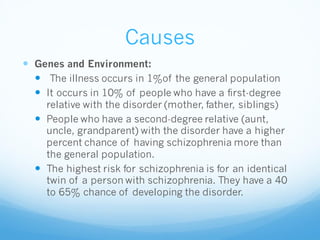
 Genes and Environment:
 The illness occurs in 1%of the general population
 It occurs in 10% of people who have a first-degree
relative with the disorder (mother, father, siblings)
 People who have a second-degree relative (aunt,
uncle, grandparent) with the disorder have a higher
percent chance of having schizophrenia more than
the general population.
 The highest risk for schizophrenia is for an identical
twin of a person with schizophrenia. They have a 40
to 65% chance of developing the disorder.
Causes
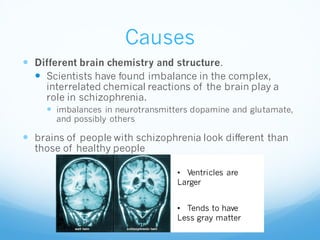
 Different brain chemistry and structure.
 Scientists have found imbalance in the complex,
interrelated chemical reactions of the brain play a
role in schizophrenia.
 imbalances in neurotransmitters dopamine and glutamate,
and possibly others
 brains of people with schizophrenia look different than
those of healthy people
• Ventricles are
Larger
• Tends to have
Less gray matter
Treatment
 Treatment helps decrease and handle the many
symptoms of schizophrenia, but most people who
have the disorder cope with symptoms throughout
their lives. However, it is possible someone with
schizophrenia can lead a rewarding and meaningful
lives in their communities.
Antipsychotic Medications
 Chlorpromazine (Thorazine)
 Haloperidol (Haldol)
 Perphenazine (Etrafon, Trilafon)
 Fluphenazine (Prolixin).
 Risperidone (Risperdal)
 Olanzapine (Zyprexa)
 Quetiapine (Seroquel)
 Ziprasidone (Geodon)
 Aripiprazole (Abilify)
 Paliperidone (Invega).
Exercise Benefits
• In 2010 a review of exercise studies by University of
Toronto by researchers Paul Gorczyniski and Guy
Faulkner discovered “that regular, moderate aerobic
exercise could alleviate feelings of depression, social
isolation and low self-esteem in schizophrenics.”
• They also notices an increase in motivation, primarily
affecting eating habits, hygiene and willingness to
exercise, was the most significant benefit.
Exercise Benefits
 Exercise may also help with the reduction of:
 perception of auditory hallucinations
 promote healthier sleep patterns,
 Improve behavior and help maintain healthy
weight,
 Doctors now recommend the same amount of
exercise for schizophrenics as they do for the rest
of the general population
 moderate exercise 30 minutes a day most days of the
week.
 Recommended types of exercise include cycling,
jogging, walking, weight training and yoga.
Our Client
 Name: Kayla Smith
 Age: 27
 Diagnoses: Schizophrenia
 The Story: Kayla works as a secretary in an office and thinks
her boss and coworkers are “out to get her”, and is convinced
her boss is watching her through surveillance cameras that
secretly hooked into the computers and phones. She ended
up hitting a breaking point and smashed all computers and
phones are her work because “the voices” told her to get the
cameras out. Since then Kayla stopped caring about her
appearance and barely showered. She claimed that voices are
telling her that someone is reading her mind and are plotting
to harm her. Kayla was brought to our attention after her
former boss pressed charges and was finally diagnosed with
Schizophrenia from a psychiatrist.
Assessment of Kayla
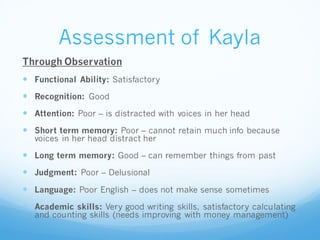
Through Observation
 Functional Ability: Satisfactory
 Recognition: Good
 Attention: Poor – is distracted with voices in her head
 Short term memory: Poor – cannot retain much info because
voices in her head distract her
 Long term memory: Good – can remember things from past
 Judgment: Poor – Delusional
 Language: Poor English – does not make sense sometimes
 Academic skills: Very good writing skills, satisfactory calculating
and counting skills (needs improving with money management)
Assessment of Kayla
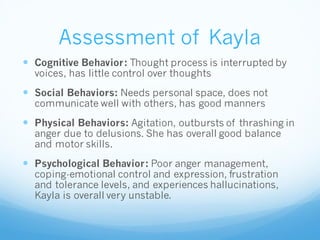
 Cognitive Behavior: Thought process is interrupted by
voices, has little control over thoughts
 Social Behaviors: Needs personal space, does not
communicate well with others, has good manners
 Physical Behaviors: Agitation, outbursts of thrashing in
anger due to delusions. She has overall good balance
and motor skills.
 Psychological Behavior: Poor anger management,
coping-emotional control and expression, frustration
and tolerance levels, and experiences hallucinations,
Kayla is overall very unstable.
Kayla’s Symptoms
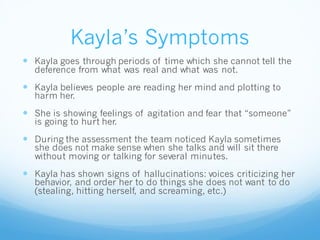
 Kayla goes through periods of time which she cannot tell the
deference from what was real and what was not.
 Kayla believes people are reading her mind and plotting to
harm her.
 She is showing feelings of agitation and fear that “someone”
is going to hurt her.
 During the assessment the team noticed Kayla sometimes
she does not make sense when she talks and will sit there
without moving or talking for several minutes.
 Kayla has shown signs of hallucinations: voices criticizing her
behavior, and order her to do things she does not want to do
(stealing, hitting herself, and screaming, etc.)
Planning
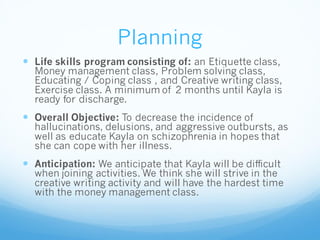
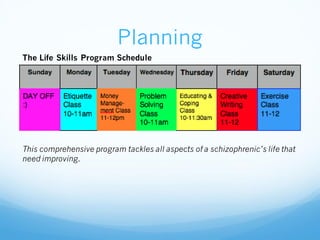
 Life skills program consisting of: an Etiquette class,
Money management class, Problem solving class,
Educating / Coping class , and Creative writing class,
Exercise class. A minimum of 2 months until Kayla is
ready for discharge.
 Overall Objective: To decrease the incidence of
hallucinations, delusions, and aggressive outbursts, as
well as educate Kayla on schizophrenia in hopes that
she can cope with her illness.
 Anticipation: We anticipate that Kayla will be difficult
when joining activities. We think she will strive in the
creative writing activity and will have the hardest time
with the money management class.
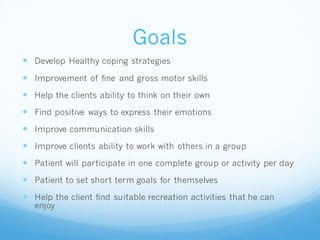
Goals
 Develop Healthy coping strategies
 Improvement of fine and gross motor skills
 Help the clients ability to think on their own
 Find positive ways to express their emotions
 Improve communication skills
 Improve clients ability to work with others in a group
 Patient will participate in one complete group or activity per day
 Patient to set short term goals for themselves
 Help the client find suitable recreation activities that he can
enjoy
Planning
The Life Skills Program Schedule
This comprehensive program tackles all aspects of a schizophrenic’s life that
need improving.
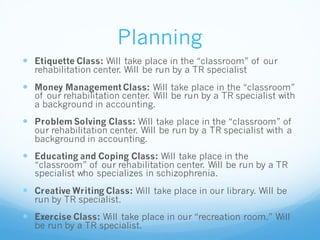
Planning
 Etiquette Class: Will take place in the “classroom” of our
rehabilitation center. Will be run by a TR specialist
 Money Management Class: Will take place in the “classroom”
of our rehabilitation center. Will be run by a TR specialist with
a background in accounting.
 Problem Solving Class: Will take place in the “classroom” of
our rehabilitation center. Will be run by a TR specialist with a
background in accounting.
 Educating and Coping Class: Will take place in the
“classroom” of our rehabilitation center. Will be run by a TR
specialist who specializes in schizophrenia.
 Creative Writing Class: Will take place in our library. Will be
run by TR specialist.
 Exercise Class: Will take place in our “recreation room.” Will
be run by a TR specialist.
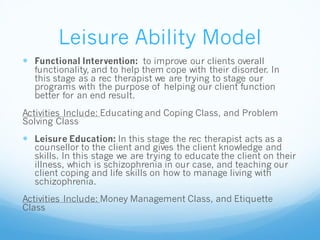
Leisure Ability Model
 Functional Intervention: to improve our clients overall
functionality, and to help them cope with their disorder. In
this stage as a rec therapist we are trying to stage our
programs with the purpose of helping our client function
better for an end result.
Activities Include: Educating and Coping Class, and Problem
Solving Class
 Leisure Education: In this stage the rec therapist acts as a
counsellor to the client and gives the client knowledge and
skills. In this stage we are trying to educate the client on their
illness, which is schizophrenia in our case, and teaching our
client coping and life skills on how to manage living with
schizophrenia.
Activities Include: Money Management Class, and Etiquette
Class
Leisure Ability Model
 Recreation Participation: After helping our client
gain new leisure knowledge and skills as a team we
can step back and become more of a leisure
resource. Our client will be able to pretty self-
sufficient when it comes to their recreation choices
but will occasionally need help from a TR
specialist. Our client will be engaging in organized
participation opportunities.
Activities Include: Exercise Class and Creative Writing
Implementation
 Kayla was hesitant in starting the program, as she
believed we were conspiring against her
 Her favorite program is the creative writing
program
 After a lot of effort and encouragement, we have
formed a helping relationship with Kayla
 She has some form of trust in us
 She does not like being with others still
Evaluation
 Kayla is still not 100% on her common courtesy and
problem solving and it seems to be taking a little bit
longer then we have planned for her. Some days she
seems like she understands what is going on and other
days she seems lost. When she is getting taught proper
etiquette she feels the teacher is out to get her at times
and Kayla’s state of mind changes instantly. During our
problem solving class Kayla seems to still be getting
distracted and gets paranoid when other are trying to
help her as she feels they are out to get them. There has
been some improvement but there definitely is room for
so much more.
Evaluation
 When it comes to money management, Exercise
and Creative writing class Kayla seems to being
doing excessively well. Personally I feel this has to
do with her self-fulfillment from it, when watching
her do different activities for each class you can see
she deeply enjoys it and it tends to keep her mind
active. We feel she is doing well in these classes
because these sorts of activities don’t require for
her to communicate and work with others and she
can just have her personal space doing it.
Evaluation
 The program that needs the most improving is
Educating and Coping Class. Every time Kayla is in
this class things just don’t seem to go right. She
tends to have a lot of outbursts when we talk about
the illness schizophrenia and gets overly frustrated.
She doesn’t like to hear what she was diagnosed
with and when it comes to educating her on it she
seems to get distracted by the “voices” in her head.
Evaluation
 Since Kayla has started taking our program we feel her
behaviour has changed rapidly over the period of time we
have had to work with her. All of her goals but one have been
achieved which is improving the clients ability to work with
others in a group.
 We seem to be having a difficult time achieving this goal as
Kayla likes to have her personal space and can’t
communicate well with others. It is a working progress but we
will overcome this and achieve this goal. Kayla tends to be
more independent based now and is able to find recreational
activities that are best suitable for her needs and wants.
Overall from our program we do see a big difference in
Kayla’s behaviour and it’s hard dealing with schizophrenia but
she is managing and challenging this stage in her life
excellently.
Final Evaluation
 We have collected this data from 2 months of Kayla
participating in our Life Skills Program.
 We are going to keep her in this program until she has
reached all of her goals
 She still has little outbursts and but she has learned
how to control her impulses
 The voices are still there but with our Educating and
Coping class she has learned how to deal with them
 Our estimation is that she will be apart of our program
for approximately the next 2 months
Task
 Try to write down positive things about yourself and
you life while listening to this voice clip.
 Its important to listen and to not block out the
voices (individuals with schizophrenia don’t have
the choice to block them out)
 https://www.youtube.com/watch?v=0vvU-Ajwbok
References
 "Exercise & Schizophrenia." LIVESTRONG.COM. LIVESTRONG.COM, 28
Jan. 2014. Web. 25 Nov. 2014.
http://www.livestrong.com/article/417782-exercise-schizophrenia/.
 "Schizophrenia." NIMH RSS. National Institutes of Health, n.d. Web. 23
Nov. 2014.
http://www.nimh.nih.gov/health/topics/schizophrenia/index.shtml
 "Schizophrenia - Canadian Mental Health Association." Canadian Mental
Health Association. Canadian Mental Health Association, n.d. Web. 25
Nov. 2014. http://www.cmha.ca/mental-health/understanding-mental-
illness/schizophrenia/.
 "Learn More About Schizophrenia." Learn about What Is Schizophrenia and
Schizophrenia Treatment Options. N.p., n.d. Web. 25 Nov. 2014.
<http://www.schizophrenia.ca/learn_more_about_schizophrenia.php#4>
.

Schizophrenia Presentation (Brianna Jane Mainprize)

  • 1.
    Life Skills Programfor Schizophrenia Christina, Brianna, and Jacqueline
  • 2.
    What is Schizophrenia? Schizophrenia is a serious mental illness that affects 300,000 Canadians.  It is a chronic, complex biochemical brain disorder that affects a persons ability on determining what is real and what is not.
  • 3.
    What is Schizophrenia? Shows up in males earlier than females  Males: late teens, early twenties  Females: late twenties, early thirties  Many people with schizophrenia have difficulty holding a job or caring for themselves, so they rely on family members or others for help.  People with the disorder may hear voices other people don't hear.
  • 4.
    Signs and Symptoms Delusions: False beliefs, peoples believe the delusion even when others tell them it is not true or logical, have bizarre thoughts (believes people are controlling their life, believe they are a historical famous person, people are poisoning them)  Hallucinations: Things a person sees, hears, smells, or feels that no one else around them can.  “Voices” are the most common type of hallucinations  seeing people or objects that are not there  Thought Disorders: Unusual or dysfunctional ways of thinking  “disorganized thinking” : when a person has trouble organizing their thoughts and connecting them logically  Movement Disorders: agitated body movements.  certain movements over and over.
  • 5.
    Signs and Symptoms Cognitive Symptoms: subtle symptoms. May be difficult to recognize.  Poor ability to understand information and use it to make decisions  Trouble focusing or paying attention  Problems with "working memory" (the ability to use information immediately after learning it).  Positive Symptoms: psychotic behaviors not seen in healthy people.  people with these symptoms often “lose touch” with reality  Negative Symptoms: disruptions to normal emotions and behaviors. these symptoms can be mistaken for depression .  "Flat affect" (a person's face does not move or he or she talks in a dull or monotonous voice)  Lack of pleasure in everyday life  does not speak much
  • 6.
    Causes  Genes andEnvironment:  The illness occurs in 1%of the general population  It occurs in 10% of people who have a first-degree relative with the disorder (mother, father, siblings)  People who have a second-degree relative (aunt, uncle, grandparent) with the disorder have a higher percent chance of having schizophrenia more than the general population.  The highest risk for schizophrenia is for an identical twin of a person with schizophrenia. They have a 40 to 65% chance of developing the disorder.
  • 7.
    Causes  Different brainchemistry and structure.  Scientists have found imbalance in the complex, interrelated chemical reactions of the brain play a role in schizophrenia.  imbalances in neurotransmitters dopamine and glutamate, and possibly others  brains of people with schizophrenia look different than those of healthy people • Ventricles are Larger • Tends to have Less gray matter
  • 8.
    Treatment  Treatment helpsdecrease and handle the many symptoms of schizophrenia, but most people who have the disorder cope with symptoms throughout their lives. However, it is possible someone with schizophrenia can lead a rewarding and meaningful lives in their communities.
  • 9.
    Antipsychotic Medications  Chlorpromazine(Thorazine)  Haloperidol (Haldol)  Perphenazine (Etrafon, Trilafon)  Fluphenazine (Prolixin).  Risperidone (Risperdal)  Olanzapine (Zyprexa)  Quetiapine (Seroquel)  Ziprasidone (Geodon)  Aripiprazole (Abilify)  Paliperidone (Invega).
  • 10.
    Exercise Benefits • In2010 a review of exercise studies by University of Toronto by researchers Paul Gorczyniski and Guy Faulkner discovered “that regular, moderate aerobic exercise could alleviate feelings of depression, social isolation and low self-esteem in schizophrenics.” • They also notices an increase in motivation, primarily affecting eating habits, hygiene and willingness to exercise, was the most significant benefit.
  • 11.
    Exercise Benefits  Exercisemay also help with the reduction of:  perception of auditory hallucinations  promote healthier sleep patterns,  Improve behavior and help maintain healthy weight,  Doctors now recommend the same amount of exercise for schizophrenics as they do for the rest of the general population  moderate exercise 30 minutes a day most days of the week.  Recommended types of exercise include cycling, jogging, walking, weight training and yoga.
  • 12.
    Our Client  Name:Kayla Smith  Age: 27  Diagnoses: Schizophrenia  The Story: Kayla works as a secretary in an office and thinks her boss and coworkers are “out to get her”, and is convinced her boss is watching her through surveillance cameras that secretly hooked into the computers and phones. She ended up hitting a breaking point and smashed all computers and phones are her work because “the voices” told her to get the cameras out. Since then Kayla stopped caring about her appearance and barely showered. She claimed that voices are telling her that someone is reading her mind and are plotting to harm her. Kayla was brought to our attention after her former boss pressed charges and was finally diagnosed with Schizophrenia from a psychiatrist.
  • 13.
    Assessment of Kayla ThroughObservation  Functional Ability: Satisfactory  Recognition: Good  Attention: Poor – is distracted with voices in her head  Short term memory: Poor – cannot retain much info because voices in her head distract her  Long term memory: Good – can remember things from past  Judgment: Poor – Delusional  Language: Poor English – does not make sense sometimes  Academic skills: Very good writing skills, satisfactory calculating and counting skills (needs improving with money management)
  • 14.
    Assessment of Kayla Cognitive Behavior: Thought process is interrupted by voices, has little control over thoughts  Social Behaviors: Needs personal space, does not communicate well with others, has good manners  Physical Behaviors: Agitation, outbursts of thrashing in anger due to delusions. She has overall good balance and motor skills.  Psychological Behavior: Poor anger management, coping-emotional control and expression, frustration and tolerance levels, and experiences hallucinations, Kayla is overall very unstable.
  • 15.
    Kayla’s Symptoms  Kaylagoes through periods of time which she cannot tell the deference from what was real and what was not.  Kayla believes people are reading her mind and plotting to harm her.  She is showing feelings of agitation and fear that “someone” is going to hurt her.  During the assessment the team noticed Kayla sometimes she does not make sense when she talks and will sit there without moving or talking for several minutes.  Kayla has shown signs of hallucinations: voices criticizing her behavior, and order her to do things she does not want to do (stealing, hitting herself, and screaming, etc.)
  • 16.
    Planning  Life skillsprogram consisting of: an Etiquette class, Money management class, Problem solving class, Educating / Coping class , and Creative writing class, Exercise class. A minimum of 2 months until Kayla is ready for discharge.  Overall Objective: To decrease the incidence of hallucinations, delusions, and aggressive outbursts, as well as educate Kayla on schizophrenia in hopes that she can cope with her illness.  Anticipation: We anticipate that Kayla will be difficult when joining activities. We think she will strive in the creative writing activity and will have the hardest time with the money management class.
  • 17.
    Goals  Develop Healthycoping strategies  Improvement of fine and gross motor skills  Help the clients ability to think on their own  Find positive ways to express their emotions  Improve communication skills  Improve clients ability to work with others in a group  Patient will participate in one complete group or activity per day  Patient to set short term goals for themselves  Help the client find suitable recreation activities that he can enjoy
  • 18.
    Planning The Life SkillsProgram Schedule This comprehensive program tackles all aspects of a schizophrenic’s life that need improving.
  • 19.
    Planning  Etiquette Class:Will take place in the “classroom” of our rehabilitation center. Will be run by a TR specialist  Money Management Class: Will take place in the “classroom” of our rehabilitation center. Will be run by a TR specialist with a background in accounting.  Problem Solving Class: Will take place in the “classroom” of our rehabilitation center. Will be run by a TR specialist with a background in accounting.  Educating and Coping Class: Will take place in the “classroom” of our rehabilitation center. Will be run by a TR specialist who specializes in schizophrenia.  Creative Writing Class: Will take place in our library. Will be run by TR specialist.  Exercise Class: Will take place in our “recreation room.” Will be run by a TR specialist.
  • 20.
    Leisure Ability Model Functional Intervention: to improve our clients overall functionality, and to help them cope with their disorder. In this stage as a rec therapist we are trying to stage our programs with the purpose of helping our client function better for an end result. Activities Include: Educating and Coping Class, and Problem Solving Class  Leisure Education: In this stage the rec therapist acts as a counsellor to the client and gives the client knowledge and skills. In this stage we are trying to educate the client on their illness, which is schizophrenia in our case, and teaching our client coping and life skills on how to manage living with schizophrenia. Activities Include: Money Management Class, and Etiquette Class
  • 21.
    Leisure Ability Model Recreation Participation: After helping our client gain new leisure knowledge and skills as a team we can step back and become more of a leisure resource. Our client will be able to pretty self- sufficient when it comes to their recreation choices but will occasionally need help from a TR specialist. Our client will be engaging in organized participation opportunities. Activities Include: Exercise Class and Creative Writing
  • 22.
    Implementation  Kayla washesitant in starting the program, as she believed we were conspiring against her  Her favorite program is the creative writing program  After a lot of effort and encouragement, we have formed a helping relationship with Kayla  She has some form of trust in us  She does not like being with others still
  • 23.
    Evaluation  Kayla isstill not 100% on her common courtesy and problem solving and it seems to be taking a little bit longer then we have planned for her. Some days she seems like she understands what is going on and other days she seems lost. When she is getting taught proper etiquette she feels the teacher is out to get her at times and Kayla’s state of mind changes instantly. During our problem solving class Kayla seems to still be getting distracted and gets paranoid when other are trying to help her as she feels they are out to get them. There has been some improvement but there definitely is room for so much more.
  • 24.
    Evaluation  When itcomes to money management, Exercise and Creative writing class Kayla seems to being doing excessively well. Personally I feel this has to do with her self-fulfillment from it, when watching her do different activities for each class you can see she deeply enjoys it and it tends to keep her mind active. We feel she is doing well in these classes because these sorts of activities don’t require for her to communicate and work with others and she can just have her personal space doing it.
  • 25.
    Evaluation  The programthat needs the most improving is Educating and Coping Class. Every time Kayla is in this class things just don’t seem to go right. She tends to have a lot of outbursts when we talk about the illness schizophrenia and gets overly frustrated. She doesn’t like to hear what she was diagnosed with and when it comes to educating her on it she seems to get distracted by the “voices” in her head.
  • 26.
    Evaluation  Since Kaylahas started taking our program we feel her behaviour has changed rapidly over the period of time we have had to work with her. All of her goals but one have been achieved which is improving the clients ability to work with others in a group.  We seem to be having a difficult time achieving this goal as Kayla likes to have her personal space and can’t communicate well with others. It is a working progress but we will overcome this and achieve this goal. Kayla tends to be more independent based now and is able to find recreational activities that are best suitable for her needs and wants. Overall from our program we do see a big difference in Kayla’s behaviour and it’s hard dealing with schizophrenia but she is managing and challenging this stage in her life excellently.
  • 27.
    Final Evaluation  Wehave collected this data from 2 months of Kayla participating in our Life Skills Program.  We are going to keep her in this program until she has reached all of her goals  She still has little outbursts and but she has learned how to control her impulses  The voices are still there but with our Educating and Coping class she has learned how to deal with them  Our estimation is that she will be apart of our program for approximately the next 2 months
  • 28.
    Task  Try towrite down positive things about yourself and you life while listening to this voice clip.  Its important to listen and to not block out the voices (individuals with schizophrenia don’t have the choice to block them out)  https://www.youtube.com/watch?v=0vvU-Ajwbok
  • 29.
    References  "Exercise &Schizophrenia." LIVESTRONG.COM. LIVESTRONG.COM, 28 Jan. 2014. Web. 25 Nov. 2014. http://www.livestrong.com/article/417782-exercise-schizophrenia/.  "Schizophrenia." NIMH RSS. National Institutes of Health, n.d. Web. 23 Nov. 2014. http://www.nimh.nih.gov/health/topics/schizophrenia/index.shtml  "Schizophrenia - Canadian Mental Health Association." Canadian Mental Health Association. Canadian Mental Health Association, n.d. Web. 25 Nov. 2014. http://www.cmha.ca/mental-health/understanding-mental- illness/schizophrenia/.  "Learn More About Schizophrenia." Learn about What Is Schizophrenia and Schizophrenia Treatment Options. N.p., n.d. Web. 25 Nov. 2014. <http://www.schizophrenia.ca/learn_more_about_schizophrenia.php#4> .