Management of Schizophrenia
Dr. Pavan Kumar K
Asst Professor
Dept Of Psychiatry
CAIMS
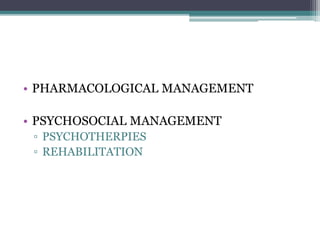
• PHARMACOLOGICAL MANAGEMENT
• PSYCHOSOCIAL MANAGEMENT
▫ PSYCHOTHERPIES
▫ REHABILITATION
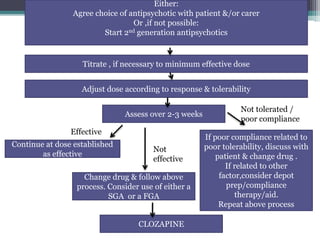
•Treatment of first
episode schizophrenia
Either:
Agree choice of antipsychotic with patient &/or carer
Or ,if not possible:
Start 2nd generation antipsychotics
Titrate , if necessary to minimum effective dose
Adjust dose according to response & tolerability
Assess over 2-3 weeks
Continue at dose established
as effective
Change drug & follow above
process. Consider use of either a
SGA or a FGA
If poor compliance related to
poor tolerability, discuss with
patient & change drug .
If related to other
factor,consider depot
prep/compliance
therapy/aid.
Repeat above process
CLOZAPINE
Effective
Not
effective
Not tolerated /
poor compliance
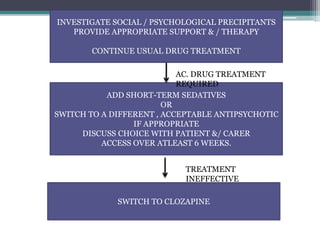
•Treatment of relapse or acute
exacerbation with adherence
confirmed.
INVESTIGATE SOCIAL / PSYCHOLOGICAL PRECIPITANTS
PROVIDE APPROPRIATE SUPPORT & / THERAPY
CONTINUE USUAL DRUG TREATMENT
ADD SHORT-TERM SEDATIVES
OR
SWITCH TO A DIFFERENT , ACCEPTABLE ANTIPSYCHOTIC
IF APPROPRIATE
DISCUSS CHOICE WITH PATIENT &/ CARER
ACCESS OVER ATLEAST 6 WEEKS.
SWITCH TO CLOZAPINE
AC. DRUG TREATMENT
REQUIRED
TREATMENT
INEFFECTIVE
•Treatment of relapse or
acute exacerbation of
schizophrenia with
adherence doubtful
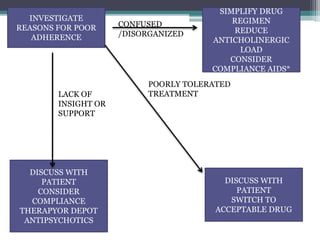
INVESTIGATE
REASONS FOR POOR
ADHERENCE
SIMPLIFY DRUG
REGIMEN
REDUCE
ANTICHOLINERGIC
LOAD
CONSIDER
COMPLIANCE AIDS*
DISCUSS WITH
PATIENT
SWITCH TO
ACCEPTABLE DRUG
DISCUSS WITH
PATIENT
CONSIDER
COMPLIANCE
THERAPYOR DEPOT
ANTIPSYCHOTICS
CONFUSED
/DISORGANIZED
POORLY TOLERATED
TREATMENTLACK OF
INSIGHT OR
SUPPORT
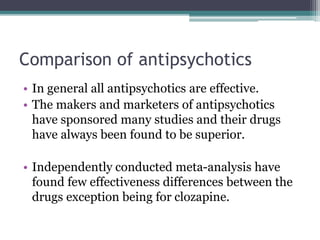
Comparison of antipsychotics
• In general all antipsychotics are effective.
• The makers and marketers of antipsychotics
have sponsored many studies and their drugs
have always been found to be superior.
• Independently conducted meta-analysis have
found few effectiveness differences between the
drugs exception being for clozapine.
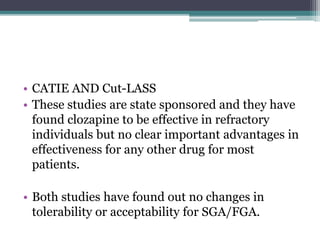
• CATIE AND Cut-LASS
• These studies are state sponsored and they have
found clozapine to be effective in refractory
individuals but no clear important advantages in
effectiveness for any other drug for most
patients.
• Both studies have found out no changes in
tolerability or acceptability for SGA/FGA.
Long acting injectable antipsychotics
• These drugs are helpful for continuation and
maintenance treatment.
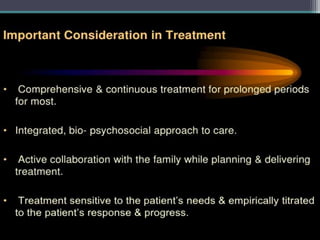
• Some oral supplementation is necessary while
optimum plasma levels are being achieved.
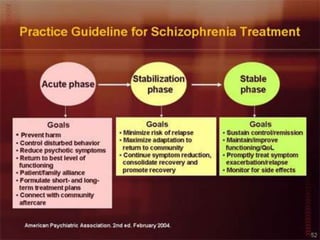
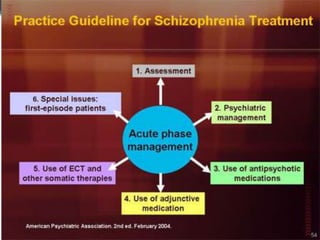
• ACUTE PHASE
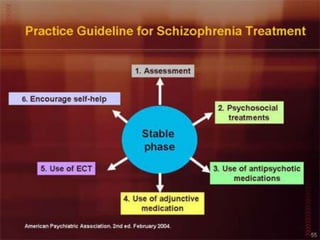
• MAINATAINANCE PHASE
▫ Stabilization phase
▫ Stable phase
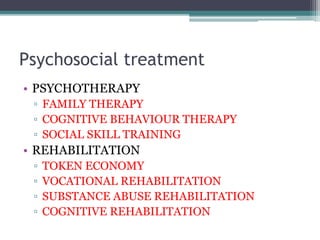
Psychosocial treatment
• PSYCHOTHERAPY
▫ FAMILY THERAPY
▫ COGNITIVE BEHAVIOUR THERAPY
▫ SOCIAL SKILL TRAINING
• REHABILITATION
▫ TOKEN ECONOMY
▫ VOCATIONAL REHABILITATION
▫ SUBSTANCE ABUSE REHABILITATION
▫ COGNITIVE REHABILITATION
PATIENT OUTCOME RESEARCH TEAM
• Family intervention
• Supported employment
• Assertive community treatment
• Skills training
• CBT
• Token economy interventions
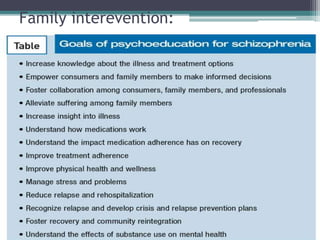
Family interevention:
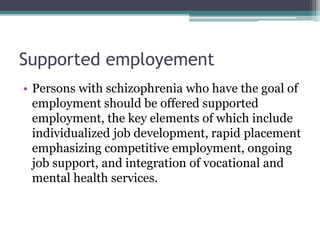
Supported employement
• Persons with schizophrenia who have the goal of
employment should be offered supported
employment, the key elements of which include
individualized job development, rapid placement
emphasizing competitive employment, ongoing
job support, and integration of vocational and
mental health services.
Social skills training
• Social dysfunction is a defining characteristic of
schizophrenia. People with this illness have
difficulty fulfilling social roles.
• Social dysfunction is semi-independent of
symptomatology, and it plays an important role
in the course and outcome of the illness
Core components:
• Social perception
• Social cognition and
• Behavioural resoponse
Elements that are to be concentrated
include
• Expressive behaviours
▫ Speech content
▫ Paralinguistic features
Voice
 volume
 Speech rate
 Pitch
 Intonation
• Nonverbal behaviors
▫ Eye contact (gaze)
▫ Posture
▫ Facial expression
• Receptive Skills (social perception)
▫ Attention to and interpretation of relevant cues
▫ Emotion recognition
• Processing Skills
▫ Analysis of the demands of the situation
▫ Incorporation of relevant contextual
information
▫ Social problem solving
• Interactive Behaviors
▫ Response timing
▫ Use of social reinforcers
▫ Turn taking Situational Factors
CBT
• findings from the past two decades suggest that
schizophrenia patients can benefit from CBT
that directly targets psychotic symptoms.
• CBT is a psychological approach to treatment
that is focused on the interrelationship between
thoughts, behaviors, and feelings
TOKEN ECONOMY PROGRAM
• Token economies are behavioral reinforcement
programs based on the principles of social
learning.
• (1) managing patients' behaviors while they are
in the hospital or facility, and
• (2) preparing them to be able to function better
in other, presumably less restrictive and less
structured settings
• (1) identification of “target behaviors” that are
considered important/desirable for all patients,
• (2) earning points or tokens for engaging in
these behaviors,
• (3) redeeming the points in exchange for
material items or privileges, and
• (4) participation by all patients in the treatment
setting
SUBSTANCE USE REHABILITATION
• Most common and clinically significant
comorbidity with schizophrenia.
• Approximately 50 percent of adults with
schizophrenia have at least one co-occurring
substance abuse
• complicate their lives,
▫ leading to increased symptoms,
▫ relapses,
▫ hospitalizations,
▫ violence, incarceration,
▫ unstable housing, homelessness, victimization,
▫ family problems, and
▫ serious medical problems such as HIV and
hepatitis
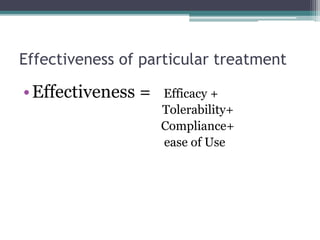
Effectiveness of particular treatment
•Effectiveness = Efficacy +
Tolerability+
Compliance+
ease of Use
Recovery
• Mental health recovery is in a journey of healing
and transformation enabling a person with a
mental health problem to live a meaningful life
in a community of his or her choice while
striving to achieve his or her full potential
REFERENCES
• Sadock BJ, Sadock VA, Ruiz P. Comprehensive textbook of
Psychiatry,Schizophrenia. 9th Edition,VOL1:Lippincott
Williams ltd; 2009.
• IPS guidelines for management of schizophrenia.
• NICE guidelines: core interventions in treatment and
management of schizophrenia ,2002.
• APA guidelines: practice guidelines for treatment of patients
with schizophrenia,2004.
THANK YOU

Schizophrenia management

  • 1.
    Management of Schizophrenia Dr.Pavan Kumar K Asst Professor Dept Of Psychiatry CAIMS
  • 2.
    • PHARMACOLOGICAL MANAGEMENT •PSYCHOSOCIAL MANAGEMENT ▫ PSYCHOTHERPIES ▫ REHABILITATION
  • 4.
  • 5.
    Either: Agree choice ofantipsychotic with patient &/or carer Or ,if not possible: Start 2nd generation antipsychotics Titrate , if necessary to minimum effective dose Adjust dose according to response & tolerability Assess over 2-3 weeks Continue at dose established as effective Change drug & follow above process. Consider use of either a SGA or a FGA If poor compliance related to poor tolerability, discuss with patient & change drug . If related to other factor,consider depot prep/compliance therapy/aid. Repeat above process CLOZAPINE Effective Not effective Not tolerated / poor compliance
  • 6.
    •Treatment of relapseor acute exacerbation with adherence confirmed.
  • 7.
    INVESTIGATE SOCIAL /PSYCHOLOGICAL PRECIPITANTS PROVIDE APPROPRIATE SUPPORT & / THERAPY CONTINUE USUAL DRUG TREATMENT ADD SHORT-TERM SEDATIVES OR SWITCH TO A DIFFERENT , ACCEPTABLE ANTIPSYCHOTIC IF APPROPRIATE DISCUSS CHOICE WITH PATIENT &/ CARER ACCESS OVER ATLEAST 6 WEEKS. SWITCH TO CLOZAPINE AC. DRUG TREATMENT REQUIRED TREATMENT INEFFECTIVE
  • 8.
    •Treatment of relapseor acute exacerbation of schizophrenia with adherence doubtful
  • 9.
    INVESTIGATE REASONS FOR POOR ADHERENCE SIMPLIFYDRUG REGIMEN REDUCE ANTICHOLINERGIC LOAD CONSIDER COMPLIANCE AIDS* DISCUSS WITH PATIENT SWITCH TO ACCEPTABLE DRUG DISCUSS WITH PATIENT CONSIDER COMPLIANCE THERAPYOR DEPOT ANTIPSYCHOTICS CONFUSED /DISORGANIZED POORLY TOLERATED TREATMENTLACK OF INSIGHT OR SUPPORT
  • 11.
    Comparison of antipsychotics •In general all antipsychotics are effective. • The makers and marketers of antipsychotics have sponsored many studies and their drugs have always been found to be superior. • Independently conducted meta-analysis have found few effectiveness differences between the drugs exception being for clozapine.
  • 12.
    • CATIE ANDCut-LASS • These studies are state sponsored and they have found clozapine to be effective in refractory individuals but no clear important advantages in effectiveness for any other drug for most patients. • Both studies have found out no changes in tolerability or acceptability for SGA/FGA.
  • 13.
    Long acting injectableantipsychotics • These drugs are helpful for continuation and maintenance treatment. • Some oral supplementation is necessary while optimum plasma levels are being achieved.
  • 16.
    • ACUTE PHASE •MAINATAINANCE PHASE ▫ Stabilization phase ▫ Stable phase
  • 21.
    Psychosocial treatment • PSYCHOTHERAPY ▫FAMILY THERAPY ▫ COGNITIVE BEHAVIOUR THERAPY ▫ SOCIAL SKILL TRAINING • REHABILITATION ▫ TOKEN ECONOMY ▫ VOCATIONAL REHABILITATION ▫ SUBSTANCE ABUSE REHABILITATION ▫ COGNITIVE REHABILITATION
  • 23.
    PATIENT OUTCOME RESEARCHTEAM • Family intervention • Supported employment • Assertive community treatment • Skills training • CBT • Token economy interventions
  • 24.
  • 25.
    Supported employement • Personswith schizophrenia who have the goal of employment should be offered supported employment, the key elements of which include individualized job development, rapid placement emphasizing competitive employment, ongoing job support, and integration of vocational and mental health services.
  • 26.
    Social skills training •Social dysfunction is a defining characteristic of schizophrenia. People with this illness have difficulty fulfilling social roles. • Social dysfunction is semi-independent of symptomatology, and it plays an important role in the course and outcome of the illness
  • 27.
    Core components: • Socialperception • Social cognition and • Behavioural resoponse
  • 28.
    Elements that areto be concentrated include • Expressive behaviours ▫ Speech content ▫ Paralinguistic features Voice  volume  Speech rate  Pitch  Intonation • Nonverbal behaviors ▫ Eye contact (gaze) ▫ Posture ▫ Facial expression
  • 29.
    • Receptive Skills(social perception) ▫ Attention to and interpretation of relevant cues ▫ Emotion recognition
  • 30.
    • Processing Skills ▫Analysis of the demands of the situation ▫ Incorporation of relevant contextual information ▫ Social problem solving
  • 31.
    • Interactive Behaviors ▫Response timing ▫ Use of social reinforcers ▫ Turn taking Situational Factors
  • 32.
    CBT • findings fromthe past two decades suggest that schizophrenia patients can benefit from CBT that directly targets psychotic symptoms. • CBT is a psychological approach to treatment that is focused on the interrelationship between thoughts, behaviors, and feelings
  • 33.
    TOKEN ECONOMY PROGRAM •Token economies are behavioral reinforcement programs based on the principles of social learning. • (1) managing patients' behaviors while they are in the hospital or facility, and • (2) preparing them to be able to function better in other, presumably less restrictive and less structured settings
  • 34.
    • (1) identificationof “target behaviors” that are considered important/desirable for all patients, • (2) earning points or tokens for engaging in these behaviors, • (3) redeeming the points in exchange for material items or privileges, and • (4) participation by all patients in the treatment setting
  • 35.
    SUBSTANCE USE REHABILITATION •Most common and clinically significant comorbidity with schizophrenia. • Approximately 50 percent of adults with schizophrenia have at least one co-occurring substance abuse
  • 36.
    • complicate theirlives, ▫ leading to increased symptoms, ▫ relapses, ▫ hospitalizations, ▫ violence, incarceration, ▫ unstable housing, homelessness, victimization, ▫ family problems, and ▫ serious medical problems such as HIV and hepatitis
  • 40.
    Effectiveness of particulartreatment •Effectiveness = Efficacy + Tolerability+ Compliance+ ease of Use
  • 41.
    Recovery • Mental healthrecovery is in a journey of healing and transformation enabling a person with a mental health problem to live a meaningful life in a community of his or her choice while striving to achieve his or her full potential
  • 42.
    REFERENCES • Sadock BJ,Sadock VA, Ruiz P. Comprehensive textbook of Psychiatry,Schizophrenia. 9th Edition,VOL1:Lippincott Williams ltd; 2009. • IPS guidelines for management of schizophrenia. • NICE guidelines: core interventions in treatment and management of schizophrenia ,2002. • APA guidelines: practice guidelines for treatment of patients with schizophrenia,2004.
  • 43.