Social attitude and social
behaviour
Mr. Marudhar
Nims Nursing College
Social attitude
• A predisposition or a tendency to respond
positively or negatively towards a certain idea,
object, person, or situation.
• Attitude influences an individual's choice of
action, and responses to challenges, incentives,
and rewards.
A social attitude is an acquired tendency to
evaluate social things in a specific way. It’s
characterized by positive or negative beliefs,
feelings and behaviors towards a particular entity.
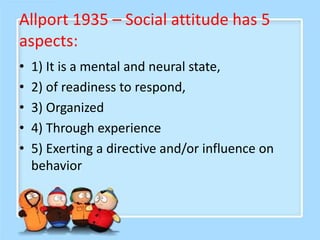
Allport 1935 – Social attitude has 5
aspects:
• 1) It is a mental and neural state,
• 2) of readiness to respond,
• 3) Organized
• 4) Through experience
• 5) Exerting a directive and/or influence on
behavior
Structure of Attitudes
• Attitudes structure can be described in terms of three
components.
• Affective component: this involves a person’s feelings /
emotions about the attitude object. For example: “I am
scared of spiders”.
• Behavioral (or conative) component: the way the
attitude we have influences how we act or behave. For
example: “I will avoid spiders and scream if I see one”.
• Cognitive component: this involves a person’s belief /
knowledge about an attitude object. For example: “I
believe spiders are dangerous”.
Characteristics
• Attitudes are the complex combination of things we tend to
call personality, beliefs, values, behaviors, and motivations.
• It can fall anywhere along a continuum from very favorable
to very unfavorable.
• All people, irrespective of their status or intelligence, hold
attitudes.
• An attitude exists in every person’s mind. It helps to define
our identity, guide our actions,
• Although the feeling and belief components of attitude are
internal to a person, we can view a person’s attitude from
his or her resulting behavior.
Cont…
• Attitude helps us define how we see situations, as well as define how we
behave toward the situation or object.
• It provides us with internal cognitions or beliefs and thoughts about
people and objects.
• It can also be explicit and implicit. Explicit attitude is those that we are
consciously aware of an implicit attitude is unconscious, but still, have an
effect on our behaviors.
• Attitudes cause us to behave in a particular way toward an object or
person.
• An attitude is a summary of a person’s past experience; thus, an attitude is
grounded in direct experience predicts future behavior more accurately.
Function of social atitude
• (1) the adjustments function- The adjustment function directs
people toward pleasurable or rewarding objects and away from
unpleasant, undesirable ones. It serves the utilitarian concept of
maximizing reward and minimizing punishment.
• (2) the ego defensive function- Attitudes firmed to protect the ego
or self image from threats help fulfill the ego defensive function.
Actually many outward expressions of such attitudes reflect the
opposite of what the person perceives him to be.
Cont…..
• (3) the value expressive function-Whereas ego
defensive attitudes are formed to protect a
person’s self image, value expressive attitudes
enable the expression of the person’s centrally
held values. Therefore consumers adopt certain
attitudes in an effort to translate their values into
something more tangible and easily expressed .
Cont…
• (4) the knowledge function. Humans have a need for a
structured and orderly world, and therefore they seek
consistency stability definition and understanding. Out
of this need develops attitudes toward acquiring
knowledge. In addition, the need to know tends to be
specific. Therefore an individual who does not play
golf, nor wish to learn the sport is unlikely to seek
knowledge or an understanding of the game.
Social attitude

Social attitude

  • 1.
    Social attitude andsocial behaviour Mr. Marudhar Nims Nursing College
  • 2.
    Social attitude • Apredisposition or a tendency to respond positively or negatively towards a certain idea, object, person, or situation. • Attitude influences an individual's choice of action, and responses to challenges, incentives, and rewards. A social attitude is an acquired tendency to evaluate social things in a specific way. It’s characterized by positive or negative beliefs, feelings and behaviors towards a particular entity.
  • 3.
    Allport 1935 –Social attitude has 5 aspects: • 1) It is a mental and neural state, • 2) of readiness to respond, • 3) Organized • 4) Through experience • 5) Exerting a directive and/or influence on behavior
  • 4.
    Structure of Attitudes •Attitudes structure can be described in terms of three components. • Affective component: this involves a person’s feelings / emotions about the attitude object. For example: “I am scared of spiders”. • Behavioral (or conative) component: the way the attitude we have influences how we act or behave. For example: “I will avoid spiders and scream if I see one”. • Cognitive component: this involves a person’s belief / knowledge about an attitude object. For example: “I believe spiders are dangerous”.
  • 5.
    Characteristics • Attitudes arethe complex combination of things we tend to call personality, beliefs, values, behaviors, and motivations. • It can fall anywhere along a continuum from very favorable to very unfavorable. • All people, irrespective of their status or intelligence, hold attitudes. • An attitude exists in every person’s mind. It helps to define our identity, guide our actions, • Although the feeling and belief components of attitude are internal to a person, we can view a person’s attitude from his or her resulting behavior.
  • 6.
    Cont… • Attitude helpsus define how we see situations, as well as define how we behave toward the situation or object. • It provides us with internal cognitions or beliefs and thoughts about people and objects. • It can also be explicit and implicit. Explicit attitude is those that we are consciously aware of an implicit attitude is unconscious, but still, have an effect on our behaviors. • Attitudes cause us to behave in a particular way toward an object or person. • An attitude is a summary of a person’s past experience; thus, an attitude is grounded in direct experience predicts future behavior more accurately.
  • 7.
    Function of socialatitude • (1) the adjustments function- The adjustment function directs people toward pleasurable or rewarding objects and away from unpleasant, undesirable ones. It serves the utilitarian concept of maximizing reward and minimizing punishment. • (2) the ego defensive function- Attitudes firmed to protect the ego or self image from threats help fulfill the ego defensive function. Actually many outward expressions of such attitudes reflect the opposite of what the person perceives him to be.
  • 8.
    Cont….. • (3) thevalue expressive function-Whereas ego defensive attitudes are formed to protect a person’s self image, value expressive attitudes enable the expression of the person’s centrally held values. Therefore consumers adopt certain attitudes in an effort to translate their values into something more tangible and easily expressed .
  • 9.
    Cont… • (4) theknowledge function. Humans have a need for a structured and orderly world, and therefore they seek consistency stability definition and understanding. Out of this need develops attitudes toward acquiring knowledge. In addition, the need to know tends to be specific. Therefore an individual who does not play golf, nor wish to learn the sport is unlikely to seek knowledge or an understanding of the game.