TOKEN ECONOMY
SANNET THOMAS
ASST. PROFESSOR, DEPARTMENT OF PSYCHOLOGY
NUCLEUS ARTS AND SCIENCE COLLEGE , PATTAMBI
CONSULTANT PSYCHOLOGIST, ST. RITA’S HOSPITAL , CHERTHALA
Contents
 Define Token Economy
 Advantages
 Disadvantages
 11 Basic Rules
 Steps
What is Token Economy ?
 It is the system of exchange in which the individual earns tokens as,
reinforces and exchanges them for tangible and social reinforces.
 Token program involves distribution of tokens
 Tokens can be stickers, stars, smiley, face, fake money etc.
 Tokens can be accumulated throughout the day and exchanged at a later
time
Advantages of Token Economy
 Tokens are flexible
 Tokens can be used for several needs
 There is no delay giving tokens after the desired behaviour has been
shown
 It does not matter who gives the tokens
 It can be consistently applied by multiple teachers/dotors/supervisor in
multiple settings
 Prevent boredom
Disadvantages
 Takes a lot of preparation and tracking of the behaviour, tokens, and
rewards
 Not everyone will respond to token system
 Once the system is implemented in one setup, it may not followed through
 Parental/guardian follow through does not always occur
 Can lead to dependency
 Maybe easily abused
 Can be expensive
 Require organization and structure
11 Basic Rules
1. Select the target behaviour
2. Present the target behaviour
3. Post the rules and review it frequently
4. Select a token
5. Establish reinforcers which the tokens can be exchanged
6. Develop a reward menu
7. Implement token economy
8. Provide immediate reinforcement for acceptable behaviour
9. Gradually change from continuous to variable schedule of reinforcers
10. Provide time for client to exchange tokens
11. Revise the reward menu frequently
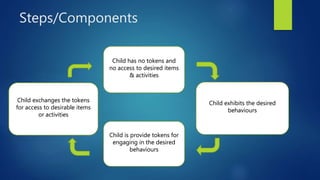
Steps/Components
Child has no tokens and
no access to desired items
& activities
Child exhibits the desired
behaviours
Child is provide tokens for
engaging in the desired
behaviours
Child exchanges the tokens
for access to desirable items
or activities
Reference
 Schultz D & Schultz E (2003) Theories of personality, (10th ed)
Wadsworth cenage learning,USA

Token economy

  • 1.
    TOKEN ECONOMY SANNET THOMAS ASST.PROFESSOR, DEPARTMENT OF PSYCHOLOGY NUCLEUS ARTS AND SCIENCE COLLEGE , PATTAMBI CONSULTANT PSYCHOLOGIST, ST. RITA’S HOSPITAL , CHERTHALA
  • 2.
    Contents  Define TokenEconomy  Advantages  Disadvantages  11 Basic Rules  Steps
  • 3.
    What is TokenEconomy ?  It is the system of exchange in which the individual earns tokens as, reinforces and exchanges them for tangible and social reinforces.  Token program involves distribution of tokens  Tokens can be stickers, stars, smiley, face, fake money etc.  Tokens can be accumulated throughout the day and exchanged at a later time
  • 4.
    Advantages of TokenEconomy  Tokens are flexible  Tokens can be used for several needs  There is no delay giving tokens after the desired behaviour has been shown  It does not matter who gives the tokens  It can be consistently applied by multiple teachers/dotors/supervisor in multiple settings  Prevent boredom
  • 5.
    Disadvantages  Takes alot of preparation and tracking of the behaviour, tokens, and rewards  Not everyone will respond to token system  Once the system is implemented in one setup, it may not followed through  Parental/guardian follow through does not always occur  Can lead to dependency  Maybe easily abused  Can be expensive  Require organization and structure
  • 6.
    11 Basic Rules 1.Select the target behaviour 2. Present the target behaviour 3. Post the rules and review it frequently 4. Select a token 5. Establish reinforcers which the tokens can be exchanged 6. Develop a reward menu 7. Implement token economy 8. Provide immediate reinforcement for acceptable behaviour 9. Gradually change from continuous to variable schedule of reinforcers 10. Provide time for client to exchange tokens 11. Revise the reward menu frequently
  • 7.
    Steps/Components Child has notokens and no access to desired items & activities Child exhibits the desired behaviours Child is provide tokens for engaging in the desired behaviours Child exchanges the tokens for access to desirable items or activities
  • 8.
    Reference  Schultz D& Schultz E (2003) Theories of personality, (10th ed) Wadsworth cenage learning,USA