Readings: Smith & Mackie chapters 7 + 8
Attitudes
Attitudes
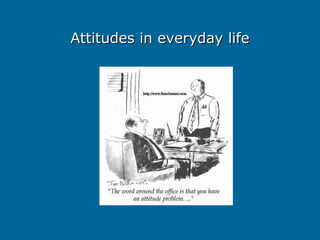
Attitudes in everyday life
What is an attitude?
A mental and neural state of readiness, organised through
experience, exerting a directive or dynamic influence
upon the individual’s response to all objects and
situations with which it is related
Allport, 1935
An attitude is a psychological tendency that is expressed
by evaluating a particular entity with some degree of
favour or disfavour
Eagly & Chaiken, 1998
Attitude structure
Attitude structure
Attitudes consist of three related components:
1. An emotional component consisting of emotional
reactions toward, or feelings about the attitude
object.
2. A cognitive component consisting of thoughts
and beliefs about the attitude object.
3. A behavioural component consisting of actions
toward the attitude object.
Imagine you’re buying a car…
It’s yellow…
Hard to park…
uses a lot of petrol..
I don’t think I’ll buy
it.
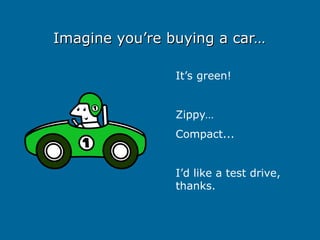
Imagine you’re buying a car…
It’s green!
Zippy…
Compact...
I’d like a test drive,
thanks.
Where do attitudes come from?
• Some attitudes seem to reflect stable, internal
dispositions of the individual
– i.e., ‘ways of seeing the world’
• Broad attitudinal dispositions might have a
shared genetic basis (Tesser, 1993)
• This is most likely for ‘gut-preferences’:
– For example, feelings of disgust at certain smells or
foods
Where do attitudes come from?
Most social psychologists agree that attitudes are formed on
the basis of experiences.
1. Cognitively-based attitudes
• People arrive at an attitudinal position after consideration of the
relevant facts.
2. Affectively based attitudes
• People form an association between some emotional state and
the attitude object – e.g., conditioning, familiarity
3. Behaviourally based attitudes
• People infer what that think by reflecting on what they do.
Explicit V. Implicit Attitudes
Once we have developed an attitude (an
orientation to some object), this attitude can
exist in a number of states:
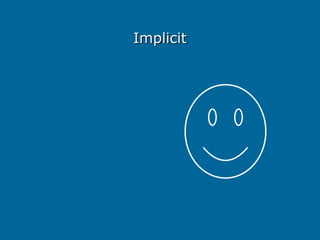
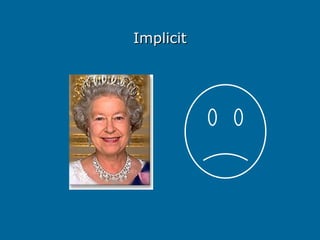
1. Explicit attitudes:
– The evaluations we consciously express.
2. Implicit attitudes:
– Involuntary responses to the attitude object.
Explicit
Explicit
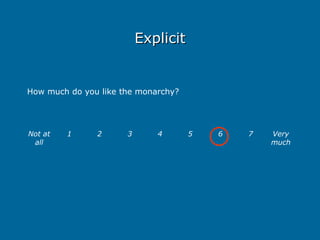
How much do you like the monarchy?
Not at
all
1 2 3 4 5 6 7 Very
much
Implicit
Implicit
Implicit
Implicit
Explicit V. Implicit Attitudes
• Our explicitly expressed attitude and our
implicit reactions can be the same thing.
• But, there can also be a difference between
what people say and what they think or
believe
• Raises questions about attitude measurement
• Raises possibilities for studying attitudes
Attitude function
Attitude function
Attitudes will fluctuate in order to serve our current needs.
Four major functions (Katz, 1960) and Smith et al. (1956):
1. Utilitarian function
- Helps person to achieve rewards and gain approval from others
(e.g., Nienhuis, Manstead, & Spears, 2001).
2. Knowledge function
- Attitudes can be used as a “frame of reference” for organizing the
world so that it makes sense (Katz, 1960).
- For example, we perceive knowledge that contradicts our views with
suspicion, thus forming a negative impression of that source of
information (Giner-Sorolla & Chaiken, 1997).
Attitude function
Attitude function
3. Ego-defensive function
- Helps to cope with emotional conflicts and protect and enhance one’s
self-esteem.
- E.g., one’s job not going well, can blame colleagues or his boss, this
negative orientation towards the people he or she blames protects one
from acknowledging painful truths.
4. Value-expressive function
- Help to express central values and core aspects of self-concept.
- For example, if you are a person who firmly believes in fair
treatment and equality towards others, you’ll most likely have a
positive attitude towards particular political parties and a negative
attitude towards others.
So, why are social psychologists
interested in attitudes?
• People like to evaluate things. Attitudes are an
important aspect of individual psychology.
• The ways in which people evaluate their social
world (e.g., other people) has important
consequences for their relationships with and
actions toward others.
• The attitudes people have guide the decisions
that they make, and therefore have important
implications for the self.
Attitudes + behaviour
• Part of the interest in attitudes is due to the assumption
that people act in accordance with their attitudes:
• Companies spend ridiculous amounts of money on
advertising campaigns designed to change people’s
attitudes toward their products.
• Political parties closely monitor opinion polls to try and
gauge the mood of the community and the likely
outcome of elections.
• Do attitudes really predict behaviour?
Attitudes + behaviour
• In the early 1930’s Richard LaPiere (an
American sociologist) went on a road trip with
a young Chinese couple.
• Expected to encounter many difficulties…
• BUT, he didn’t
Attitudes + behaviour
• After the trip, LaPiere wrote to all the
establishments and asked them for their
attitude about serving a Chinese visitor:
• Of the 128 who responded, 92% said that
they would NOT serve Chinese.
• Suggests a gap between people’s attitudes
and their actual behaviour
Attitudes + behaviour
• Later research confirmed the gap:
– E.g., Wicker (1969) reviewed research on the
attitude-behaviour link
– Although the two were usually positively related, the
relationship was typically small (average r = .15).
• Evidence for weak relationships between attitudes and
behaviour prompted 2 responses:
1. Attitudes are a load of rubbish!
2. Attitudes are related to behaviour, but the
relationship is more complex
Attitudes + behaviour: The full story
1. Not all attitudes should be related to
behaviour:
• Specific attitudes should predict behaviour
better then general attitudes
• Strong (accessible) attitudes should predict
behaviour better than weak attitudes.
2. Other variables are involved in the attitude-
behaviour relationship
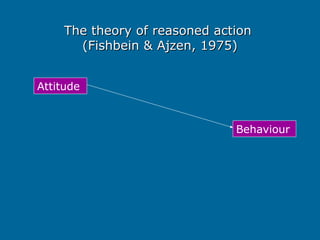
The theory of reasoned action
(Fishbein & Ajzen, 1975)
Attitude
Behaviour
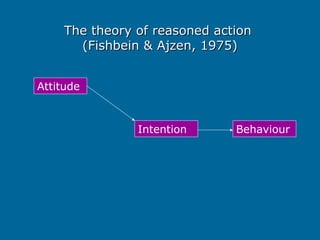
The theory of reasoned action
(Fishbein & Ajzen, 1975)
Attitude
Behaviour
Intention
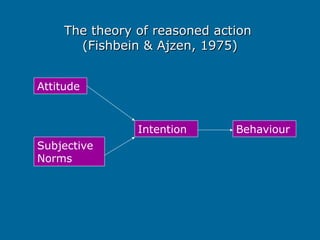
The theory of reasoned action
(Fishbein & Ajzen, 1975)
Attitude
Behaviour
Intention
Subjective
Norms
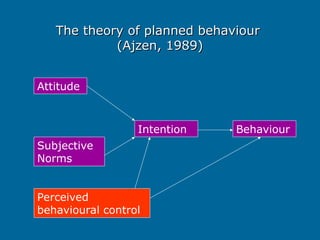
The theory of planned behaviour
(Ajzen, 1989)
(Ajzen, 1989)
Attitude
Behaviour
Intention
Subjective
Norms
Perceived
behavioural control
Attitudes + Behaviour: The full story
• Research using more complete models have provided a
better account of the attitude behaviour relationship:
• Attitudes are related to behaviours – but not directly.
• Attitudes affect behaviour - in combination with norms,
control beliefs, and intentions.
• In addition to being a theoretical improvement, this
approach has also proven to be very practical.
Summary
Summary
• Attitudes are evaluations
• Attitudes guide people’s behaviours…
sometimes
• Attitudes can change …
– but the same technique won’t work the
same way for all people all of the time
attitudes - attitudes - attitudes   .ppt

attitudes - attitudes - attitudes .ppt

  • 1.
    Readings: Smith &Mackie chapters 7 + 8 Attitudes Attitudes
  • 2.
    Attitudes in everydaylife Attitudes in everyday life
  • 3.
    Attitudes in everydaylife Attitudes in everyday life
  • 4.
    Attitudes in everydaylife Attitudes in everyday life
  • 5.
    What is anattitude? What is an attitude? A mental and neural state of readiness, organised through experience, exerting a directive or dynamic influence upon the individual’s response to all objects and situations with which it is related Allport, 1935 An attitude is a psychological tendency that is expressed by evaluating a particular entity with some degree of favour or disfavour Eagly & Chaiken, 1998
  • 6.
    Attitude structure Attitude structure Attitudesconsist of three related components: 1. An emotional component consisting of emotional reactions toward, or feelings about the attitude object. 2. A cognitive component consisting of thoughts and beliefs about the attitude object. 3. A behavioural component consisting of actions toward the attitude object.
  • 7.
    Imagine you’re buyinga car… Imagine you’re buying a car… It’s yellow… Hard to park… uses a lot of petrol.. I don’t think I’ll buy it.
  • 8.
    Imagine you’re buyinga car… Imagine you’re buying a car… It’s green! Zippy… Compact... I’d like a test drive, thanks.
  • 9.
    Where do attitudescome from? Where do attitudes come from? • Some attitudes seem to reflect stable, internal dispositions of the individual – i.e., ‘ways of seeing the world’ • Broad attitudinal dispositions might have a shared genetic basis (Tesser, 1993) • This is most likely for ‘gut-preferences’: – For example, feelings of disgust at certain smells or foods
  • 10.
    Where do attitudescome from? Where do attitudes come from? Most social psychologists agree that attitudes are formed on the basis of experiences. 1. Cognitively-based attitudes • People arrive at an attitudinal position after consideration of the relevant facts. 2. Affectively based attitudes • People form an association between some emotional state and the attitude object – e.g., conditioning, familiarity 3. Behaviourally based attitudes • People infer what that think by reflecting on what they do.
  • 11.
    Explicit V. ImplicitAttitudes Explicit V. Implicit Attitudes Once we have developed an attitude (an orientation to some object), this attitude can exist in a number of states: 1. Explicit attitudes: – The evaluations we consciously express. 2. Implicit attitudes: – Involuntary responses to the attitude object.
  • 12.
    Explicit Explicit How much doyou like the monarchy? Not at all 1 2 3 4 5 6 7 Very much
  • 13.
  • 14.
  • 15.
    Explicit V. ImplicitAttitudes Explicit V. Implicit Attitudes • Our explicitly expressed attitude and our implicit reactions can be the same thing. • But, there can also be a difference between what people say and what they think or believe • Raises questions about attitude measurement • Raises possibilities for studying attitudes
  • 16.
    Attitude function Attitude function Attitudeswill fluctuate in order to serve our current needs. Four major functions (Katz, 1960) and Smith et al. (1956): 1. Utilitarian function - Helps person to achieve rewards and gain approval from others (e.g., Nienhuis, Manstead, & Spears, 2001). 2. Knowledge function - Attitudes can be used as a “frame of reference” for organizing the world so that it makes sense (Katz, 1960). - For example, we perceive knowledge that contradicts our views with suspicion, thus forming a negative impression of that source of information (Giner-Sorolla & Chaiken, 1997).
  • 17.
    Attitude function Attitude function 3.Ego-defensive function - Helps to cope with emotional conflicts and protect and enhance one’s self-esteem. - E.g., one’s job not going well, can blame colleagues or his boss, this negative orientation towards the people he or she blames protects one from acknowledging painful truths. 4. Value-expressive function - Help to express central values and core aspects of self-concept. - For example, if you are a person who firmly believes in fair treatment and equality towards others, you’ll most likely have a positive attitude towards particular political parties and a negative attitude towards others.
  • 18.
    So, why aresocial psychologists So, why are social psychologists interested in attitudes? interested in attitudes? • People like to evaluate things. Attitudes are an important aspect of individual psychology. • The ways in which people evaluate their social world (e.g., other people) has important consequences for their relationships with and actions toward others. • The attitudes people have guide the decisions that they make, and therefore have important implications for the self.
  • 19.
    Attitudes + behaviour Attitudes+ behaviour • Part of the interest in attitudes is due to the assumption that people act in accordance with their attitudes: • Companies spend ridiculous amounts of money on advertising campaigns designed to change people’s attitudes toward their products. • Political parties closely monitor opinion polls to try and gauge the mood of the community and the likely outcome of elections. • Do attitudes really predict behaviour?
  • 20.
    Attitudes + behaviour Attitudes+ behaviour • In the early 1930’s Richard LaPiere (an American sociologist) went on a road trip with a young Chinese couple. • Expected to encounter many difficulties… • BUT, he didn’t
  • 21.
    Attitudes + behaviour Attitudes+ behaviour • After the trip, LaPiere wrote to all the establishments and asked them for their attitude about serving a Chinese visitor: • Of the 128 who responded, 92% said that they would NOT serve Chinese. • Suggests a gap between people’s attitudes and their actual behaviour
  • 22.
    Attitudes + behaviour Attitudes+ behaviour • Later research confirmed the gap: – E.g., Wicker (1969) reviewed research on the attitude-behaviour link – Although the two were usually positively related, the relationship was typically small (average r = .15). • Evidence for weak relationships between attitudes and behaviour prompted 2 responses: 1. Attitudes are a load of rubbish! 2. Attitudes are related to behaviour, but the relationship is more complex
  • 23.
    Attitudes + behaviour:The full story Attitudes + behaviour: The full story 1. Not all attitudes should be related to behaviour: • Specific attitudes should predict behaviour better then general attitudes • Strong (accessible) attitudes should predict behaviour better than weak attitudes. 2. Other variables are involved in the attitude- behaviour relationship
  • 24.
    The theory ofreasoned action The theory of reasoned action (Fishbein & Ajzen, 1975) (Fishbein & Ajzen, 1975) Attitude Behaviour
  • 25.
    The theory ofreasoned action The theory of reasoned action (Fishbein & Ajzen, 1975) (Fishbein & Ajzen, 1975) Attitude Behaviour Intention
  • 26.
    The theory ofreasoned action The theory of reasoned action (Fishbein & Ajzen, 1975) (Fishbein & Ajzen, 1975) Attitude Behaviour Intention Subjective Norms
  • 27.
    The theory ofplanned behaviour The theory of planned behaviour (Ajzen, 1989) (Ajzen, 1989) Attitude Behaviour Intention Subjective Norms Perceived behavioural control
  • 28.
    Attitudes + Behaviour:The full story Attitudes + Behaviour: The full story • Research using more complete models have provided a better account of the attitude behaviour relationship: • Attitudes are related to behaviours – but not directly. • Attitudes affect behaviour - in combination with norms, control beliefs, and intentions. • In addition to being a theoretical improvement, this approach has also proven to be very practical.
  • 29.
    Summary Summary • Attitudes areevaluations • Attitudes guide people’s behaviours… sometimes • Attitudes can change … – but the same technique won’t work the same way for all people all of the time

Editor's Notes