CHAPTER TWO
Foundation of Individual
Behavior in an Organization
CHAPTER
TWO
By: Biruk T.
I. Perception,
Attribution,
and Individual
Decision
Making
INDIVIDUAL BEHAVIOR
Individual Behavior
Behavior refers to the response made by the individual. The
response may be the result of influence of external factors.
The external factor is termed as stimulus and the action taken by
the individual is known as response.
Both heredity and environment determine the behavior of an
individual.
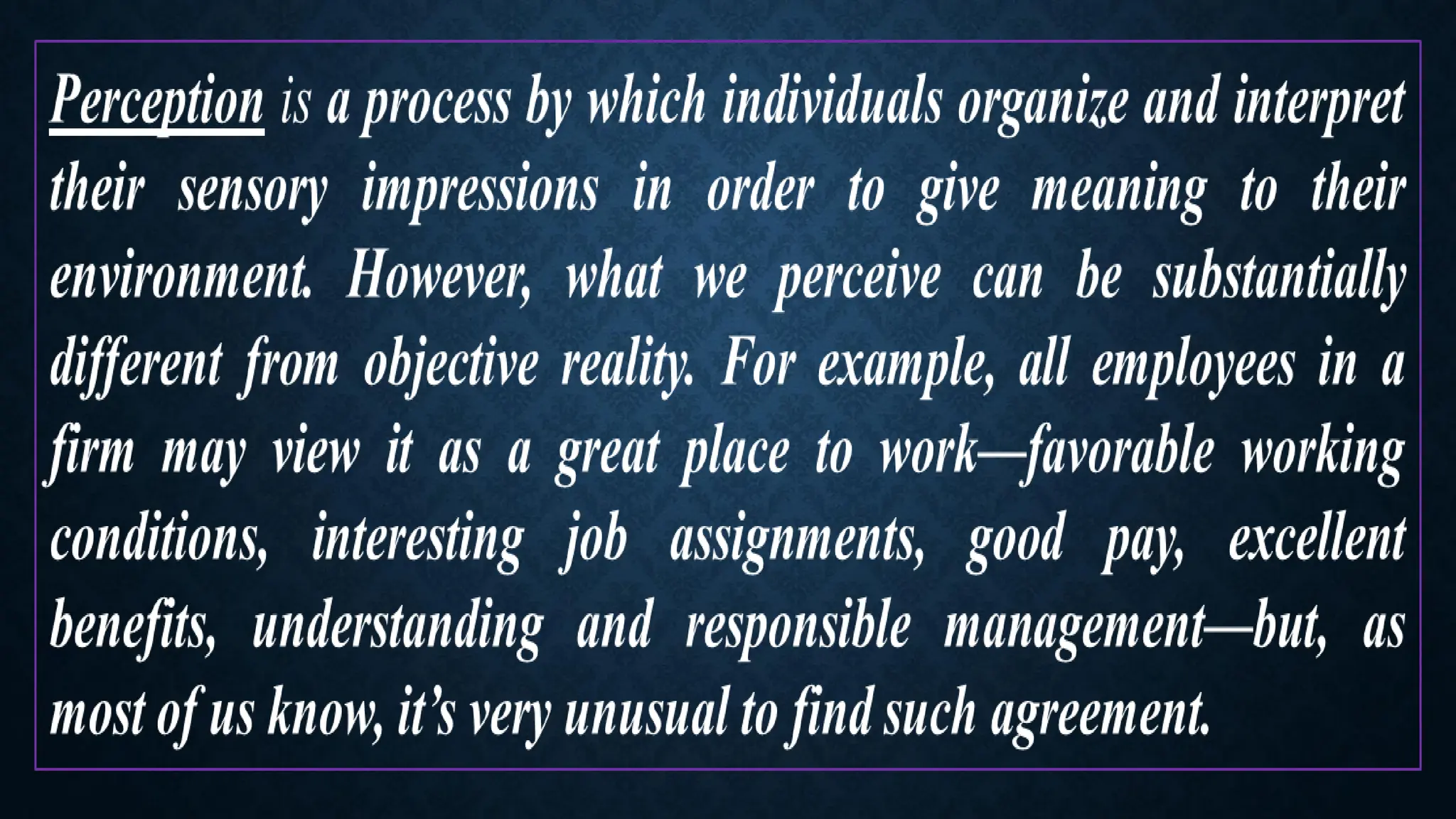
Perception
A process by
which individuals
organize and
interpret their
sensory
impressions in
order to give
meaning to their
environment
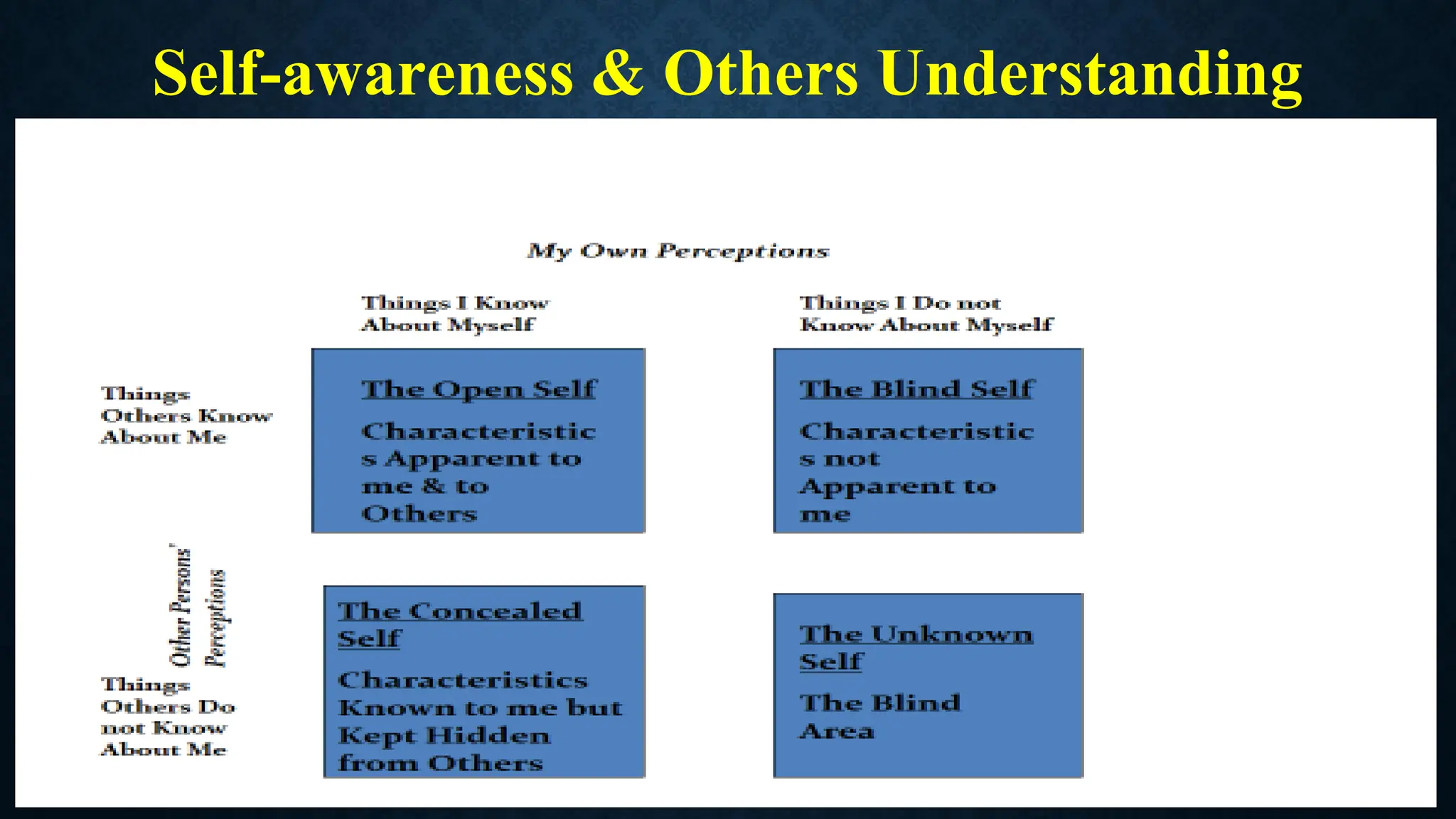
Self-awareness & Others Understanding
Attribution Theory: Judging Others
 Our perception and judgment of others is significantly influenced by
our assumptions of the other person’s internal state.
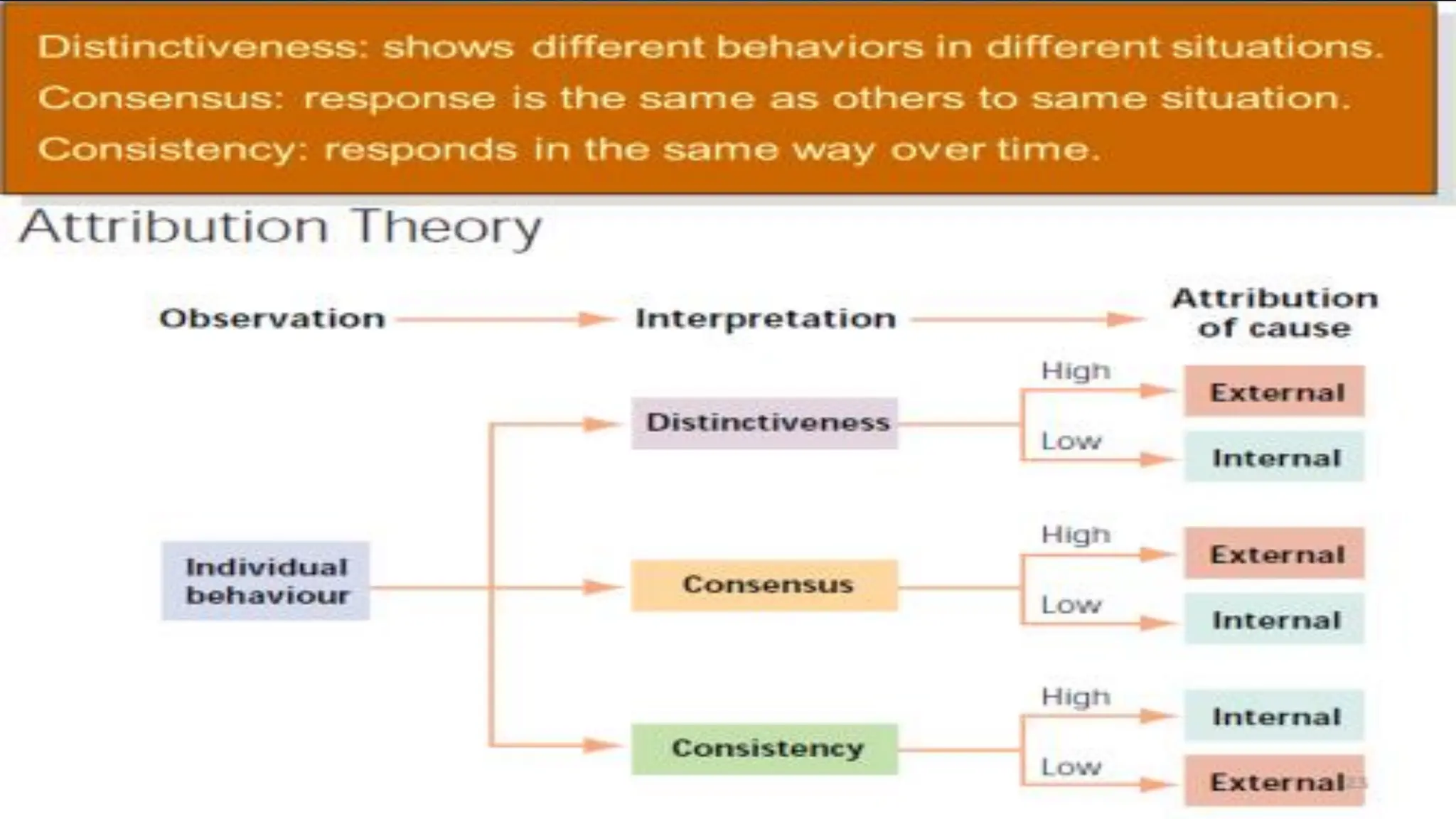
– When individuals observe behavior, they attempt to determine whether it
is internally or externally caused.
• Internal causes are under that person’s control
• External causes are not under the person’s control
Errors and Biases in Attributions
Fundamental Attribution Error
– The tendency to underestimate the influence of external
factors and overestimate the influence of internal factors
when making judgments about the behavior of others
– We blame people first, not the situation
Barriers to Accurate Perception
1. Similar-to-me effect or projection
2. Selective perceptions
3. Halo effect
4. Contrast effects
5. Stereotyping
6. Primacy effect
7. Recency effect
8. Distortion
2.Selective Perception
It is a tendency to observe people selectively and accordingly interpret based on
their interest, background, experience and attitudes. For example, a production
manager is always likely to identify the need to strengthen the production
system; the marketing manager will focus only on the marketing research and
sales promotions activities.
3. Halo Effect
3. Halo Effect:
It is tendency to draw a general overall impression about an individual based on
single striking characteristics. For instance, if a person speaks English fluently,
we tend to assume that that person is very knowledgeable, intelligent, smart,
clever etc. hard working, smart etc.
4. CONTRAST EFFECT
◦Evaluation of a person’s characteristics that are affected by comparisons
with other people recently encountered who rank higher or lower on the
same characteristics
◦Contrast effect is an unconscious bias that happens when two
things are judged in comparison to one another, instead of being
assessed individually.
5. Stereotyping
Stereotyping
Judging someone on the basis of one’s perception of the
group to which that person belongs.
CONT..
• For example we generally perceive man as executive
and woman as secretary even if the situation may be
different.
• For example, category of teenagers would generally be
independent, indiscipline and so on. In reality this may not
be true. Similarly we attach positive attribute to judges,
professors and doctors and negative attributes to school
dropouts, addicts although they may not be really so.
6.Projection
6. Projection
Attributing one’s own characteristics to other people- can
distort perceptions made about others. It is easy to judge others if we
assume that they are similar to us.
Learning
Individual Behavior
• Learning
–Any relatively permanent
change in behavior that occurs
as a result of experience.
•Involves change
•Is relatively permanent
•Is acquired through experience
27
Cont………
• Learning brings relatively permanent
change in human behavior that occurs as a
result of experience.
• All complex behavior is a learned behavior.
• If we want to predict and explain behavior,
we must understand how people learn.
• It is continuous process, which occurs all
the time.
• We cannot see learning but we can see
changed behavior as a consequence of
learning.
28
29
30
31
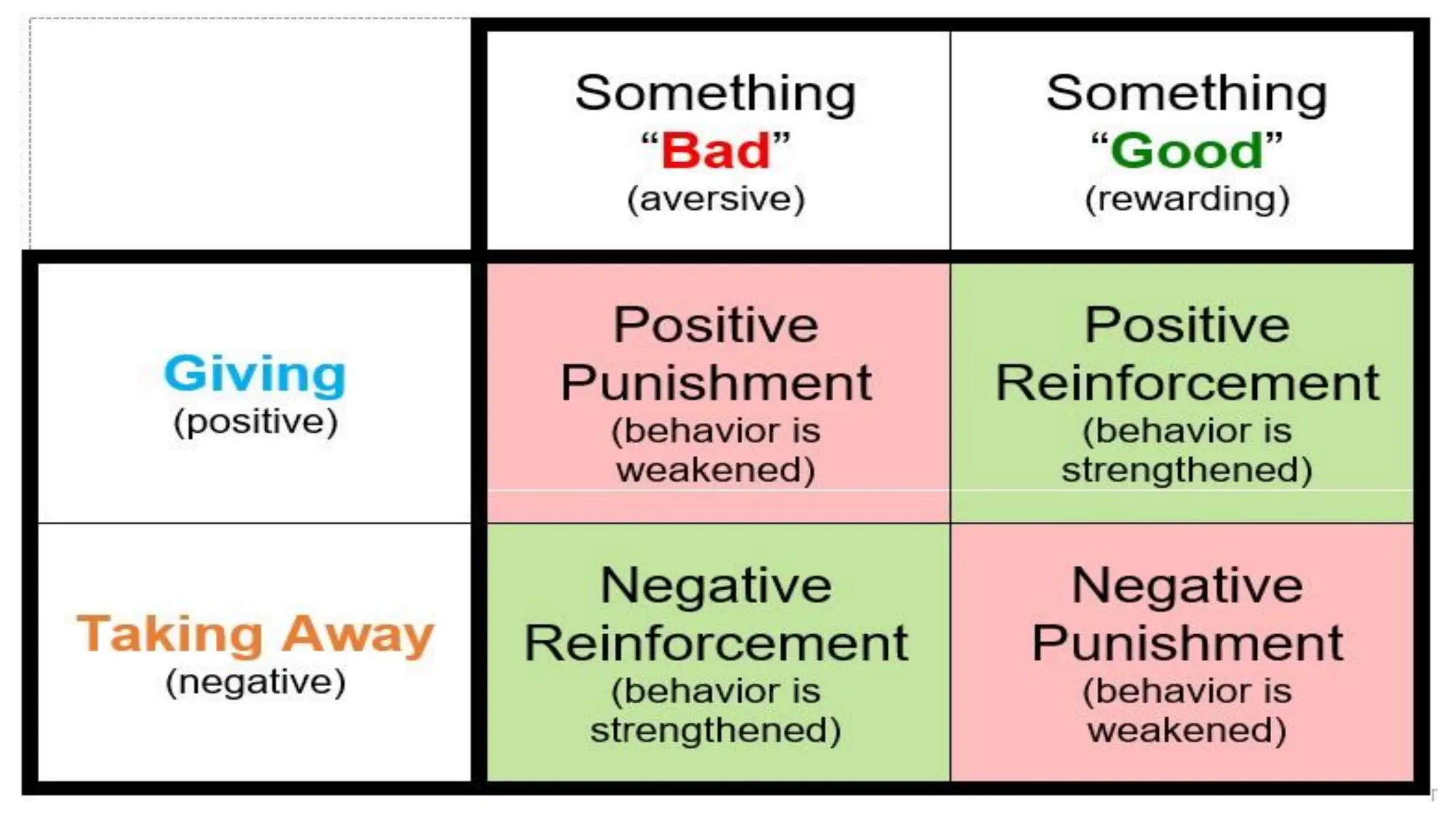
OPERANT CONDITIONING
• Operant conditioning, sometimes referred to as instrumental
conditioning, is a method of learning that
uses rewards and punishment to modify behavior. Through
operant conditioning, behavior that is rewarded is likely to be
repeated, and behavior that is punished will rarely occur.
• For example, when you are rewarded at work with a
performance bonus for exceptional work, you will be inclined to
continue performing at a higher level in hopes of receiving
another bonus in the future. Because this behavior was
followed by a positive outcome, the behavior will likely be
repeated.
32
33
34
35
36
37
38
39
40
ORGANIZATIONAL BEHAVIOR
S T E P H E N P. R O B B I N S
E L E V E N T H E D I T I O N
W W W . P R E N H A L L . C O M / R O B B I N S
© 2005 Prentice Hall Inc.
All rights reserved.
PowerPoint Presentation
by Charlie Cook
Attitudes, and Job
Satisfaction
INDIVIDUAL BEHAVIOUR…..
Attitudes
• Attitudes are positive or negative feelings concerning
objects, people, or events
• Attitudes are thus responses to situations.
• An attitude can be defined as a predisposition to respond in a favorable or unfavorable way
to objects or persons in one's environment. When we like or dislike something, we are, in
effect, expressing our attitude toward the person or object.
• An Attitude a mental position with regard to a fact or state. a helpful attitude.
: a feeling or emotion toward a fact or state. a negative attitude. an optimistic
attitude
COMPONENTS OF ATTITUDE
1. Cognitive component
– The opinion or belief
segment of an attitude.
– It consists of belief, ideas,
values and other
information that an
individual may possess or
has faith in.
– Ex. “I believe spiders are
dangerous.”
2. Affective Component
– The emotional or feeling
segment of an attitude.
– is related to person’s feelings
about another person, which
may be positive, negative or
neutral..
– It is an expression of feelings
about a person, object or a
situation.
– Ex. “ I love Chocolet”
3. Behavioral Component
– An intention to behave in a certain way toward someone or
something.
– is related to impact of various situations or objects that lead to
individual’s behavior based on cognitive and affective components.
– Cognitive and affective components are bases for such behavior.
– Former two components cannot be seen; only the behavior
component can be seen.
– Former is important because it is a base for formation of attitude.
– EX.“I will avoid spiders and scream if I see one.”
EXAMPLE
Types of Attitudes
• Job Satisfaction
– A collection of positive and/or negative feelings that an
individual holds toward his or her job.
– An individual’s general attitude toward his or her job.
– A person having a high level of satisfaction will generally hold
a positive attitude while dissatisfied people will generally
display negative attitude towards life.
49
Types of Attitudes
• Job Involvement
– Identifying with the job, actively participating in it, and considering
performance important to self-worth.
– Employees with a high level of job involvement strongly identify
with and really care about the kind of work they do.
– High levels of job involvement have been found to be related to
fewer absences and lower resignation rates (turnover).
50
Types of Attitudes
• Organizational Commitment
– Identifying with a particular organization and its goals, and wishing to
maintain membership in the organization
– Affective, Normative, and Continuance Commitment
• High organizational commitment
–Increase productivity and job
satisfaction
–Minimize absenteeism and turnover
–Make better work place relation
51
Why are some people quiet and passive,
while others are loud and aggressive?
52
To be continuous……..
53

Organization Behaviour CHAPTER TWO PPT.pdf

  • 1.
    CHAPTER TWO Foundation ofIndividual Behavior in an Organization CHAPTER TWO By: Biruk T.
  • 2.
  • 3.
  • 5.
    Individual Behavior Behavior refersto the response made by the individual. The response may be the result of influence of external factors. The external factor is termed as stimulus and the action taken by the individual is known as response. Both heredity and environment determine the behavior of an individual.
  • 6.
    Perception A process by whichindividuals organize and interpret their sensory impressions in order to give meaning to their environment
  • 8.
  • 10.
    Attribution Theory: JudgingOthers  Our perception and judgment of others is significantly influenced by our assumptions of the other person’s internal state. – When individuals observe behavior, they attempt to determine whether it is internally or externally caused. • Internal causes are under that person’s control • External causes are not under the person’s control
  • 11.
    Errors and Biasesin Attributions Fundamental Attribution Error – The tendency to underestimate the influence of external factors and overestimate the influence of internal factors when making judgments about the behavior of others – We blame people first, not the situation
  • 14.
    Barriers to AccuratePerception 1. Similar-to-me effect or projection 2. Selective perceptions 3. Halo effect 4. Contrast effects 5. Stereotyping 6. Primacy effect 7. Recency effect 8. Distortion
  • 16.
    2.Selective Perception 2.Selective Perception Itis a tendency to observe people selectively and accordingly interpret based on their interest, background, experience and attitudes. For example, a production manager is always likely to identify the need to strengthen the production system; the marketing manager will focus only on the marketing research and sales promotions activities.
  • 18.
    3. Halo Effect 3.Halo Effect: It is tendency to draw a general overall impression about an individual based on single striking characteristics. For instance, if a person speaks English fluently, we tend to assume that that person is very knowledgeable, intelligent, smart, clever etc. hard working, smart etc.
  • 19.
  • 20.
    ◦Evaluation of aperson’s characteristics that are affected by comparisons with other people recently encountered who rank higher or lower on the same characteristics ◦Contrast effect is an unconscious bias that happens when two things are judged in comparison to one another, instead of being assessed individually.
  • 21.
    5. Stereotyping Stereotyping Judging someoneon the basis of one’s perception of the group to which that person belongs.
  • 22.
    CONT.. • For examplewe generally perceive man as executive and woman as secretary even if the situation may be different. • For example, category of teenagers would generally be independent, indiscipline and so on. In reality this may not be true. Similarly we attach positive attribute to judges, professors and doctors and negative attributes to school dropouts, addicts although they may not be really so.
  • 23.
    6.Projection 6. Projection Attributing one’sown characteristics to other people- can distort perceptions made about others. It is easy to judge others if we assume that they are similar to us.
  • 25.
  • 27.
    • Learning –Any relativelypermanent change in behavior that occurs as a result of experience. •Involves change •Is relatively permanent •Is acquired through experience 27
  • 28.
    Cont……… • Learning bringsrelatively permanent change in human behavior that occurs as a result of experience. • All complex behavior is a learned behavior. • If we want to predict and explain behavior, we must understand how people learn. • It is continuous process, which occurs all the time. • We cannot see learning but we can see changed behavior as a consequence of learning. 28
  • 29.
  • 30.
  • 31.
  • 32.
    OPERANT CONDITIONING • Operantconditioning, sometimes referred to as instrumental conditioning, is a method of learning that uses rewards and punishment to modify behavior. Through operant conditioning, behavior that is rewarded is likely to be repeated, and behavior that is punished will rarely occur. • For example, when you are rewarded at work with a performance bonus for exceptional work, you will be inclined to continue performing at a higher level in hopes of receiving another bonus in the future. Because this behavior was followed by a positive outcome, the behavior will likely be repeated. 32
  • 33.
  • 34.
  • 35.
  • 36.
  • 37.
  • 38.
  • 39.
  • 40.
  • 41.
    ORGANIZATIONAL BEHAVIOR S TE P H E N P. R O B B I N S E L E V E N T H E D I T I O N W W W . P R E N H A L L . C O M / R O B B I N S © 2005 Prentice Hall Inc. All rights reserved. PowerPoint Presentation by Charlie Cook Attitudes, and Job Satisfaction INDIVIDUAL BEHAVIOUR…..
  • 43.
    Attitudes • Attitudes arepositive or negative feelings concerning objects, people, or events • Attitudes are thus responses to situations. • An attitude can be defined as a predisposition to respond in a favorable or unfavorable way to objects or persons in one's environment. When we like or dislike something, we are, in effect, expressing our attitude toward the person or object. • An Attitude a mental position with regard to a fact or state. a helpful attitude. : a feeling or emotion toward a fact or state. a negative attitude. an optimistic attitude
  • 44.
  • 45.
    COMPONENTS OF ATTITUDE 1.Cognitive component – The opinion or belief segment of an attitude. – It consists of belief, ideas, values and other information that an individual may possess or has faith in. – Ex. “I believe spiders are dangerous.” 2. Affective Component – The emotional or feeling segment of an attitude. – is related to person’s feelings about another person, which may be positive, negative or neutral.. – It is an expression of feelings about a person, object or a situation. – Ex. “ I love Chocolet”
  • 46.
    3. Behavioral Component –An intention to behave in a certain way toward someone or something. – is related to impact of various situations or objects that lead to individual’s behavior based on cognitive and affective components. – Cognitive and affective components are bases for such behavior. – Former two components cannot be seen; only the behavior component can be seen. – Former is important because it is a base for formation of attitude. – EX.“I will avoid spiders and scream if I see one.”
  • 47.
  • 49.
    Types of Attitudes •Job Satisfaction – A collection of positive and/or negative feelings that an individual holds toward his or her job. – An individual’s general attitude toward his or her job. – A person having a high level of satisfaction will generally hold a positive attitude while dissatisfied people will generally display negative attitude towards life. 49
  • 50.
    Types of Attitudes •Job Involvement – Identifying with the job, actively participating in it, and considering performance important to self-worth. – Employees with a high level of job involvement strongly identify with and really care about the kind of work they do. – High levels of job involvement have been found to be related to fewer absences and lower resignation rates (turnover). 50
  • 51.
    Types of Attitudes •Organizational Commitment – Identifying with a particular organization and its goals, and wishing to maintain membership in the organization – Affective, Normative, and Continuance Commitment • High organizational commitment –Increase productivity and job satisfaction –Minimize absenteeism and turnover –Make better work place relation 51
  • 52.
    Why are somepeople quiet and passive, while others are loud and aggressive? 52
  • 53.