MENTAL HEALTH & ILLNESS
CHARACTERISTICS OF MENTALLY
HEALTHY &ILL
AND
PSYCHOLOGICAL PROBLEMS OF
PATIENTS & RELATIVES
BY
LORITA FURTADO
MENTAL HEALTH
• It is a state of balance between the individual & the
surrounding world, a state of harmony between oneself
& others, co-existence between the realities of the self &
that of other people.
• DEFINITION
“An adjustment of human beings to the world & to each
other with a maximum of effectiveness & happiness.”- Karl
Menninger
COMPONENTS OF MENTALHEALTH
• The ability to
 Accept self
 Fulfill life’s tasks
 Feel right towards others
CRITERIA FOR MENTAL HEALTH
Adequate contact with reality
Control of thoughts & imagination
Efficiency in work & play
Social acceptance
Positive self-concept
A healthy emotional life.
INDICATORS OF MENTAL HEALTH
• A positive attitude towards self
• Integration growth, development & the ability for self-
actualization
• Autonomy
• Environmental mastery
• Perception of reality
CHARACTERISTICS OF A MENTALLY
HEALTHY PERSON
• Ability to make adjustments.
• Has a sense of personal worth, feels worthwhile & important.
• Solves his problems largely by his own effort & make his own
decisions.
• Has a sense of personal security & feels secure in a group, shows
understanding of other people’ s problems & motives.
• Has a sense of responsibility.
• Can give & accept love.
• Lives in a world of reality rather than fantasy.
• Shows emotional maturity in his behavior, and develops a capacity
to tolerate frustration & disappointments in his daily life.
• Has developed a philosophy of life that gives meaning & purpose to
his daily activities.
• Has a variety of interests & generally lives a well-balanced life of
work, rest & recreation.
MENTAL ILLNESS
Mental illness is maladjustment in living. It produces a
disharmony in the person’ s ability to meet human needs
comfortably or effectively & function within a culture.
Definition
Clinically significant conditions characterized by alterations
in thinking, mood (emotions) or behavior associated with
personal distress or impaired functioning.-WHO
CHARACTERISTICS OF MENTALLY ILL
• Changes in one’s thinking, memory, perception, feeling &
judgment resulting in changes in talk & behavior which
appear to be deviant from previous personality or from
the norms of community.
• These changes in behavior cause distress & suffering to
the individual or others or both.
• Changes & the consequent distress cause disturbance
in day to day activities, work & relationship with
important others.(social & vocational dysfunction).
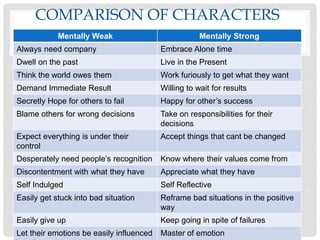
COMPARISON OF CHARACTERS
Mentally Weak Mentally Strong
Always need company Embrace Alone time
Dwell on the past Live in the Present
Think the world owes them Work furiously to get what they want
Demand Immediate Result Willing to wait for results
Secretly Hope for others to fail Happy for other’s success
Blame others for wrong decisions Take on responsibilities for their
decisions
Expect everything is under their
control
Accept things that cant be changed
Desperately need people’s recognition Know where their values come from
Discontentment with what they have Appreciate what they have
Self Indulged Self Reflective
Easily get stuck into bad situation Reframe bad situations in the positive
way
Easily give up Keep going in spite of failures
Let their emotions be easily influenced Master of emotion
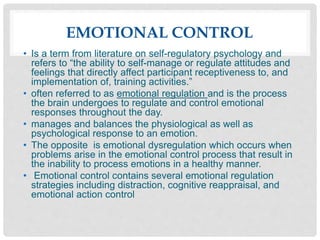
EMOTIONAL CONTROL
• Is a term from literature on self-regulatory psychology and
refers to “the ability to self-manage or regulate attitudes and
feelings that directly affect participant receptiveness to, and
implementation of, training activities.”
• often referred to as emotional regulation and is the process
the brain undergoes to regulate and control emotional
responses throughout the day.
• manages and balances the physiological as well as
psychological response to an emotion.
• The opposite is emotional dysregulation which occurs when
problems arise in the emotional control process that result in
the inability to process emotions in a healthy manner.
• Emotional control contains several emotional regulation
strategies including distraction, cognitive reappraisal, and
emotional action control
PSYCHOLOGY OF PATIENTS AND
RELATIVES
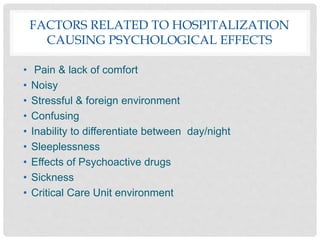
FACTORS RELATED TO HOSPITALIZATION
CAUSING PSYCHOLOGICAL EFFECTS
• Pain & lack of comfort
• Noisy
• Stressful & foreign environment
• Confusing
• Inability to differentiate between day/night
• Sleeplessness
• Effects of Psychoactive drugs
• Sickness
• Critical Care Unit environment
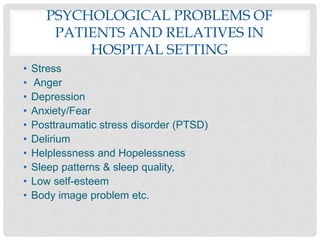
PSYCHOLOGICAL PROBLEMS OF
PATIENTS AND RELATIVES IN
HOSPITAL SETTING
• Stress
• Anger
• Depression
• Anxiety/Fear
• Posttraumatic stress disorder (PTSD)
• Delirium
• Helplessness and Hopelessness
• Sleep patterns & sleep quality,
• Low self-esteem
• Body image problem etc.
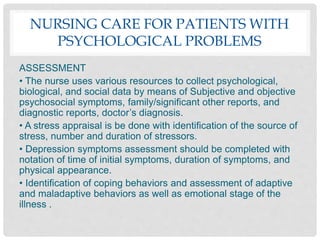
NURSING CARE FOR PATIENTS WITH
PSYCHOLOGICAL PROBLEMS
ASSESSMENT
• The nurse uses various resources to collect psychological,
biological, and social data by means of Subjective and objective
psychosocial symptoms, family/significant other reports, and
diagnostic reports, doctor’s diagnosis.
• A stress appraisal is be done with identification of the source of
stress, number and duration of stressors.
• Depression symptoms assessment should be completed with
notation of time of initial symptoms, duration of symptoms, and
physical appearance.
• Identification of coping behaviors and assessment of adaptive
and maladaptive behaviors as well as emotional stage of the
illness .
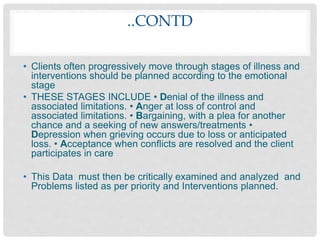
..CONTD
• Clients often progressively move through stages of illness and
interventions should be planned according to the emotional
stage
• THESE STAGES INCLUDE • Denial of the illness and
associated limitations. • Anger at loss of control and
associated limitations. • Bargaining, with a plea for another
chance and a seeking of new answers/treatments •
Depression when grieving occurs due to loss or anticipated
loss. • Acceptance when conflicts are resolved and the client
participates in care
• This Data must then be critically examined and analyzed and
Problems listed as per priority and Interventions planned.
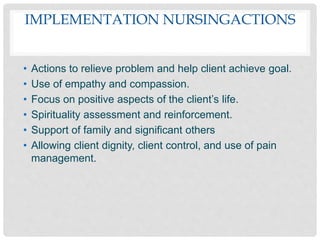
IMPLEMENTATION NURSINGACTIONS
• Actions to relieve problem and help client achieve goal.
• Use of empathy and compassion.
• Focus on positive aspects of the client’s life.
• Spirituality assessment and reinforcement.
• Support of family and significant others
• Allowing client dignity, client control, and use of pain
management.
REFERENCES
• https://www.slideshare.net/search/slideshow?searchfrom
=header&q=characteristics+of+mentally+healthy+by+jasl
een&ud=any&ft=all&lang=**&sort=
• https://www.slideshare.net/sivaprasathtr/characteristics-
of-mentally-healthy-person-82391759?qid=f9bd10f6-
17f2-4d79-b426-c35d4a4104ca&v=&b=&from_search=3
• https://en.wikipedia.org/wiki/Control_(psychology)
• https://www.slideshare.net/marsyad/psychological-
problems-patients-in-critical-care-unit
Thank You