Simple Mail Transfer Protocol
Prepared By: Ali A. Obaid
Ramadhan S. Ramadhan
2017
Overview
 Introduction
 Message Breakdown
 Sending Messages
 Extensions
 Retrieving mail (Mailbox Protocols)
 Examples
Introduction
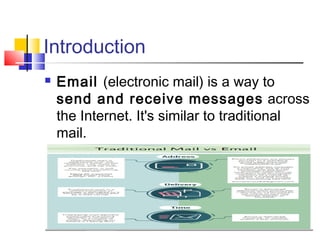
 Email (electronic mail) is a way to
send and receive messages across
the Internet. It's similar to traditional
mail.
Email Statistics
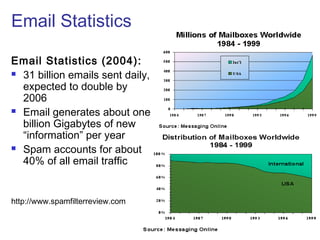
Email Statistics (2004):
 31 billion emails sent daily,
expected to double by
2006
 Email generates about one
billion Gigabytes of new
“information” per year
 Spam accounts for about
40% of all email traffic
http://www.spamfilterreview.com
SMTP
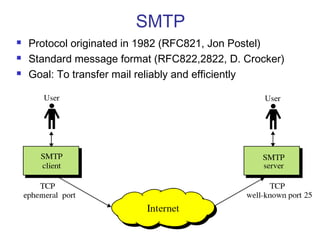
 Protocol originated in 1982 (RFC821, Jon Postel)
 Standard message format (RFC822,2822, D. Crocker)
 Goal: To transfer mail reliably and efficiently
SMTP
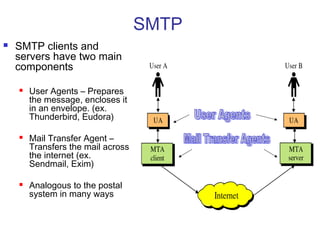
 SMTP clients and
servers have two main
components
 User Agents – Prepares
the message, encloses it
in an envelope. (ex.
Thunderbird, Eudora)
 Mail Transfer Agent –
Transfers the mail across
the internet (ex.
Sendmail, Exim)
 Analogous to the postal
system in many ways
SMTP
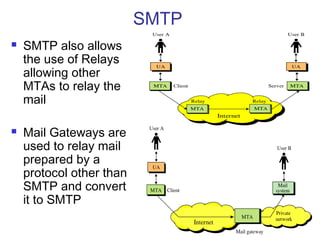
 SMTP also allows
the use of Relays
allowing other
MTAs to relay the
mail
 Mail Gateways are
used to relay mail
prepared by a
protocol other than
SMTP and convert
it to SMTP
Format of an email
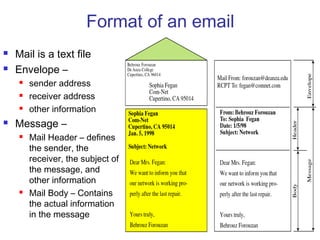
 Mail is a text file
 Envelope –
 sender address
 receiver address
 other information
 Message –
 Mail Header – defines
the sender, the
receiver, the subject of
the message, and
other information
 Mail Body – Contains
the actual information
in the message
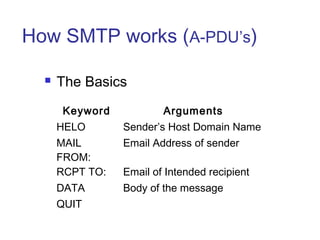
How SMTP works (A-PDU’s)
 The Basics
Keyword Arguments
HELO Sender’s Host Domain Name
MAIL
FROM:
Email Address of sender
RCPT TO: Email of Intended recipient
DATA Body of the message
QUIT
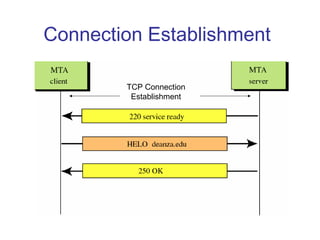
Connection Establishment
TCP Connection
Establishment
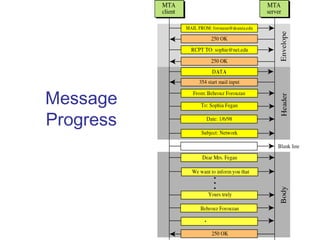
Message
Progress
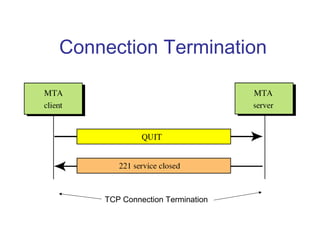
Connection Termination
TCP Connection Termination
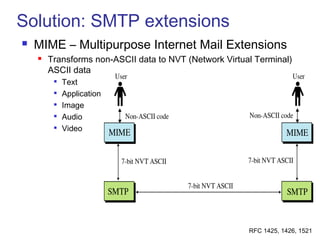
Solution: SMTP extensions
 MIME – Multipurpose Internet Mail Extensions
 Transforms non-ASCII data to NVT (Network Virtual Terminal)
ASCII data

Text

Application

Image

Audio

Video
RFC 1425, 1426, 1521
Any
Questions ?

Smtp protocol

  • 1.
    Simple Mail TransferProtocol Prepared By: Ali A. Obaid Ramadhan S. Ramadhan 2017
  • 2.
    Overview  Introduction  MessageBreakdown  Sending Messages  Extensions  Retrieving mail (Mailbox Protocols)  Examples
  • 3.
    Introduction  Email (electronicmail) is a way to send and receive messages across the Internet. It's similar to traditional mail.
  • 4.
    Email Statistics Email Statistics(2004):  31 billion emails sent daily, expected to double by 2006  Email generates about one billion Gigabytes of new “information” per year  Spam accounts for about 40% of all email traffic http://www.spamfilterreview.com
  • 5.
    SMTP  Protocol originatedin 1982 (RFC821, Jon Postel)  Standard message format (RFC822,2822, D. Crocker)  Goal: To transfer mail reliably and efficiently
  • 6.
    SMTP  SMTP clientsand servers have two main components  User Agents – Prepares the message, encloses it in an envelope. (ex. Thunderbird, Eudora)  Mail Transfer Agent – Transfers the mail across the internet (ex. Sendmail, Exim)  Analogous to the postal system in many ways
  • 7.
    SMTP  SMTP alsoallows the use of Relays allowing other MTAs to relay the mail  Mail Gateways are used to relay mail prepared by a protocol other than SMTP and convert it to SMTP
  • 8.
    Format of anemail  Mail is a text file  Envelope –  sender address  receiver address  other information  Message –  Mail Header – defines the sender, the receiver, the subject of the message, and other information  Mail Body – Contains the actual information in the message
  • 9.
    How SMTP works(A-PDU’s)  The Basics Keyword Arguments HELO Sender’s Host Domain Name MAIL FROM: Email Address of sender RCPT TO: Email of Intended recipient DATA Body of the message QUIT
  • 10.
  • 11.
  • 12.
  • 13.
    Solution: SMTP extensions MIME – Multipurpose Internet Mail Extensions  Transforms non-ASCII data to NVT (Network Virtual Terminal) ASCII data  Text  Application  Image  Audio  Video RFC 1425, 1426, 1521
  • 14.

Editor's Notes

  • #2 http://www.spamfilterreview.com/spam-statistics.html, stats about spam