By:- BHAWANA SRIVASTAVA
 Email is emerging as one of the most
valuable services on the internet today. Most
of the internet systems use SMTP as a
method to transfer mail from one user to
another.
 SMTP is a push protocol and is used to send
the mail whereas POP (post office protocol)
or IMAP (internet message access protocol)
are used to retrieve those mails at the
receiver’s side.
 SMTP is an application layer protocol. The
client who wants to send the mail opens a
TCP connection to the SMTP server and then
sends the mail across the connection.
 The SMTP server is always on listening mode.
As soon as it listens for a TCP connection
from any client, the SMTP process initiates a
connection on that port (25).
 After successfully establishing the TCP
connection the client process sends the mail
instantly.
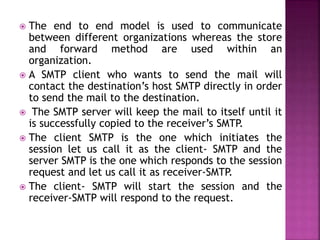
 The SMTP model is of two type
1. End-to- end method
2. Store-and- forward method
 The end to end model is used to communicate
between different organizations whereas the store
and forward method are used within an
organization.
 A SMTP client who wants to send the mail will
contact the destination’s host SMTP directly in order
to send the mail to the destination.
 The SMTP server will keep the mail to itself until it
is successfully copied to the receiver’s SMTP.
 The client SMTP is the one which initiates the
session let us call it as the client- SMTP and the
server SMTP is the one which responds to the session
request and let us call it as receiver-SMTP.
 The client- SMTP will start the session and the
receiver-SMTP will respond to the request.
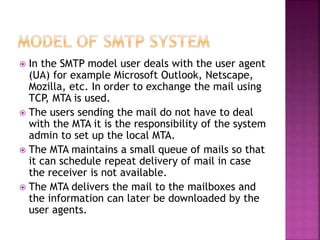
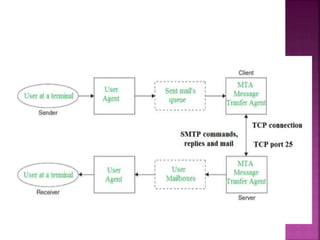
 In the SMTP model user deals with the user agent
(UA) for example Microsoft Outlook, Netscape,
Mozilla, etc. In order to exchange the mail using
TCP, MTA is used.
 The users sending the mail do not have to deal
with the MTA it is the responsibility of the system
admin to set up the local MTA.
 The MTA maintains a small queue of mails so that
it can schedule repeat delivery of mail in case
the receiver is not available.
 The MTA delivers the mail to the mailboxes and
the information can later be downloaded by the
user agents.
 Both the SMTP-client and SMTP-server
should have 2 components:
1. User agent (UA)
2. Local MTA
 The senders, user agent prepare the message
and send it to the MTA. The MTA functioning
is to transfer the mail across the network to
the receivers MTA. To send mail, a system
must have the client MTA, and to receive
mail, a system must have a server MTA.
 Mail is sent by a series of request and
response messages between the client and a
server.
 The message which is sent across consists of
a header and the body.
 A null line is used to terminate the mail
header. Everything which is after the null
line is considered as the body of the message
which is a sequence of ASCII characters.
 The message body contains the actual
information read by the receipt.
 The user agent at the server-side checks the
mailboxes at a particular time of intervals.
 If any information is received it informs the
user about the mail.
 When the user tries to read the mail it
displays a list of mails with a short
description of each mail in the mailbox.
 By selecting any of the mail user can view its
contents on the terminal.
 HELO – Identifies the client to the server,
fully qualified domain name, only sent once
per session
 MAIL – Initiate a message transfer, fully
qualified domain of originator
 RCPT – Follows MAIL, identifies an addressee,
typically the fully qualified name of the
addressee and for multiple addressees use
one RCPT for each addressee
 DATA – send data line by line
Simple mail transfer protocol (smtp)

Simple mail transfer protocol (smtp)

  • 1.
  • 2.
     Email isemerging as one of the most valuable services on the internet today. Most of the internet systems use SMTP as a method to transfer mail from one user to another.  SMTP is a push protocol and is used to send the mail whereas POP (post office protocol) or IMAP (internet message access protocol) are used to retrieve those mails at the receiver’s side.
  • 3.
     SMTP isan application layer protocol. The client who wants to send the mail opens a TCP connection to the SMTP server and then sends the mail across the connection.  The SMTP server is always on listening mode. As soon as it listens for a TCP connection from any client, the SMTP process initiates a connection on that port (25).  After successfully establishing the TCP connection the client process sends the mail instantly.
  • 4.
     The SMTPmodel is of two type 1. End-to- end method 2. Store-and- forward method
  • 5.
     The endto end model is used to communicate between different organizations whereas the store and forward method are used within an organization.  A SMTP client who wants to send the mail will contact the destination’s host SMTP directly in order to send the mail to the destination.  The SMTP server will keep the mail to itself until it is successfully copied to the receiver’s SMTP.  The client SMTP is the one which initiates the session let us call it as the client- SMTP and the server SMTP is the one which responds to the session request and let us call it as receiver-SMTP.  The client- SMTP will start the session and the receiver-SMTP will respond to the request.
  • 6.
     In theSMTP model user deals with the user agent (UA) for example Microsoft Outlook, Netscape, Mozilla, etc. In order to exchange the mail using TCP, MTA is used.  The users sending the mail do not have to deal with the MTA it is the responsibility of the system admin to set up the local MTA.  The MTA maintains a small queue of mails so that it can schedule repeat delivery of mail in case the receiver is not available.  The MTA delivers the mail to the mailboxes and the information can later be downloaded by the user agents.
  • 8.
     Both theSMTP-client and SMTP-server should have 2 components: 1. User agent (UA) 2. Local MTA
  • 9.
     The senders,user agent prepare the message and send it to the MTA. The MTA functioning is to transfer the mail across the network to the receivers MTA. To send mail, a system must have the client MTA, and to receive mail, a system must have a server MTA.
  • 10.
     Mail issent by a series of request and response messages between the client and a server.  The message which is sent across consists of a header and the body.  A null line is used to terminate the mail header. Everything which is after the null line is considered as the body of the message which is a sequence of ASCII characters.  The message body contains the actual information read by the receipt.
  • 11.
     The useragent at the server-side checks the mailboxes at a particular time of intervals.  If any information is received it informs the user about the mail.  When the user tries to read the mail it displays a list of mails with a short description of each mail in the mailbox.  By selecting any of the mail user can view its contents on the terminal.
  • 12.
     HELO –Identifies the client to the server, fully qualified domain name, only sent once per session  MAIL – Initiate a message transfer, fully qualified domain of originator  RCPT – Follows MAIL, identifies an addressee, typically the fully qualified name of the addressee and for multiple addressees use one RCPT for each addressee  DATA – send data line by line