E-MAIL FLOW
Topics
• What is an E-Mail?
• How it works?
• Types of Protocols
• Mail Clients
• Question & Answers
What is e-mail?
• Electronic mail, most commonly referred to as email or e-mail.
• It is a method of exchanging digital messages from sender to one or more
recipients.
• Early email systems required both the sender and receiver should be online,
now that is called as “Instant Messaging.”
• Today’s email system is based on a “Store-and-forward” model.
Email Format
• It consists of 3 parts:
i) Sender and Recipient address
ii) Subject line
iii) body
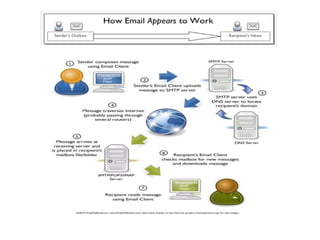
How email flows?
Protocols
• Simple Mail Transfer Protocol (SMTP)
• Internet Message Access Protocol (IMAP)
• Post Office Protocol 3 (POP3)
Protocols
• SMTP (Simple Mail Transfer Protocol):
It is a connection-oriented, text based protocol, communicates with a mail
sender and mail receiver by issuing commands.
SMTP transaction consists of 3 commands:
i) MAIL command, to establish the return address i.e., sender
ii) RCPT command, to establish a recipient of the message.
iii) DATA to send the message .
SMTP Server connects to by looking up the MX (Mail Exchange) DNS
resource and connects to it.
SMTP uses TCP port 25
Protocols
• Internet message access protocol (IMAP) is a protocol for e-mail
retrieval.
• IMAP server listens on well-known port 143.
• IMAP is an Application Layer Internet protocol that allows an e-mail client
to access e-mail on a remote mail server.
• E-mail clients using IMAP generally leave messages on the server until the
user explicitly deletes them.
• Incoming e-mail messages are sent to an e-mail server that stores messages
in the recipient's e-mail box. The user retrieves the messages with an e-mail
client that uses one of a number of e-mail retrieval protocols.
Protocols
• Post Office Protocol 3 (POP3) is a protocol for e-mail retrieval.
• POP3 is an application-layer Internet standard protocol used by local e-mail
clients to retrieve e-mail from a remote server over a TCP/IP connection.
• POP supports simple download-and-delete requirements for access to
remote mailboxes.
• A POP3 server listens on well-known port 110.
Email Clients
Locally installed Clients:
• Microsoft Outlook
• Mozilla Thunder Bird
• IBM Lotus Notes
Web based Mail Clients:
• Gmail
• Yahoo Mail
• Mail.com
• Outlook.com
Q&A

E mail flow

  • 1.
  • 2.
    Topics • What isan E-Mail? • How it works? • Types of Protocols • Mail Clients • Question & Answers
  • 3.
    What is e-mail? •Electronic mail, most commonly referred to as email or e-mail. • It is a method of exchanging digital messages from sender to one or more recipients. • Early email systems required both the sender and receiver should be online, now that is called as “Instant Messaging.” • Today’s email system is based on a “Store-and-forward” model.
  • 4.
    Email Format • Itconsists of 3 parts: i) Sender and Recipient address ii) Subject line iii) body
  • 6.
  • 7.
    Protocols • Simple MailTransfer Protocol (SMTP) • Internet Message Access Protocol (IMAP) • Post Office Protocol 3 (POP3)
  • 8.
    Protocols • SMTP (SimpleMail Transfer Protocol): It is a connection-oriented, text based protocol, communicates with a mail sender and mail receiver by issuing commands. SMTP transaction consists of 3 commands: i) MAIL command, to establish the return address i.e., sender ii) RCPT command, to establish a recipient of the message. iii) DATA to send the message . SMTP Server connects to by looking up the MX (Mail Exchange) DNS resource and connects to it. SMTP uses TCP port 25
  • 9.
    Protocols • Internet messageaccess protocol (IMAP) is a protocol for e-mail retrieval. • IMAP server listens on well-known port 143. • IMAP is an Application Layer Internet protocol that allows an e-mail client to access e-mail on a remote mail server. • E-mail clients using IMAP generally leave messages on the server until the user explicitly deletes them. • Incoming e-mail messages are sent to an e-mail server that stores messages in the recipient's e-mail box. The user retrieves the messages with an e-mail client that uses one of a number of e-mail retrieval protocols.
  • 10.
    Protocols • Post OfficeProtocol 3 (POP3) is a protocol for e-mail retrieval. • POP3 is an application-layer Internet standard protocol used by local e-mail clients to retrieve e-mail from a remote server over a TCP/IP connection. • POP supports simple download-and-delete requirements for access to remote mailboxes. • A POP3 server listens on well-known port 110.
  • 11.
    Email Clients Locally installedClients: • Microsoft Outlook • Mozilla Thunder Bird • IBM Lotus Notes Web based Mail Clients: • Gmail • Yahoo Mail • Mail.com • Outlook.com
  • 12.