CS450 – Internet Protocol
Md Syed Ahamad 1301030
CS450 - Internet Protocol presentation
1
 Introduction
 Fundamentals
 SMTP model and protocols
 End-to-end mailing system
 Stored-and-forward mailing system
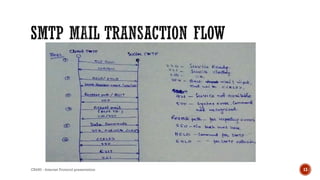
 SMTP mail transaction flow
 Mail Access modes
 Mail Access protocols
CS450 - Internet Protocol presentation 2
 Most email systems that send mail over the internet use SMTP to send messages
from server to another server.
 Email client retrieves the messages using POP & IMAP.
 SMTP works in client – server architecture between mail servers.
CS450 - Internet Protocol presentation 3
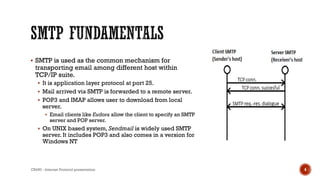
 SMTP is used as the common mechanism for
transporting email among different host within
TCP/IP suite.
 It is application layer protocol at port 25.
 Mail arrived via SMTP is forwarded to a remote server.
 POP3 and IMAP allows user to download from local
server.
 Email clients like Eudora allow the client to specify an SMTP
server and POP server.
 On UNIX based system, Sendmail is widely used SMTP
server. It includes POP3 and also comes in a version for
Windows NT
CS450 - Internet Protocol presentation 4
 User Agent(UA): It is a program that is used to send/receive email.This are email
clients.
 Unix based - Berkeley mail, Elm, MH, Pine etc.
 Windows based - MS outlook, Netscape/Mozilla Communication
 Message Transfer Agent(MTA) - transfers email messages from one computer to
another using a client–server application architecture.
 MTA maintains queue for scheduling repeat delivery attempts in case a remote server is
unable.
 Unix based – Sendmail,eMailman,etc.
 Windows based – MS Exchange.
CS450 - Internet Protocol presentation 5
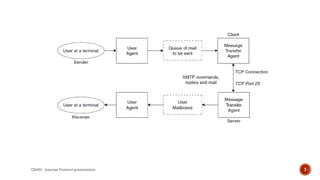
 Model:
 End-to-end mail delivery: used between organisations
 No intermediate message transfer agents (MTAs).
 SMTP client keeps the mail items until it is successfully transferred to
recipient/destination.
CS450 - Internet Protocol presentation 6
CS450 - Internet Protocol presentation 7
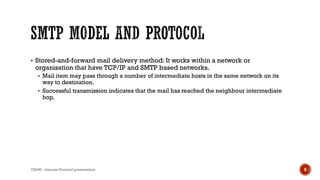
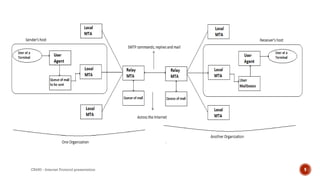
 Stored-and-forward mail delivery method: It works within a network or
organisation that have TCP/IP and SMTP based networks.
 Mail item may pass through a number of intermediate hosts in the same network on its
way to destination.
 Successful transmission indicates that the mail has reached the neighbour intermediate
hop.
CS450 - Internet Protocol presentation 8
CS450 - Internet Protocol presentation 9
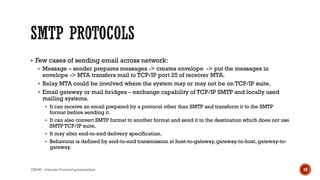
 Few cases of sending email across network:
 Message – sender prepares messages -> creates envelope -> put the messages in
envelope -> MTA transfers mail to TCP/IP port 25 of receiver MTA.
 Relay MTA could be involved where the system may or may not be on TCP/IP suite.
 Email gateway or mail bridges – exchange capability of TCP/IP SMTP and locally used
mailing systems.
 It can receive an email prepared by a protocol other than SMTP and transform it to the SMTP
format before sending it.
 It can also convert SMTP format to another format and send it to the destination which does not use
SMTP TCP/IP suite.
 It may alter end-to-end delivery specification.
 Behaviour is defined by end-to-end transmission at host-to-gateway, gateway-to-host, gateway-to-
gateway.
CS450 - Internet Protocol presentation 10
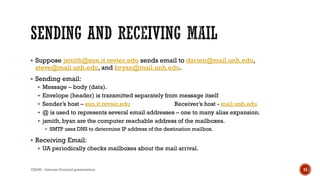
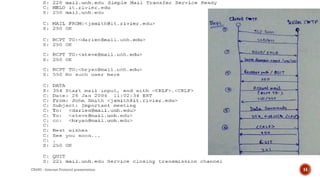
 Suppose jsmith@sun.it.revier.edu sends email to darien@mail.unh.edu,
steve@mail.unh.edu, and bryan@mail.unh.edu.
 Sending email:
 Message – body (data).
 Envelope (header) is transmitted separately from message itself
 Sender’s host – sun.it.revier.edu Receiver’s host - mail.unh.edu
 @ is used to represents several email addresses – one to many alias expansion.
 jsmith, byan are the computer reachable address of the mailboxes.
 SMTP uses DNS to determine IP address of the destination mailbox.
 Receiving Email:
 UA periodically checks mailboxes about the mail arrival.
CS450 - Internet Protocol presentation 11
 SMTP destination address
 user@host – TCP/IP
 User%remote-host@gateway-host – non SMTP destination host via gateway-host.
 @host-a,@host-b:user@host-c – for relay messages (explicit routing information)
 Not eligible for end-to-end delivery system and it is no longer used.
 Delay messages: messages can be delay at sender site, receiver site or the
intermediate servers.
 Sender site – It will be storing in spooling system and client mail periodically (10 to 15
minutes) checks the spool to find the mail can be sent. If it can’t be delivered in the
timeout period (3 to 5 days), the mail returns to the sender.
 Intermediate MTA also has mail storage and spooling storage.
CS450 - Internet Protocol presentation 12
CS450 - Internet Protocol presentation 13
CS450 - Internet Protocol presentation 14
 A mail client (UA) is the software that a user employs to read, send, file, and
otherwise process the electronic mail.
 The mail client also manages related e-mail data (address books, spelling dictionaries, and
stationery).
 The mail client connects to a mail server to retrieve new mail.
 The communication between the mail client and mail server is regulated by the mail access protocol,
a standardized set of transmitted commands and responses sent over many different types of network
connections
 A mail access protocol operates in three common modes
 Offline mode - e-mail is downloaded from a temporary storage on the mail server to the user’s
computer. After download, the mail is deleted from the server.
 Online mode – permanent storage at mail server but temporary storage at client mailbox.
 Disconnected/resynchronization mode – combines both offline and online mode.
CS450 - Internet Protocol presentation 15
 POP3 –
 It can be used with or without SMTP. POP2 was designed for SMTP only.
 Offline , Resynchronized modes supported.
 It allows users to download only header to one season.
 No interoperability issues
 End user mailbox at server mailbox for end-to-end users.
 IMAP4 - a protocol for retrieving email.
 Used for remote access in the mail server.
 It supports additional features over POP i.e. search message on mail server.
 IMAP is like post office and SMTP as postal carriers.
 Used TCP/IP for reliability.
CS450 - Internet Protocol presentation 16
 Vladimir V. Riabov, SMTP ((Simple Mail Transfer Protocol)), Revier College.
 Rfc – 5321.
CS450 - Internet Protocol presentation 17

E mail protocol - SMTP

  • 1.
    CS450 – InternetProtocol Md Syed Ahamad 1301030 CS450 - Internet Protocol presentation 1
  • 2.
     Introduction  Fundamentals SMTP model and protocols  End-to-end mailing system  Stored-and-forward mailing system  SMTP mail transaction flow  Mail Access modes  Mail Access protocols CS450 - Internet Protocol presentation 2
  • 3.
     Most emailsystems that send mail over the internet use SMTP to send messages from server to another server.  Email client retrieves the messages using POP & IMAP.  SMTP works in client – server architecture between mail servers. CS450 - Internet Protocol presentation 3
  • 4.
     SMTP isused as the common mechanism for transporting email among different host within TCP/IP suite.  It is application layer protocol at port 25.  Mail arrived via SMTP is forwarded to a remote server.  POP3 and IMAP allows user to download from local server.  Email clients like Eudora allow the client to specify an SMTP server and POP server.  On UNIX based system, Sendmail is widely used SMTP server. It includes POP3 and also comes in a version for Windows NT CS450 - Internet Protocol presentation 4
  • 5.
     User Agent(UA):It is a program that is used to send/receive email.This are email clients.  Unix based - Berkeley mail, Elm, MH, Pine etc.  Windows based - MS outlook, Netscape/Mozilla Communication  Message Transfer Agent(MTA) - transfers email messages from one computer to another using a client–server application architecture.  MTA maintains queue for scheduling repeat delivery attempts in case a remote server is unable.  Unix based – Sendmail,eMailman,etc.  Windows based – MS Exchange. CS450 - Internet Protocol presentation 5
  • 6.
     Model:  End-to-endmail delivery: used between organisations  No intermediate message transfer agents (MTAs).  SMTP client keeps the mail items until it is successfully transferred to recipient/destination. CS450 - Internet Protocol presentation 6
  • 7.
    CS450 - InternetProtocol presentation 7
  • 8.
     Stored-and-forward maildelivery method: It works within a network or organisation that have TCP/IP and SMTP based networks.  Mail item may pass through a number of intermediate hosts in the same network on its way to destination.  Successful transmission indicates that the mail has reached the neighbour intermediate hop. CS450 - Internet Protocol presentation 8
  • 9.
    CS450 - InternetProtocol presentation 9
  • 10.
     Few casesof sending email across network:  Message – sender prepares messages -> creates envelope -> put the messages in envelope -> MTA transfers mail to TCP/IP port 25 of receiver MTA.  Relay MTA could be involved where the system may or may not be on TCP/IP suite.  Email gateway or mail bridges – exchange capability of TCP/IP SMTP and locally used mailing systems.  It can receive an email prepared by a protocol other than SMTP and transform it to the SMTP format before sending it.  It can also convert SMTP format to another format and send it to the destination which does not use SMTP TCP/IP suite.  It may alter end-to-end delivery specification.  Behaviour is defined by end-to-end transmission at host-to-gateway, gateway-to-host, gateway-to- gateway. CS450 - Internet Protocol presentation 10
  • 11.
     Suppose jsmith@sun.it.revier.edusends email to darien@mail.unh.edu, steve@mail.unh.edu, and bryan@mail.unh.edu.  Sending email:  Message – body (data).  Envelope (header) is transmitted separately from message itself  Sender’s host – sun.it.revier.edu Receiver’s host - mail.unh.edu  @ is used to represents several email addresses – one to many alias expansion.  jsmith, byan are the computer reachable address of the mailboxes.  SMTP uses DNS to determine IP address of the destination mailbox.  Receiving Email:  UA periodically checks mailboxes about the mail arrival. CS450 - Internet Protocol presentation 11
  • 12.
     SMTP destinationaddress  user@host – TCP/IP  User%remote-host@gateway-host – non SMTP destination host via gateway-host.  @host-a,@host-b:user@host-c – for relay messages (explicit routing information)  Not eligible for end-to-end delivery system and it is no longer used.  Delay messages: messages can be delay at sender site, receiver site or the intermediate servers.  Sender site – It will be storing in spooling system and client mail periodically (10 to 15 minutes) checks the spool to find the mail can be sent. If it can’t be delivered in the timeout period (3 to 5 days), the mail returns to the sender.  Intermediate MTA also has mail storage and spooling storage. CS450 - Internet Protocol presentation 12
  • 13.
    CS450 - InternetProtocol presentation 13
  • 14.
    CS450 - InternetProtocol presentation 14
  • 15.
     A mailclient (UA) is the software that a user employs to read, send, file, and otherwise process the electronic mail.  The mail client also manages related e-mail data (address books, spelling dictionaries, and stationery).  The mail client connects to a mail server to retrieve new mail.  The communication between the mail client and mail server is regulated by the mail access protocol, a standardized set of transmitted commands and responses sent over many different types of network connections  A mail access protocol operates in three common modes  Offline mode - e-mail is downloaded from a temporary storage on the mail server to the user’s computer. After download, the mail is deleted from the server.  Online mode – permanent storage at mail server but temporary storage at client mailbox.  Disconnected/resynchronization mode – combines both offline and online mode. CS450 - Internet Protocol presentation 15
  • 16.
     POP3 – It can be used with or without SMTP. POP2 was designed for SMTP only.  Offline , Resynchronized modes supported.  It allows users to download only header to one season.  No interoperability issues  End user mailbox at server mailbox for end-to-end users.  IMAP4 - a protocol for retrieving email.  Used for remote access in the mail server.  It supports additional features over POP i.e. search message on mail server.  IMAP is like post office and SMTP as postal carriers.  Used TCP/IP for reliability. CS450 - Internet Protocol presentation 16
  • 17.
     Vladimir V.Riabov, SMTP ((Simple Mail Transfer Protocol)), Revier College.  Rfc – 5321. CS450 - Internet Protocol presentation 17