SMART MATERIALS
Presented by
JISHNU U
S5 MECHANICAL
NO :35
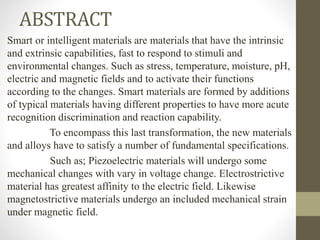
ABSTRACT
Smart or intelligent materials are materials that have the intrinsic
and extrinsic capabilities, fast to respond to stimuli and
environmental changes. Such as stress, temperature, moisture, pH,
electric and magnetic fields and to activate their functions
according to the changes. Smart materials are formed by additions
of typical materials having different properties to have more acute
recognition discrimination and reaction capability.
To encompass this last transformation, the new materials
and alloys have to satisfy a number of fundamental specifications.
Such as; Piezoelectric materials will undergo some
mechanical changes with vary in voltage change. Electrostrictive
material has greatest affinity to the electric field. Likewise
magnetostrictive materials undergo an included mechanical strain
under magnetic field.
Shape memory alloys when subjected to a thermal field (heat &
cold), this material will undergo phase transformation which will
produce Shape changing. Optical fibres are excellent sensors used
in data transformations. pH sensing elements are helpful for
material’s acidity and basicity property by its colour changing.
Electro-chromic materials are helpful for manufacturing of LCD
display and finally smart gels have the ability to shrink or swell its
volume by a factor of 1000 times of its volume by absorbing or
releasing fluid in response to chemical or physical response.
It leads to technological applications in various fields
like the aero elastic form of an aircraft wing, Photo-chromic glass,
Hybrid mechanical/ -electronic systems, Sensing and Actuation
occurs at the atomic or molecular level, vibration control of
lightweight structures such as satellites. So these are found in wide
applications in electronics and metallurgy. With wide spread
research and development (R&D) smart materials are set to play an
important role in our lives
INTRODUCTION:-
Smart or intelligent materials are materials that have the
intrinsic and extrinsic capabilities, fast to respond to
stimuli and environmental changes. Such as stress,
temperature, moisture, pH, electric and magnetic fields
and to activate their functions according to the changes.
The stimuli could originate internally or externally. Since
its beginnings, materials science has undergone a distinct
evolution: from the use of inert structural materials to
materials built for a particular function, to active or
adaptive materials, for more acute recognition,
discrimination and reaction capability
SMART MATERIAL
REQUIREMENTS:-
Technical properties: Mechanical characteristics such
as plastic flow, fatigue and yield strength; and
behavioural characteristics such as damage tolerance
and electrical, heat and fire resistance;
Technological properties: Welding abilities, thermal
processing, waste level, workability, automation and
repair capacities;
Economic criteria: Related to raw material and
production costs, supply expenses and availability;
 Environmental characteristics: Toxicity and
pollution; and
Sustainable development criteria: Implying reuse
and recycling capacities
CLASSIFICATION OF SMART
MATERIALS
Smart materials are classified into various categories by their
physical behaviour, chemical property, and composition of
material used, reaction to the external environment, durability,
industrial application, and availability. The different materials
have different applications.
The types of such materials are:
Piezoelectric Materials
Shape Memory Alloys
Magnetostrictive Materials
Electro-Rheological
Ph. - Sensitive Materials
Photo Chromic Materials
Smart Gels
Optical Fibres
PIEZOELECTRIC MATERIALS
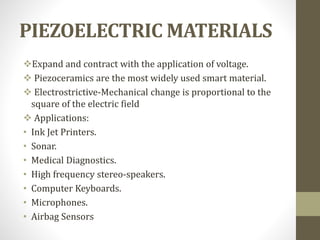
Expand and contract with the application of voltage.
 Piezoceramics are the most widely used smart material.
 Electrostrictive-Mechanical change is proportional to the
square of the electric field
 Applications:
• Ink Jet Printers.
• Sonar.
• Medical Diagnostics.
• High frequency stereo-speakers.
• Computer Keyboards.
• Microphones.
• Airbag Sensors
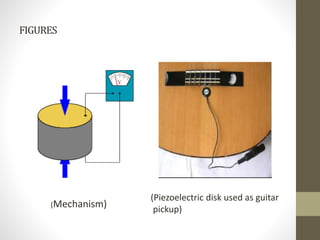
FIGURES
(Mechanism)
(Piezoelectric disk used as guitar
pickup)
SHAPE MEMORY ALLOYS:-
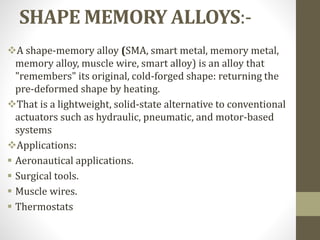
A shape-memory alloy (SMA, smart metal, memory metal,
memory alloy, muscle wire, smart alloy) is an alloy that
"remembers" its original, cold-forged shape: returning the
pre-deformed shape by heating.
That is a lightweight, solid-state alternative to conventional
actuators such as hydraulic, pneumatic, and motor-based
systems
Applications:
 Aeronautical applications.
 Surgical tools.
 Muscle wires.
 Thermostats
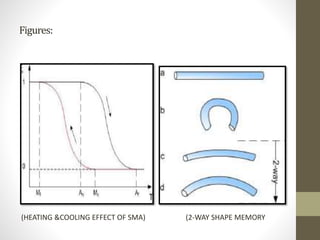
Figures:
(HEATING &COOLING EFFECT OF SMA) (2-WAY SHAPE MEMORY
MAGNETOSTRICTIVE
MATERIALS
Expand and contract with the application of magnetic
fields.
Magnetization due to mechanical stress
Applications
 High-power sonar transducers.
 Motors:(Damping washing machine vibration ,surface
polishing of machine parts, engine mounts designed to
reduce noise, Hydraulic actuators, Car shocks; (Ex:
Trefoil-D.)
 Most common form of MR fluid consists of tiny iron
particles suspended in oil
 Prosthetic limbs, exercise equipment
(Animation of Magnetostriction)
[Magnetostrictive material (inside), magnetizing coil, and
magnetic enclosure completing the magnetic circuit (outside)]
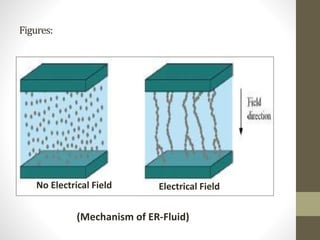
ELECTRO-RHEOLOGICAL:-
Respond to an electric (electro-rheological) or a magnetic
(magneto-rheological) field with a change in viscosity.
Electro rheological (ER) fluids are suspensions of
extremely fine non-conducting particles (up to 50
micrometres diameter) in an electrically insulating fluid.
ER fluids are a type of smart fluid. A simple ER fluid can be
made by mixing corn flour in a light vegetable oil or
(better) Silicone oil.
 Applications:
 Tunable dampers.(For vehicle seats)
 Vibration-isolation systems. (Shock Absorbers)
 Clutches.
 Brakes.
 Resistance Controls, Exercise equipment.
Figures:
No Electrical Field Electrical Field
(Mechanism of ER-Fluid)
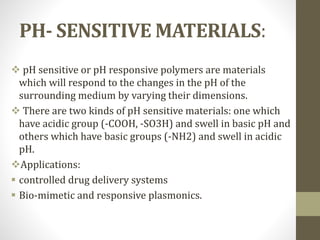
PH- SENSITIVE MATERIALS:
 pH sensitive or pH responsive polymers are materials
which will respond to the changes in the pH of the
surrounding medium by varying their dimensions.
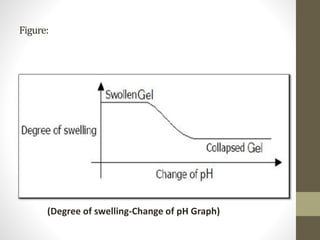
 There are two kinds of pH sensitive materials: one which
have acidic group (-COOH, -SO3H) and swell in basic pH and
others which have basic groups (-NH2) and swell in acidic
pH.
Applications:
 controlled drug delivery systems
 Bio-mimetic and responsive plasmonics.
Figure:
(Degree of swelling-Change of pH Graph)
ELECTRO CHROMIC MATERIALS
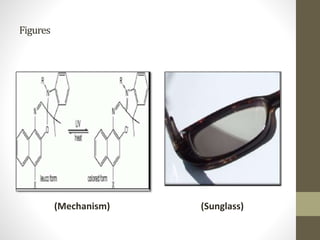
Photochromic is the reversible transformation of a
chemical species between two forms by the absorption of
electromagnetic radiation, where the two forms have
different absorption spectra.
Photo chromic molecules can belong to various classes:
triarylmethanes, stilbenes, azastilbenes, nitrones,
fulgides, spiropyrans, naphthopyrans, spiro-oxazines,
Quinone's and others.
Applications:
 Sun glasses
 Supra molecular chemistry
 Data storage
 Novelty items
Figures
(Mechanism) (Sunglass)
SMART GELS
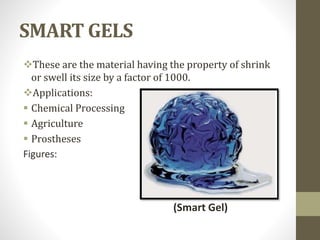
These are the material having the property of shrink
or swell its size by a factor of 1000.
Applications:
 Chemical Processing
 Agriculture
 Prostheses
Figures:
(Smart Gel)
OPTICAL FIBER:
It functions as a waveguide or "light pipe", to transmit
light between the two ends of the fiber.
The field of applied science and engineering concerned
with the design and application of optical fiber is known
as fiber optics.
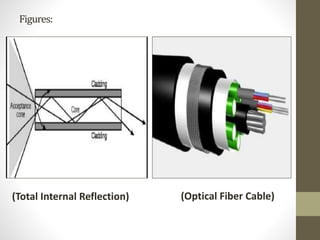
It is based on the principle of “total internal reflection”.
Applications:
 Optical fiber cables
 Termination and splicing
 Free space coupling
 Fiber Fuses
 Power transmission
Figures:
(Optical Fiber Cable)(Total Internal Reflection)
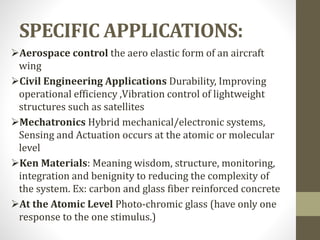
SPECIFIC APPLICATIONS:
Aerospace control the aero elastic form of an aircraft
wing
Civil Engineering Applications Durability, Improving
operational efficiency ,Vibration control of lightweight
structures such as satellites
Mechatronics Hybrid mechanical/electronic systems,
Sensing and Actuation occurs at the atomic or molecular
level
Ken Materials: Meaning wisdom, structure, monitoring,
integration and benignity to reducing the complexity of
the system. Ex: carbon and glass fiber reinforced concrete
At the Atomic Level Photo-chromic glass (have only one
response to the one stimulus.)
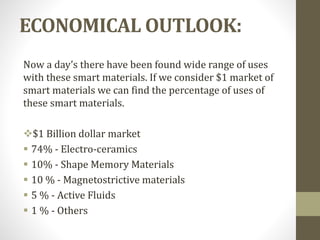
ECONOMICAL OUTLOOK:
Now a day’s there have been found wide range of uses
with these smart materials. If we consider $1 market of
smart materials we can find the percentage of uses of
these smart materials.
$1 Billion dollar market
 74% - Electro-ceramics
 10% - Shape Memory Materials
 10 % - Magnetostrictive materials
 5 % - Active Fluids
 1 % - Others
REFERENCES:
Prof. Jagannath Padhy [HOD, EEE Dept.]
Asst. Prof Sidharth Sabyasachi
Lect. Smita Jana
www.google.com
www.wikipedia.com
Book-Material Science & Engineering
By Achyut Kumar Panda.
Smart materials

Smart materials

  • 1.
  • 2.
    ABSTRACT Smart or intelligentmaterials are materials that have the intrinsic and extrinsic capabilities, fast to respond to stimuli and environmental changes. Such as stress, temperature, moisture, pH, electric and magnetic fields and to activate their functions according to the changes. Smart materials are formed by additions of typical materials having different properties to have more acute recognition discrimination and reaction capability. To encompass this last transformation, the new materials and alloys have to satisfy a number of fundamental specifications. Such as; Piezoelectric materials will undergo some mechanical changes with vary in voltage change. Electrostrictive material has greatest affinity to the electric field. Likewise magnetostrictive materials undergo an included mechanical strain under magnetic field.
  • 3.
    Shape memory alloyswhen subjected to a thermal field (heat & cold), this material will undergo phase transformation which will produce Shape changing. Optical fibres are excellent sensors used in data transformations. pH sensing elements are helpful for material’s acidity and basicity property by its colour changing. Electro-chromic materials are helpful for manufacturing of LCD display and finally smart gels have the ability to shrink or swell its volume by a factor of 1000 times of its volume by absorbing or releasing fluid in response to chemical or physical response. It leads to technological applications in various fields like the aero elastic form of an aircraft wing, Photo-chromic glass, Hybrid mechanical/ -electronic systems, Sensing and Actuation occurs at the atomic or molecular level, vibration control of lightweight structures such as satellites. So these are found in wide applications in electronics and metallurgy. With wide spread research and development (R&D) smart materials are set to play an important role in our lives
  • 4.
    INTRODUCTION:- Smart or intelligentmaterials are materials that have the intrinsic and extrinsic capabilities, fast to respond to stimuli and environmental changes. Such as stress, temperature, moisture, pH, electric and magnetic fields and to activate their functions according to the changes. The stimuli could originate internally or externally. Since its beginnings, materials science has undergone a distinct evolution: from the use of inert structural materials to materials built for a particular function, to active or adaptive materials, for more acute recognition, discrimination and reaction capability
  • 5.
    SMART MATERIAL REQUIREMENTS:- Technical properties:Mechanical characteristics such as plastic flow, fatigue and yield strength; and behavioural characteristics such as damage tolerance and electrical, heat and fire resistance; Technological properties: Welding abilities, thermal processing, waste level, workability, automation and repair capacities; Economic criteria: Related to raw material and production costs, supply expenses and availability;  Environmental characteristics: Toxicity and pollution; and Sustainable development criteria: Implying reuse and recycling capacities
  • 6.
    CLASSIFICATION OF SMART MATERIALS Smartmaterials are classified into various categories by their physical behaviour, chemical property, and composition of material used, reaction to the external environment, durability, industrial application, and availability. The different materials have different applications. The types of such materials are: Piezoelectric Materials Shape Memory Alloys Magnetostrictive Materials Electro-Rheological Ph. - Sensitive Materials Photo Chromic Materials Smart Gels Optical Fibres
  • 7.
    PIEZOELECTRIC MATERIALS Expand andcontract with the application of voltage.  Piezoceramics are the most widely used smart material.  Electrostrictive-Mechanical change is proportional to the square of the electric field  Applications: • Ink Jet Printers. • Sonar. • Medical Diagnostics. • High frequency stereo-speakers. • Computer Keyboards. • Microphones. • Airbag Sensors
  • 8.
  • 9.
    SHAPE MEMORY ALLOYS:- Ashape-memory alloy (SMA, smart metal, memory metal, memory alloy, muscle wire, smart alloy) is an alloy that "remembers" its original, cold-forged shape: returning the pre-deformed shape by heating. That is a lightweight, solid-state alternative to conventional actuators such as hydraulic, pneumatic, and motor-based systems Applications:  Aeronautical applications.  Surgical tools.  Muscle wires.  Thermostats
  • 10.
    Figures: (HEATING &COOLING EFFECTOF SMA) (2-WAY SHAPE MEMORY
  • 11.
    MAGNETOSTRICTIVE MATERIALS Expand and contractwith the application of magnetic fields. Magnetization due to mechanical stress Applications  High-power sonar transducers.  Motors:(Damping washing machine vibration ,surface polishing of machine parts, engine mounts designed to reduce noise, Hydraulic actuators, Car shocks; (Ex: Trefoil-D.)  Most common form of MR fluid consists of tiny iron particles suspended in oil  Prosthetic limbs, exercise equipment
  • 12.
    (Animation of Magnetostriction) [Magnetostrictivematerial (inside), magnetizing coil, and magnetic enclosure completing the magnetic circuit (outside)]
  • 13.
    ELECTRO-RHEOLOGICAL:- Respond to anelectric (electro-rheological) or a magnetic (magneto-rheological) field with a change in viscosity. Electro rheological (ER) fluids are suspensions of extremely fine non-conducting particles (up to 50 micrometres diameter) in an electrically insulating fluid. ER fluids are a type of smart fluid. A simple ER fluid can be made by mixing corn flour in a light vegetable oil or (better) Silicone oil.  Applications:  Tunable dampers.(For vehicle seats)  Vibration-isolation systems. (Shock Absorbers)  Clutches.  Brakes.  Resistance Controls, Exercise equipment.
  • 14.
    Figures: No Electrical FieldElectrical Field (Mechanism of ER-Fluid)
  • 15.
    PH- SENSITIVE MATERIALS: pH sensitive or pH responsive polymers are materials which will respond to the changes in the pH of the surrounding medium by varying their dimensions.  There are two kinds of pH sensitive materials: one which have acidic group (-COOH, -SO3H) and swell in basic pH and others which have basic groups (-NH2) and swell in acidic pH. Applications:  controlled drug delivery systems  Bio-mimetic and responsive plasmonics.
  • 16.
  • 17.
    ELECTRO CHROMIC MATERIALS Photochromicis the reversible transformation of a chemical species between two forms by the absorption of electromagnetic radiation, where the two forms have different absorption spectra. Photo chromic molecules can belong to various classes: triarylmethanes, stilbenes, azastilbenes, nitrones, fulgides, spiropyrans, naphthopyrans, spiro-oxazines, Quinone's and others. Applications:  Sun glasses  Supra molecular chemistry  Data storage  Novelty items
  • 18.
  • 19.
    SMART GELS These arethe material having the property of shrink or swell its size by a factor of 1000. Applications:  Chemical Processing  Agriculture  Prostheses Figures: (Smart Gel)
  • 20.
    OPTICAL FIBER: It functionsas a waveguide or "light pipe", to transmit light between the two ends of the fiber. The field of applied science and engineering concerned with the design and application of optical fiber is known as fiber optics. It is based on the principle of “total internal reflection”. Applications:  Optical fiber cables  Termination and splicing  Free space coupling  Fiber Fuses  Power transmission
  • 21.
  • 22.
    SPECIFIC APPLICATIONS: Aerospace controlthe aero elastic form of an aircraft wing Civil Engineering Applications Durability, Improving operational efficiency ,Vibration control of lightweight structures such as satellites Mechatronics Hybrid mechanical/electronic systems, Sensing and Actuation occurs at the atomic or molecular level Ken Materials: Meaning wisdom, structure, monitoring, integration and benignity to reducing the complexity of the system. Ex: carbon and glass fiber reinforced concrete At the Atomic Level Photo-chromic glass (have only one response to the one stimulus.)
  • 23.
    ECONOMICAL OUTLOOK: Now aday’s there have been found wide range of uses with these smart materials. If we consider $1 market of smart materials we can find the percentage of uses of these smart materials. $1 Billion dollar market  74% - Electro-ceramics  10% - Shape Memory Materials  10 % - Magnetostrictive materials  5 % - Active Fluids  1 % - Others
  • 24.
    REFERENCES: Prof. Jagannath Padhy[HOD, EEE Dept.] Asst. Prof Sidharth Sabyasachi Lect. Smita Jana www.google.com www.wikipedia.com Book-Material Science & Engineering By Achyut Kumar Panda.