Group Members 
 Habib ur Rehman (2012-IM-117) 
 M Abu Bakar (2012-IM-126) 
 Haseeb ur Rehman (2012-IM-109) 
Rachna College of Engineering and 
Technology, Gujranwala
Smart Materials 
If you want to build the future, you need to 
understand smart materials
Contents 
 What are smart materials??? 
 Types 
 Examples 
 Applications 
 Advantages and Dis-advantages
What are Smart 
Materials???
What are Smart Materials??? 
 Smart materials have a fairly vague definition, which 
points to any material that exhibits smart behaviors. 
 Smart behavior occurs when a material can sense some 
stimulus from its environment and react to it in a useful, 
reliable, reproducible and usually reversible manner.
Definition 
Smart materials are designed materials that have one or 
more properties that can be significantly changed in a 
controlled fashion by external stimuli, such 
as stress, temperature, moisture, 
pH, electric or magnetic fields.
Smart materials 
 Smart materials have properties that react to changes in 
their environment. 
 This means that one of their properties can be changed by 
an external condition, such as temperature, light, 
pressure or electricity. 
 This change is reversible and can be repeated many times. 
 They are often also called “responsive” or “intelligent” 
materials.
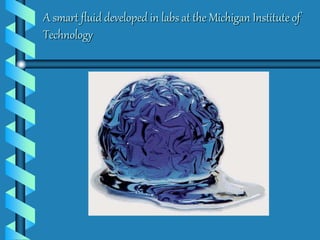
A smart fluid developed in labs at the Michigan Institute of 
Technology
Major Types
Major Types 
 Piezoelectric 
 Electrostrictive 
 Magnetostrictive 
 Shape memory alloys 
 Magnetocaloric
Piezoelectric 
 When subjected to an electric charge or a variation 
in voltage, piezoelectric material will undergo some 
mechanical changes. 
 The best known example is electric cigarette lighter.
Electrostrictive 
 This material has the same properties as 
piezoelectric material, but the mechanical 
change is proportional to the square of the 
electric field. 
 Lead Magnesium Niobate (PMN) and its doped 
derivatives are classical electrostrictive materials.
Magnetostrictive 
 When subjected to a magnetic field, this 
material will undergo an induced mechanical 
change. 
 Consequently, it can be used as sensors.
Shape Memory Alloys 
 When subjected to a thermal field, this material will 
undergo phase change which will produce shape 
changes. 
 These are used in aircrafts, piping, automotives, 
telecommunication, robotics and in medicines as well.
Magnetocaloric materials 
 Magnetocaloric materials are compounds that undergo a 
reversible change in temperature upon exposure to a 
changing magnetic field. 
 These materials have applications in refrigeration.
Examples
Examples 
 Smart Colors 
1. Thermo Chromic 
2. Photo Chromic 
 Polymorph 
 Smart Grease 
 Conductive Polymers 
 Nanomaterials
Examples 
 Treated Paper 
 Thermo color Sheet 
 Precious Metal Clay (PMC) 
 Paper foam 
 Footwear 
 Etc.
Applications
Thermochromism 
 Thermochromismis the property of substances to 
change color due to a change in temperature. 
 Smart materials are used in all types of thermochromatic 
liquid crystals, leuco dyes, thermochromic papers, 
thermochromic polymers and thermochromic inks.
Photochromic Lens 
 Smart materials are also used in photochromic lens. 
 Photochromic lenses are lenses that darken on exposure to 
specific types of light, most commonly ultraviolet 
(UV) radiation. 
 Once the light source is removed (for example by walking 
indoors), the lenses will gradually return to their clear 
state.
Shape-Memory Polymers 
 Shape-memory polymers (SMPs) are polymeric smart 
materials that have the ability to return from a deformed 
state (temporary shape) to their original (permanent) 
shape induced by an external stimulus (trigger), such as 
temperature change.
Advantages and 
Dis-Advantages
Advantages of Smart 
Materials 
 High energy density (compared to pneumatic and 
hydraulic actuators) 
 Excellent bandwidth 
 Simplified packaging 
 Novel functions such as the huge volume change as a 
function of temperature exhibited by smart gels.
Disadvantages of Smart 
Materials 
 Dropping people out of the labor 
 Not biodegradable 
 Environmental pollution 
 Expensive to produce 
 Long term effects unknown 
 Global crisis
Smart materials
Smart materials

Smart materials

  • 2.
    Group Members Habib ur Rehman (2012-IM-117)  M Abu Bakar (2012-IM-126)  Haseeb ur Rehman (2012-IM-109) Rachna College of Engineering and Technology, Gujranwala
  • 3.
    Smart Materials Ifyou want to build the future, you need to understand smart materials
  • 4.
    Contents  Whatare smart materials???  Types  Examples  Applications  Advantages and Dis-advantages
  • 5.
    What are Smart Materials???
  • 6.
    What are SmartMaterials???  Smart materials have a fairly vague definition, which points to any material that exhibits smart behaviors.  Smart behavior occurs when a material can sense some stimulus from its environment and react to it in a useful, reliable, reproducible and usually reversible manner.
  • 7.
    Definition Smart materialsare designed materials that have one or more properties that can be significantly changed in a controlled fashion by external stimuli, such as stress, temperature, moisture, pH, electric or magnetic fields.
  • 8.
    Smart materials Smart materials have properties that react to changes in their environment.  This means that one of their properties can be changed by an external condition, such as temperature, light, pressure or electricity.  This change is reversible and can be repeated many times.  They are often also called “responsive” or “intelligent” materials.
  • 9.
    A smart fluiddeveloped in labs at the Michigan Institute of Technology
  • 11.
  • 12.
    Major Types Piezoelectric  Electrostrictive  Magnetostrictive  Shape memory alloys  Magnetocaloric
  • 13.
    Piezoelectric  Whensubjected to an electric charge or a variation in voltage, piezoelectric material will undergo some mechanical changes.  The best known example is electric cigarette lighter.
  • 14.
    Electrostrictive  Thismaterial has the same properties as piezoelectric material, but the mechanical change is proportional to the square of the electric field.  Lead Magnesium Niobate (PMN) and its doped derivatives are classical electrostrictive materials.
  • 15.
    Magnetostrictive  Whensubjected to a magnetic field, this material will undergo an induced mechanical change.  Consequently, it can be used as sensors.
  • 16.
    Shape Memory Alloys  When subjected to a thermal field, this material will undergo phase change which will produce shape changes.  These are used in aircrafts, piping, automotives, telecommunication, robotics and in medicines as well.
  • 17.
    Magnetocaloric materials Magnetocaloric materials are compounds that undergo a reversible change in temperature upon exposure to a changing magnetic field.  These materials have applications in refrigeration.
  • 18.
  • 19.
    Examples  SmartColors 1. Thermo Chromic 2. Photo Chromic  Polymorph  Smart Grease  Conductive Polymers  Nanomaterials
  • 20.
    Examples  TreatedPaper  Thermo color Sheet  Precious Metal Clay (PMC)  Paper foam  Footwear  Etc.
  • 21.
  • 22.
    Thermochromism  Thermochromismisthe property of substances to change color due to a change in temperature.  Smart materials are used in all types of thermochromatic liquid crystals, leuco dyes, thermochromic papers, thermochromic polymers and thermochromic inks.
  • 24.
    Photochromic Lens Smart materials are also used in photochromic lens.  Photochromic lenses are lenses that darken on exposure to specific types of light, most commonly ultraviolet (UV) radiation.  Once the light source is removed (for example by walking indoors), the lenses will gradually return to their clear state.
  • 25.
    Shape-Memory Polymers Shape-memory polymers (SMPs) are polymeric smart materials that have the ability to return from a deformed state (temporary shape) to their original (permanent) shape induced by an external stimulus (trigger), such as temperature change.
  • 26.
  • 27.
    Advantages of Smart Materials  High energy density (compared to pneumatic and hydraulic actuators)  Excellent bandwidth  Simplified packaging  Novel functions such as the huge volume change as a function of temperature exhibited by smart gels.
  • 28.
    Disadvantages of Smart Materials  Dropping people out of the labor  Not biodegradable  Environmental pollution  Expensive to produce  Long term effects unknown  Global crisis