
Click to edit Master title style
1
E L E M E N T S O F M AT E R I A L S C I E N C E
Click to edit Master title style
2
WHAT IS A SMART
MATERIAL?
• A smart material can be defined as the
material which can change their behavior
or their properties as per change in the
atmosphere or in the response of external
stimuli and these stimuli could be anything
i.e. pressure, force, temperature, stress.
• This concept of “Smart materials” or
intelligent materials are used
tocharacterizethe material those are able
to answer in the suitable way to the
surrounding and changes in it.
2
Click to edit Master title style
3
TYPES OF SMART MATERIALS :
3
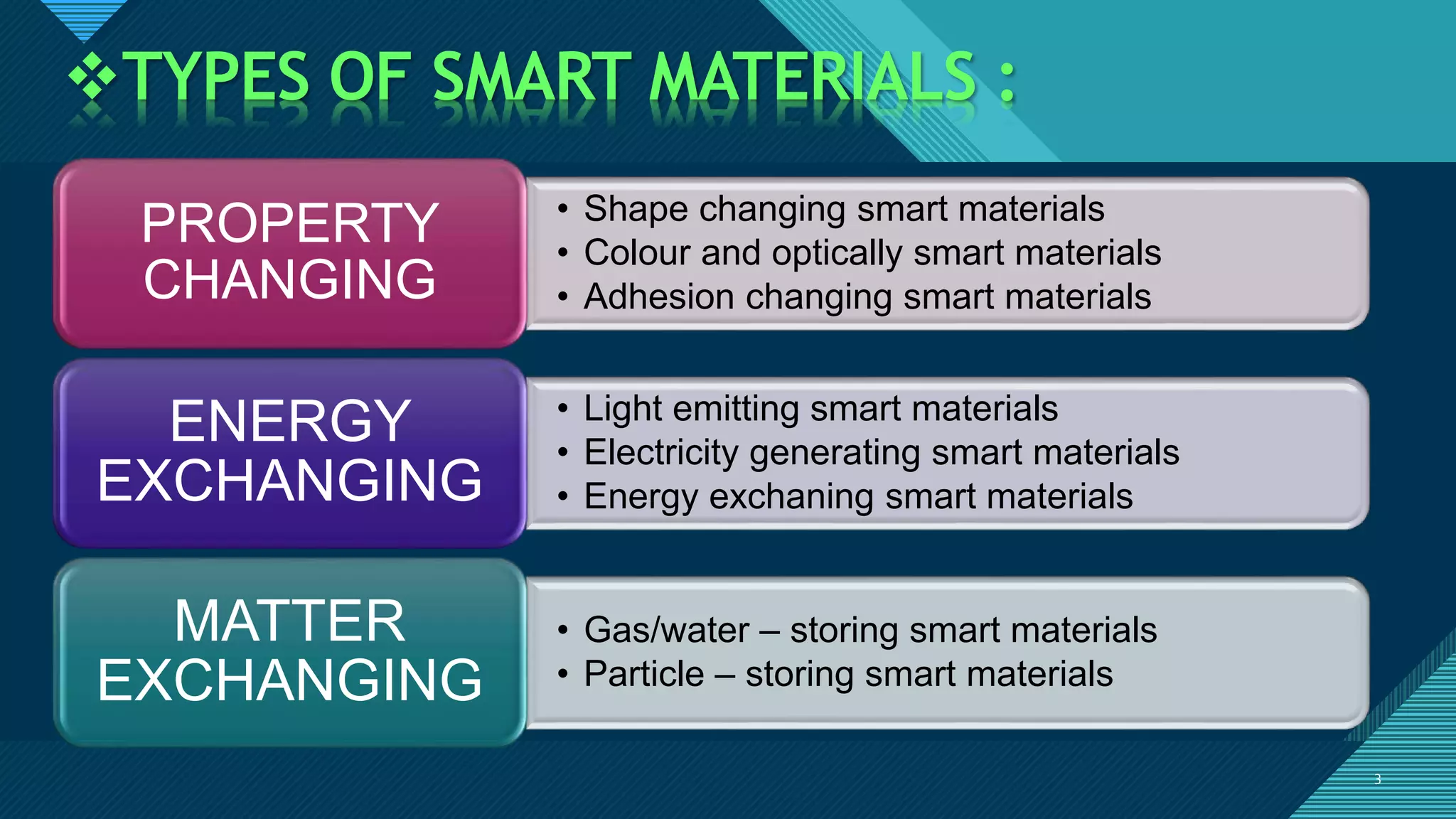
• Shape changing smart materials
• Colour and optically smart materials
• Adhesion changing smart materials
PROPERTY
CHANGING
• Light emitting smart materials
• Electricity generating smart materials
• Energy exchaning smart materials
ENERGY
EXCHANGING
• Gas/water – storing smart materials
• Particle – storing smart materials
MATTER
EXCHANGING
Click to edit Master title style
4
TYPES OF SMART MATERIALS :
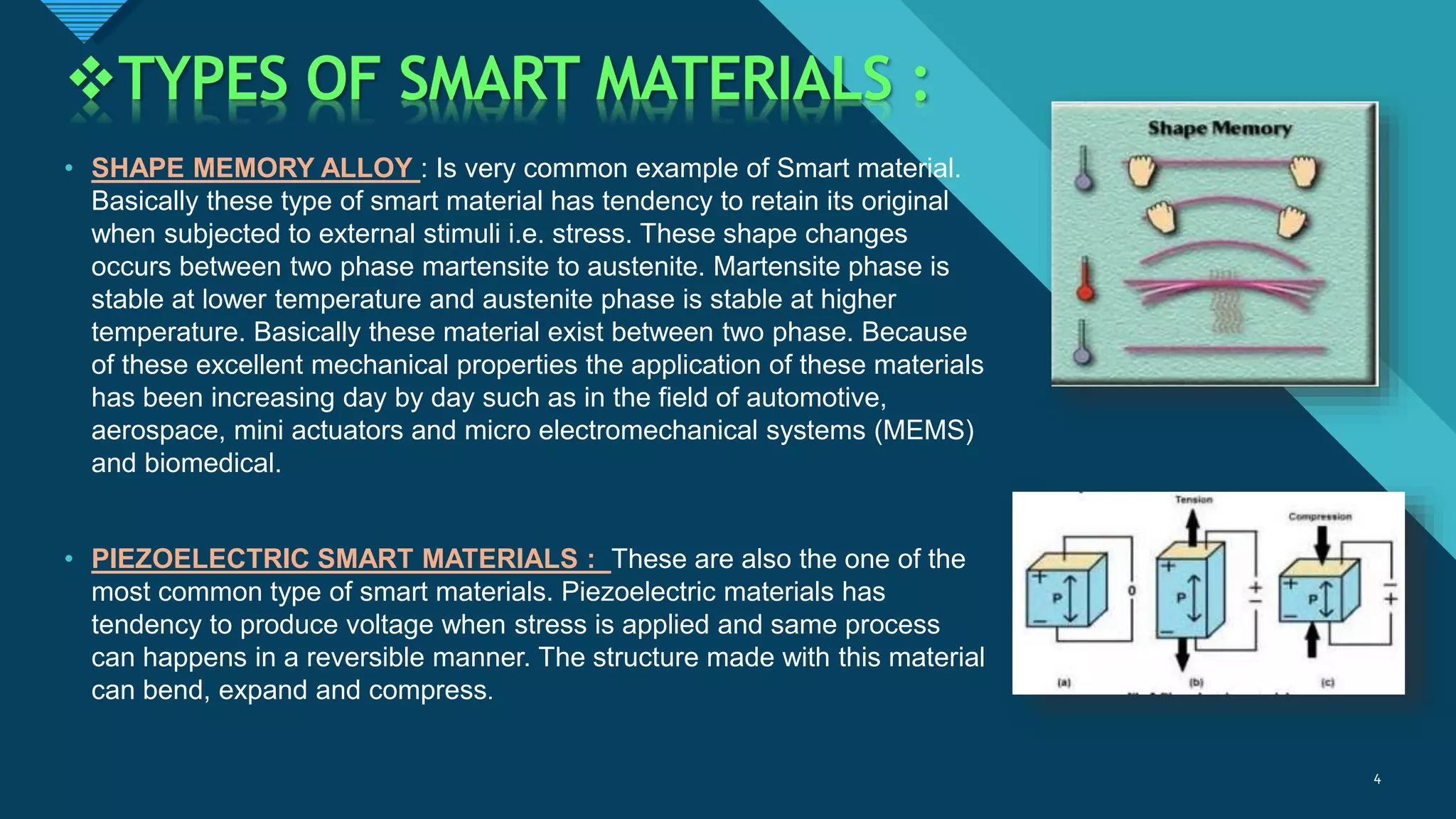
• SHAPE MEMORY ALLOY : Is very common example of Smart material.
Basically these type of smart material has tendency to retain its original
when subjected to external stimuli i.e. stress. These shape changes
occurs between two phase martensite to austenite. Martensite phase is
stable at lower temperature and austenite phase is stable at higher
temperature. Basically these material exist between two phase. Because
of these excellent mechanical properties the application of these materials
has been increasing day by day such as in the field of automotive,
aerospace, mini actuators and micro electromechanical systems (MEMS)
and biomedical.
• PIEZOELECTRIC SMART MATERIALS : These are also the one of the
most common type of smart materials. Piezoelectric materials has
tendency to produce voltage when stress is applied and same process
can happens in a reversible manner. The structure made with this material
can bend, expand and compress.
4
Click to edit Master title style
5
TYPES OF SMART MATERIALS :
5
• CHROMATIC MATERIALS : These materials have very excellent property to change their color
when subjected to external impetus (temperature, lights, electric field). These materials can
more classified into (i) Thermochromic materials (ii) Photo chromic materials (iii) Halo
chromic materials.
• MAGNETOSTRICTIVE MATERIALS : These materials are that kind of Smart materials that can
alter their shape when subjected to magnetic field. This is reversible process so when
magnetic field will be applied then change in shape will occur. These materials are almost
similar to the piezoelectric materials difference is only that they respond to electric field
while magneto-restrictive material has tendency to response to the magnetic field.
• ph SENSITIVE MATERIAL : This kind of smart materials have properties to change their color
when their will be the change in the acidity of the liquid. These kind of smart materials can
be use to indicates the corrosion by mixing it with the paint.
Click to edit Master title style
6
APPLICATIONS OF SMART MATERIALS
6
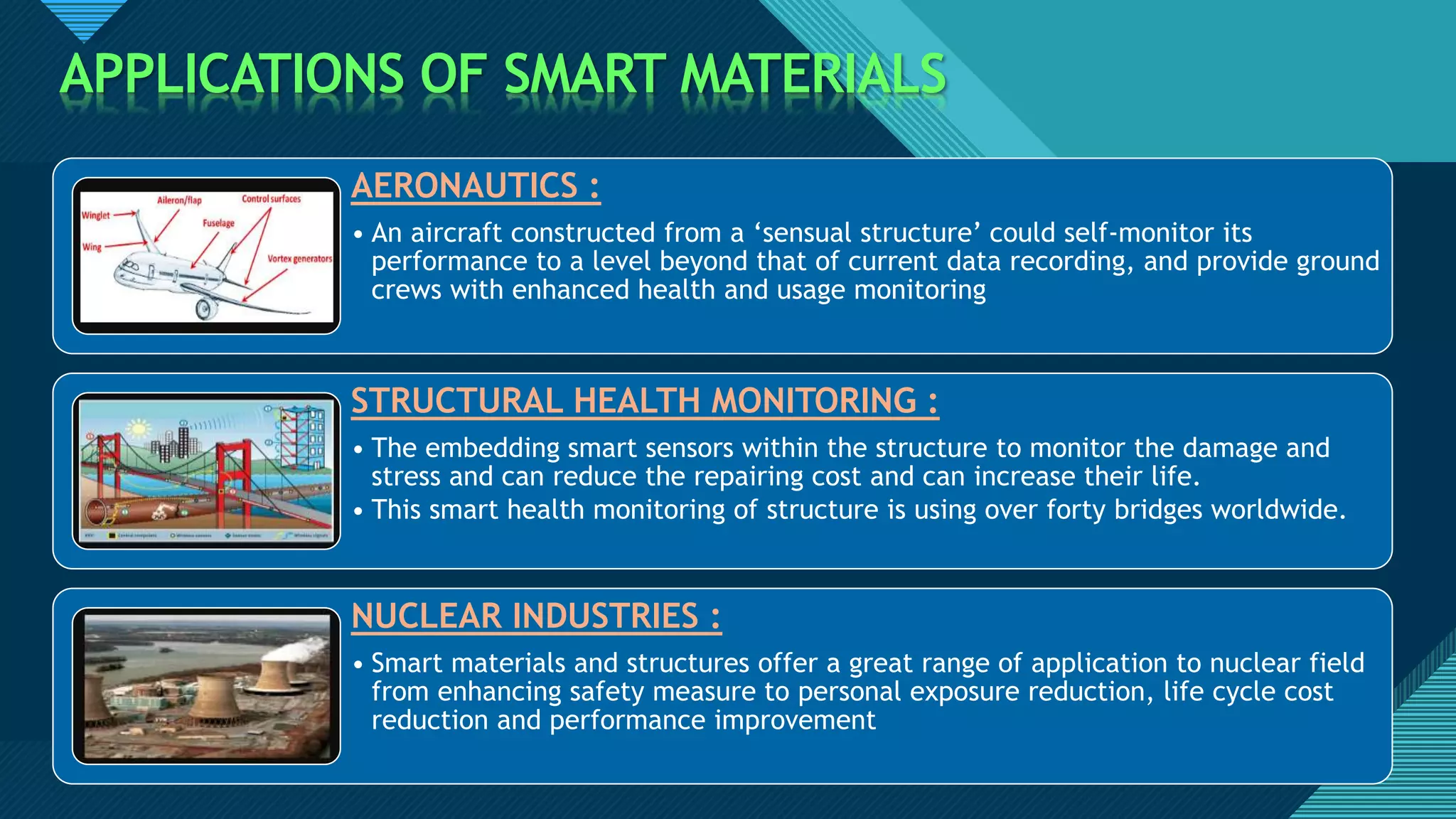
AERONAUTICS :
• An aircraft constructed from a ‘sensual structure’ could self-monitor its
performance to a level beyond that of current data recording, and provide ground
crews with enhanced health and usage monitoring
STRUCTURAL HEALTH MONITORING :
• The embedding smart sensors within the structure to monitor the damage and
stress and can reduce the repairing cost and can increase their life.
• This smart health monitoring of structure is using over forty bridges worldwide.
NUCLEAR INDUSTRIES :
• Smart materials and structures offer a great range of application to nuclear field
from enhancing safety measure to personal exposure reduction, life cycle cost
reduction and performance improvement
Click to edit Master title style
7
APPLICATION OF SMART MATERIALS :
7
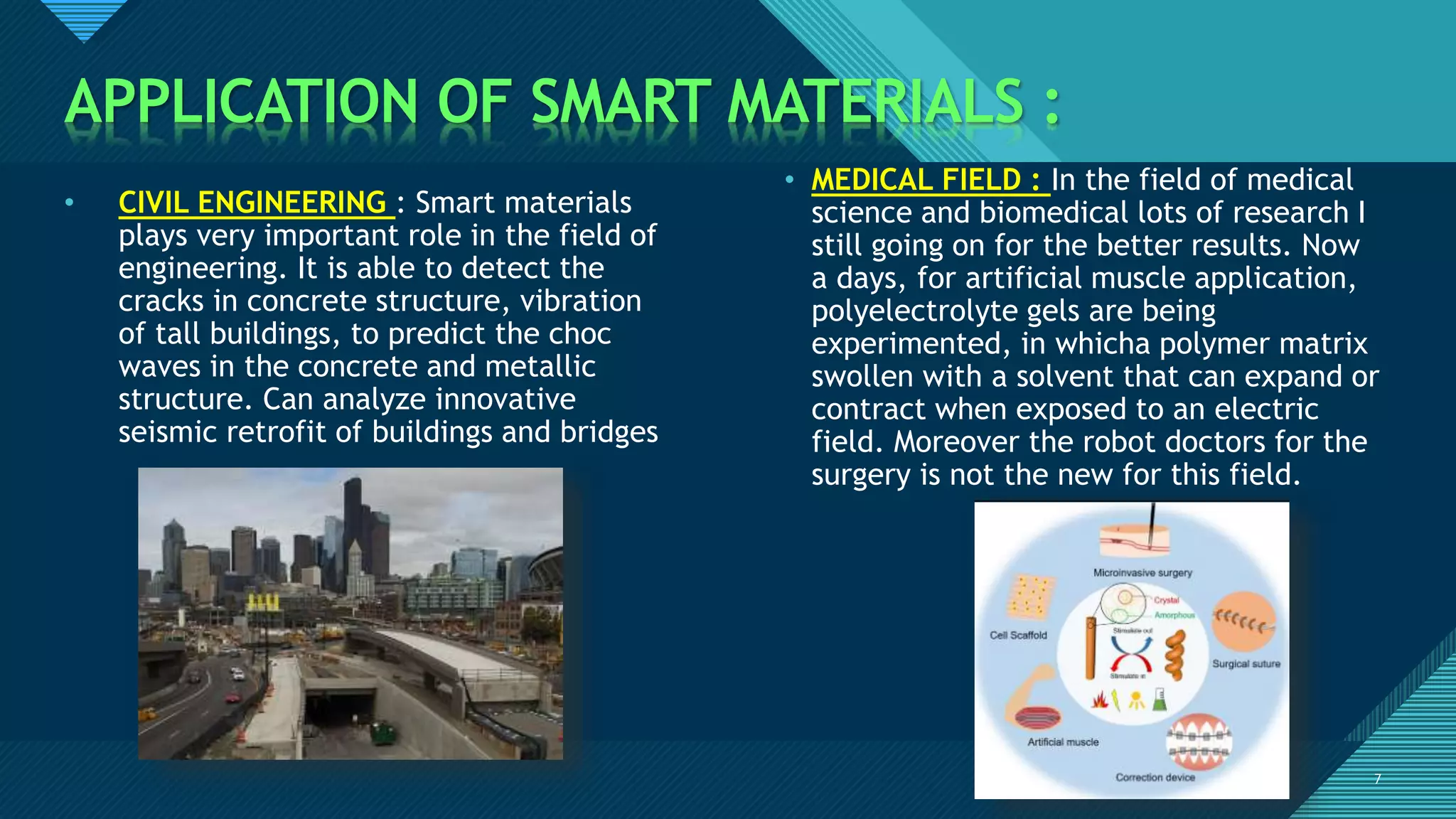
• CIVIL ENGINEERING : Smart materials
plays very important role in the field of
engineering. It is able to detect the
cracks in concrete structure, vibration
of tall buildings, to predict the choc
waves in the concrete and metallic
structure. Can analyze innovative
seismic retrofit of buildings and bridges
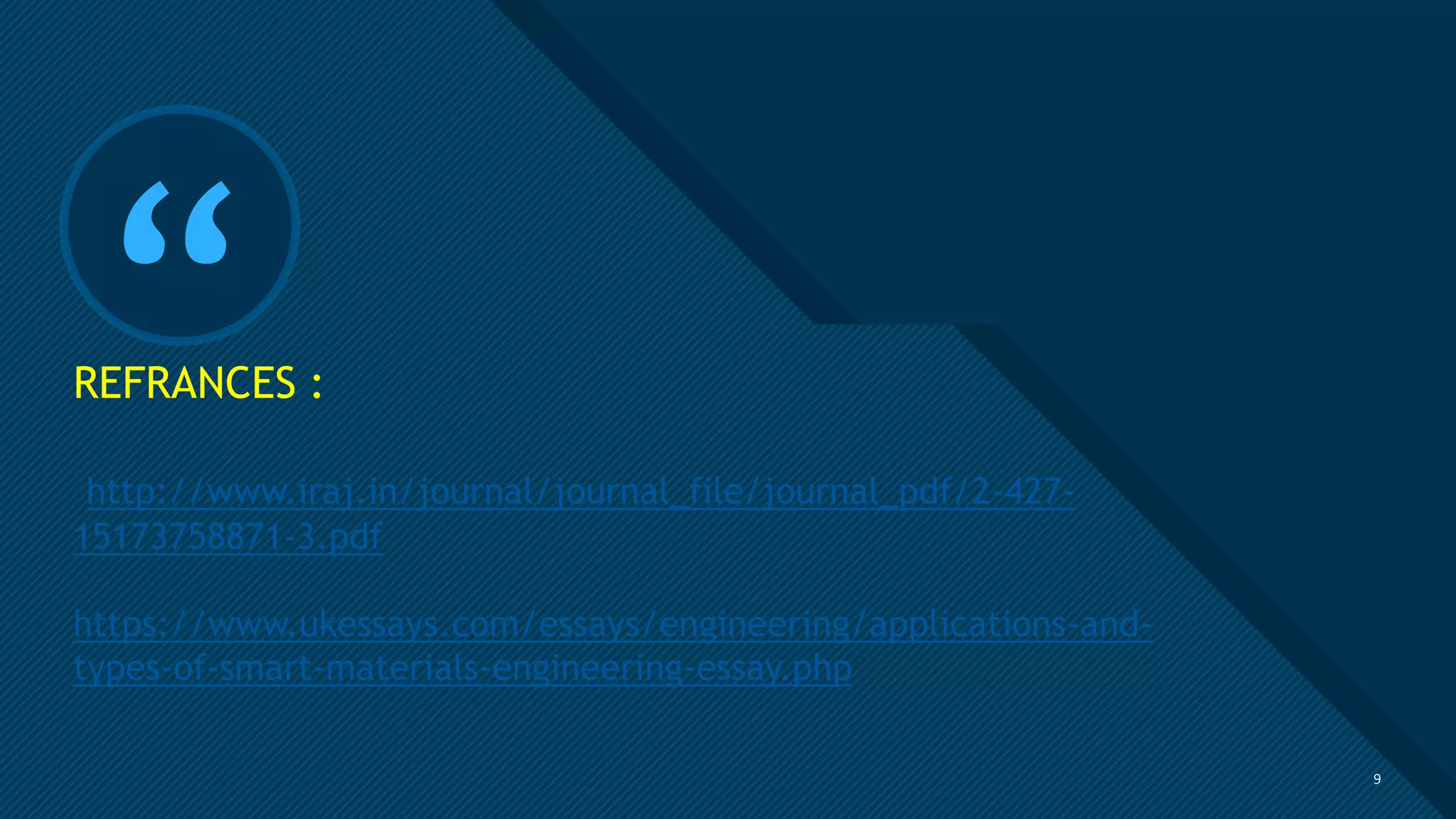
• MEDICAL FIELD : In the field of medical
science and biomedical lots of research I
still going on for the better results. Now
a days, for artificial muscle application,
polyelectrolyte gels are being
experimented, in whicha polymer matrix
swollen with a solvent that can expand or
contract when exposed to an electric
field. Moreover the robot doctors for the
surgery is not the new for this field.
Click to edit Master title style
8
APPLICATION OF SMART MATERIALS :
In future electromechanical devices can be smart enough to communicate directly with the human brain.
The development of supersensitive noses, ears, and eyes would enable us to smell more scents, to hear
beyond our frequency range and to see which cannot be normally seen .
8
Click to edit Master title style
9
“
REFRANCES :
http://www.iraj.in/journal/journal_file/journal_pdf/2-427-
15173758871-3.pdf
https://www.ukessays.com/essays/engineering/applications-and-
types-of-smart-materials-engineering-essay.php
9
Click to edit Master title style
10
B Y : S w a r a S a l a p
S . T. D : T Y B . S c B . E d ( P h y s i c s )
R O L L N O . : 0 3 5
D e p a r t m e n t o f E d u c a t i o n & E x t e n s i o n
S a v i t r i b a i P h u l e P u n e U n i v e r s i t y

Introduction to smart materials

  • 1.
    Click to editMaster title style 1 E L E M E N T S O F M AT E R I A L S C I E N C E
  • 2.
    Click to editMaster title style 2 WHAT IS A SMART MATERIAL? • A smart material can be defined as the material which can change their behavior or their properties as per change in the atmosphere or in the response of external stimuli and these stimuli could be anything i.e. pressure, force, temperature, stress. • This concept of “Smart materials” or intelligent materials are used tocharacterizethe material those are able to answer in the suitable way to the surrounding and changes in it. 2
  • 3.
    Click to editMaster title style 3 TYPES OF SMART MATERIALS : 3 • Shape changing smart materials • Colour and optically smart materials • Adhesion changing smart materials PROPERTY CHANGING • Light emitting smart materials • Electricity generating smart materials • Energy exchaning smart materials ENERGY EXCHANGING • Gas/water – storing smart materials • Particle – storing smart materials MATTER EXCHANGING
  • 4.
    Click to editMaster title style 4 TYPES OF SMART MATERIALS : • SHAPE MEMORY ALLOY : Is very common example of Smart material. Basically these type of smart material has tendency to retain its original when subjected to external stimuli i.e. stress. These shape changes occurs between two phase martensite to austenite. Martensite phase is stable at lower temperature and austenite phase is stable at higher temperature. Basically these material exist between two phase. Because of these excellent mechanical properties the application of these materials has been increasing day by day such as in the field of automotive, aerospace, mini actuators and micro electromechanical systems (MEMS) and biomedical. • PIEZOELECTRIC SMART MATERIALS : These are also the one of the most common type of smart materials. Piezoelectric materials has tendency to produce voltage when stress is applied and same process can happens in a reversible manner. The structure made with this material can bend, expand and compress. 4
  • 5.
    Click to editMaster title style 5 TYPES OF SMART MATERIALS : 5 • CHROMATIC MATERIALS : These materials have very excellent property to change their color when subjected to external impetus (temperature, lights, electric field). These materials can more classified into (i) Thermochromic materials (ii) Photo chromic materials (iii) Halo chromic materials. • MAGNETOSTRICTIVE MATERIALS : These materials are that kind of Smart materials that can alter their shape when subjected to magnetic field. This is reversible process so when magnetic field will be applied then change in shape will occur. These materials are almost similar to the piezoelectric materials difference is only that they respond to electric field while magneto-restrictive material has tendency to response to the magnetic field. • ph SENSITIVE MATERIAL : This kind of smart materials have properties to change their color when their will be the change in the acidity of the liquid. These kind of smart materials can be use to indicates the corrosion by mixing it with the paint.
  • 6.
    Click to editMaster title style 6 APPLICATIONS OF SMART MATERIALS 6 AERONAUTICS : • An aircraft constructed from a ‘sensual structure’ could self-monitor its performance to a level beyond that of current data recording, and provide ground crews with enhanced health and usage monitoring STRUCTURAL HEALTH MONITORING : • The embedding smart sensors within the structure to monitor the damage and stress and can reduce the repairing cost and can increase their life. • This smart health monitoring of structure is using over forty bridges worldwide. NUCLEAR INDUSTRIES : • Smart materials and structures offer a great range of application to nuclear field from enhancing safety measure to personal exposure reduction, life cycle cost reduction and performance improvement
  • 7.
    Click to editMaster title style 7 APPLICATION OF SMART MATERIALS : 7 • CIVIL ENGINEERING : Smart materials plays very important role in the field of engineering. It is able to detect the cracks in concrete structure, vibration of tall buildings, to predict the choc waves in the concrete and metallic structure. Can analyze innovative seismic retrofit of buildings and bridges • MEDICAL FIELD : In the field of medical science and biomedical lots of research I still going on for the better results. Now a days, for artificial muscle application, polyelectrolyte gels are being experimented, in whicha polymer matrix swollen with a solvent that can expand or contract when exposed to an electric field. Moreover the robot doctors for the surgery is not the new for this field.
  • 8.
    Click to editMaster title style 8 APPLICATION OF SMART MATERIALS : In future electromechanical devices can be smart enough to communicate directly with the human brain. The development of supersensitive noses, ears, and eyes would enable us to smell more scents, to hear beyond our frequency range and to see which cannot be normally seen . 8
  • 9.
    Click to editMaster title style 9 “ REFRANCES : http://www.iraj.in/journal/journal_file/journal_pdf/2-427- 15173758871-3.pdf https://www.ukessays.com/essays/engineering/applications-and- types-of-smart-materials-engineering-essay.php 9
  • 10.
    Click to editMaster title style 10 B Y : S w a r a S a l a p S . T. D : T Y B . S c B . E d ( P h y s i c s ) R O L L N O . : 0 3 5 D e p a r t m e n t o f E d u c a t i o n & E x t e n s i o n S a v i t r i b a i P h u l e P u n e U n i v e r s i t y