Fractions
Index What are Fractions Examples Need of Fractions Parts of Fractions Example Types of Fractions- Proper fractions & Improper Fractions Mixed Fractions Like Fractions & Unlike Fractions Equivalent Fractions Operations of Fractions Addition Subtraction Multiplication Division Comparison Greater than and Smaller than How does the Denominator controls the Fraction How does the Denominator controls the Fraction
What are Fractions? Fractions are for counting part of something. Loosely speaking, a fraction is a quantity that cannot be represented by  a whole number. A fraction (from the Latin fractus, broken) is a number that can represent part of a whole. The earliest fractions were reciprocals of integers: ancient symbols representing one part of two, one part of three, one part of four, and so on. A much later development were the common or "vulgar" fractions which are still used today (½, ⅝, ¾, etc.)
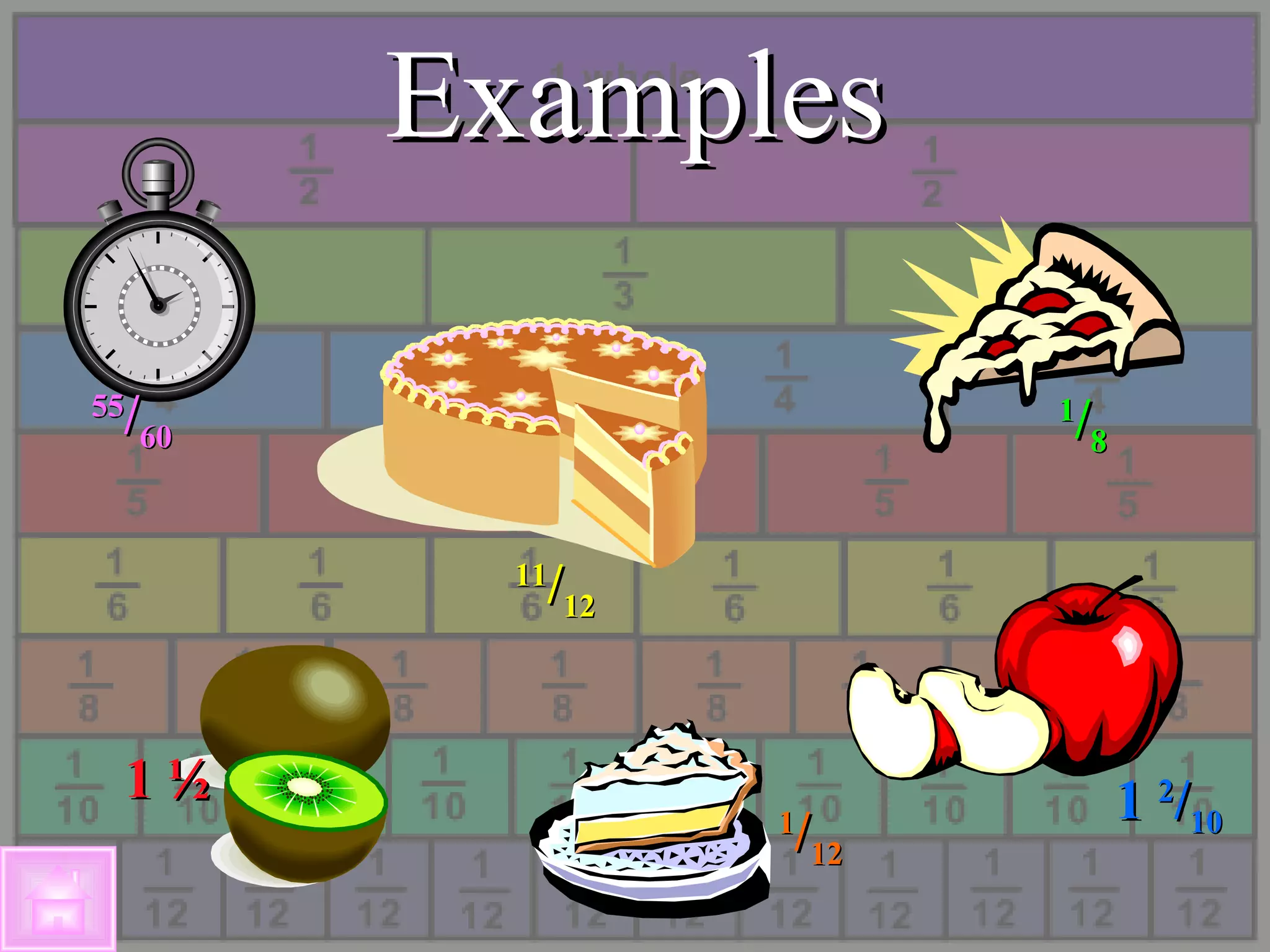
Examples 1  2 / 10 1 / 12 1 / 8 1  ½ 11 / 12 55 / 60
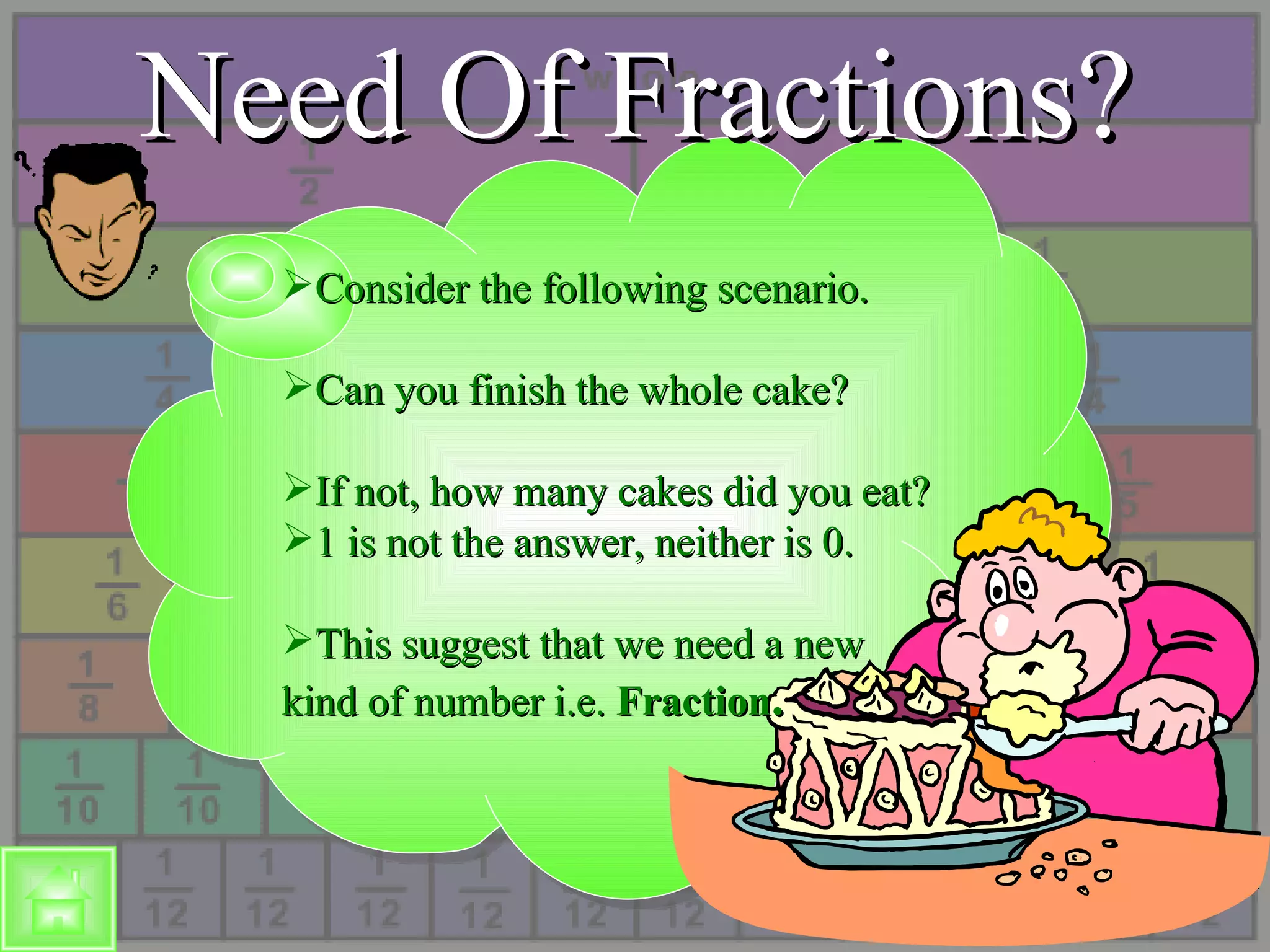
Need Of Fractions? Consider the following scenario. Can you finish the whole cake?   If not, how many cakes did you eat? 1 is not the answer, neither is 0. This suggest that we need a new  kind of number i.e.  Fraction .
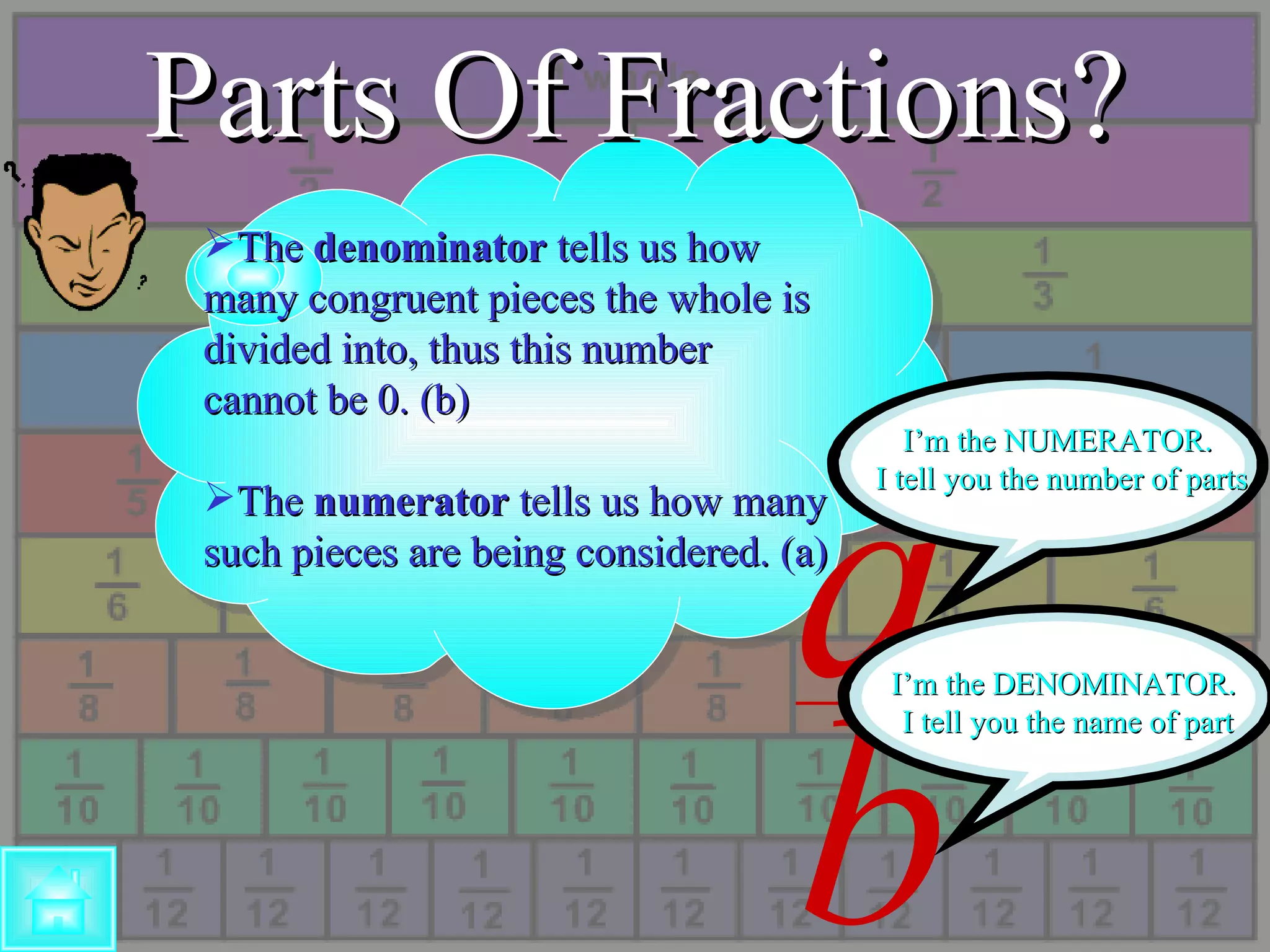
Parts Of Fractions? I’m the NUMERATOR. I tell you the number of parts I’m the DENOMINATOR. I tell you the name of part The  denominator  tells us how many congruent pieces the whole is divided into, thus this number cannot be 0. (b) The  numerator  tells us how many such pieces are being considered. (a)
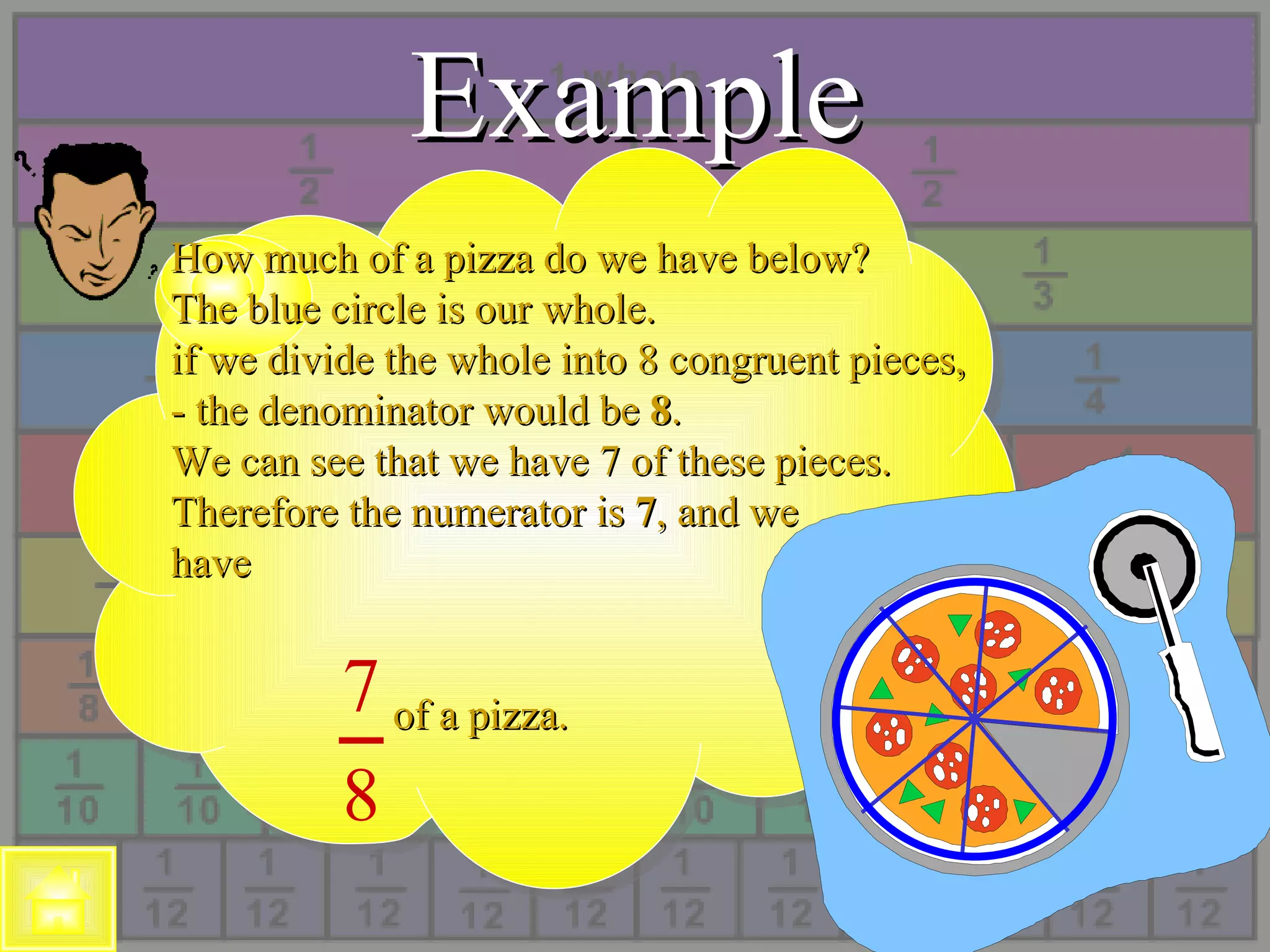
Example How much of a pizza do we have below? The blue circle is our whole.  if we divide the whole into 8 congruent pieces, - the denominator would be  8 . We can see that we have 7 of these pieces. Therefore the numerator is  7 , and we  have  of a pizza.
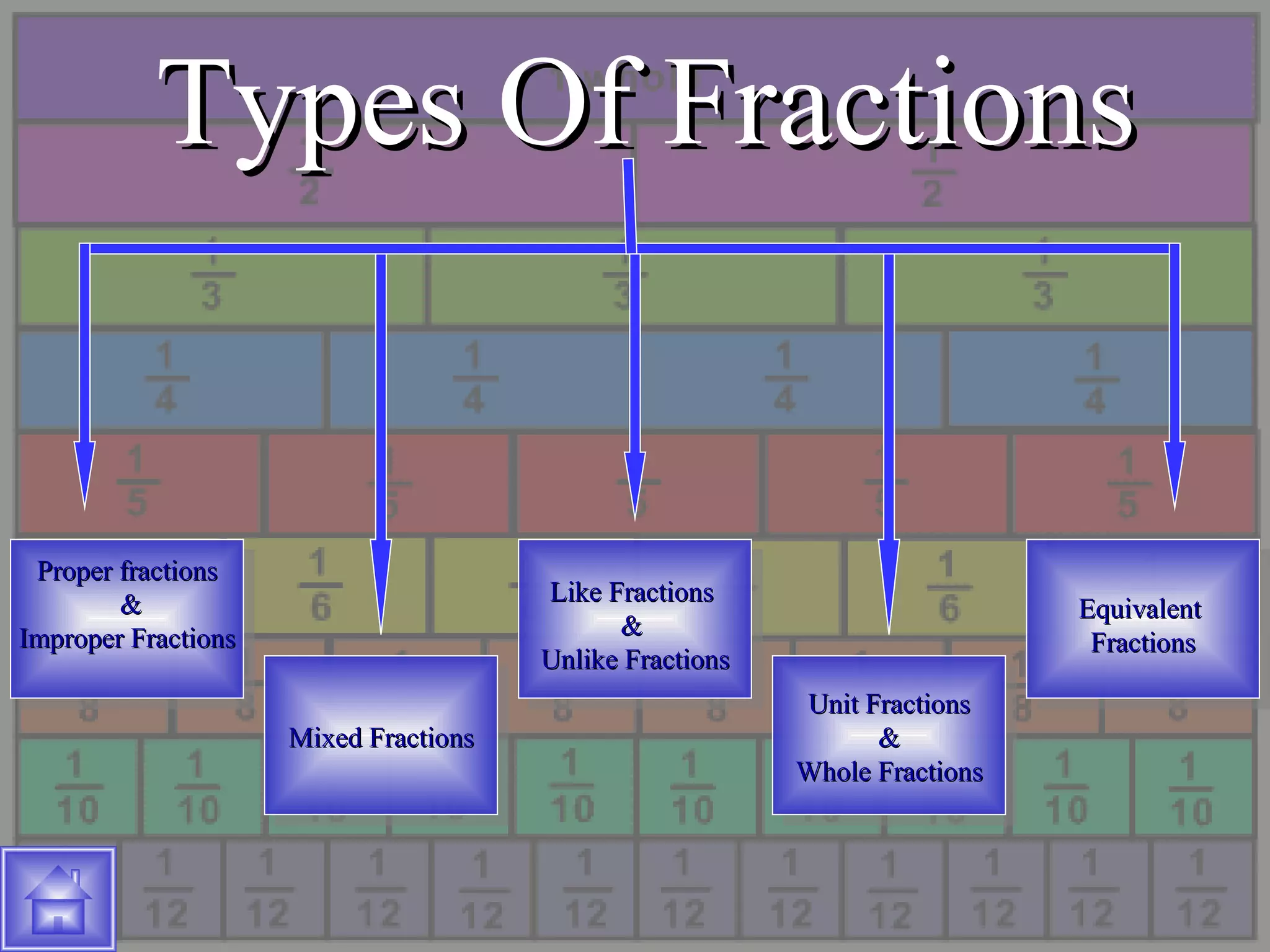
Types Of Fractions Proper fractions & Improper Fractions Equivalent  Fractions Like Fractions  &  Unlike Fractions Mixed Fractions Unit Fractions & Whole Fractions
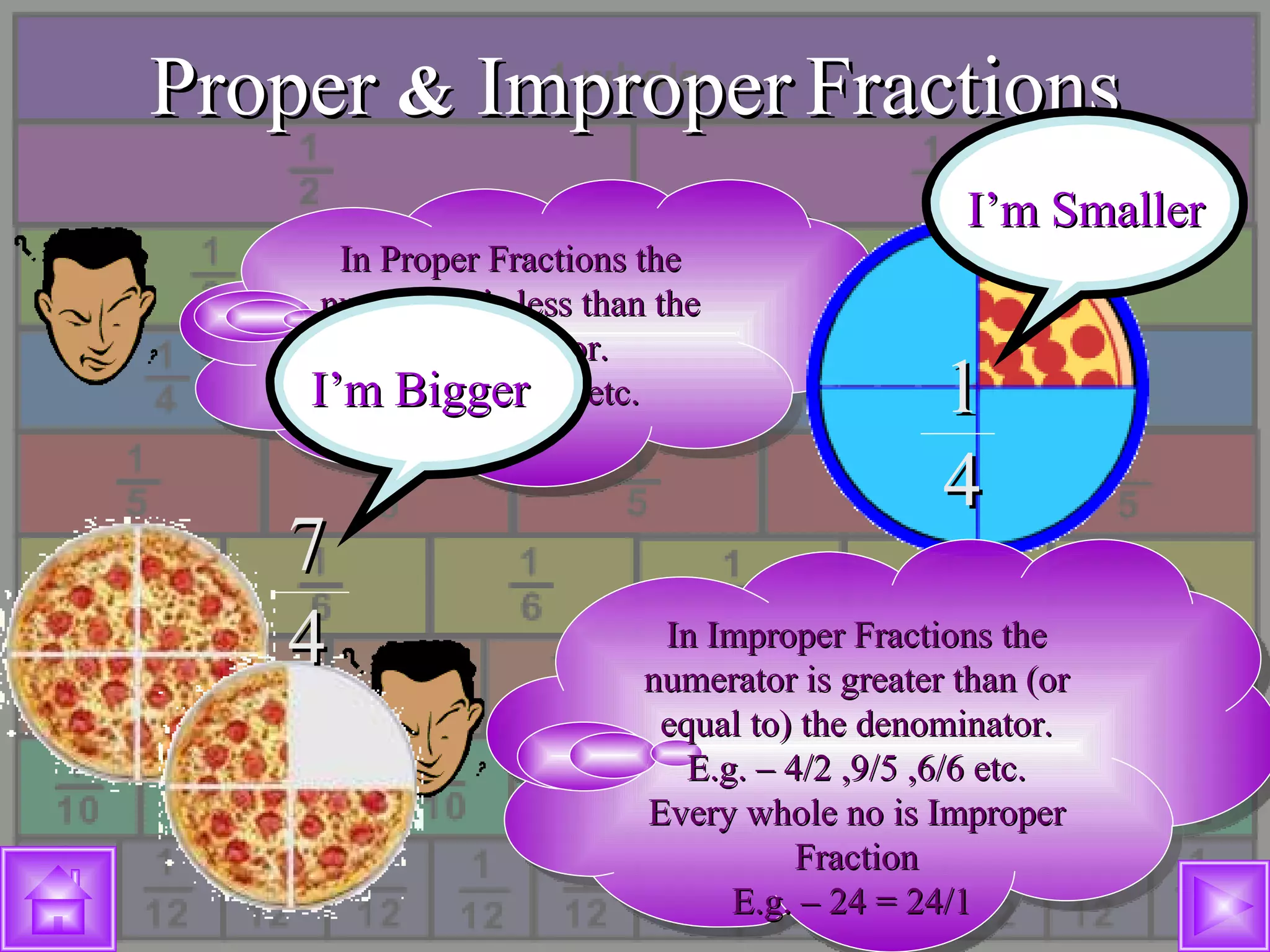
Proper  &  Improper   Fractions In Proper Fractions the numerator is less than the denominator. E.g.. – 1/2 ,3/4 ,2/7 etc.   In Improper Fractions the numerator is greater than (or equal to)   the denominator. E.g. – 4/2 ,9/5 ,6/6 etc. Every whole no is Improper Fraction E.g. – 24 = 24/1  1 4 7 4 I’m Smaller I’m Bigger
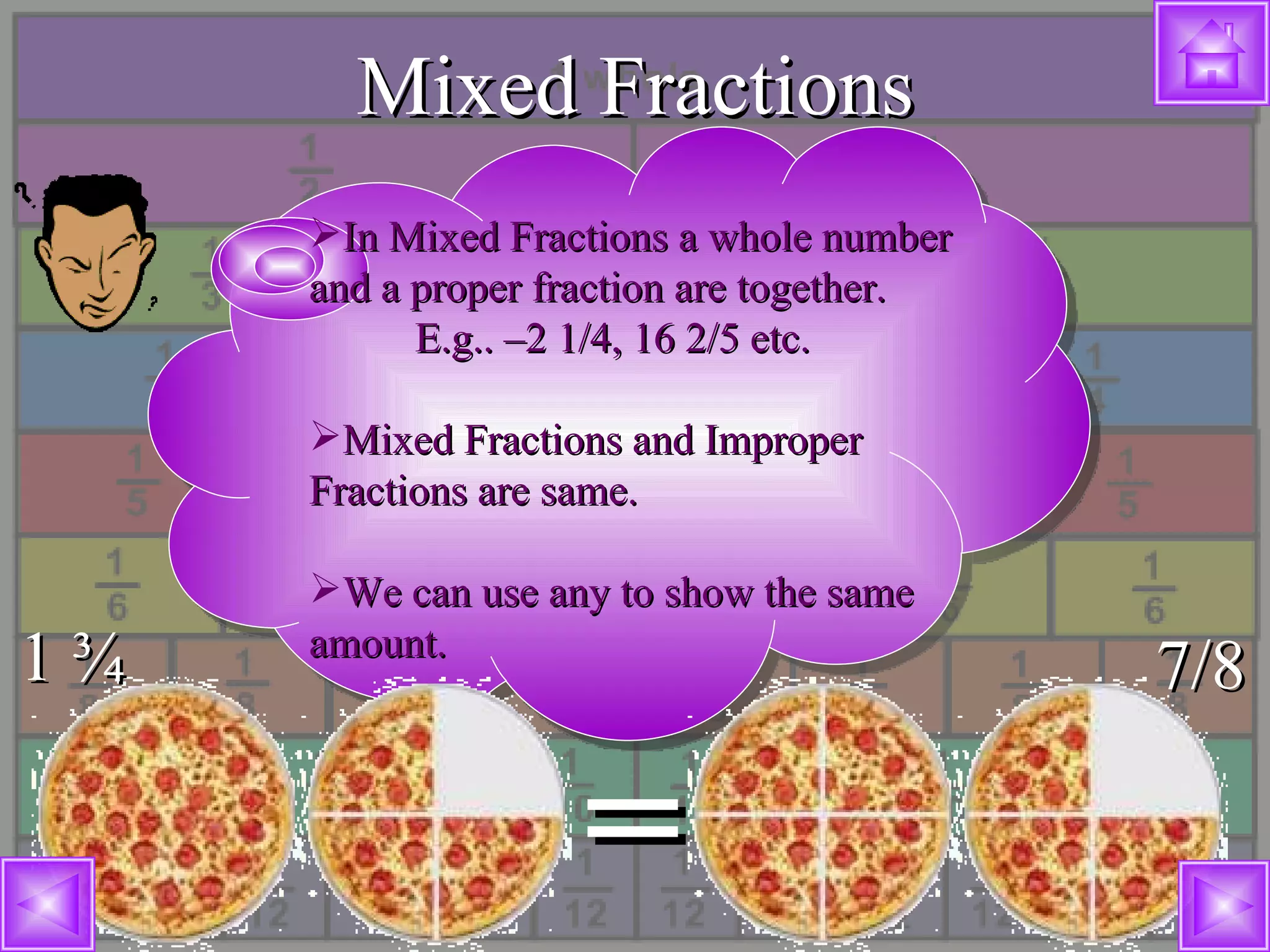
Mixed Fractions 1 ¾ 7/8 In Mixed Fractions a whole number and a proper fraction are together. E.g.. –2 1/4, 16 2/5 etc. Mixed Fractions and Improper Fractions are same. We can use any to show the same amount.  =
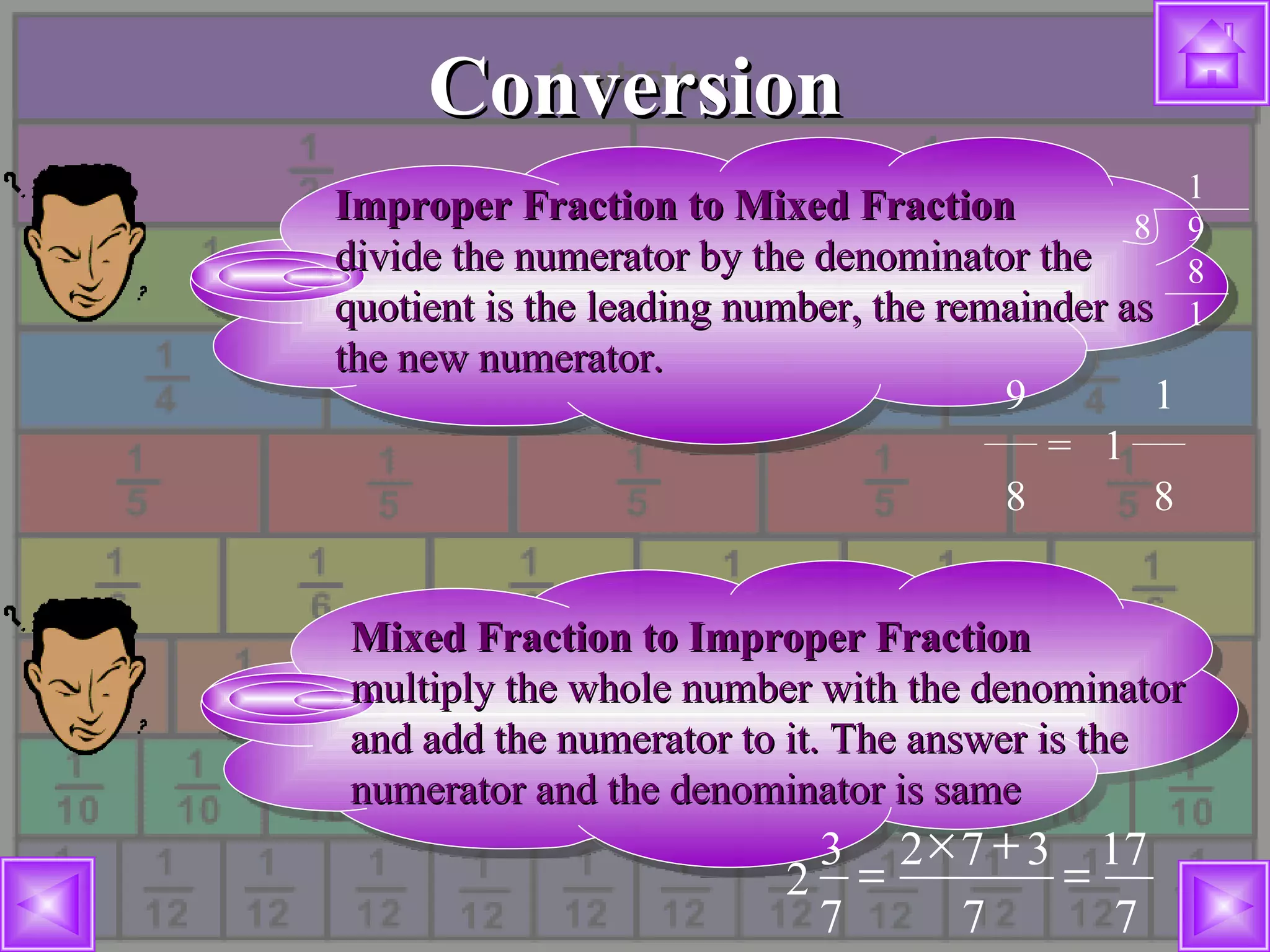
Conversion Improper   Fraction   to   Mixed   Fraction divide the numerator by the denominator the quotient is the leading number, the remainder as the new numerator. Mixed   Fraction to Improper Fraction multiply the whole number with the denominator and add the numerator to it. The answer is the numerator and the denominator is same  8 1 9 8 1 9  1 =  1  8  8 7 17 7 3 7 2 7 3 2    
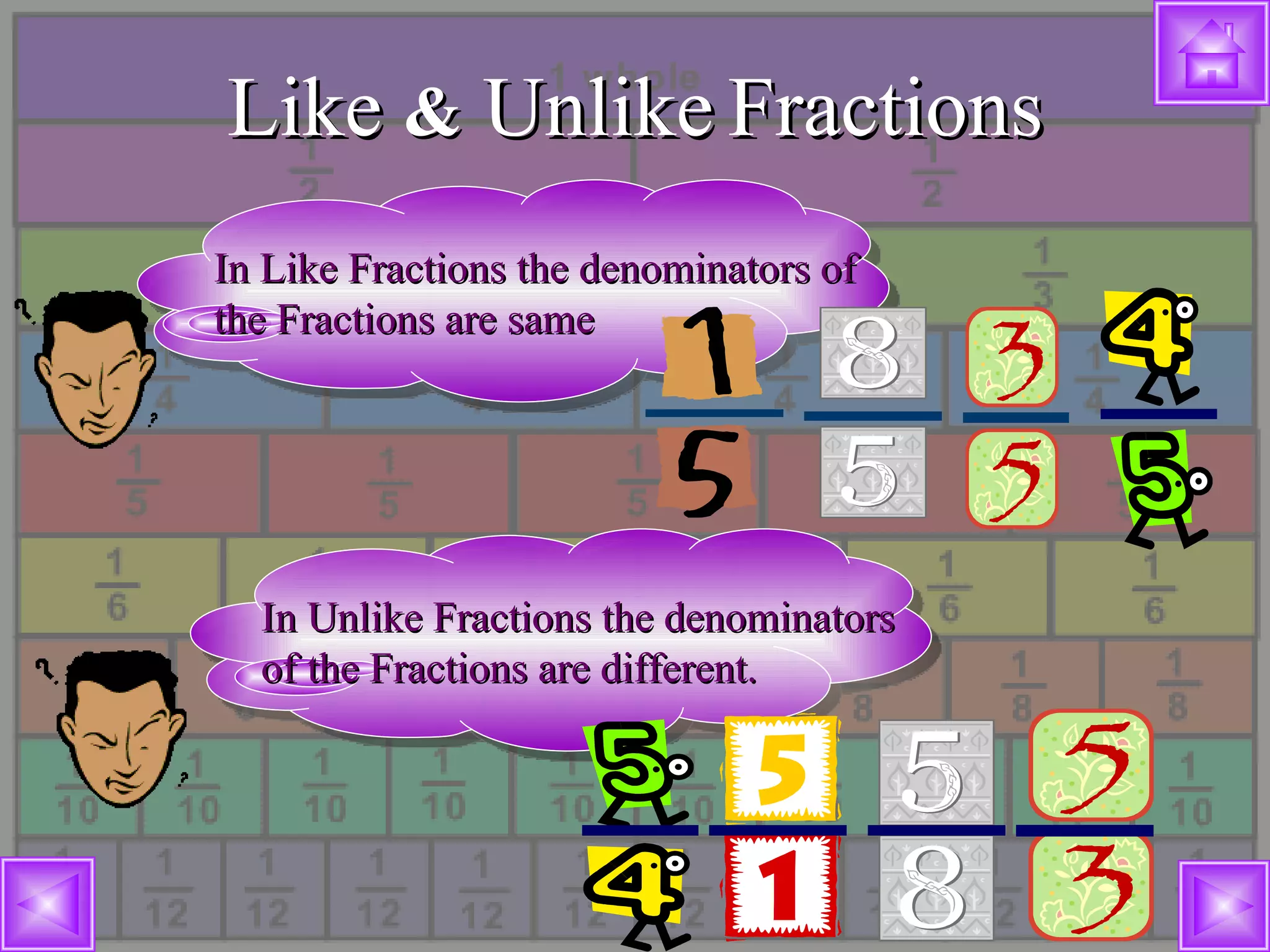
Like  &  Unlike   Fractions     In Like Fractions the denominators of the Fractions are same In Unlike Fractions the denominators of the Fractions are different.
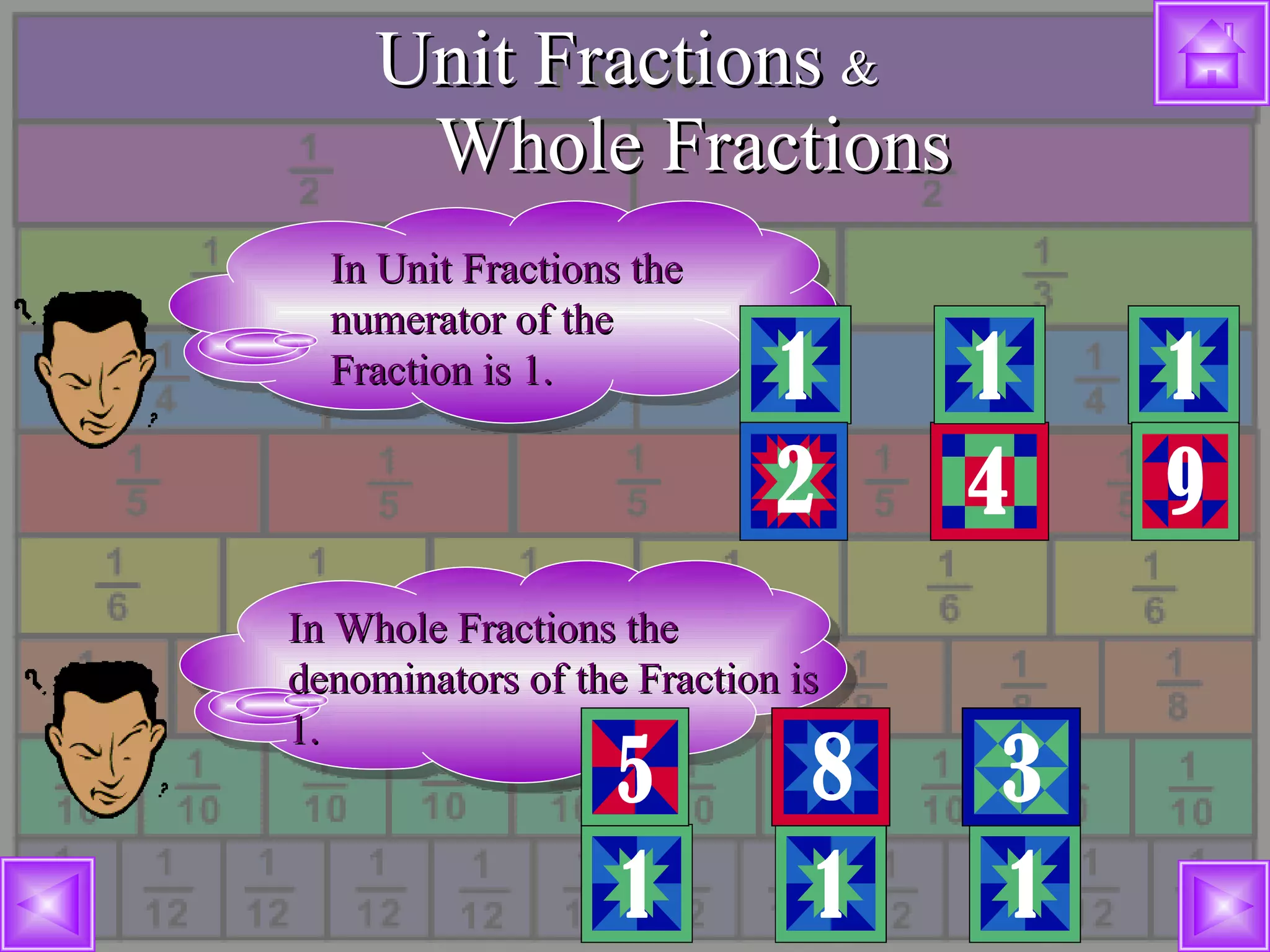
Unit Fractions   &   Whole Fractions     In Unit Fractions the numerator of the Fraction is 1. In Whole Fractions the denominators of the Fraction is 1.
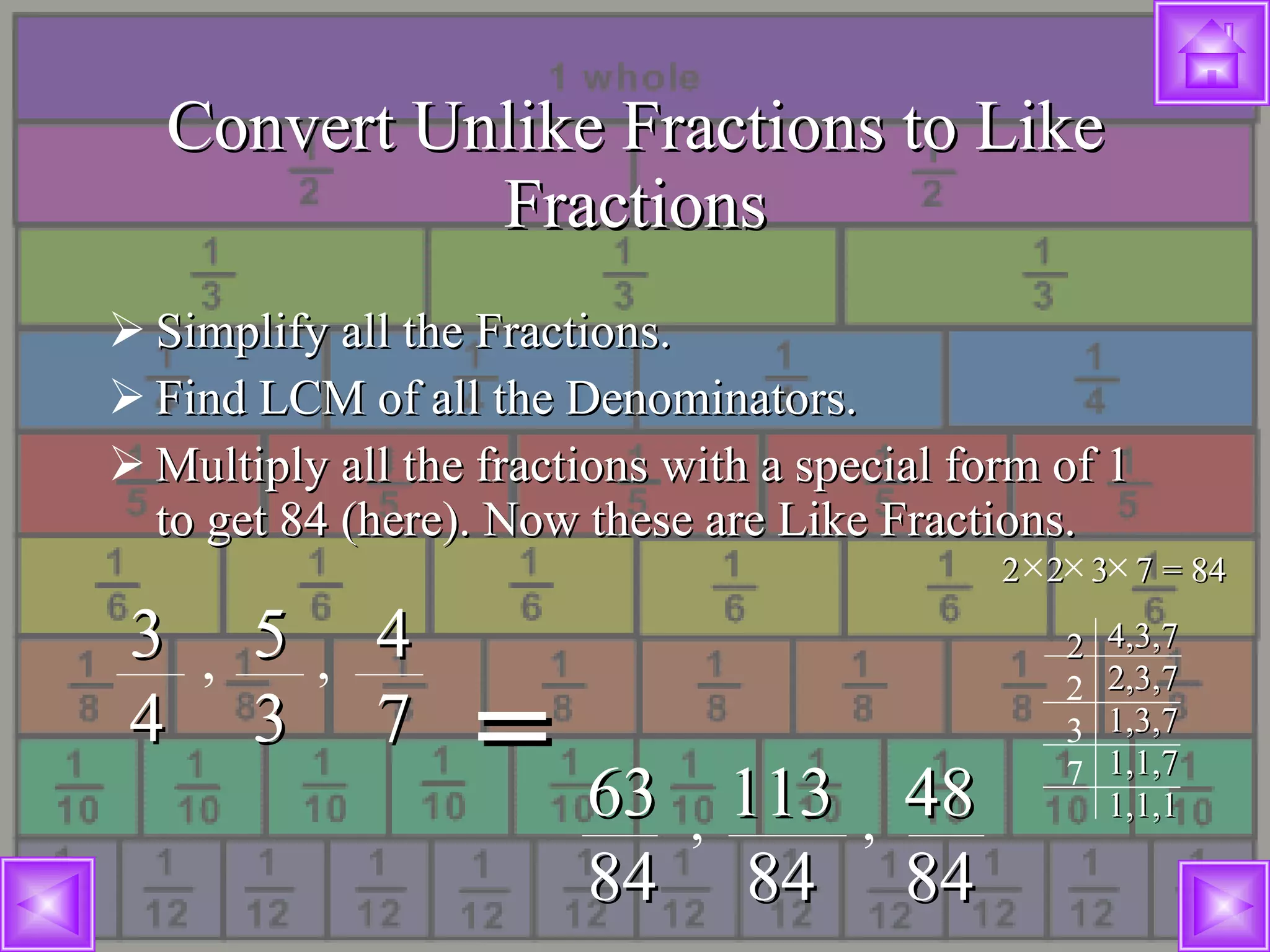
Convert Unlike Fractions to Like Fractions Simplify all the Fractions. Find LCM of all the Denominators. Multiply all the fractions with a special form of 1 to get 84 (here). Now these are Like Fractions. = 3  5  4 4  3  7 , , 4,3,7 2,3,7 1,3,7 1,1,7 1,1,1 2 2 3 7 2  2  3  7 = 84    63  113  48 84  84  84 , ,
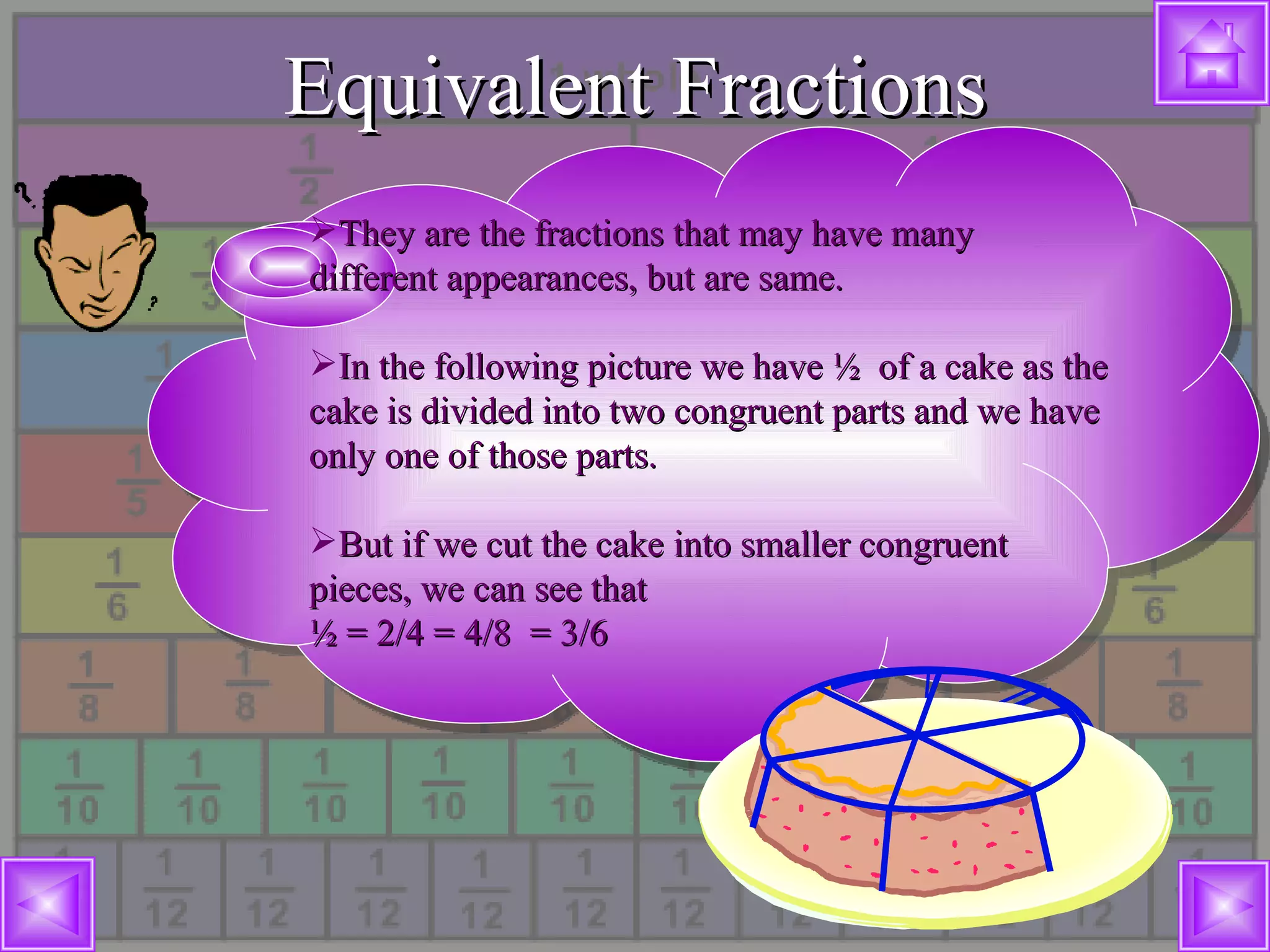
Equivalent Fractions They are the fractions that may have many different appearances, but are same. In the following picture we have ½  of a cake as the cake is divided into two congruent parts and we have only one of those parts. But if we cut the cake into smaller congruent pieces, we can see that ½ = 2/4 = 4/8  = 3/6
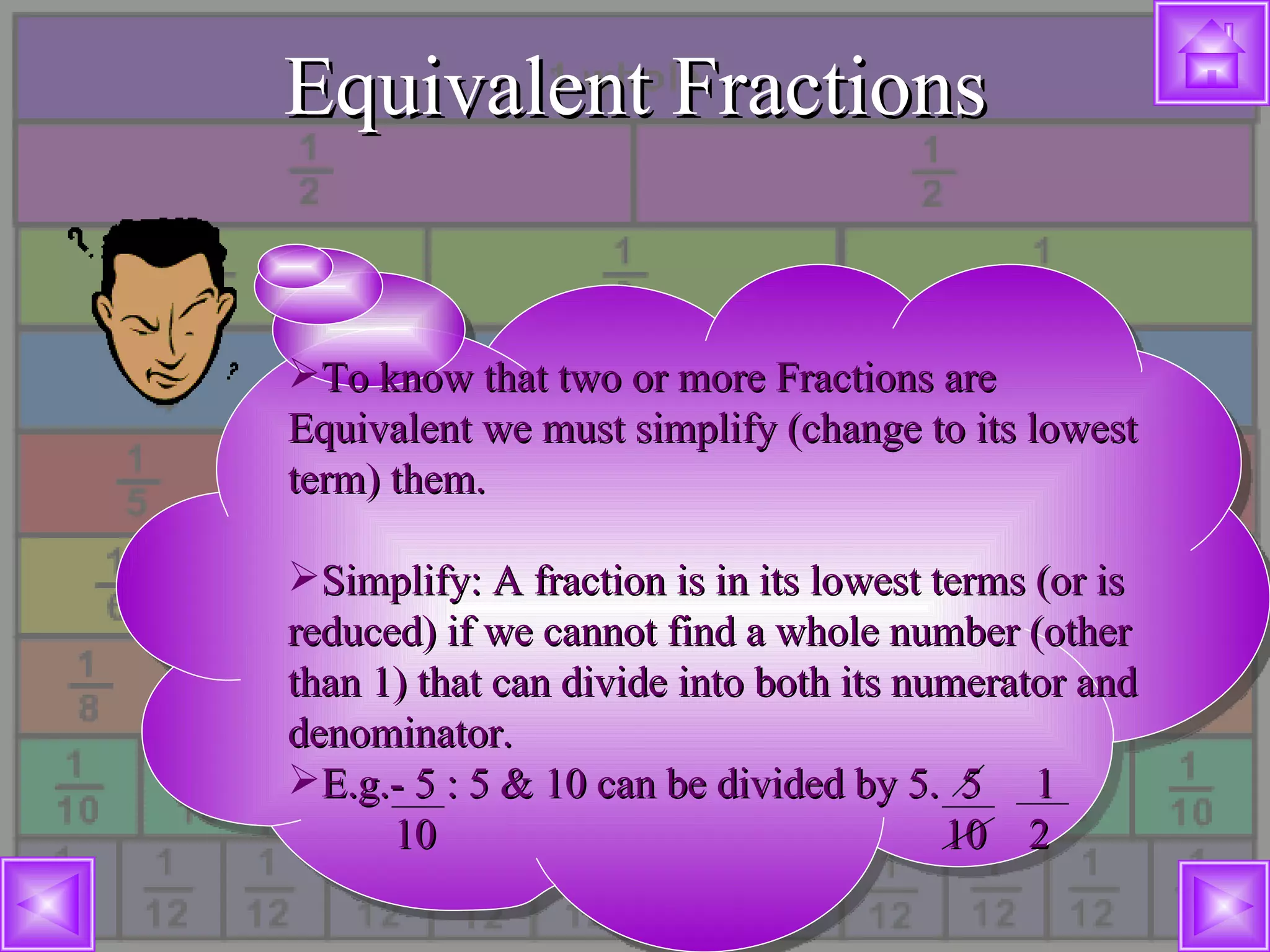
Equivalent Fractions To know that two or more Fractions are Equivalent we must simplify (change to its lowest term) them. Simplify: A fraction is in its lowest terms (or is reduced) if we cannot find a whole number (other than 1) that can divide into both its numerator and denominator. E.g.- 5 : 5 & 10 can be divided by 5.  5  1 10  10  2
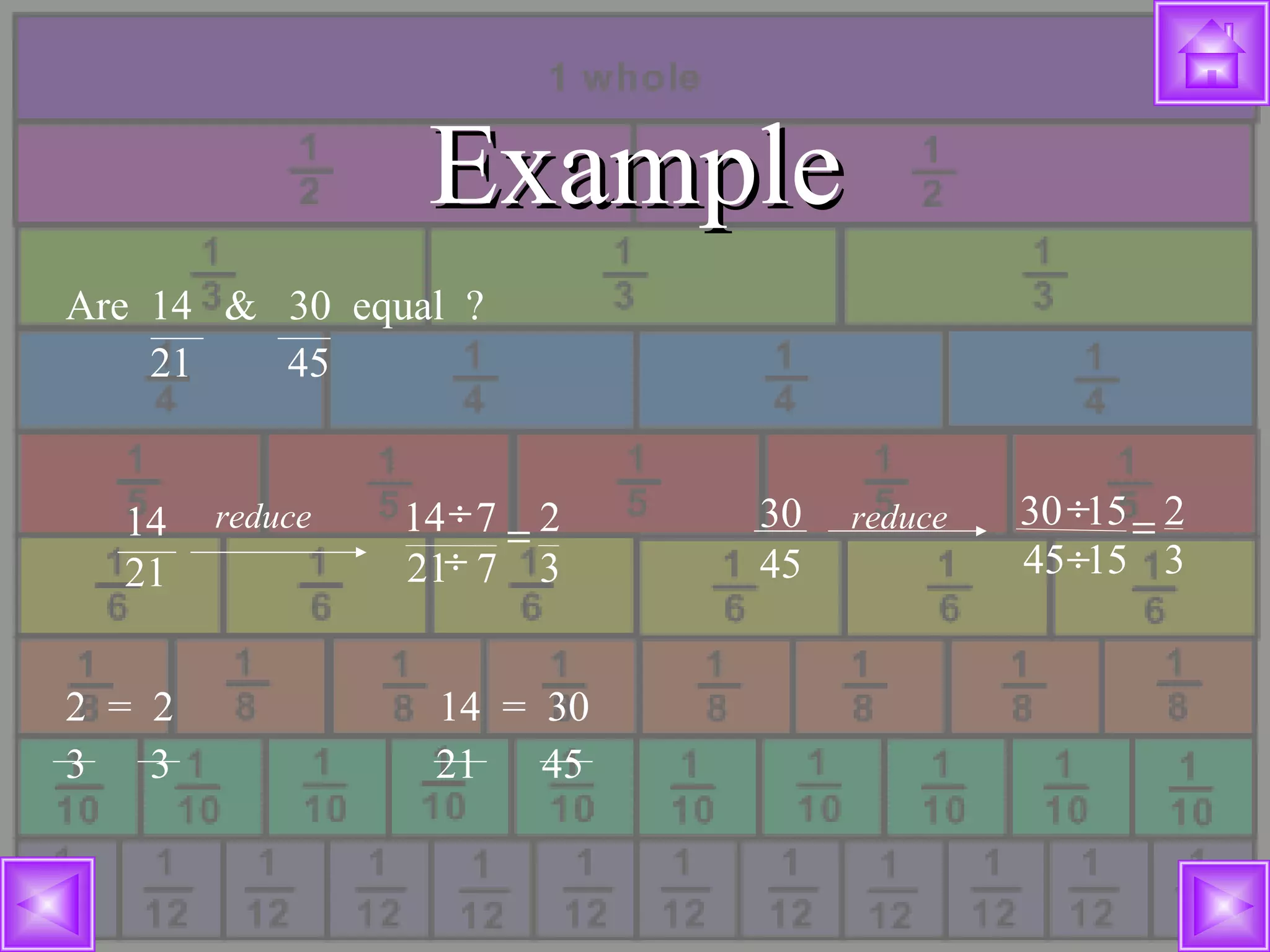
Example Are  14  &  30  equal  ? 21  45 2  =  2  14  =  30  3  3  21  45 reduce 3 2 7 21 7 14    14 21 reduce 3 2 15 45 15 30    30 45
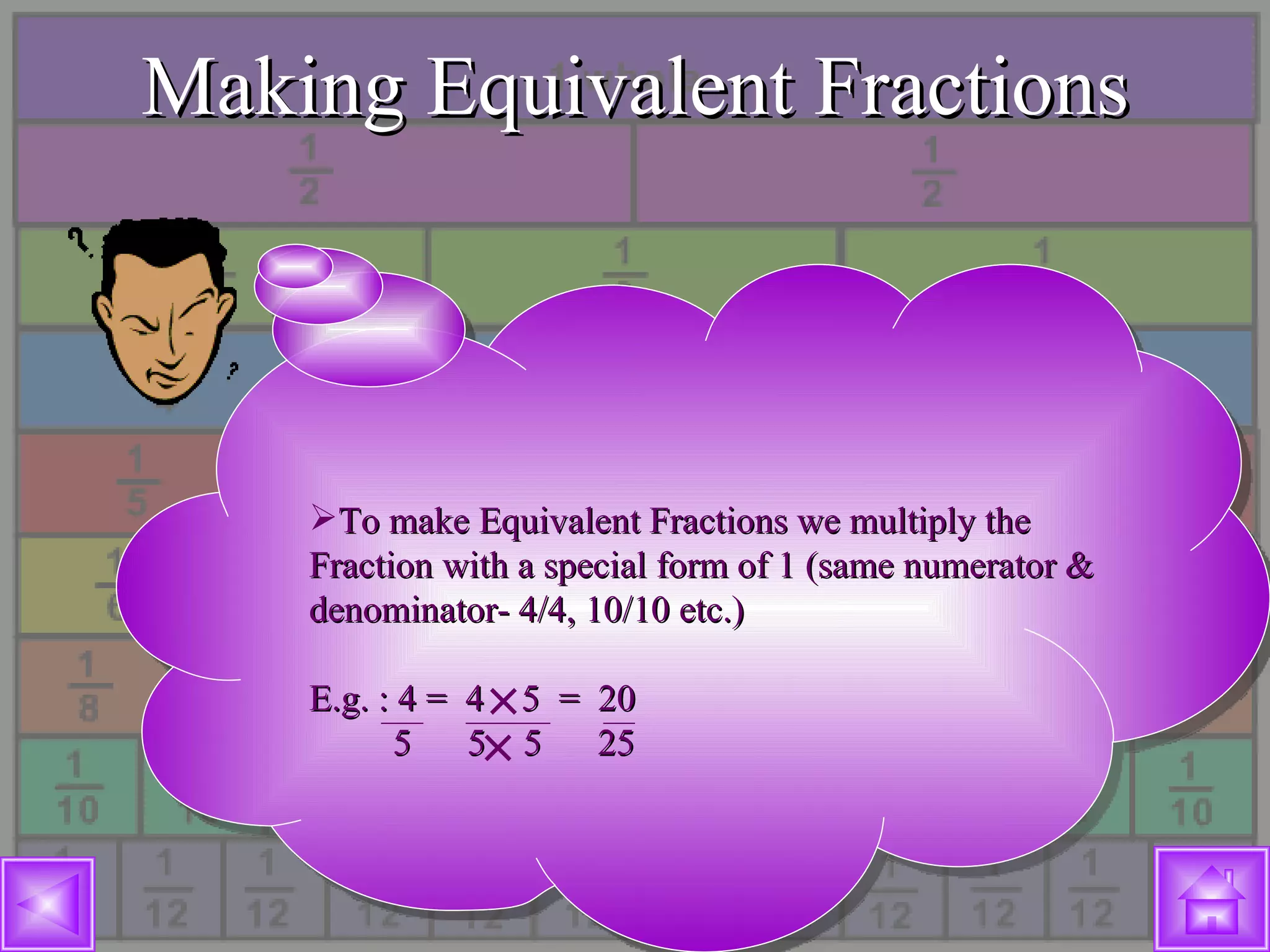
Making Equivalent Fractions To make Equivalent Fractions we multiply the Fraction with a special form of 1 (same numerator & denominator- 4/4, 10/10 etc.) E.g. : 4 =  4  5  =  20 5  5  5  25  
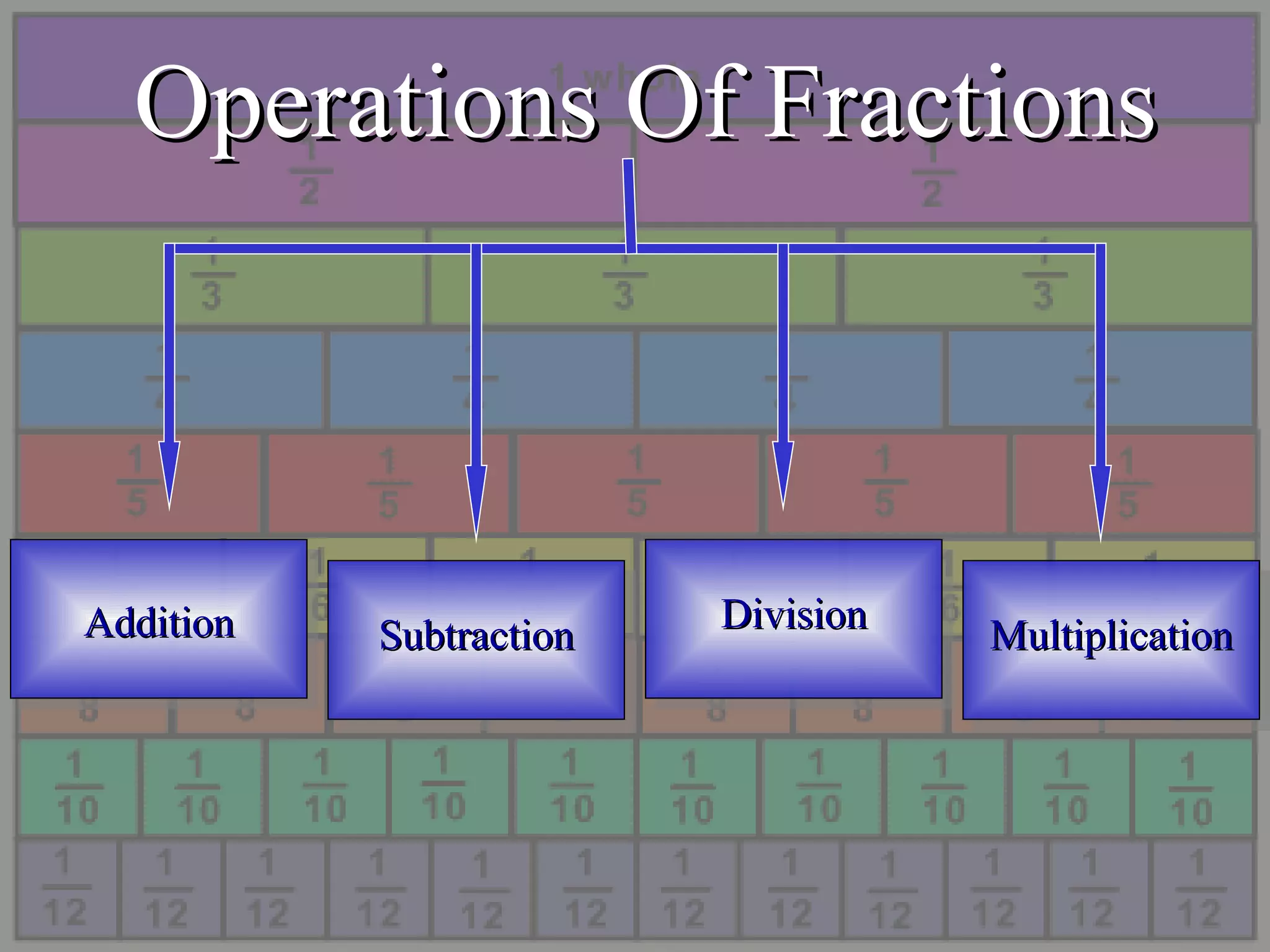
Operations Of Fractions Subtraction Multiplication Addition Division
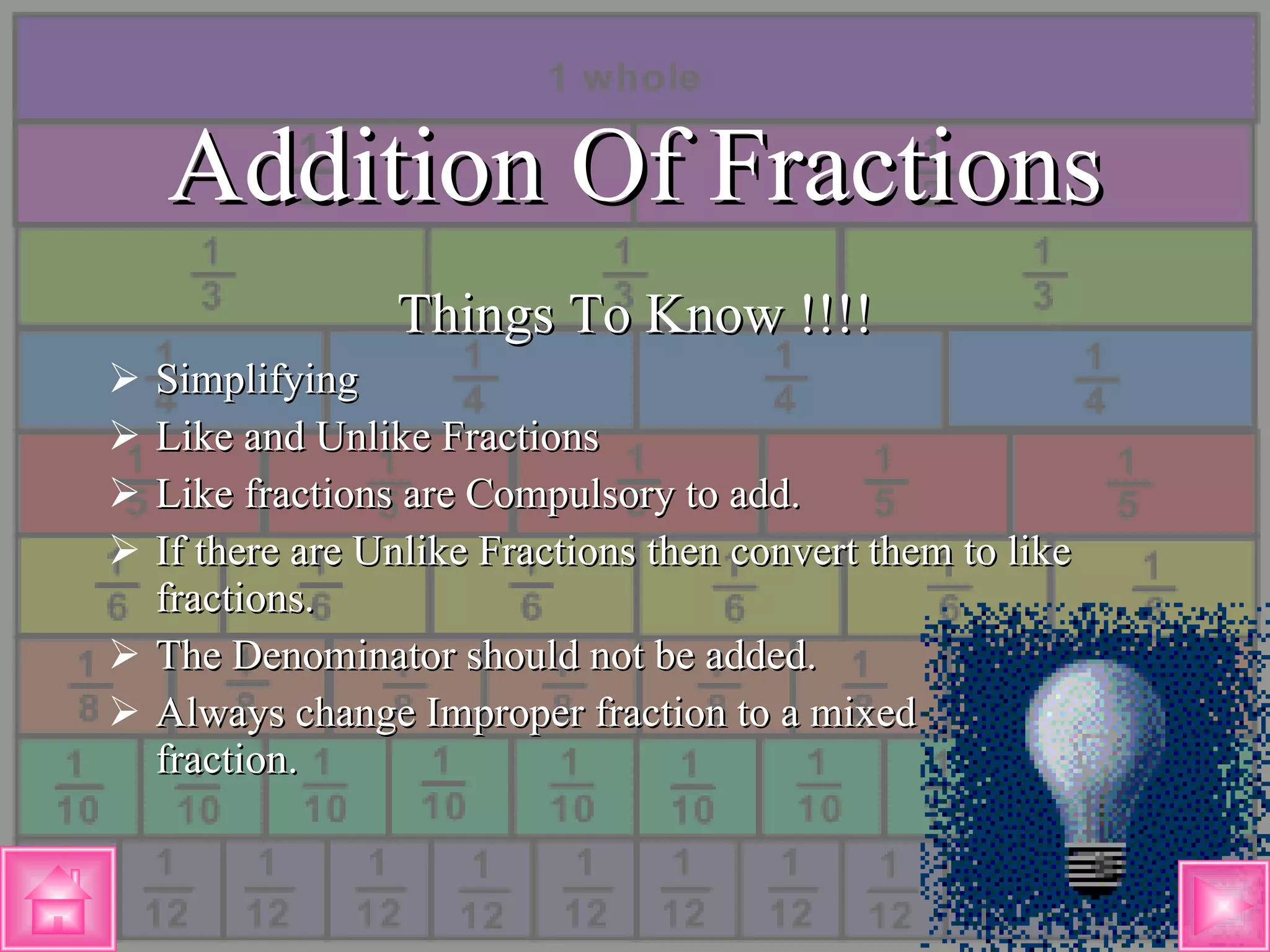
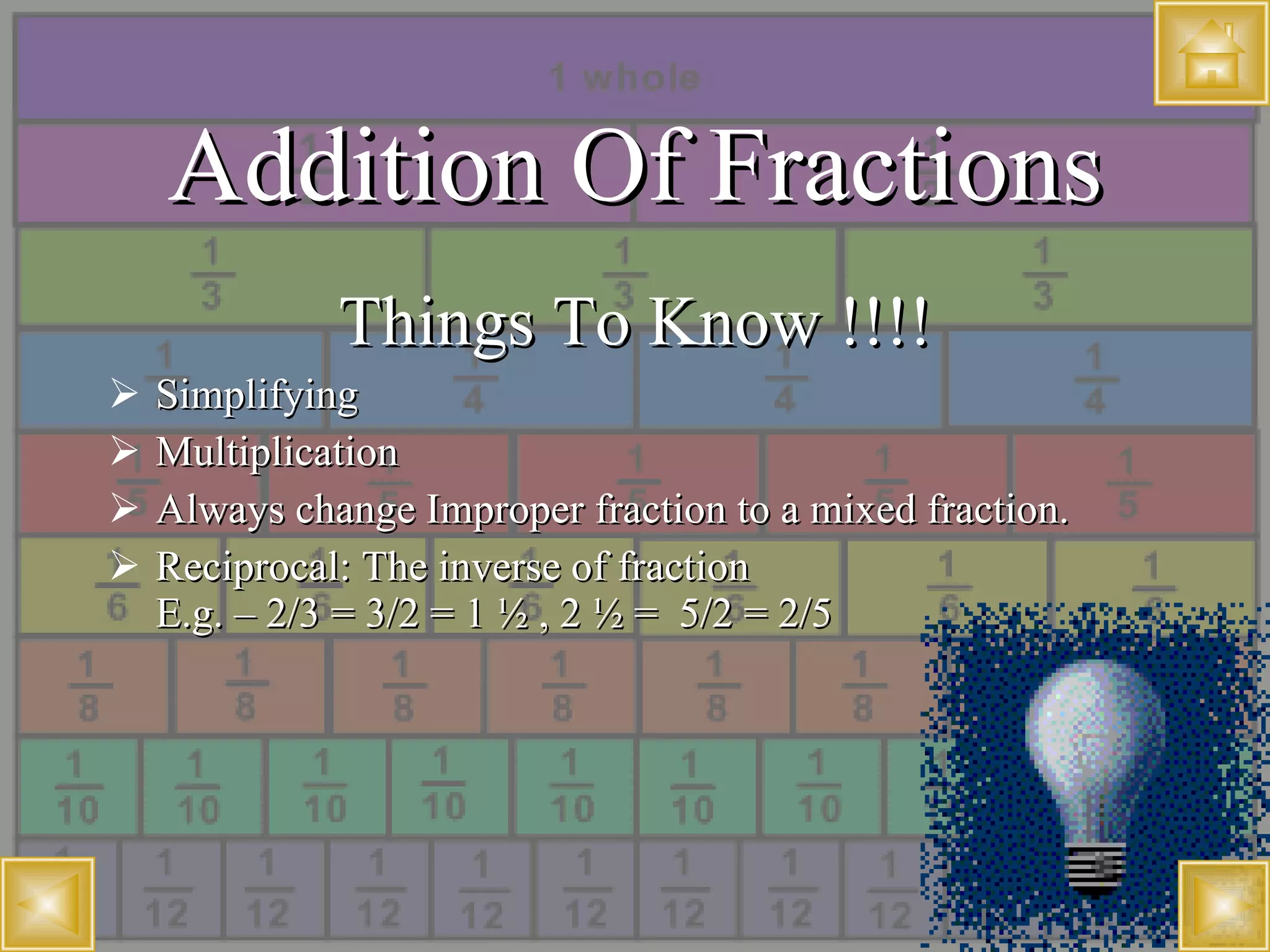
Addition Of Fractions Things To Know !!!! Simplifying Like and Unlike Fractions Like fractions are Compulsory to add. If there are Unlike Fractions then convert them to like fractions. The Denominator should not be added. Always change Improper fraction to a mixed  fraction.
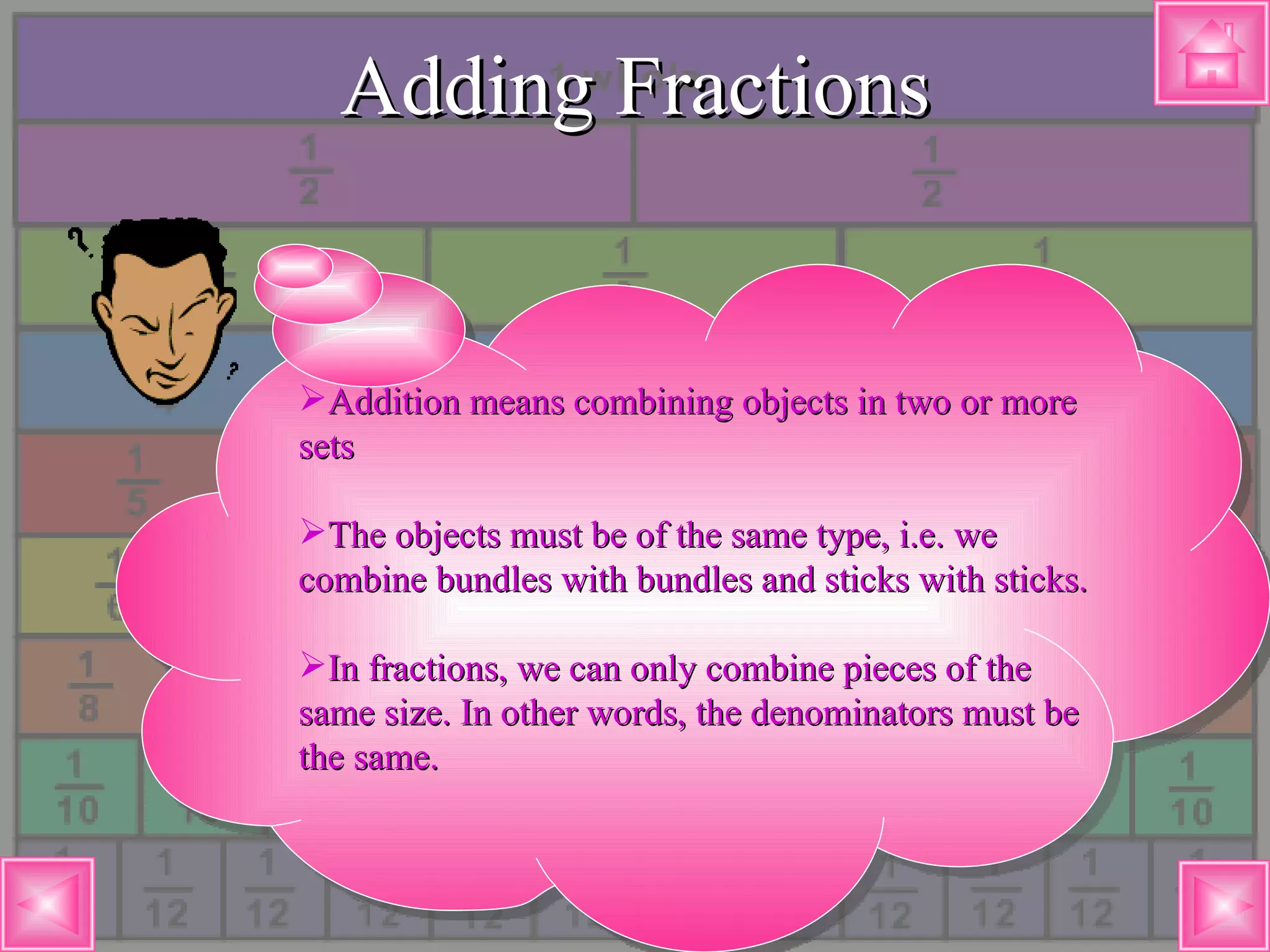
Adding Fractions Addition means combining objects in two or more sets The objects must be of the same type, i.e. we combine bundles with bundles and sticks with sticks. In fractions, we can only combine pieces of the same size. In other words, the denominators must be the same.
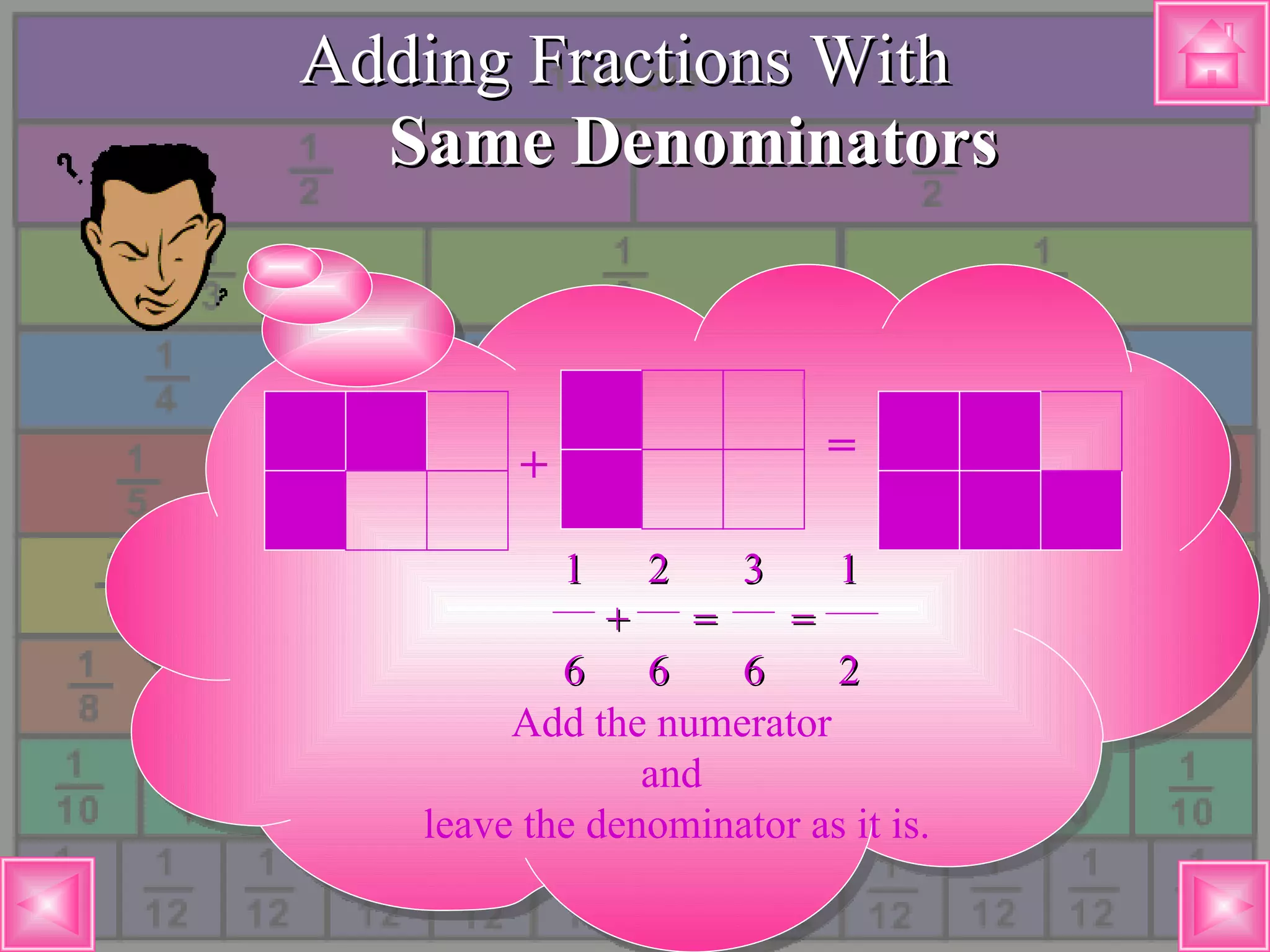
Adding Fractions With   Same Denominators Add the numerator  and  leave the denominator as it is. + = 1  2  3  1 +  =  =  6  6  6  2
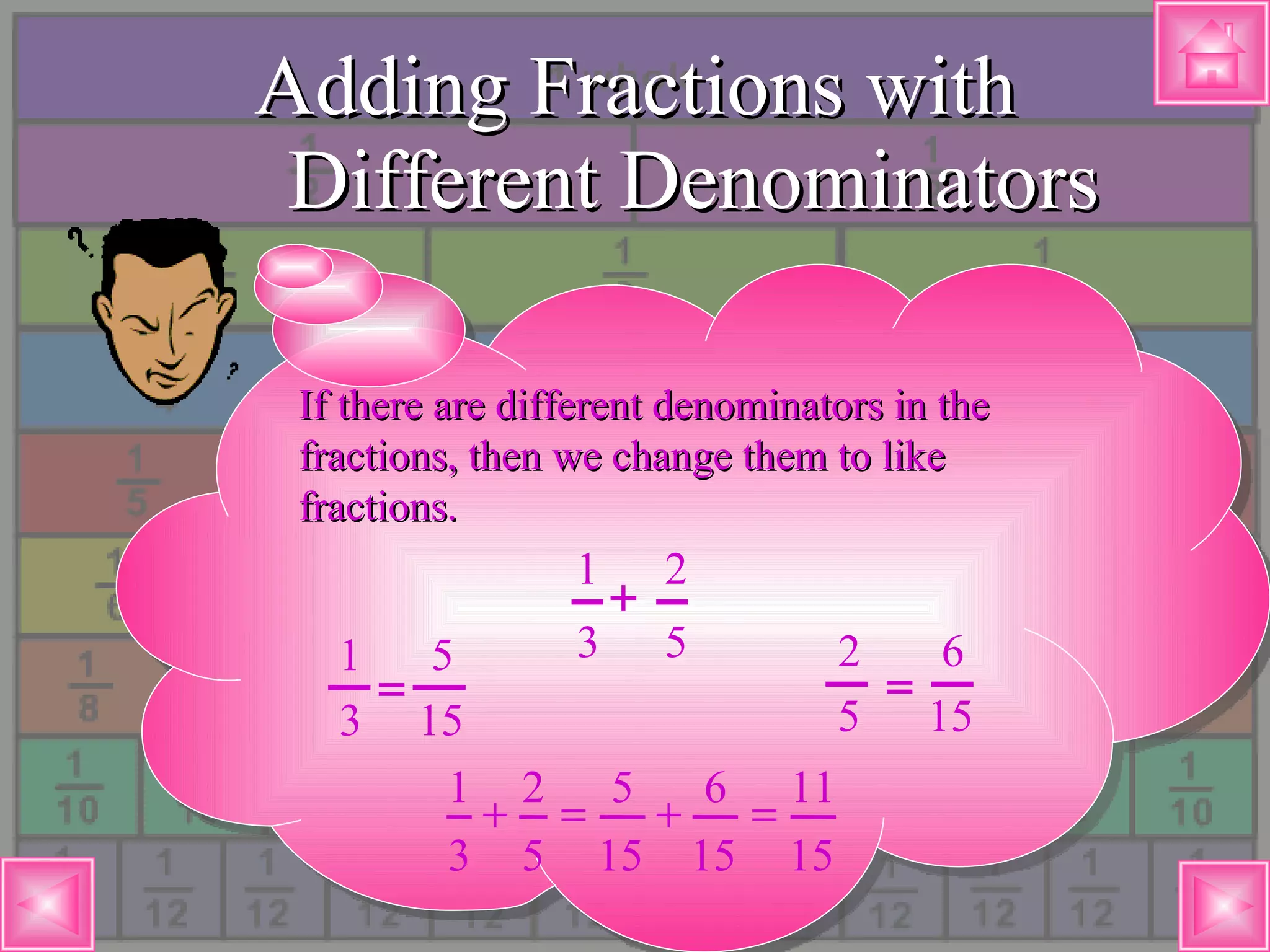
Adding Fractions with Different Denominators If there are different denominators in the fractions, then we change them to like fractions. 15 5 3 1   5 2 15 6 5 2 3 1  15 11 15 6 15 5 5 2 3 1    
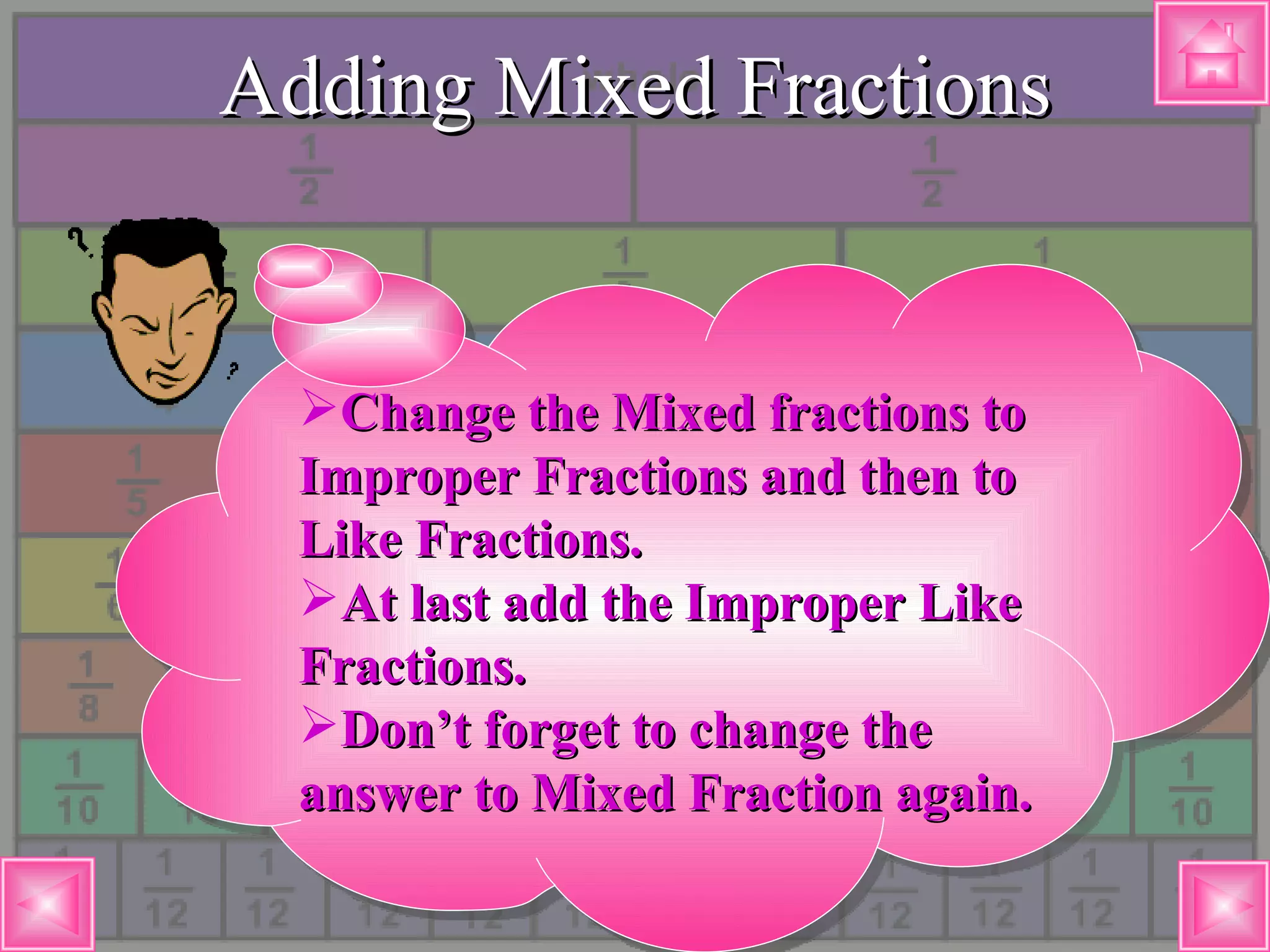
Adding Mixed Fractions Change the Mixed fractions to Improper Fractions and then to Like Fractions. At last add the Improper Like Fractions. Don’t forget to change the answer to Mixed Fraction again.
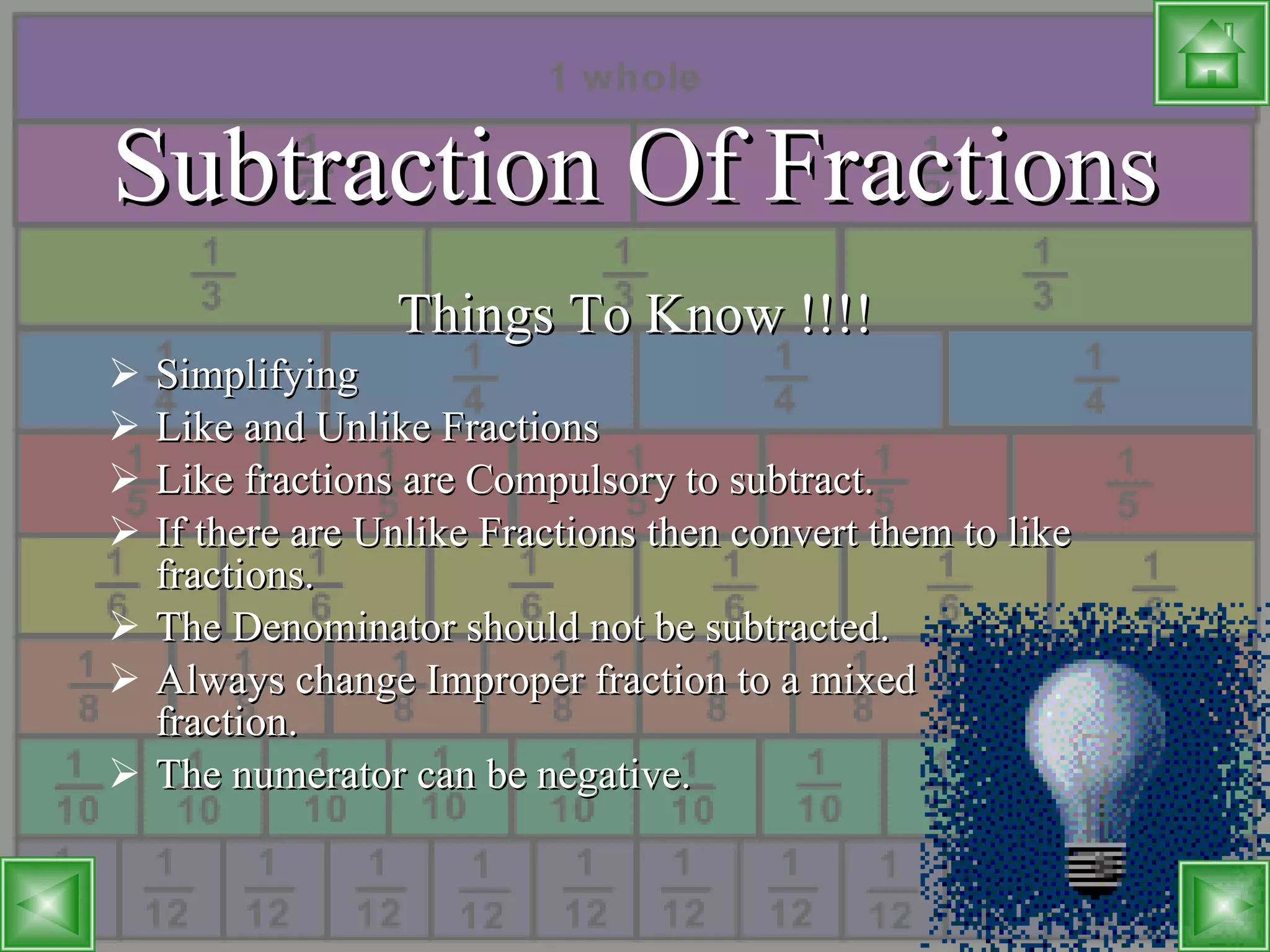
Subtraction Of Fractions Things To Know !!!! Simplifying Like and Unlike Fractions Like fractions are Compulsory to subtract. If there are Unlike Fractions then convert them to like fractions. The Denominator should not be subtracted. Always change Improper fraction to a mixed  fraction. The numerator can be negative.
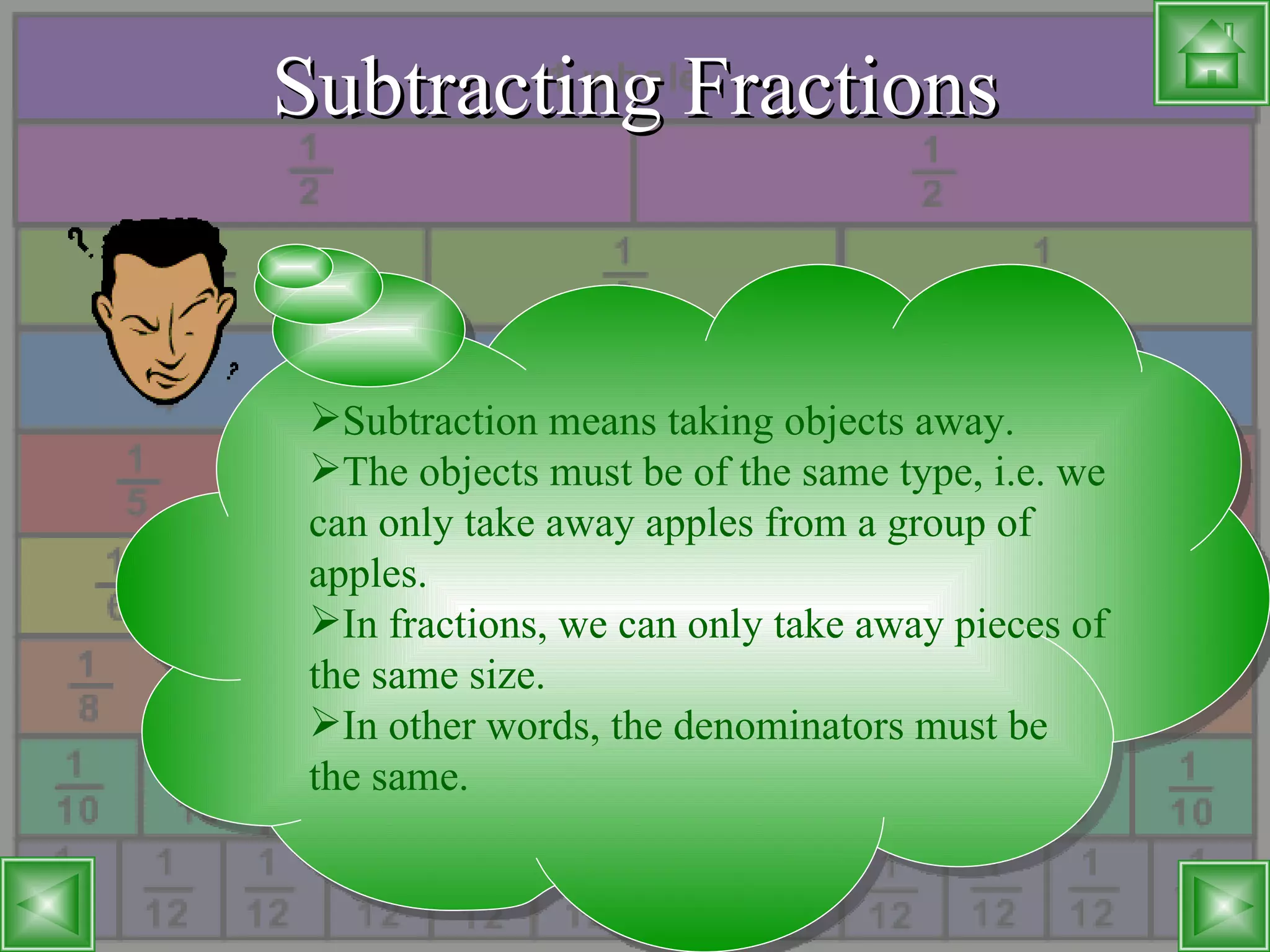
Subtracting Fractions Subtraction means taking objects away. The objects must be of the same type, i.e. we can only take away apples from a group of apples. In fractions, we can only take away pieces of the same size.  In other words, the denominators must be the same.
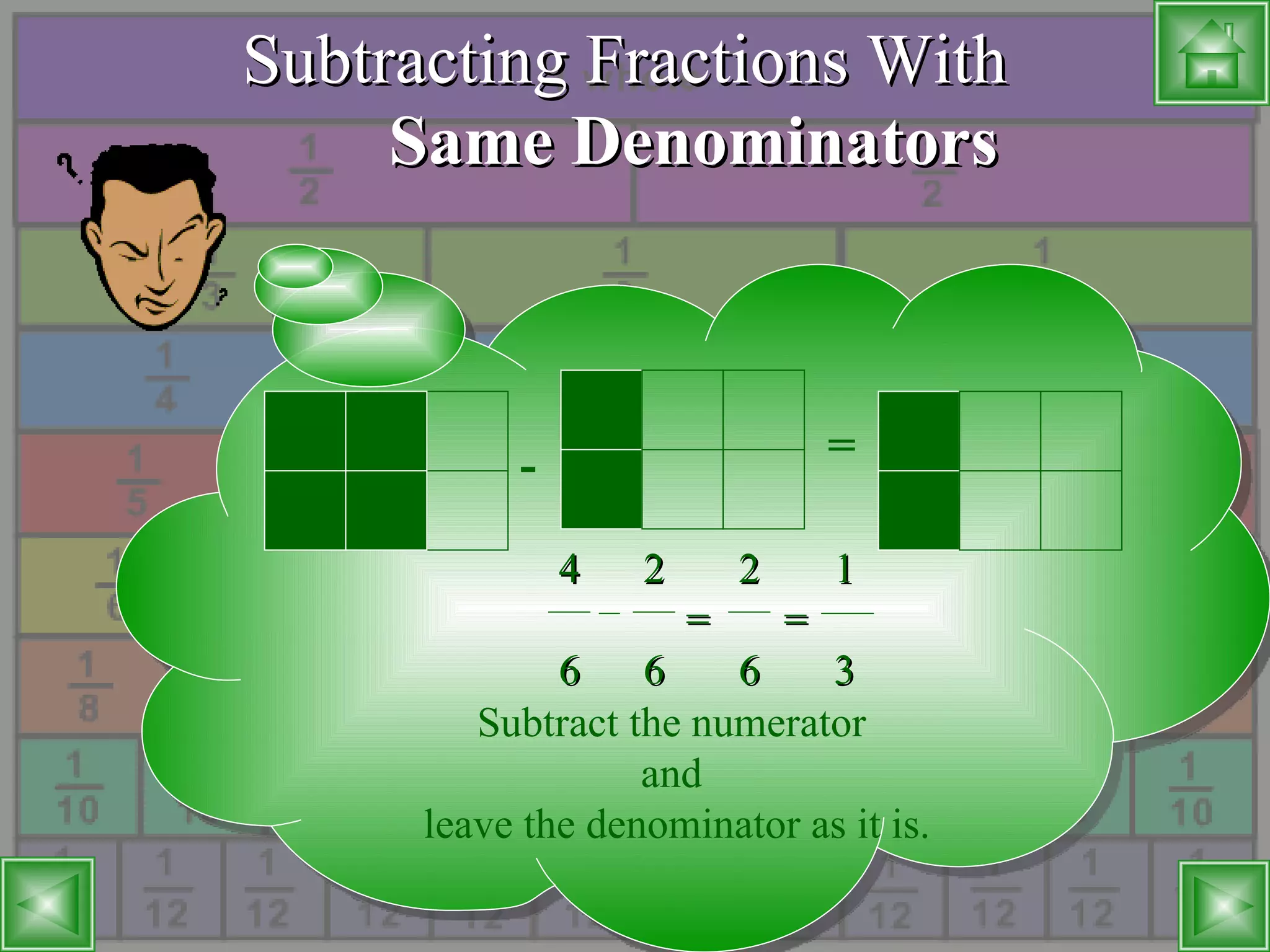
Subtracting Fractions With   Same Denominators Subtract the numerator  and  leave the denominator as it is. - = 4  2  2  1 =  =  6  6  6  3
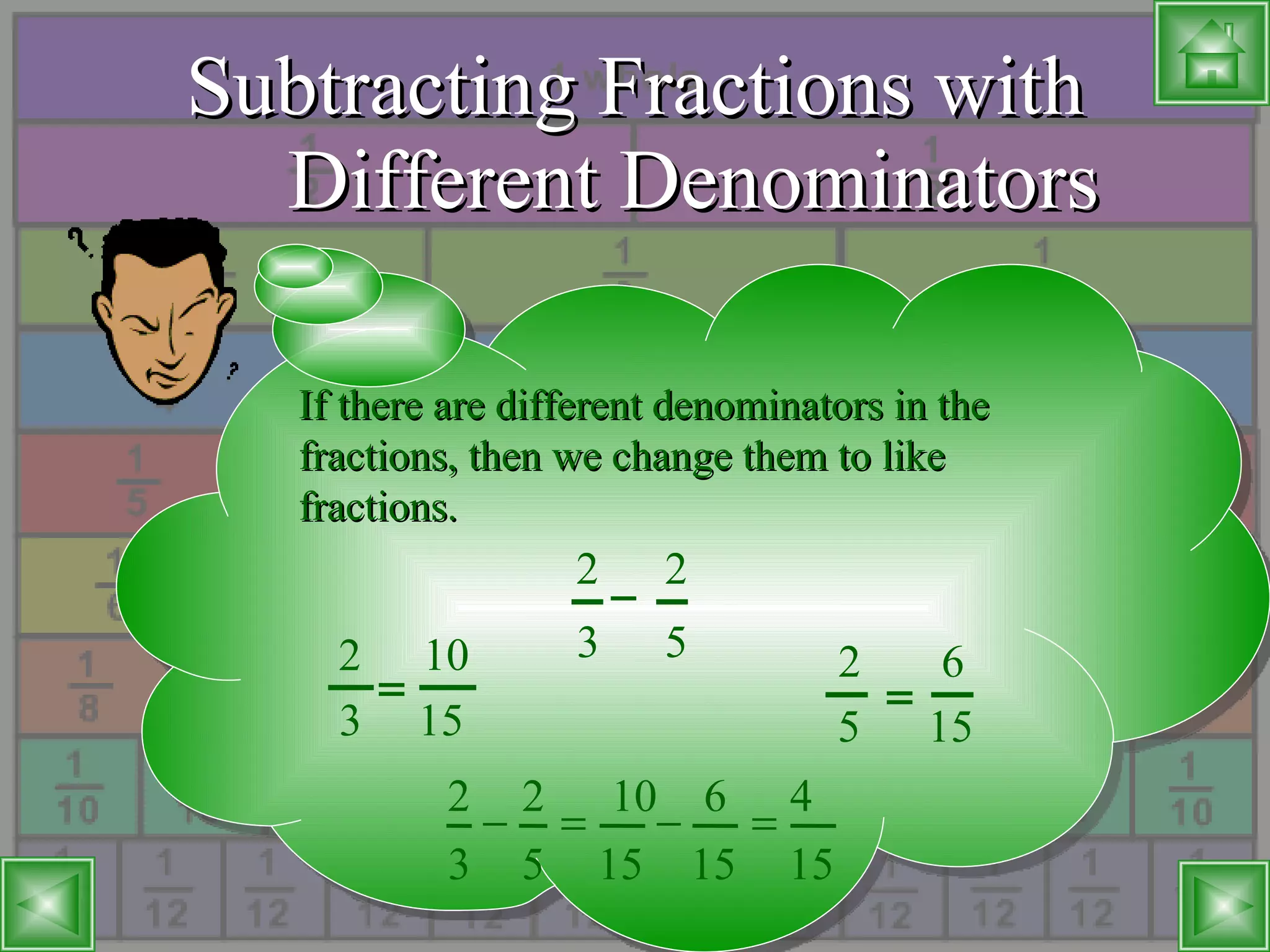
Subtracting Fractions with Different Denominators If there are different denominators in the fractions, then we change them to like fractions. 15 10 3 2   5 2 15 6 5 2 3 2  15 4 15 6 15 10 5 2 3 2    
Subtracting Mixed Fractions Change the Mixed fractions to Improper Fractions and then to Like Fractions. At last subtract the Improper Like Fractions. Don’t forget to change the answer to Mixed Fraction again.
Multiplication Of Fractions Things To Know !!!! Simplifying The Denominator are always multiplied. “  Of ” : Of means multiply. E.g. : ½ of 2 = ½  × 2 = 1   Product of two Proper Fractions is always less than both of them. Product of two Improper Fractions is always  greater  than both of them. Product of one Improper Fraction and one Proper  Fraction is always less than the Improper Fraction  and greater than the Proper Fraction.
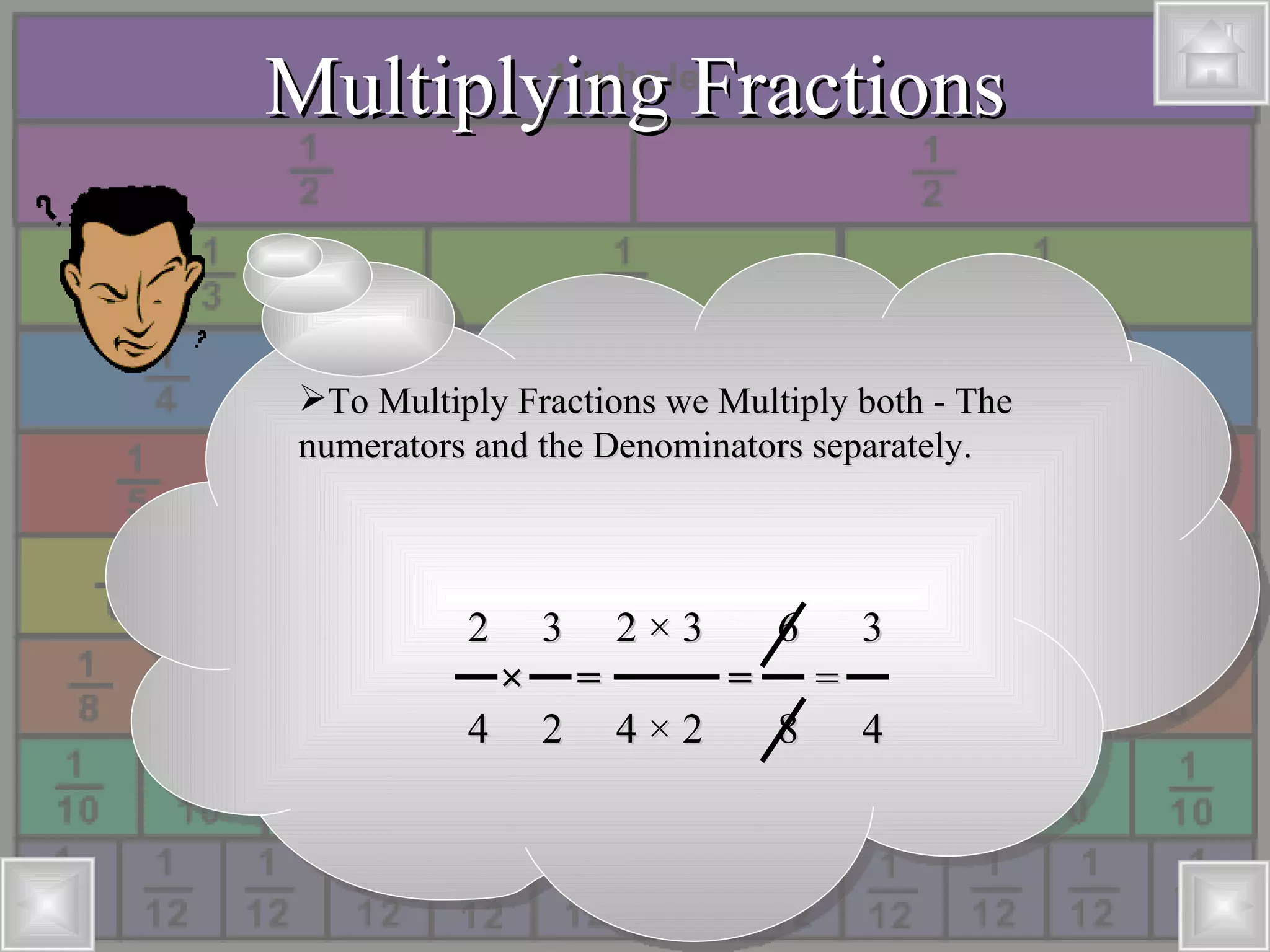
Multiplying Fractions To Multiply Fractions we Multiply both - The numerators and the Denominators separately. 2  3  2  ×  3  6  3 ×   =  =   = 4  2  4 × 2  8  4
Multiplying Mixed Fractions Change the Mixed fractions to Improper Fractions. Then multiply the Improper Fraction. Don’t forget to change the answer to Mixed Fraction again.
Addition Of Fractions Things To Know !!!! Simplifying Multiplication Always change Improper fraction to a mixed fraction. Reciprocal: The inverse of fraction  E.g. – 2/3 = 3/2 = 1 ½ , 2 ½ =  5/2 = 2/5
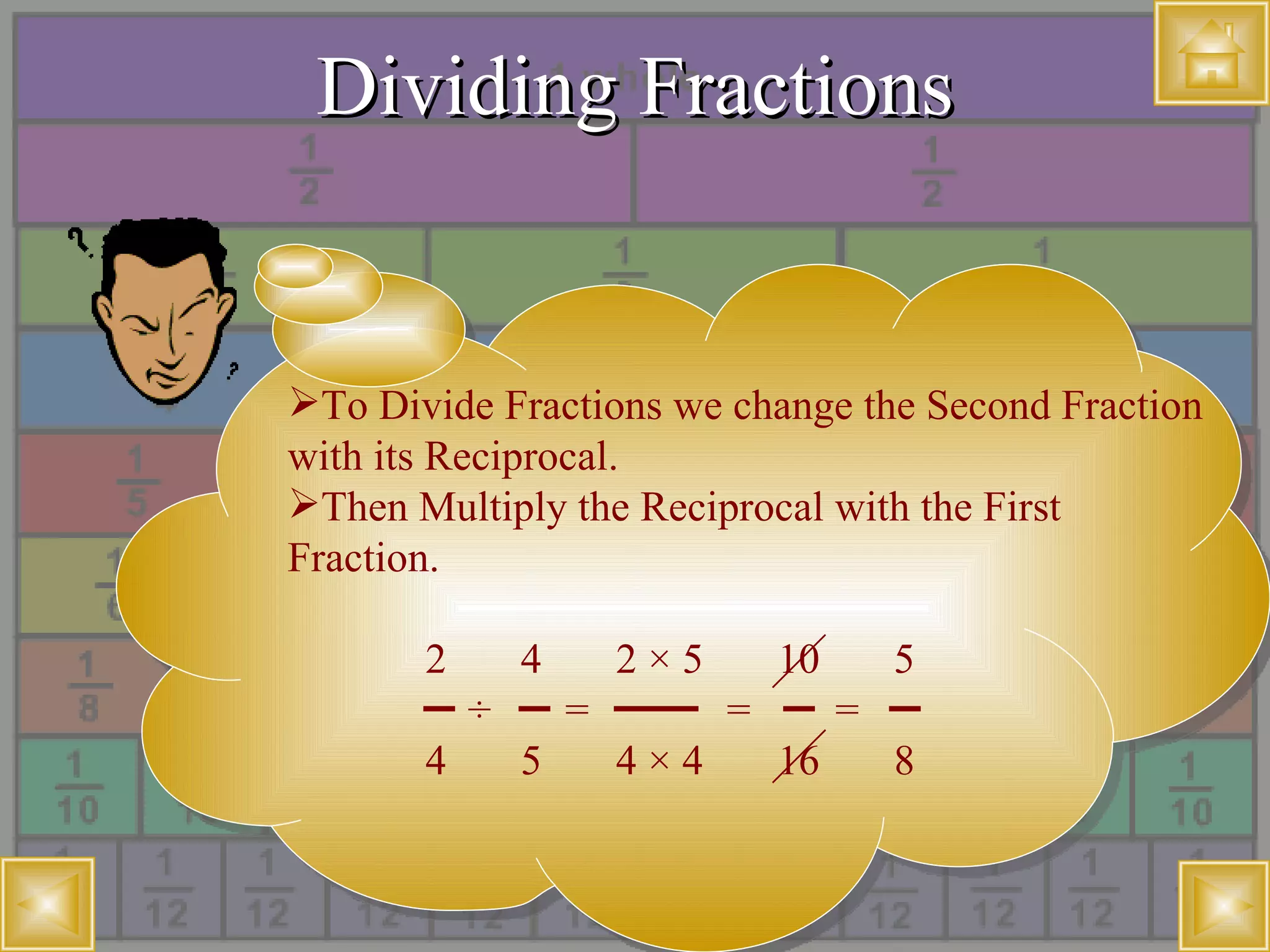
Dividing Fractions To Divide Fractions we change the Second Fraction with its Reciprocal. Then Multiply the Reciprocal with the First Fraction. 2  4  2 × 5  10  5 ÷  =  =  = 4  5  4  ×  4  16  8
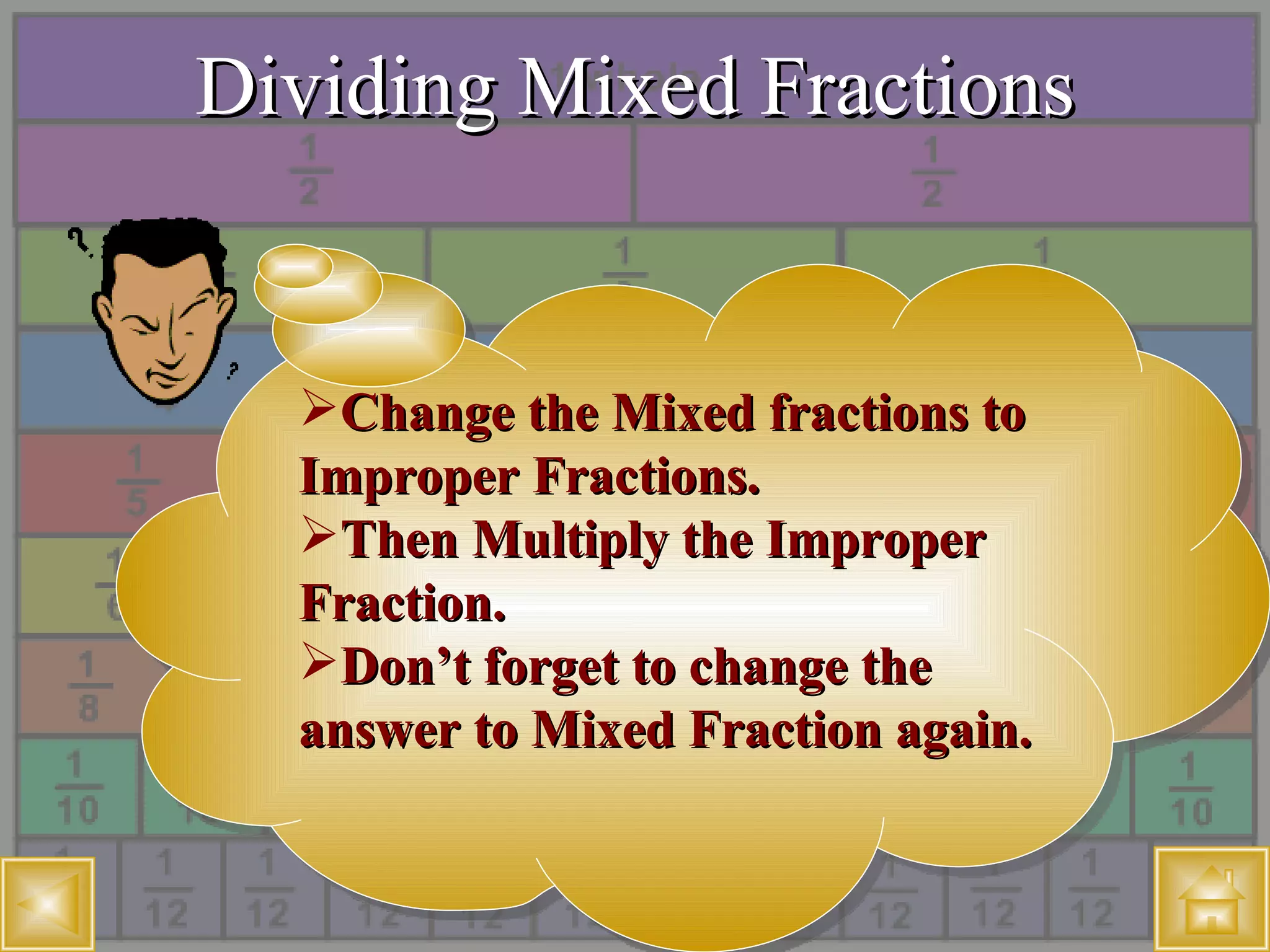
Dividing Mixed Fractions Change the Mixed fractions to Improper Fractions. Then Multiply the Improper Fraction. Don’t forget to change the answer to Mixed Fraction again.
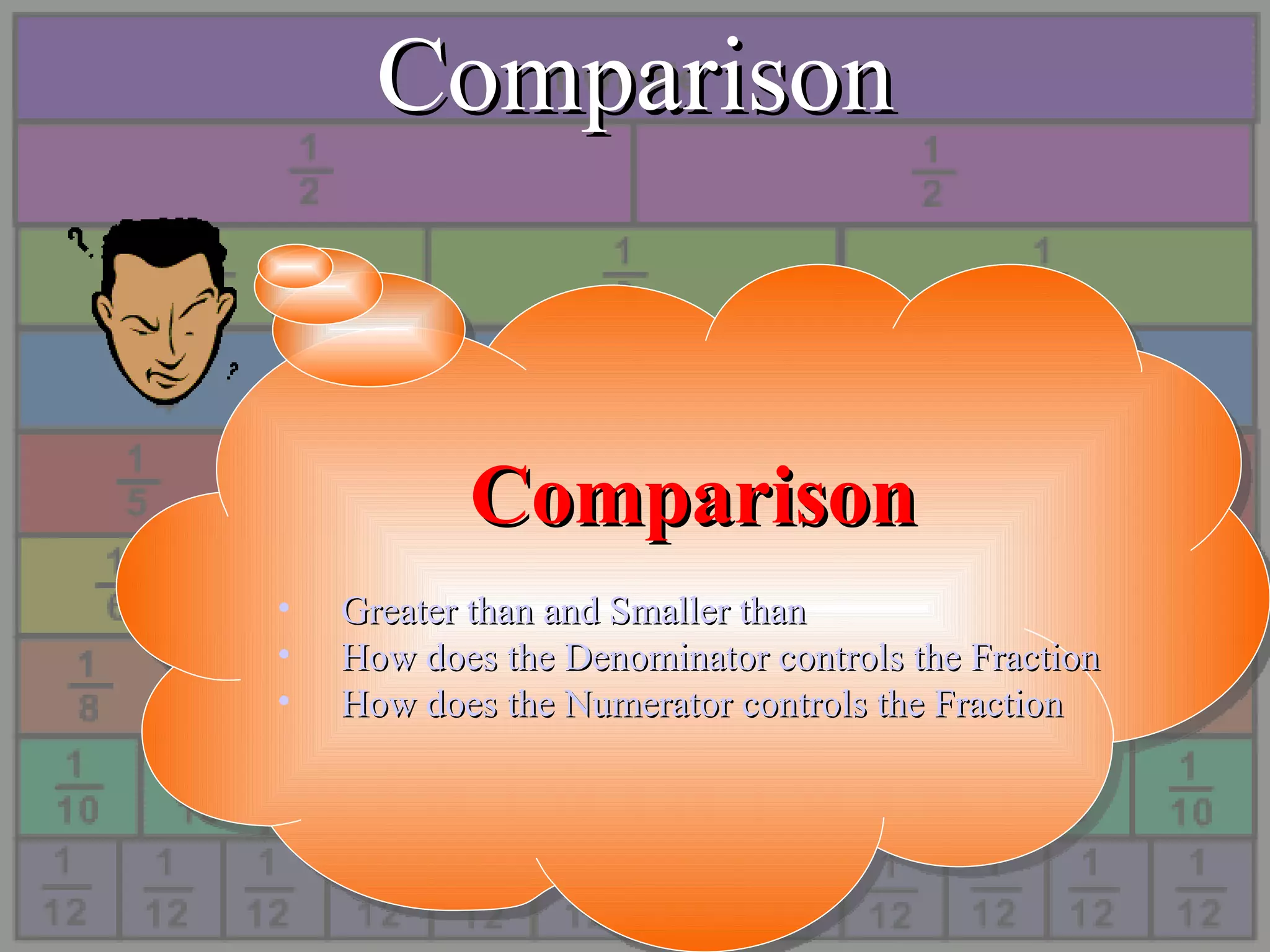
Comparison Comparison  Greater than and Smaller than How does the Denominator controls the Fraction How does the Numerator controls the Fraction
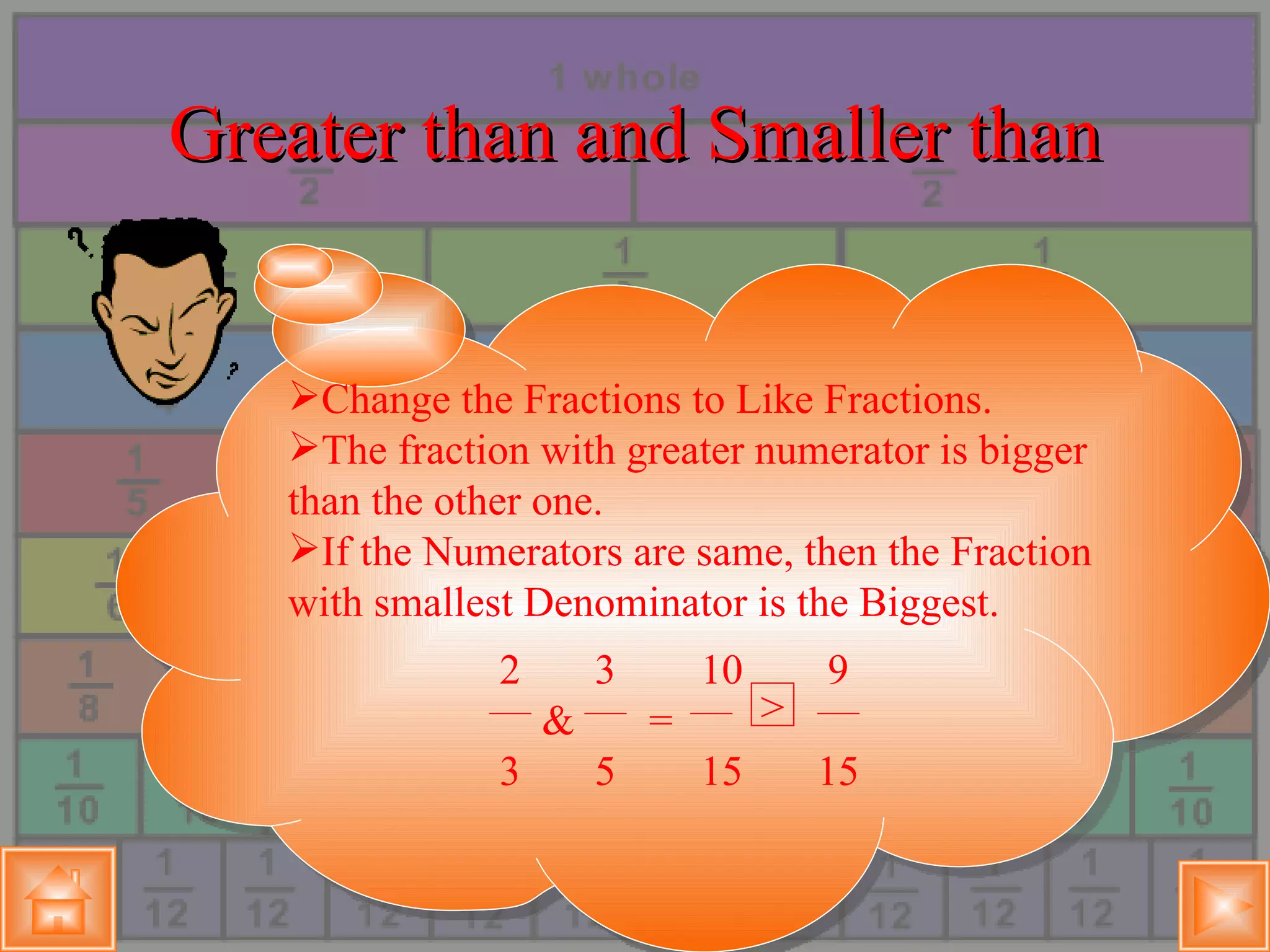
Greater than and Smaller than Change the Fractions to Like Fractions. The fraction with greater numerator is bigger than the other one. If the Numerators are same, then the Fraction with smallest Denominator is the Biggest. > 2  3  10  9 &  =  3  5  15  15
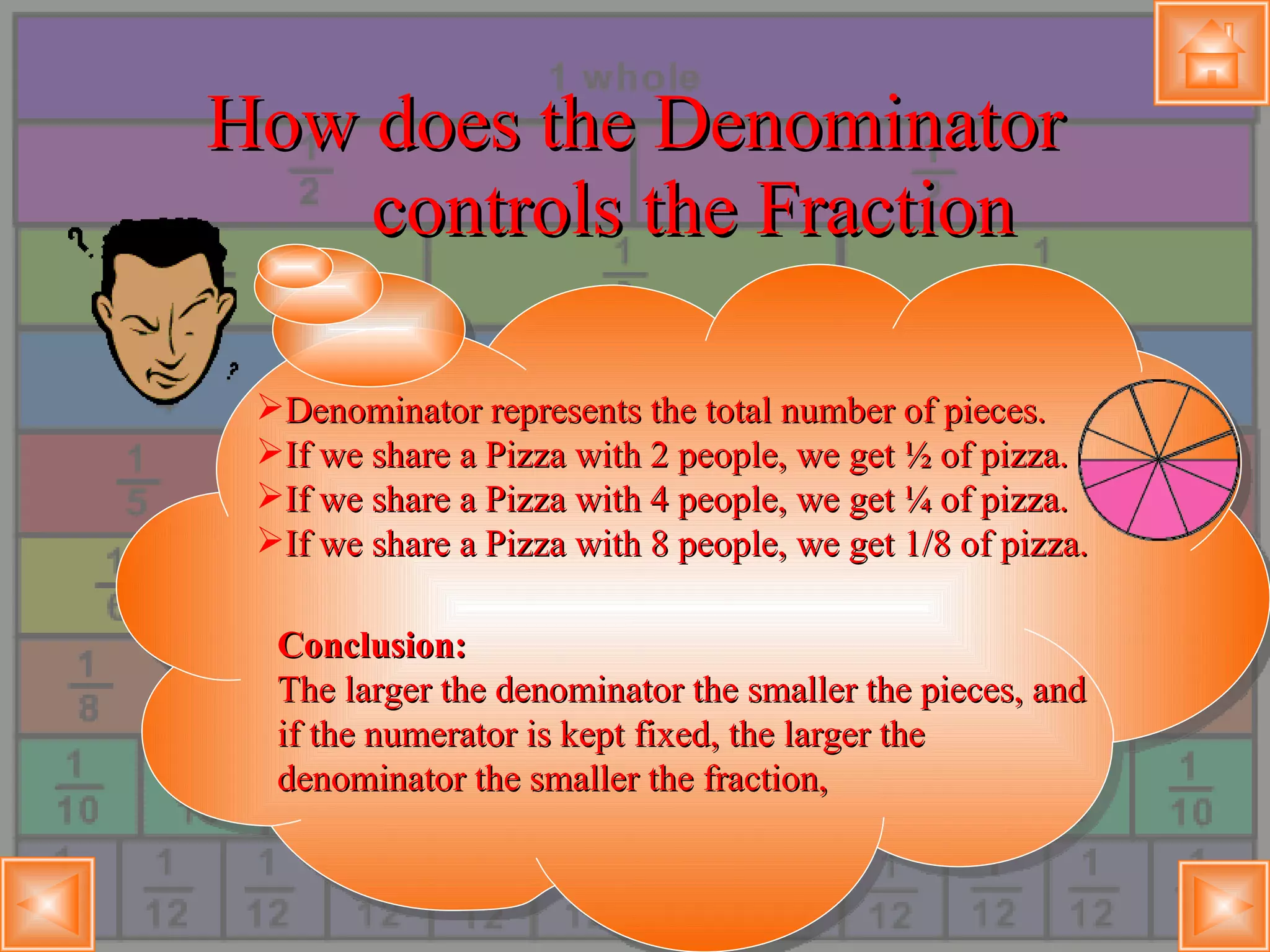
How does the Denominator controls the Fraction Denominator represents the total number of pieces. If we share a Pizza with 2 people, we get ½ of pizza. If we share a Pizza with 4 people, we get ¼ of pizza. If we share a Pizza with 8 people, we get 1/8 of pizza. Conclusion:  The larger the denominator the smaller the pieces, and if the numerator is kept fixed, the larger the denominator the smaller the fraction,
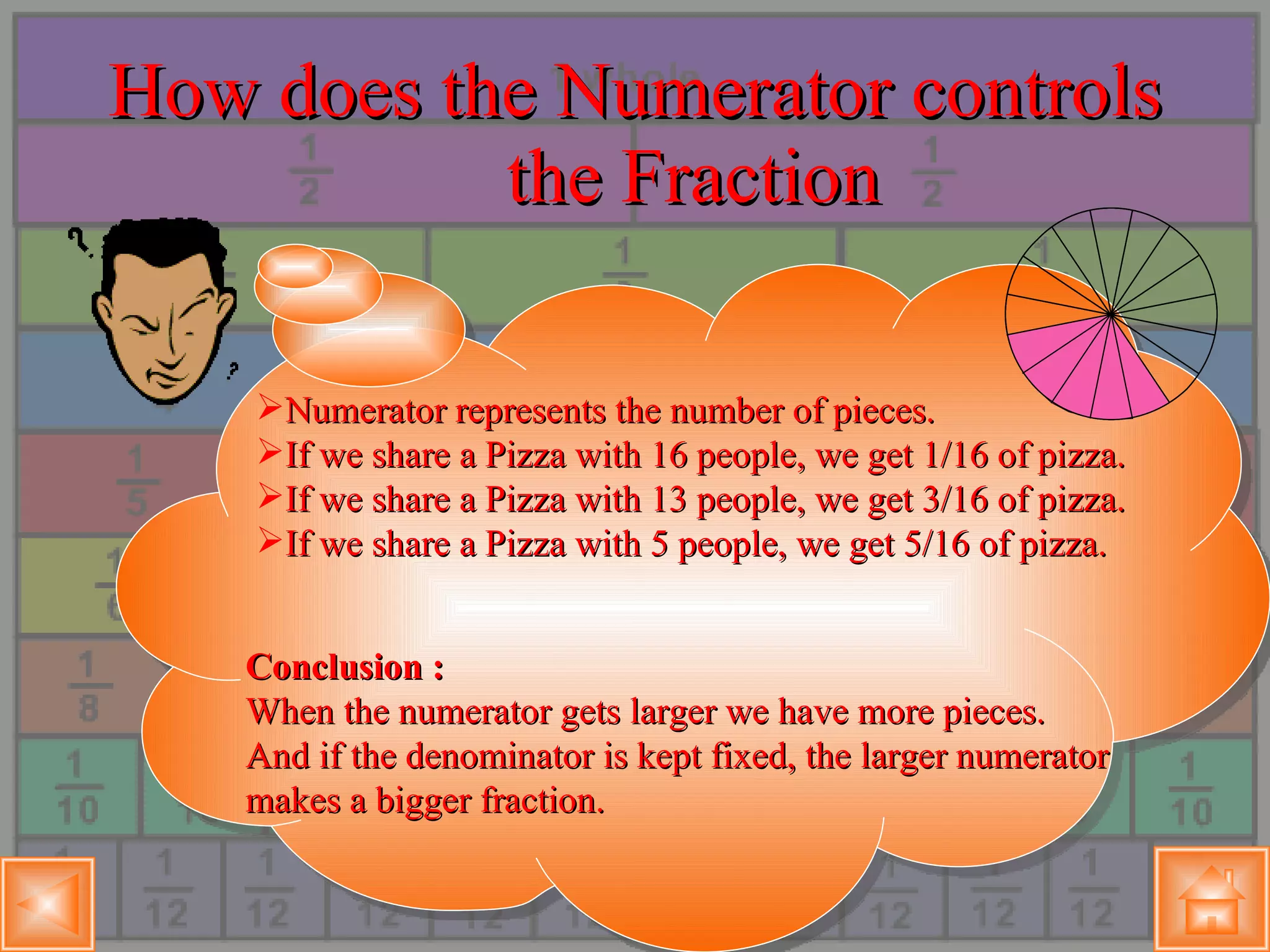
How does the Numerator controls the Fraction Numerator represents the number of pieces. If we share a Pizza with 16 people, we get 1/16 of pizza. If we share a Pizza with 13 people, we get 3/16 of pizza. If we share a Pizza with 5 people, we get 5/16 of pizza. Conclusion : When the numerator gets larger we have more pieces.  And if the denominator is kept fixed, the larger numerator makes a bigger fraction.
THANK YOU

Fractions

  • 1.
  • 2.
    Index What areFractions Examples Need of Fractions Parts of Fractions Example Types of Fractions- Proper fractions & Improper Fractions Mixed Fractions Like Fractions & Unlike Fractions Equivalent Fractions Operations of Fractions Addition Subtraction Multiplication Division Comparison Greater than and Smaller than How does the Denominator controls the Fraction How does the Denominator controls the Fraction
  • 3.
    What are Fractions?Fractions are for counting part of something. Loosely speaking, a fraction is a quantity that cannot be represented by a whole number. A fraction (from the Latin fractus, broken) is a number that can represent part of a whole. The earliest fractions were reciprocals of integers: ancient symbols representing one part of two, one part of three, one part of four, and so on. A much later development were the common or "vulgar" fractions which are still used today (½, ⅝, ¾, etc.)
  • 4.
    Examples 1 2 / 10 1 / 12 1 / 8 1 ½ 11 / 12 55 / 60
  • 5.
    Need Of Fractions?Consider the following scenario. Can you finish the whole cake? If not, how many cakes did you eat? 1 is not the answer, neither is 0. This suggest that we need a new kind of number i.e. Fraction .
  • 6.
    Parts Of Fractions?I’m the NUMERATOR. I tell you the number of parts I’m the DENOMINATOR. I tell you the name of part The denominator tells us how many congruent pieces the whole is divided into, thus this number cannot be 0. (b) The numerator tells us how many such pieces are being considered. (a)
  • 7.
    Example How muchof a pizza do we have below? The blue circle is our whole. if we divide the whole into 8 congruent pieces, - the denominator would be 8 . We can see that we have 7 of these pieces. Therefore the numerator is 7 , and we have of a pizza.
  • 8.
    Types Of FractionsProper fractions & Improper Fractions Equivalent Fractions Like Fractions & Unlike Fractions Mixed Fractions Unit Fractions & Whole Fractions
  • 9.
    Proper & Improper Fractions In Proper Fractions the numerator is less than the denominator. E.g.. – 1/2 ,3/4 ,2/7 etc.   In Improper Fractions the numerator is greater than (or equal to) the denominator. E.g. – 4/2 ,9/5 ,6/6 etc. Every whole no is Improper Fraction E.g. – 24 = 24/1 1 4 7 4 I’m Smaller I’m Bigger
  • 10.
    Mixed Fractions 1¾ 7/8 In Mixed Fractions a whole number and a proper fraction are together. E.g.. –2 1/4, 16 2/5 etc. Mixed Fractions and Improper Fractions are same. We can use any to show the same amount. =
  • 11.
    Conversion Improper Fraction to Mixed Fraction divide the numerator by the denominator the quotient is the leading number, the remainder as the new numerator. Mixed Fraction to Improper Fraction multiply the whole number with the denominator and add the numerator to it. The answer is the numerator and the denominator is same 8 1 9 8 1 9 1 = 1 8 8 7 17 7 3 7 2 7 3 2    
  • 12.
    Like & Unlike Fractions     In Like Fractions the denominators of the Fractions are same In Unlike Fractions the denominators of the Fractions are different.
  • 13.
    Unit Fractions & Whole Fractions     In Unit Fractions the numerator of the Fraction is 1. In Whole Fractions the denominators of the Fraction is 1.
  • 14.
    Convert Unlike Fractionsto Like Fractions Simplify all the Fractions. Find LCM of all the Denominators. Multiply all the fractions with a special form of 1 to get 84 (here). Now these are Like Fractions. = 3 5 4 4 3 7 , , 4,3,7 2,3,7 1,3,7 1,1,7 1,1,1 2 2 3 7 2 2 3 7 = 84    63 113 48 84 84 84 , ,
  • 15.
    Equivalent Fractions Theyare the fractions that may have many different appearances, but are same. In the following picture we have ½ of a cake as the cake is divided into two congruent parts and we have only one of those parts. But if we cut the cake into smaller congruent pieces, we can see that ½ = 2/4 = 4/8 = 3/6
  • 16.
    Equivalent Fractions Toknow that two or more Fractions are Equivalent we must simplify (change to its lowest term) them. Simplify: A fraction is in its lowest terms (or is reduced) if we cannot find a whole number (other than 1) that can divide into both its numerator and denominator. E.g.- 5 : 5 & 10 can be divided by 5. 5 1 10 10 2
  • 17.
    Example Are 14 & 30 equal ? 21 45 2 = 2 14 = 30 3 3 21 45 reduce 3 2 7 21 7 14    14 21 reduce 3 2 15 45 15 30    30 45
  • 18.
    Making Equivalent FractionsTo make Equivalent Fractions we multiply the Fraction with a special form of 1 (same numerator & denominator- 4/4, 10/10 etc.) E.g. : 4 = 4 5 = 20 5 5 5 25  
  • 19.
    Operations Of FractionsSubtraction Multiplication Addition Division
  • 20.
    Addition Of FractionsThings To Know !!!! Simplifying Like and Unlike Fractions Like fractions are Compulsory to add. If there are Unlike Fractions then convert them to like fractions. The Denominator should not be added. Always change Improper fraction to a mixed fraction.
  • 21.
    Adding Fractions Additionmeans combining objects in two or more sets The objects must be of the same type, i.e. we combine bundles with bundles and sticks with sticks. In fractions, we can only combine pieces of the same size. In other words, the denominators must be the same.
  • 22.
    Adding Fractions With Same Denominators Add the numerator and leave the denominator as it is. + = 1 2 3 1 + = = 6 6 6 2
  • 23.
    Adding Fractions withDifferent Denominators If there are different denominators in the fractions, then we change them to like fractions. 15 5 3 1   5 2 15 6 5 2 3 1  15 11 15 6 15 5 5 2 3 1    
  • 24.
    Adding Mixed FractionsChange the Mixed fractions to Improper Fractions and then to Like Fractions. At last add the Improper Like Fractions. Don’t forget to change the answer to Mixed Fraction again.
  • 25.
    Subtraction Of FractionsThings To Know !!!! Simplifying Like and Unlike Fractions Like fractions are Compulsory to subtract. If there are Unlike Fractions then convert them to like fractions. The Denominator should not be subtracted. Always change Improper fraction to a mixed fraction. The numerator can be negative.
  • 26.
    Subtracting Fractions Subtractionmeans taking objects away. The objects must be of the same type, i.e. we can only take away apples from a group of apples. In fractions, we can only take away pieces of the same size. In other words, the denominators must be the same.
  • 27.
    Subtracting Fractions With Same Denominators Subtract the numerator and leave the denominator as it is. - = 4 2 2 1 = = 6 6 6 3
  • 28.
    Subtracting Fractions withDifferent Denominators If there are different denominators in the fractions, then we change them to like fractions. 15 10 3 2   5 2 15 6 5 2 3 2  15 4 15 6 15 10 5 2 3 2    
  • 29.
    Subtracting Mixed FractionsChange the Mixed fractions to Improper Fractions and then to Like Fractions. At last subtract the Improper Like Fractions. Don’t forget to change the answer to Mixed Fraction again.
  • 30.
    Multiplication Of FractionsThings To Know !!!! Simplifying The Denominator are always multiplied. “ Of ” : Of means multiply. E.g. : ½ of 2 = ½ × 2 = 1 Product of two Proper Fractions is always less than both of them. Product of two Improper Fractions is always greater than both of them. Product of one Improper Fraction and one Proper Fraction is always less than the Improper Fraction and greater than the Proper Fraction.
  • 31.
    Multiplying Fractions ToMultiply Fractions we Multiply both - The numerators and the Denominators separately. 2 3 2 × 3 6 3 × = = = 4 2 4 × 2 8 4
  • 32.
    Multiplying Mixed FractionsChange the Mixed fractions to Improper Fractions. Then multiply the Improper Fraction. Don’t forget to change the answer to Mixed Fraction again.
  • 33.
    Addition Of FractionsThings To Know !!!! Simplifying Multiplication Always change Improper fraction to a mixed fraction. Reciprocal: The inverse of fraction E.g. – 2/3 = 3/2 = 1 ½ , 2 ½ = 5/2 = 2/5
  • 34.
    Dividing Fractions ToDivide Fractions we change the Second Fraction with its Reciprocal. Then Multiply the Reciprocal with the First Fraction. 2 4 2 × 5 10 5 ÷ = = = 4 5 4 × 4 16 8
  • 35.
    Dividing Mixed FractionsChange the Mixed fractions to Improper Fractions. Then Multiply the Improper Fraction. Don’t forget to change the answer to Mixed Fraction again.
  • 36.
    Comparison Comparison Greater than and Smaller than How does the Denominator controls the Fraction How does the Numerator controls the Fraction
  • 37.
    Greater than andSmaller than Change the Fractions to Like Fractions. The fraction with greater numerator is bigger than the other one. If the Numerators are same, then the Fraction with smallest Denominator is the Biggest. > 2 3 10 9 & = 3 5 15 15
  • 38.
    How does theDenominator controls the Fraction Denominator represents the total number of pieces. If we share a Pizza with 2 people, we get ½ of pizza. If we share a Pizza with 4 people, we get ¼ of pizza. If we share a Pizza with 8 people, we get 1/8 of pizza. Conclusion: The larger the denominator the smaller the pieces, and if the numerator is kept fixed, the larger the denominator the smaller the fraction,
  • 39.
    How does theNumerator controls the Fraction Numerator represents the number of pieces. If we share a Pizza with 16 people, we get 1/16 of pizza. If we share a Pizza with 13 people, we get 3/16 of pizza. If we share a Pizza with 5 people, we get 5/16 of pizza. Conclusion : When the numerator gets larger we have more pieces. And if the denominator is kept fixed, the larger numerator makes a bigger fraction.
  • 40.