ANALYTIC GEOMETRY (Lesson 2) Math 14   Plane and Analytic Geometry
OBJECTIVES : At the end of the lesson, the student is expected to be able to: •  Define and determine the angle of inclinations and slopes of a single line, parallel lines, perpendicular lines and intersecting lines.
INCLINATION AND SLOPE OF A LINE
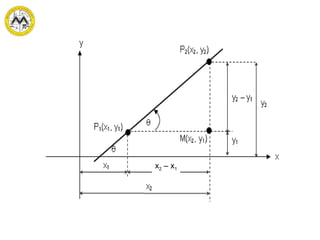
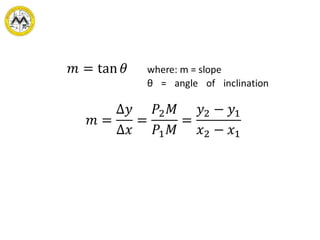
INCLINATION AND SLOPE OF A LINE The inclination of the line, L, (not parallel to the x-axis) is defined as the smallest positive angle measured from the positive direction of the x-axis or the counterclockwise direction to L. The slope of the line is defined as the tangent of the angle of inclination.
x 2  – x 1
 
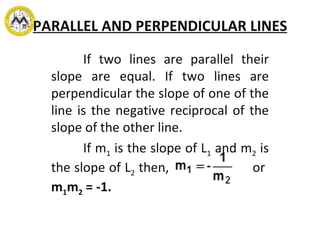
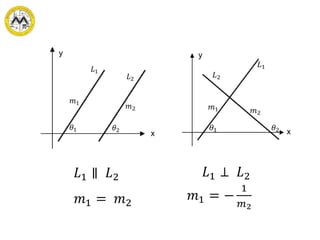
PARALLEL AND PERPENDICULAR LINES If two lines are parallel their slope are equal. If two lines are perpendicular the slope of one of the line is the negative reciprocal of the slope of the other line. If m 1  is the slope of L 1  and m 2  is the slope of L 2  then,    or   m 1 m 2  = -1.
x x y y
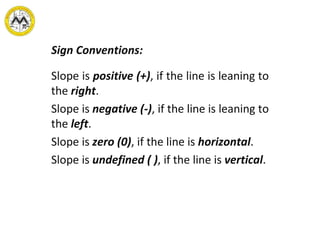
Sign Conventions: Slope is  positive (+) , if the line is leaning to the  right . Slope is  negative (-) , if the line is leaning to the  left . Slope is  zero (0) , if the line is  horizontal . Slope is  undefined ( ) , if the line is  vertical .
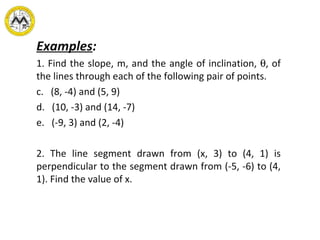
Examples : 1. Find the slope, m, and the angle of inclination,   , of the lines through each of the following pair of points. (8, -4) and (5, 9) (10, -3) and (14, -7) (-9, 3) and (2, -4) 2. The line segment drawn from (x, 3) to (4, 1) is perpendicular to the segment drawn from (-5, -6) to (4, 1). Find the value of x.
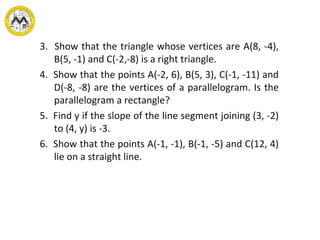
3.  Show that the triangle whose vertices are A(8, -4), B(5, -1) and C(-2,-8)   is a right triangle. 4.  Show that the points A(-2, 6), B(5, 3), C(-1, -11) and D(-8, -8) are the vertices of a parallelogram. Is the parallelogram a rectangle? 5.  Find y if the slope of the line segment joining (3, -2) to (4, y) is -3. 6.  Show that the points A(-1, -1), B(-1, -5) and C(12, 4) lie on a straight line.    
ANGLE BETWEEN TWO INTERSECTING LINES
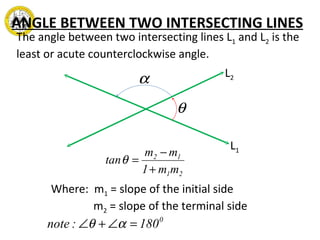
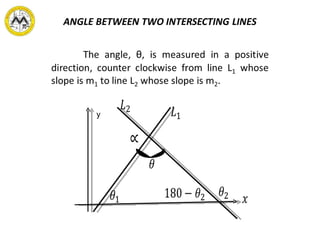
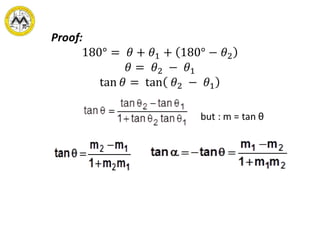
ANGLE BETWEEN TWO INTERSECTING LINES Where:  m 1  = slope of the initial side m 2  = slope of the terminal side The angle between two intersecting lines L 1  and L 2  is the least or acute counterclockwise angle. L 1 L 2
y
 
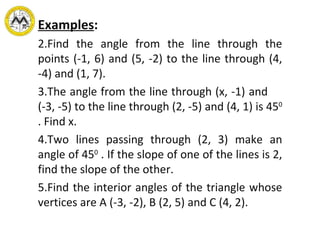
Examples : Find the angle from the line through the points (-1, 6) and (5, -2) to the line through (4, -4) and (1, 7).  The angle from the line through (x, -1) and  (-3, -5) to the line through (2, -5) and (4, 1) is 45 0  . Find x. Two lines passing through (2, 3) make an angle of 45 0  . If the slope of one of the lines is 2, find the slope of the other. Find the interior angles of the triangle whose vertices are A (-3, -2), B (2, 5) and C (4, 2).
REFERENCES Analytic Geometry, 6 th  Edition, by Douglas F. Riddle Analytic Geometry, 7 th  Edition, by Gordon Fuller/Dalton Tarwater Analytic Geometry, by Quirino and Mijares

Math14 lesson 2

  • 1.
    ANALYTIC GEOMETRY (Lesson2) Math 14 Plane and Analytic Geometry
  • 2.
    OBJECTIVES : Atthe end of the lesson, the student is expected to be able to: • Define and determine the angle of inclinations and slopes of a single line, parallel lines, perpendicular lines and intersecting lines.
  • 3.
  • 4.
    INCLINATION AND SLOPEOF A LINE The inclination of the line, L, (not parallel to the x-axis) is defined as the smallest positive angle measured from the positive direction of the x-axis or the counterclockwise direction to L. The slope of the line is defined as the tangent of the angle of inclination.
  • 5.
    x 2 – x 1
  • 6.
  • 7.
    PARALLEL AND PERPENDICULARLINES If two lines are parallel their slope are equal. If two lines are perpendicular the slope of one of the line is the negative reciprocal of the slope of the other line. If m 1 is the slope of L 1 and m 2 is the slope of L 2 then, or m 1 m 2 = -1.
  • 8.
  • 9.
    Sign Conventions: Slopeis positive (+) , if the line is leaning to the right . Slope is negative (-) , if the line is leaning to the left . Slope is zero (0) , if the line is horizontal . Slope is undefined ( ) , if the line is vertical .
  • 10.
    Examples : 1.Find the slope, m, and the angle of inclination,  , of the lines through each of the following pair of points. (8, -4) and (5, 9) (10, -3) and (14, -7) (-9, 3) and (2, -4) 2. The line segment drawn from (x, 3) to (4, 1) is perpendicular to the segment drawn from (-5, -6) to (4, 1). Find the value of x.
  • 11.
    3. Showthat the triangle whose vertices are A(8, -4), B(5, -1) and C(-2,-8) is a right triangle. 4. Show that the points A(-2, 6), B(5, 3), C(-1, -11) and D(-8, -8) are the vertices of a parallelogram. Is the parallelogram a rectangle? 5. Find y if the slope of the line segment joining (3, -2) to (4, y) is -3. 6. Show that the points A(-1, -1), B(-1, -5) and C(12, 4) lie on a straight line.    
  • 12.
    ANGLE BETWEEN TWOINTERSECTING LINES
  • 13.
    ANGLE BETWEEN TWOINTERSECTING LINES Where: m 1 = slope of the initial side m 2 = slope of the terminal side The angle between two intersecting lines L 1 and L 2 is the least or acute counterclockwise angle. L 1 L 2
  • 14.
  • 15.
  • 16.
    Examples : Findthe angle from the line through the points (-1, 6) and (5, -2) to the line through (4, -4) and (1, 7). The angle from the line through (x, -1) and (-3, -5) to the line through (2, -5) and (4, 1) is 45 0 . Find x. Two lines passing through (2, 3) make an angle of 45 0 . If the slope of one of the lines is 2, find the slope of the other. Find the interior angles of the triangle whose vertices are A (-3, -2), B (2, 5) and C (4, 2).
  • 17.
    REFERENCES Analytic Geometry,6 th Edition, by Douglas F. Riddle Analytic Geometry, 7 th Edition, by Gordon Fuller/Dalton Tarwater Analytic Geometry, by Quirino and Mijares