1
MSE 280: Introduction to Engineering Materials
Reading: Chapter 8 Callister
Deformation and Strengthening
g p
• Plastic deformation at the atomic level.
• Why is dislocation motion primarily in metals
(why not in ceramics and covalent solids)?
• Relation between strength and dislocation
MSE280© 2007, 2008 Moonsub Shim, University of Illinois
1
motion.
• Strategies for strengthening.
© 2007 University of Illinois Board of Trustees. All rights reserved.
Recall dislocations
Edge dislocation
MSE280© 2007, 2008 Moonsub Shim, University of Illinois
2
Edge dislocation
Screw dislocation
Plastic deformation corresponds to motion of dislocations!
2
Why are dislocations important in
plastic deformation?
Shear force
All bonds on this
plane need to be
Perfect crystal
plane need to be
broken and new
ones made at the
same time….
With a
dislocation
MSE280© 2007, 2008 Moonsub Shim, University of Illinois
3
dislocation,
break and make
bond along one
line at a time….
Slip: plastic deformation by dislocation motion.
Slip plane: crystallographic plane on which dislocation line traverses.
http://www.learner.org/jnorth/tm/monarch/LarvaLocomotion.html
From Callister 6e resource CD.
MSE280© 2007, 2008 Moonsub Shim, University of Illinois
4
3
Why mainly in metals and not other materials?
+
++
+++++++
+ + + + + +
• Metals: Disl. motion easier.
-non-directional bonding
-close-packed directions for slip.
electron cloud
++++++++
close packed directions for slip.
-dislocation density ~ 103 to 1010 mm-2).
ion cores
• Covalent Ceramics
(Si, diamond): Motion hard.
-directional (angular) bonding.
-dislocation density ~ 0.1 to 1 mm-2 for
single crystal Si.
MSE280© 2007, 2008 Moonsub Shim, University of Illinois
5
• Ionic Ceramics: Motion hard.
-need to avoid ++ and --
neighbors.
-dislocation density ~ 102 to 104 mm-2.
+ + + +
+++
+ + + +
- - -
----
- - -
From Callister resource CD
Lattice strain around dislocations
Edge dislocation:
MSE280© 2007, 2008 Moonsub Shim, University of Illinois
6
Screw dislocation:
Pure shear strain.
4
Stress fields from dislocations with no applied stresses.
Like ones Repel
Interacting Edge Dislocations
Opposites attract
Two halves make a whole. No
MSE280© 2007, 2008 Moonsub Shim, University of Illinois
7
strain from missing half row.
Obstacles,
e.g. GB, twins, particles
(precipitates).
Larger back stress w/ many.
Dislocation pile-ups: traffic jam
Different slip planes and less than 450,
like ones still repel.
Interacting Edges
Different slip planes and greater than 450,
like ones attract.
MSE280© 2007, 2008 Moonsub Shim, University of Illinois
8
Final configuration that is stable (w/o applied stress).
Low-angle grain boundary (Collection of edges).
D. Johnson
5
Less than 450, opposites attract.
Final stable configuration
Interacting Oppositely Oriented Edges
Greater than 450, opposites
repel.
g
that minimizes local stress.
MSE280© 2007, 2008 Moonsub Shim, University of Illinois
9
Array of opposing edges.
Slip system
Slip system = slip plane + slip direction
z
Slip plane
Slip direction
e.g. slip in
FCC
y
MSE280© 2007, 2008 Moonsub Shim, University of Illinois
10
x
Slip on (111) along direction indicated
Slip system = (111) [1 0 ]1
For metals: slip plane is the
most close-packed plane.
(Why?) – Burger’s vector
6
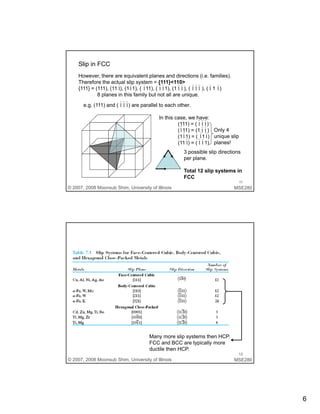
Slip in FCC
However, there are equivalent planes and directions (i.e. families).
Therefore the actual slip system = {111}<110>
{111} = (111), (11 ), (1 1), ( 11), ( 1), (1 ), ( ), ( 1 )
8 planes in this family but not all are unique.
1 1 1 11 11 111 1 1
y
e.g. (111) and ( ) are parallel to each other.111
In this case, we have:
(111) = ( )
( 11) = (1 )
(1 1) = ( 1 )
(11 ) = ( 1)
111
11
1 1
11
1
1
1
Only 4
unique slip
planes!
MSE280© 2007, 2008 Moonsub Shim, University of Illinois
11
( ) ( ) p
3 possible slip directions
per plane.
Total 12 slip systems in
FCC
MSE280© 2007, 2008 Moonsub Shim, University of Illinois
12
Many more slip systems then HCP.
FCC and BCC are typically more
ductile then HCP.
7
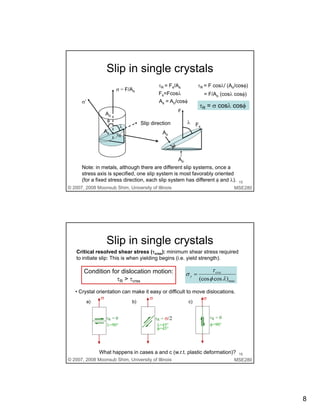
Slip in single crystals
MSE280© 2007, 2008 Moonsub Shim, University of Illinois
13
Slip in single crystals
Even with pure tensile stress, shear component may also exist
σ
Note: τR will lie in the slip direction.Applied stress
Slip direction
τR
σ’
φ
λ
In general, φ + λ does not have to
equal 90o.
Slip plane
τR
σσ’
λ
φ
MSE280© 2007, 2008 Moonsub Shim, University of Illinois
14
Resolved shear stress:
λφστ coscos=R
Schmid factor
8
Slip in single crystals
σ = F/Ao
τR = Fs/As
Fs=Fcosλ
τR = F cosλ/ (Ao/cosφ)
= F/Ao (cosλ cosφ)
Ao
σ’
Slip direction
φ
φ
As
F
Fs
λ
As = Ao/cosφ
τR = σ cosλ cosφ
As τR
λ
MSE280© 2007, 2008 Moonsub Shim, University of Illinois
15
Note: in metals, although there are different slip systems, once a
stress axis is specified, one slip system is most favorably oriented
(for a fixed stress direction, each slip system has different φ and λ).
φ
Ao
Slip in single crystals
Critical resolved shear stress (τcrss): minimum shear stress required
to initiate slip: This is when yielding begins (i.e. yield strength).
C diti f di l ti ti τCondition for dislocation motion:
τR > τcrss max)cos(cos λφ
τ
σ crss
y =
• Crystal orientation can make it easy or difficult to move dislocations.
0
σ
/2
σσ
a) b) c)
MSE280© 2007, 2008 Moonsub Shim, University of Illinois
16
τR = 0
φ=90°
τR = σ/2
λ=45°
φ=45°
τR = 0
λ=90°
What happens in cases a and c (w.r.t. plastic deformation)?
9
Example1
Example 2
Determine the Schmid factor for an FCC single crystal oriented
with its [100] direction parallel to the loading axis.
Tensile stress is applied along [010] direction of a single crystal of BCC
iron.
a) Calculate the resolved shear stress along slip system (110)[ 11] when
tensile stress = 52 MPa.
b) Calculate the magnitude of applied stress to initiate yielding if critical
resolved shear stress is 30 MPa.
Example 2
1
MSE280© 2007, 2008 Moonsub Shim, University of Illinois
17
Example 3
For an FCC Ag single crystal, slip initiates at 1.1 MPa of
applied tensile stress along [001] direction.
Calculate the critical resolved shear stress.
Plastic deformation in
polycrystalline materials
• Similar to single crystals,
slip systems that have theslip systems that have the
most favorable orientation
w.r.t. applied stress are where
dislocation motions occur.
• More complex then single
crystals: direction of slip
varies from grain to grain due
MSE280© 2007, 2008 Moonsub Shim, University of Illinois
18
to random crystallographic
orientation.
Which do you expect to be
stronger: single crystalline or
polycrystalline?
10
Single vs. polycrystal
σ
Single crystal
e.g. σ
polycrystalline
τR = σ/2
λ=45°
φ=45°
e.g.
τR = σ/2
λ=45°
φ=45°
Center grain
For each grain,
τcrss
MSE280© 2007, 2008 Moonsub Shim, University of Illinois
19
σy = 2τcrss
max)cos(cos λφ
σ crss
y =
But φ and λ are different for each grain.
Which will require more stress to slip single crystal or the center
grain in polycrystal?
Before & After Plastic Deformation
MSE280© 2007, 2008 Moonsub Shim, University of Illinois
20
Grains elongate in the direction of stress but grain boundaries remain intact.
In order for the center grain in the previous slide to slip,
surrounding grains, which may have higher yield strengths,
also have to slip.
11
Strengthening mechanisms
• Grain size reduction
• Solid solutions
• Precipitation strengthening
• Strain hardening (cold working)
MSE280© 2007, 2008 Moonsub Shim, University of Illinois
21
1. Strengthening via grain size reduction
• Grain boundaries are barriers to slip.
• Barrier "strength“ increases with
misorientation.
• Smaller grain size: more barriers to slip
slip plane
rain
B
• Smaller grain size: more barriers to slip.
• Grain size may be controlled by solidification
process and by plastic deformation followed
by appropriate heat treatment.
grainboundary
grain A
gra
2/1−
+= dkyoy σσ
Hall-Petch Equation:
MSE280© 2007, 2008 Moonsub Shim, University of Illinois
22
What happens at very small or
very large grain sizes?
Material-dependent constants
Average grain diameter
Fig. 7.13 Callister 6e
12
2. Strengthening via solid solutions
Smaller impurity atoms
• Impurity atoms distort the lattice & generate stress.
• Stress can produce a barrier to dislocation motion.
Smaller impurity atoms
Larger impurity atoms
MSE280© 2007, 2008 Moonsub Shim, University of Illinois
23
g p y
2. Strengthening via solid solutions
MSE280© 2007, 2008 Moonsub Shim, University of Illinois
24
13
3. Strengthening via precipitation
Large shear stress needed
precipitate
g
to move dislocation toward
precipitate and shear it.
Side View
Top View
Slipped part of slip plane
Uns lipped part of slip plane
S
Dislocation
“advances” but
precipitates act as
“pinning” sites with
spacing S.
MSE280© 2007, 2008 Moonsub Shim, University of Illinois
25
• Result: σy ~
1
S
From Callister resource CD
3. Strengthening via precipitation
Simulation
• Precipitate volume fraction: 10%
A i it t i 64 b (b 1 t i li di t )
Simulation courtesy of Volker
Mohles, Institut für Materialphysik
der Universitåt, Münster, Germany
(http://www.uni-munster.de/physik
/MP/mohles/). Used with
permission.
• Average precipitate size: 64 b (b = 1 atomic slip distance)
MSE280© 2007, 2008 Moonsub Shim, University of Illinois
26
From Callister resource CD
14
3. Strengthening via precipitation
Example: aluminum alloys used for airplanes
MSE280© 2007, 2008 Moonsub Shim, University of Illinois
27
4. Strengthening via strain hardening
• Strengthening by plastic deformation.
• Called cold working because deformation is carried out at a
“low” temperature (i e below melting temperature)low temperature (i.e. below melting temperature).
• Usually at RT for metals.
Percent cold work = %CW =
Ao − Ad
Ao
x100
MSE280© 2007, 2008 Moonsub Shim, University of Illinois
28
15
4. Strengthening via strain hardening
Forging Rolling
Extrusion Drawing
MSE280© 2007, 2008 Moonsub Shim, University of Illinois
29
4. Strengthening via strain hardening
MSE280© 2007, 2008 Moonsub Shim, University of Illinois
30
16
Example problem
• Of the 3 metals from previous slide (Cu,
b d 1040 t l) hi h b ldbrass and 1040 steel), which can be cold
worked to give yield strength > 345 MPa
and %EL > 20%?
MSE280© 2007, 2008 Moonsub Shim, University of Illinois
31
Recovery
Annihilation reduces dislocation density.
• Scenario 1 extra half-plane
of atoms Disl.
• Scenario 2
atoms
diffuse
to regions
of tension
extra half-plane
of atoms
annhilate
and form
a perfect
atomic
plane.
3. “Climbed” disl. can now τR
MSE280© 2007, 2008 Moonsub Shim, University of Illinois
32
1. dislocation blocked;
can’t move to the right
obstacle dislocation
2. grey atoms leave by
vacancy diffusion
allowing disl. to “climb”
4. opposite dislocations
meet and annihilate
move on new slip plane
From Callister resources CD
17
Dislocations can avoid obstacles.
• Scenario 2
-- Dislocation is block by obstacle (precipitate or another dislocation).
-- Edge moves to another slip plane by vacancy-assisted climb, which is
Recovery by Edge “Climb” Process
temperature-dependent process.
-- Climbed dislocation can now move on parallel slip plane and annihilate, as in
scenario 1.
MSE280© 2007, 2008 Moonsub Shim, University of Illinois
33
Inclusion,
Precipitate.
t=0 t= Δt1 t= Δt2
D. Johnson
Can screw dislocations annihilate one another?
• Recall two edges dislocations (positive and negative)
• Screws also have positive and negative sense.
Disl. Motion
MSE280© 2007, 2008 Moonsub Shim, University of Illinois
34
Burger’s Vector
What’s left when the two screw dislocations meet?
Line direction of screw
D. Johnson
18
Recrystallization
• New crystals are formed that:
--have a small disl. density
--are smallare small
--consume cold-worked crystals.
Adapted from
Fig. 7.19 (a),(b),
Callister 6e.
(Fig. 7.19 (a),(b)
are courtesy of
0.6 mm 0.6 mm
MSE280© 2007, 2008 Moonsub Shim, University of Illinois
35
33% cold
worked
brass
New crystals
nucleate after
3 sec. at 580C.
are courtesy of
J.E. Burke,
General Electric
Company.)
From Callister resources CD
Further recrystallization
• All cold-worked crystals are consumed.
0 6 mm0 6 mm
Adapted from
Fig. 7.19 (c),(d),
Callister 6e.
(Fig. 7.19 (c),(d)
are courtesy of
J E Burke
0.6 mm0.6 mm
MSE280© 2007, 2008 Moonsub Shim, University of Illinois
36
After 4
seconds
After 8
seconds
J.E. Burke,
General Electric
Company.)
From Callister resources CD
19
Grain Growth
• At longer times, larger grains consume smaller ones.
• Why? Grain boundary area (and therefore energy)
i d d
0.6 mm 0.6 mm
Adapted from
Fig. 7.19 (d),(e),
Callister 6e.
(Fig. 7.19 (d),(e)
are courtesy of
J.E. Burke,
General Electric
Company.)
is reduced.
MSE280© 2007, 2008 Moonsub Shim, University of Illinois
37From Callister resources CD
After 8 s,
580C
After 15 min,
580C
dn
− do
n
= Kt
elapsed time
coefficient dependent
on material and T.
grain diam.
at time t.
exponent typ. ~ 2
Effects on mechanical properties
MSE280© 2007, 2008 Moonsub Shim, University of Illinois
38
20
Example problem
10.2 mm 7.6 mm
Brass Brass
MSE280© 2007, 2008 Moonsub Shim, University of Illinois
39
How do we achieve the above change while maintaining
σy>380MPa & ductility > 15%EL?
Deformation in Ceramics
• Crystalline: plastic deformation via dislocation
motion However more difficult for dislocationsmotion. However, more difficult for dislocations
to move and smaller number of them to start
with.
– Ionic ceramics: electrostatic repulsion makes it
difficult to generate and to move dislocations.
– Covalent ceramics: relatively strong bonds, limited
number of slip systems, and dislocation structures are
MSE280© 2007, 2008 Moonsub Shim, University of Illinois
40
number of slip systems, and dislocation structures are
often complex.
• Noncrystalline: plastic deformation by viscous
flow (like liquids).
21
Deformation in polymers
• Semicrystalline polymers
– Elastic deformation:
• Elongation of polymer chains along load axis.
• Bending and stretching of bonds (some displacement of
neighboring molecules).
• Elastic Modulus: combination of crystalline and
amorphous regions.
– Plastic deformation:
1. Separation of crystalline regions via elongation of
amorphous regions.
MSE280© 2007, 2008 Moonsub Shim, University of Illinois
41
p g
2. Distortion of crystalline regions (alignment along load axis).
3. Segmentation of crystalline blocks.
4. Alignment of crystalline blocks along load axis.
Note: may be reversible by heating to recover original
configuration.
Semicrystalline polymer deformation
MSE280© 2007, 2008 Moonsub Shim, University of Illinois
42
22
Factors that influence mechanical properties
• Molecular weight
– Tensile modulus: usually independent of chain length.
– Tensile strength: longer chains tend to have more entangled
h i hi h i TSchains which increases TS.
• Degree of crystallinity
– Crystalline regions are more densely packed: more secondary
bonds.
– Tensile modulus increases with increasing crystallinity.
– Tensile strength also increases with increasing crystallinity
nM
A
TSTS −= ∞ TS in the “infinite”
MW limit.
MSE280© 2007, 2008 Moonsub Shim, University of Illinois
43
Tensile strength also increases with increasing crystallinity.
– Brittleness increases with crystallinity.
– e.g. Polyethylene.
Factors that influence mechanical properties
• Predeformation by Drawing
– Neck extension
(continued)
– Neck extension.
– Analogous to strain hardening.
– Anisotropic properties:
• Tensile modulus parallel can icrease up to ~3x
• TS parallel can increase ~ 2 to 5x
• TS perpendicular can decrease by about 1/3 ~ ½
• Heat treating (annealing)
MSE280© 2007, 2008 Moonsub Shim, University of Illinois
44
Heat treating (annealing)
– Increase modulus & yield strength.
– Decrease ductility.
– Opposite effects to annealing metals.
23
Deformation of elastomers
Elastomers
Driving force for elastic deformation: ENTROPY
Disorder Ordered
MSE280© 2007, 2008 Moonsub Shim, University of Illinois
45
Criteria to be an elastomer:
1. Amorphous
2. Easy chain bond rotation (e.g. single vs. double bond)
3. Delayed onset of plastic deformation (e.g. via crosslinking preventing
“slipping” of chains)
4. Glass transition temperature (above it: otherwise becomes brittle).
Cis vs. trans isoprene
C CH
CH3
1
42
CH
C
C
CH3
H
C C
H2
CH3
CH2
C
C
H
CH2
trans-isoprene
3
CH2
C
CH2
cis-isoprene
C
CH3
H
H
MSE280© 2007, 2008 Moonsub Shim, University of Illinois
46
trans-1,4-polyisoprene
C
H2
C
C
H
C
n n
C
C
H
H
H
H
cis-1,4-polyisoprene
Which one will be a “better” elastomer?
24
Vulcanization
Crosslinking process in elastomers.
Enhances – elastic modulus
– tensile strengthtensile strength
– resistance to degradation
Typically ~1 – 5 wt% sulfur in useful rubbers.
MSE280© 2007, 2008 Moonsub Shim, University of Illinois
47
Concepts to remember
• Dislocation motion and plastic deformation.
• Why is dislocation motion primarily in metals?y p y
• Lattice distortions around dislocations.
• Interaction between dislocations.
• Slip system.
• Single crystal slip.
• Single crystalline vs. polycrystalline deformation.
• Strengthening mechanisms.
MSE280© 2007, 2008 Moonsub Shim, University of Illinois
48
• Recovery, recrystallization, and grain growth.
• Deformation in ceramics.
• Deformation in polymers (different factors that contribute
to mechanical properties).

Deformation and strengthening

  • 1.
    1 MSE 280: Introductionto Engineering Materials Reading: Chapter 8 Callister Deformation and Strengthening g p • Plastic deformation at the atomic level. • Why is dislocation motion primarily in metals (why not in ceramics and covalent solids)? • Relation between strength and dislocation MSE280© 2007, 2008 Moonsub Shim, University of Illinois 1 motion. • Strategies for strengthening. © 2007 University of Illinois Board of Trustees. All rights reserved. Recall dislocations Edge dislocation MSE280© 2007, 2008 Moonsub Shim, University of Illinois 2 Edge dislocation Screw dislocation Plastic deformation corresponds to motion of dislocations!
  • 2.
    2 Why are dislocationsimportant in plastic deformation? Shear force All bonds on this plane need to be Perfect crystal plane need to be broken and new ones made at the same time…. With a dislocation MSE280© 2007, 2008 Moonsub Shim, University of Illinois 3 dislocation, break and make bond along one line at a time…. Slip: plastic deformation by dislocation motion. Slip plane: crystallographic plane on which dislocation line traverses. http://www.learner.org/jnorth/tm/monarch/LarvaLocomotion.html From Callister 6e resource CD. MSE280© 2007, 2008 Moonsub Shim, University of Illinois 4
  • 3.
    3 Why mainly inmetals and not other materials? + ++ +++++++ + + + + + + • Metals: Disl. motion easier. -non-directional bonding -close-packed directions for slip. electron cloud ++++++++ close packed directions for slip. -dislocation density ~ 103 to 1010 mm-2). ion cores • Covalent Ceramics (Si, diamond): Motion hard. -directional (angular) bonding. -dislocation density ~ 0.1 to 1 mm-2 for single crystal Si. MSE280© 2007, 2008 Moonsub Shim, University of Illinois 5 • Ionic Ceramics: Motion hard. -need to avoid ++ and -- neighbors. -dislocation density ~ 102 to 104 mm-2. + + + + +++ + + + + - - - ---- - - - From Callister resource CD Lattice strain around dislocations Edge dislocation: MSE280© 2007, 2008 Moonsub Shim, University of Illinois 6 Screw dislocation: Pure shear strain.
  • 4.
    4 Stress fields fromdislocations with no applied stresses. Like ones Repel Interacting Edge Dislocations Opposites attract Two halves make a whole. No MSE280© 2007, 2008 Moonsub Shim, University of Illinois 7 strain from missing half row. Obstacles, e.g. GB, twins, particles (precipitates). Larger back stress w/ many. Dislocation pile-ups: traffic jam Different slip planes and less than 450, like ones still repel. Interacting Edges Different slip planes and greater than 450, like ones attract. MSE280© 2007, 2008 Moonsub Shim, University of Illinois 8 Final configuration that is stable (w/o applied stress). Low-angle grain boundary (Collection of edges). D. Johnson
  • 5.
    5 Less than 450,opposites attract. Final stable configuration Interacting Oppositely Oriented Edges Greater than 450, opposites repel. g that minimizes local stress. MSE280© 2007, 2008 Moonsub Shim, University of Illinois 9 Array of opposing edges. Slip system Slip system = slip plane + slip direction z Slip plane Slip direction e.g. slip in FCC y MSE280© 2007, 2008 Moonsub Shim, University of Illinois 10 x Slip on (111) along direction indicated Slip system = (111) [1 0 ]1 For metals: slip plane is the most close-packed plane. (Why?) – Burger’s vector
  • 6.
    6 Slip in FCC However,there are equivalent planes and directions (i.e. families). Therefore the actual slip system = {111}<110> {111} = (111), (11 ), (1 1), ( 11), ( 1), (1 ), ( ), ( 1 ) 8 planes in this family but not all are unique. 1 1 1 11 11 111 1 1 y e.g. (111) and ( ) are parallel to each other.111 In this case, we have: (111) = ( ) ( 11) = (1 ) (1 1) = ( 1 ) (11 ) = ( 1) 111 11 1 1 11 1 1 1 Only 4 unique slip planes! MSE280© 2007, 2008 Moonsub Shim, University of Illinois 11 ( ) ( ) p 3 possible slip directions per plane. Total 12 slip systems in FCC MSE280© 2007, 2008 Moonsub Shim, University of Illinois 12 Many more slip systems then HCP. FCC and BCC are typically more ductile then HCP.
  • 7.
    7 Slip in singlecrystals MSE280© 2007, 2008 Moonsub Shim, University of Illinois 13 Slip in single crystals Even with pure tensile stress, shear component may also exist σ Note: τR will lie in the slip direction.Applied stress Slip direction τR σ’ φ λ In general, φ + λ does not have to equal 90o. Slip plane τR σσ’ λ φ MSE280© 2007, 2008 Moonsub Shim, University of Illinois 14 Resolved shear stress: λφστ coscos=R Schmid factor
  • 8.
    8 Slip in singlecrystals σ = F/Ao τR = Fs/As Fs=Fcosλ τR = F cosλ/ (Ao/cosφ) = F/Ao (cosλ cosφ) Ao σ’ Slip direction φ φ As F Fs λ As = Ao/cosφ τR = σ cosλ cosφ As τR λ MSE280© 2007, 2008 Moonsub Shim, University of Illinois 15 Note: in metals, although there are different slip systems, once a stress axis is specified, one slip system is most favorably oriented (for a fixed stress direction, each slip system has different φ and λ). φ Ao Slip in single crystals Critical resolved shear stress (τcrss): minimum shear stress required to initiate slip: This is when yielding begins (i.e. yield strength). C diti f di l ti ti τCondition for dislocation motion: τR > τcrss max)cos(cos λφ τ σ crss y = • Crystal orientation can make it easy or difficult to move dislocations. 0 σ /2 σσ a) b) c) MSE280© 2007, 2008 Moonsub Shim, University of Illinois 16 τR = 0 φ=90° τR = σ/2 λ=45° φ=45° τR = 0 λ=90° What happens in cases a and c (w.r.t. plastic deformation)?
  • 9.
    9 Example1 Example 2 Determine theSchmid factor for an FCC single crystal oriented with its [100] direction parallel to the loading axis. Tensile stress is applied along [010] direction of a single crystal of BCC iron. a) Calculate the resolved shear stress along slip system (110)[ 11] when tensile stress = 52 MPa. b) Calculate the magnitude of applied stress to initiate yielding if critical resolved shear stress is 30 MPa. Example 2 1 MSE280© 2007, 2008 Moonsub Shim, University of Illinois 17 Example 3 For an FCC Ag single crystal, slip initiates at 1.1 MPa of applied tensile stress along [001] direction. Calculate the critical resolved shear stress. Plastic deformation in polycrystalline materials • Similar to single crystals, slip systems that have theslip systems that have the most favorable orientation w.r.t. applied stress are where dislocation motions occur. • More complex then single crystals: direction of slip varies from grain to grain due MSE280© 2007, 2008 Moonsub Shim, University of Illinois 18 to random crystallographic orientation. Which do you expect to be stronger: single crystalline or polycrystalline?
  • 10.
    10 Single vs. polycrystal σ Singlecrystal e.g. σ polycrystalline τR = σ/2 λ=45° φ=45° e.g. τR = σ/2 λ=45° φ=45° Center grain For each grain, τcrss MSE280© 2007, 2008 Moonsub Shim, University of Illinois 19 σy = 2τcrss max)cos(cos λφ σ crss y = But φ and λ are different for each grain. Which will require more stress to slip single crystal or the center grain in polycrystal? Before & After Plastic Deformation MSE280© 2007, 2008 Moonsub Shim, University of Illinois 20 Grains elongate in the direction of stress but grain boundaries remain intact. In order for the center grain in the previous slide to slip, surrounding grains, which may have higher yield strengths, also have to slip.
  • 11.
    11 Strengthening mechanisms • Grainsize reduction • Solid solutions • Precipitation strengthening • Strain hardening (cold working) MSE280© 2007, 2008 Moonsub Shim, University of Illinois 21 1. Strengthening via grain size reduction • Grain boundaries are barriers to slip. • Barrier "strength“ increases with misorientation. • Smaller grain size: more barriers to slip slip plane rain B • Smaller grain size: more barriers to slip. • Grain size may be controlled by solidification process and by plastic deformation followed by appropriate heat treatment. grainboundary grain A gra 2/1− += dkyoy σσ Hall-Petch Equation: MSE280© 2007, 2008 Moonsub Shim, University of Illinois 22 What happens at very small or very large grain sizes? Material-dependent constants Average grain diameter Fig. 7.13 Callister 6e
  • 12.
    12 2. Strengthening viasolid solutions Smaller impurity atoms • Impurity atoms distort the lattice & generate stress. • Stress can produce a barrier to dislocation motion. Smaller impurity atoms Larger impurity atoms MSE280© 2007, 2008 Moonsub Shim, University of Illinois 23 g p y 2. Strengthening via solid solutions MSE280© 2007, 2008 Moonsub Shim, University of Illinois 24
  • 13.
    13 3. Strengthening viaprecipitation Large shear stress needed precipitate g to move dislocation toward precipitate and shear it. Side View Top View Slipped part of slip plane Uns lipped part of slip plane S Dislocation “advances” but precipitates act as “pinning” sites with spacing S. MSE280© 2007, 2008 Moonsub Shim, University of Illinois 25 • Result: σy ~ 1 S From Callister resource CD 3. Strengthening via precipitation Simulation • Precipitate volume fraction: 10% A i it t i 64 b (b 1 t i li di t ) Simulation courtesy of Volker Mohles, Institut für Materialphysik der Universitåt, Münster, Germany (http://www.uni-munster.de/physik /MP/mohles/). Used with permission. • Average precipitate size: 64 b (b = 1 atomic slip distance) MSE280© 2007, 2008 Moonsub Shim, University of Illinois 26 From Callister resource CD
  • 14.
    14 3. Strengthening viaprecipitation Example: aluminum alloys used for airplanes MSE280© 2007, 2008 Moonsub Shim, University of Illinois 27 4. Strengthening via strain hardening • Strengthening by plastic deformation. • Called cold working because deformation is carried out at a “low” temperature (i e below melting temperature)low temperature (i.e. below melting temperature). • Usually at RT for metals. Percent cold work = %CW = Ao − Ad Ao x100 MSE280© 2007, 2008 Moonsub Shim, University of Illinois 28
  • 15.
    15 4. Strengthening viastrain hardening Forging Rolling Extrusion Drawing MSE280© 2007, 2008 Moonsub Shim, University of Illinois 29 4. Strengthening via strain hardening MSE280© 2007, 2008 Moonsub Shim, University of Illinois 30
  • 16.
    16 Example problem • Ofthe 3 metals from previous slide (Cu, b d 1040 t l) hi h b ldbrass and 1040 steel), which can be cold worked to give yield strength > 345 MPa and %EL > 20%? MSE280© 2007, 2008 Moonsub Shim, University of Illinois 31 Recovery Annihilation reduces dislocation density. • Scenario 1 extra half-plane of atoms Disl. • Scenario 2 atoms diffuse to regions of tension extra half-plane of atoms annhilate and form a perfect atomic plane. 3. “Climbed” disl. can now τR MSE280© 2007, 2008 Moonsub Shim, University of Illinois 32 1. dislocation blocked; can’t move to the right obstacle dislocation 2. grey atoms leave by vacancy diffusion allowing disl. to “climb” 4. opposite dislocations meet and annihilate move on new slip plane From Callister resources CD
  • 17.
    17 Dislocations can avoidobstacles. • Scenario 2 -- Dislocation is block by obstacle (precipitate or another dislocation). -- Edge moves to another slip plane by vacancy-assisted climb, which is Recovery by Edge “Climb” Process temperature-dependent process. -- Climbed dislocation can now move on parallel slip plane and annihilate, as in scenario 1. MSE280© 2007, 2008 Moonsub Shim, University of Illinois 33 Inclusion, Precipitate. t=0 t= Δt1 t= Δt2 D. Johnson Can screw dislocations annihilate one another? • Recall two edges dislocations (positive and negative) • Screws also have positive and negative sense. Disl. Motion MSE280© 2007, 2008 Moonsub Shim, University of Illinois 34 Burger’s Vector What’s left when the two screw dislocations meet? Line direction of screw D. Johnson
  • 18.
    18 Recrystallization • New crystalsare formed that: --have a small disl. density --are smallare small --consume cold-worked crystals. Adapted from Fig. 7.19 (a),(b), Callister 6e. (Fig. 7.19 (a),(b) are courtesy of 0.6 mm 0.6 mm MSE280© 2007, 2008 Moonsub Shim, University of Illinois 35 33% cold worked brass New crystals nucleate after 3 sec. at 580C. are courtesy of J.E. Burke, General Electric Company.) From Callister resources CD Further recrystallization • All cold-worked crystals are consumed. 0 6 mm0 6 mm Adapted from Fig. 7.19 (c),(d), Callister 6e. (Fig. 7.19 (c),(d) are courtesy of J E Burke 0.6 mm0.6 mm MSE280© 2007, 2008 Moonsub Shim, University of Illinois 36 After 4 seconds After 8 seconds J.E. Burke, General Electric Company.) From Callister resources CD
  • 19.
    19 Grain Growth • Atlonger times, larger grains consume smaller ones. • Why? Grain boundary area (and therefore energy) i d d 0.6 mm 0.6 mm Adapted from Fig. 7.19 (d),(e), Callister 6e. (Fig. 7.19 (d),(e) are courtesy of J.E. Burke, General Electric Company.) is reduced. MSE280© 2007, 2008 Moonsub Shim, University of Illinois 37From Callister resources CD After 8 s, 580C After 15 min, 580C dn − do n = Kt elapsed time coefficient dependent on material and T. grain diam. at time t. exponent typ. ~ 2 Effects on mechanical properties MSE280© 2007, 2008 Moonsub Shim, University of Illinois 38
  • 20.
    20 Example problem 10.2 mm7.6 mm Brass Brass MSE280© 2007, 2008 Moonsub Shim, University of Illinois 39 How do we achieve the above change while maintaining σy>380MPa & ductility > 15%EL? Deformation in Ceramics • Crystalline: plastic deformation via dislocation motion However more difficult for dislocationsmotion. However, more difficult for dislocations to move and smaller number of them to start with. – Ionic ceramics: electrostatic repulsion makes it difficult to generate and to move dislocations. – Covalent ceramics: relatively strong bonds, limited number of slip systems, and dislocation structures are MSE280© 2007, 2008 Moonsub Shim, University of Illinois 40 number of slip systems, and dislocation structures are often complex. • Noncrystalline: plastic deformation by viscous flow (like liquids).
  • 21.
    21 Deformation in polymers •Semicrystalline polymers – Elastic deformation: • Elongation of polymer chains along load axis. • Bending and stretching of bonds (some displacement of neighboring molecules). • Elastic Modulus: combination of crystalline and amorphous regions. – Plastic deformation: 1. Separation of crystalline regions via elongation of amorphous regions. MSE280© 2007, 2008 Moonsub Shim, University of Illinois 41 p g 2. Distortion of crystalline regions (alignment along load axis). 3. Segmentation of crystalline blocks. 4. Alignment of crystalline blocks along load axis. Note: may be reversible by heating to recover original configuration. Semicrystalline polymer deformation MSE280© 2007, 2008 Moonsub Shim, University of Illinois 42
  • 22.
    22 Factors that influencemechanical properties • Molecular weight – Tensile modulus: usually independent of chain length. – Tensile strength: longer chains tend to have more entangled h i hi h i TSchains which increases TS. • Degree of crystallinity – Crystalline regions are more densely packed: more secondary bonds. – Tensile modulus increases with increasing crystallinity. – Tensile strength also increases with increasing crystallinity nM A TSTS −= ∞ TS in the “infinite” MW limit. MSE280© 2007, 2008 Moonsub Shim, University of Illinois 43 Tensile strength also increases with increasing crystallinity. – Brittleness increases with crystallinity. – e.g. Polyethylene. Factors that influence mechanical properties • Predeformation by Drawing – Neck extension (continued) – Neck extension. – Analogous to strain hardening. – Anisotropic properties: • Tensile modulus parallel can icrease up to ~3x • TS parallel can increase ~ 2 to 5x • TS perpendicular can decrease by about 1/3 ~ ½ • Heat treating (annealing) MSE280© 2007, 2008 Moonsub Shim, University of Illinois 44 Heat treating (annealing) – Increase modulus & yield strength. – Decrease ductility. – Opposite effects to annealing metals.
  • 23.
    23 Deformation of elastomers Elastomers Drivingforce for elastic deformation: ENTROPY Disorder Ordered MSE280© 2007, 2008 Moonsub Shim, University of Illinois 45 Criteria to be an elastomer: 1. Amorphous 2. Easy chain bond rotation (e.g. single vs. double bond) 3. Delayed onset of plastic deformation (e.g. via crosslinking preventing “slipping” of chains) 4. Glass transition temperature (above it: otherwise becomes brittle). Cis vs. trans isoprene C CH CH3 1 42 CH C C CH3 H C C H2 CH3 CH2 C C H CH2 trans-isoprene 3 CH2 C CH2 cis-isoprene C CH3 H H MSE280© 2007, 2008 Moonsub Shim, University of Illinois 46 trans-1,4-polyisoprene C H2 C C H C n n C C H H H H cis-1,4-polyisoprene Which one will be a “better” elastomer?
  • 24.
    24 Vulcanization Crosslinking process inelastomers. Enhances – elastic modulus – tensile strengthtensile strength – resistance to degradation Typically ~1 – 5 wt% sulfur in useful rubbers. MSE280© 2007, 2008 Moonsub Shim, University of Illinois 47 Concepts to remember • Dislocation motion and plastic deformation. • Why is dislocation motion primarily in metals?y p y • Lattice distortions around dislocations. • Interaction between dislocations. • Slip system. • Single crystal slip. • Single crystalline vs. polycrystalline deformation. • Strengthening mechanisms. MSE280© 2007, 2008 Moonsub Shim, University of Illinois 48 • Recovery, recrystallization, and grain growth. • Deformation in ceramics. • Deformation in polymers (different factors that contribute to mechanical properties).