CHAPTER 7 : MATERIALITY & AUDIT
RISK
SHARIFAH NUR AFIZA BT SYED AHMAD MUSTAFAH
(10 DAT 11 F 2013)
NORFAZIRA BT KASIM
(10 DAT 11 F 2014)
NUR ADIBAH BT ALIAS
(10 DAT 11 F 2023)
ADZRUL AINI BT ZAHARI
(10 DAT 11 F 2026)
NORSHAHIDA BT MOHD AZRUL JOON
(10 DAT 11 F 2052)
MUHAMMAD IZZAT AMIR BIN MOHD RAHIMI
(10 DAT 11 F 2097)
7.0 MATERIALITY AND AUDIT RISK
7.1 Know the audit materiality
7.1.1 Define the meaning of audit
materiality
7.1.2 Determine the level of audit
materiality
7.1.3 Discuss the impact of audit
materiality to audit work
DEFINITION OF AUDIT MATERIALITY
Materiality can be defined as a misstatement in the
financial statement of such magnitude that it :
 By its omission or misstatement
 Will affect the decision of a reasonable user of the
statement
LEVEL OF AUDIT MATERIALITY
a) Amount are immaterial
 Where a misstatement in the financial statement
exist but it is unlikely to affect the decision of a
reasonable user, it is consider to be immaterial. An
unqualified opinion is therefore appropriate.
b) Amount are material but not pervasive
 This second level of materiality exist when a misstatement in
the financial statement would affect a user’s decision but the
overall statement still present a true and fair view, and
therefore usefull.
c) Amount are so material and pervasive
 That the overall truth and fairness of the financial statement
is in question the highest level of materiality exist when the
user are likely to make incorrect decisions if they real rely on
the overall financial statement
IMPACT OF AUDIT MATERIALITY
 Indicate that auditors considers the factors of
materiality when evaluating the materiality of a
quantitatively immaterial misstatement.
 Auditors fail to consider audit risk in the
materiality decision.
 The materiality decisions of the auditors were
not affected by whether the company had a
high audit risk or a low audit risk.
 The amount of auditor experience may have an
impact on the decision.
 More experienced auditors were more likely to require an
audit adjustment for a factor of quantitative
misstatement than were less experienced auditors.
7.2 Know the audit risk
7.2.1 Define the meaning of audit risk
7.2.2 Determine types of audit risk as
below
a) Inherent Risk
b) Control Risk
c) Detection Risk
7.2.3 Diferrentiate between audit risk and
business risk
DEFINITION OF AUDIT RISK
 Audit risk is the risk that auditors may express
an inappropriate auditors opinion, such as
issuing an unqualified audit opinion when the
financial statement contain material
misstatement
TYPES OF AUDIT RISK
 Inherent Risk (IR)
 Detection Risk (DR)
 Current Risk (CR)
INHERENT RISK
 Susceptibility of an assertion to material
misstatement assuming no related internal
controls.
 The auditor should consider several major factor
when assessing inherent risk :
a) Nature of the client’s Business
b) Results Of Precious Audits
c) Initial versus repeat engagement
d) Related parties
e) Non-routine transaction
f) Judgement required to correctly record account
balanced and transaction
g) Makeup of the population
CONTROL RISK
 Risk of misstatement not being detected by
system of internal control
 There are two basic phases to an auditor’s
evaluation on control risk :
a) Obtain an understanding of internal
control. This phase applies to all audits.
b) Test the internal controls for effectiveness.
This phase only applies when the auditor
chooses to assess control risk at below
the maximum
PLANNED DETECTION RISK
 Risk of misstatement not being detected by the
auditor
 Planned detection risk will change if the auditor
change the other factor
 If planned detection risk is reduced, the auditor
need to accumulate more evidence to achieve
the reduce planned risk
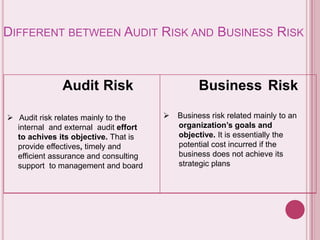
DIFFERENT BETWEEN AUDIT RISK AND BUSINESS RISK
Audit Risk
 Audit risk relates mainly to the
internal and external audit effort
to achives its objective. That is
provide effectives, timely and
efficient assurance and consulting
support to management and board
Business Risk
 Business risk related mainly to an
organization’s goals and
objective. It is essentially the
potential cost incurred if the
business does not achieve its
strategic plans
7.3 Understand the relationship between audit
materiality and audit risk
7.3.1 Distinguish the stages of audit
materiality to be considered in the
audit process
7.3.2 Identify the level of audit risk
THE STAGE OF AUDIT MATERIALITY
 Materiality should be considered by auditors when
planning and evaluating the results of an audit .
 No authoritative guidance is provides on factors
that should be considered when establishing
materiality for planning or evaluating purposes
 During the planning phase of an audit, auditors
establish materiality to determine the nature,
timing, and extent of audit procedures to perform
 Auditors commonly establish a quantitative amount
for materiality during the planning phase
 This quantitative amount will be referred to as “
planning materiality “ as it can change if audit
circumstances changes
THE LEVEL OF AUDIT RISK
 It is not posibble to quantity the audit risk
achieved in an audit. The idea of a reasonable
level of audit risk is subjective and determine by
judgement. In some circumstances, very low
audit essential for both users and the auditor
 When user place heavy reliance on the financial
difficulty
 When the auditor has more legal liabilty
exposure
BUSINESS RISK
 1) Accounting risk
 2) Credit risk
 3) Management risk
 4) Physical security risk
 5) Risk relating to automated (IT)
procedures
 6) Risks relating to electronic commerce
 ACCOUNTING RISK
- the risk that accounting standards, interpretation
of the standards or accounting treatments
may be applied incorrectly.
- it is a matter of opinion of how best to account for
and reflect the transactions in accordance with its
substance rather than the form.
 CREDIT RISK
- The risk of counter parties defaulting, is controlled
by the application of credit approval, limits and
monitoring procedures.
- credit risk could be minimized and monitored by
strictly limiting the company’s associations to
business partners with high credit worthiness.
- trade receivables should be monitored on an ongoing
basis via the company’s management reporting
procedures.
 MANAGEMENT RISK
- the risk that the auditor not detecting a material
misstatement resulting from management fraud
or irregularity is greater than for employee
fraud.
- level of management may also be in a position to
override control procedures designed to prevent
similar frauds by other employees.
 PHYSICAL SECURITY RISK
- cover areas such as protection of people, products,
processes and properties.
- risk related to physical security could not be overlooked
as lossess suffered from this risk could be material to
the business.
 RISKS RELATING TO AUTOMATED (IT)
PROCEDURES
- The use of manual or automated elements in
internal control affects the manner in which
transactions are initiated, recorded, processed and
reported.
- IT also poses specific risks to a company’s internal
control, such as unauthorized access to data,
unauthorized changes to data in master files and
to systems or programs, and inappropriate manual
intervention.
 RISKS RELATING TO ELECTRONIC
COMMERCE
- Businesses are involved in electronic commerce
(e-commerce), the risks exposures are even higher
in terms of interaction with unknown third
parties over the internet and the risk of
corruption of the systems by viruses and worms.

Audit Chapter 7

  • 1.
    CHAPTER 7 :MATERIALITY & AUDIT RISK SHARIFAH NUR AFIZA BT SYED AHMAD MUSTAFAH (10 DAT 11 F 2013) NORFAZIRA BT KASIM (10 DAT 11 F 2014) NUR ADIBAH BT ALIAS (10 DAT 11 F 2023) ADZRUL AINI BT ZAHARI (10 DAT 11 F 2026) NORSHAHIDA BT MOHD AZRUL JOON (10 DAT 11 F 2052) MUHAMMAD IZZAT AMIR BIN MOHD RAHIMI (10 DAT 11 F 2097)
  • 2.
    7.0 MATERIALITY ANDAUDIT RISK 7.1 Know the audit materiality 7.1.1 Define the meaning of audit materiality 7.1.2 Determine the level of audit materiality 7.1.3 Discuss the impact of audit materiality to audit work
  • 3.
    DEFINITION OF AUDITMATERIALITY Materiality can be defined as a misstatement in the financial statement of such magnitude that it :  By its omission or misstatement  Will affect the decision of a reasonable user of the statement
  • 4.
    LEVEL OF AUDITMATERIALITY a) Amount are immaterial  Where a misstatement in the financial statement exist but it is unlikely to affect the decision of a reasonable user, it is consider to be immaterial. An unqualified opinion is therefore appropriate.
  • 5.
    b) Amount arematerial but not pervasive  This second level of materiality exist when a misstatement in the financial statement would affect a user’s decision but the overall statement still present a true and fair view, and therefore usefull. c) Amount are so material and pervasive  That the overall truth and fairness of the financial statement is in question the highest level of materiality exist when the user are likely to make incorrect decisions if they real rely on the overall financial statement
  • 6.
    IMPACT OF AUDITMATERIALITY  Indicate that auditors considers the factors of materiality when evaluating the materiality of a quantitatively immaterial misstatement.  Auditors fail to consider audit risk in the materiality decision.  The materiality decisions of the auditors were not affected by whether the company had a high audit risk or a low audit risk.  The amount of auditor experience may have an impact on the decision.  More experienced auditors were more likely to require an audit adjustment for a factor of quantitative misstatement than were less experienced auditors.
  • 7.
    7.2 Know theaudit risk 7.2.1 Define the meaning of audit risk 7.2.2 Determine types of audit risk as below a) Inherent Risk b) Control Risk c) Detection Risk 7.2.3 Diferrentiate between audit risk and business risk
  • 8.
    DEFINITION OF AUDITRISK  Audit risk is the risk that auditors may express an inappropriate auditors opinion, such as issuing an unqualified audit opinion when the financial statement contain material misstatement
  • 9.
    TYPES OF AUDITRISK  Inherent Risk (IR)  Detection Risk (DR)  Current Risk (CR)
  • 10.
    INHERENT RISK  Susceptibilityof an assertion to material misstatement assuming no related internal controls.  The auditor should consider several major factor when assessing inherent risk : a) Nature of the client’s Business b) Results Of Precious Audits c) Initial versus repeat engagement d) Related parties e) Non-routine transaction f) Judgement required to correctly record account balanced and transaction g) Makeup of the population
  • 11.
    CONTROL RISK  Riskof misstatement not being detected by system of internal control  There are two basic phases to an auditor’s evaluation on control risk : a) Obtain an understanding of internal control. This phase applies to all audits. b) Test the internal controls for effectiveness. This phase only applies when the auditor chooses to assess control risk at below the maximum
  • 12.
    PLANNED DETECTION RISK Risk of misstatement not being detected by the auditor  Planned detection risk will change if the auditor change the other factor  If planned detection risk is reduced, the auditor need to accumulate more evidence to achieve the reduce planned risk
  • 13.
    DIFFERENT BETWEEN AUDITRISK AND BUSINESS RISK Audit Risk  Audit risk relates mainly to the internal and external audit effort to achives its objective. That is provide effectives, timely and efficient assurance and consulting support to management and board Business Risk  Business risk related mainly to an organization’s goals and objective. It is essentially the potential cost incurred if the business does not achieve its strategic plans
  • 14.
    7.3 Understand therelationship between audit materiality and audit risk 7.3.1 Distinguish the stages of audit materiality to be considered in the audit process 7.3.2 Identify the level of audit risk
  • 15.
    THE STAGE OFAUDIT MATERIALITY  Materiality should be considered by auditors when planning and evaluating the results of an audit .  No authoritative guidance is provides on factors that should be considered when establishing materiality for planning or evaluating purposes  During the planning phase of an audit, auditors establish materiality to determine the nature, timing, and extent of audit procedures to perform  Auditors commonly establish a quantitative amount for materiality during the planning phase  This quantitative amount will be referred to as “ planning materiality “ as it can change if audit circumstances changes
  • 16.
    THE LEVEL OFAUDIT RISK  It is not posibble to quantity the audit risk achieved in an audit. The idea of a reasonable level of audit risk is subjective and determine by judgement. In some circumstances, very low audit essential for both users and the auditor  When user place heavy reliance on the financial difficulty  When the auditor has more legal liabilty exposure
  • 17.
    BUSINESS RISK  1)Accounting risk  2) Credit risk  3) Management risk  4) Physical security risk  5) Risk relating to automated (IT) procedures  6) Risks relating to electronic commerce
  • 18.
     ACCOUNTING RISK -the risk that accounting standards, interpretation of the standards or accounting treatments may be applied incorrectly. - it is a matter of opinion of how best to account for and reflect the transactions in accordance with its substance rather than the form.
  • 19.
     CREDIT RISK -The risk of counter parties defaulting, is controlled by the application of credit approval, limits and monitoring procedures. - credit risk could be minimized and monitored by strictly limiting the company’s associations to business partners with high credit worthiness. - trade receivables should be monitored on an ongoing basis via the company’s management reporting procedures.
  • 20.
     MANAGEMENT RISK -the risk that the auditor not detecting a material misstatement resulting from management fraud or irregularity is greater than for employee fraud. - level of management may also be in a position to override control procedures designed to prevent similar frauds by other employees.
  • 21.
     PHYSICAL SECURITYRISK - cover areas such as protection of people, products, processes and properties. - risk related to physical security could not be overlooked as lossess suffered from this risk could be material to the business.
  • 22.
     RISKS RELATINGTO AUTOMATED (IT) PROCEDURES - The use of manual or automated elements in internal control affects the manner in which transactions are initiated, recorded, processed and reported. - IT also poses specific risks to a company’s internal control, such as unauthorized access to data, unauthorized changes to data in master files and to systems or programs, and inappropriate manual intervention.
  • 23.
     RISKS RELATINGTO ELECTRONIC COMMERCE - Businesses are involved in electronic commerce (e-commerce), the risks exposures are even higher in terms of interaction with unknown third parties over the internet and the risk of corruption of the systems by viruses and worms.