Modern Auditing:
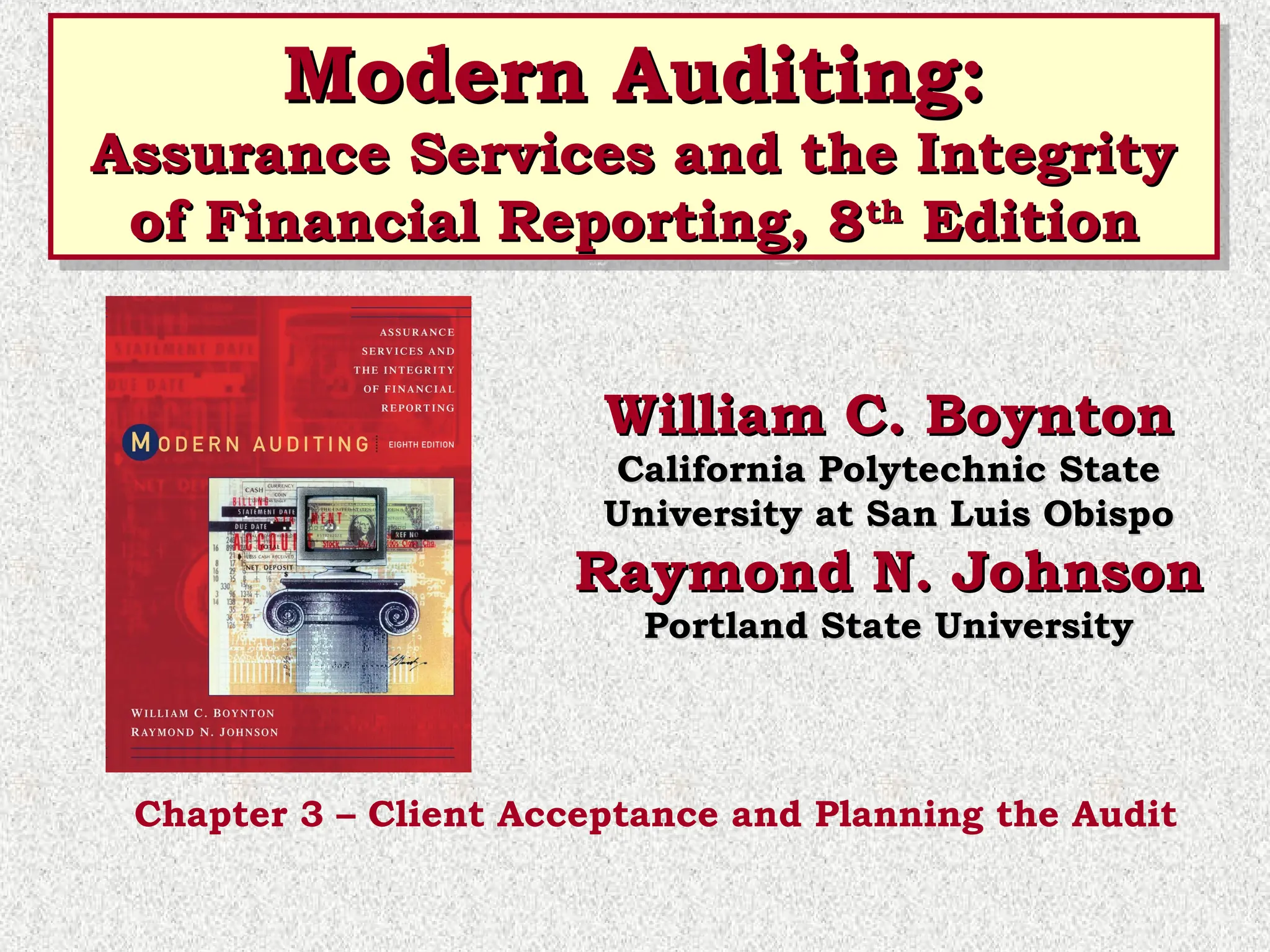
Modern Auditing:
Assurance Services and the Integrity
of Financial Reporting, 8
of Financial Reporting, 8th
th
Edition
Edition
William C. Boynton
William C. Boynton
California Polytechnic State
University at San Luis Obispo
Raymond N. Johnson
Raymond N. Johnson
Portland State University
Chapter 3 – Client Acceptance and Planning the Audit
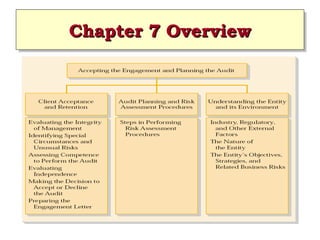
Chapter 7 Overview
Chapter 7 Overview
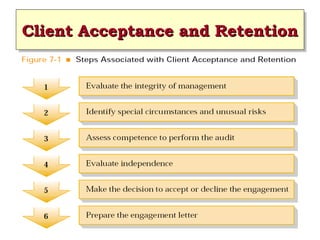
Client Acceptance and Retention
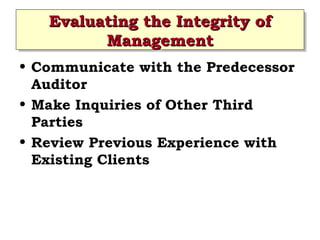
Evaluating the Integrity of
Management
Management
• Communicate with the Predecessor
Auditor
• Make Inquiries of Other Third
Parties
• Review Previous Experience with
Existing Clients
Identifying Special Circumstances
and Unusual Risks
and Unusual Risks
• Identify Intended Users of Audited
Statements
• Assess Prospective Client’s Legal and
Financial Stability
• Identify Scope Limitations
• Evaluate the Entity’s Financial
Reporting Systems and Auditability
Assessing Competence to
Perform the Audit
Perform the Audit
• Services Desired
• Identify the Audit Team
– Partner
– Manager(s)
– Senior(s)
– Staff Assistants
• Consider Need for Consultation and
Specialists
Evaluating Independence
• Identify Circumstances Impairing
Independence
• Identify Professional Staff Financial
and Business Relationships
• Identify Conflicts of Interest with
Other Clients
Making the Decision to Accept or
Decline the Audit
Decline the Audit
• Integrity of Management
• Special Circumstances and Unusual
Risks
• Competence Issues
• Independence Issues
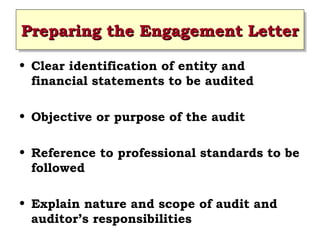
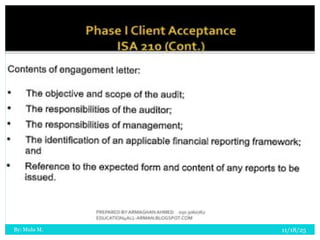
Preparing the Engagement Letter
• Clear identification of entity and
financial statements to be audited
• Objective or purpose of the audit
• Reference to professional standards to be
followed
• Explain nature and scope of audit and
auditor’s responsibilities
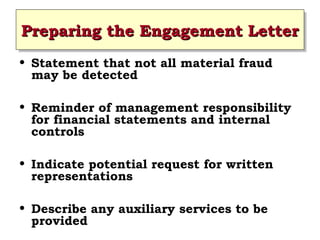
Preparing the Engagement Letter
• Statement that not all material fraud
may be detected
• Reminder of management responsibility
for financial statements and internal
controls
• Indicate potential request for written
representations
• Describe any auxiliary services to be
provided
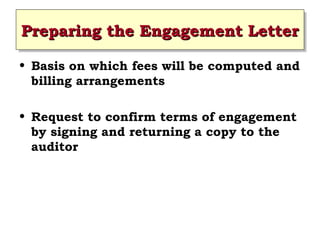
Preparing the Engagement Letter
• Basis on which fees will be computed and
billing arrangements
• Request to confirm terms of engagement
by signing and returning a copy to the
auditor
11/18/25
By: Mulu M.
12
11/18/25
By: Mulu M.
13
11/18/25
By: Mulu M.
14
11/18/25
By: Mulu M.
15
11/18/25
By: Mulu M.
16
11/18/25
By: Mulu M.
17
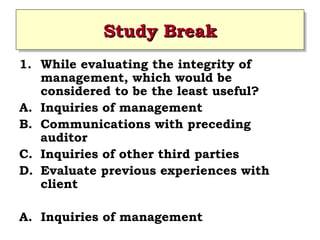
Study Break
Study Break
1. While evaluating the integrity of
management, which would be
considered to be the least useful?
A. Inquiries of management
B. Communications with preceding
auditor
C. Inquiries of other third parties
D. Evaluate previous experiences with
client
A. Inquiries of management
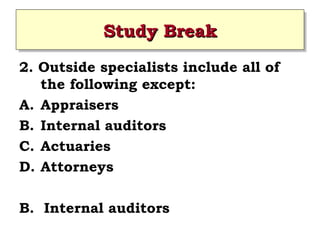
Study Break
Study Break
2. Outside specialists include all of
the following except:
A. Appraisers
B. Internal auditors
C. Actuaries
D. Attorneys
B. Internal auditors
11/18/25
By: Mulu M.
20
11/18/25
By: Mulu M.
21
11/18/25
By: Mulu M.
22
11/18/25
By: Mulu M.
23
11/18/25
By: Mulu M.
24
11/18/25
By: Mulu M.
25
11/18/25
By: Mulu M.
26
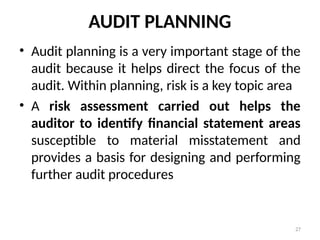
AUDIT PLANNING
• Audit planning is a very important stage of the
audit because it helps direct the focus of the
audit. Within planning, risk is a key topic area
• A risk assessment carried out helps the
auditor to identify financial statement areas
susceptible to material misstatement and
provides a basis for designing and performing
further audit procedures
27
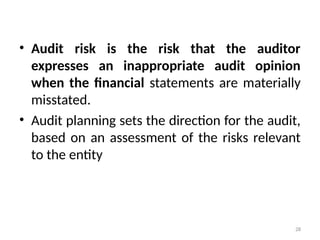
• Audit risk is the risk that the auditor
expresses an inappropriate audit opinion
when the financial statements are materially
misstated.
• Audit planning sets the direction for the audit,
based on an assessment of the risks relevant
to the entity
28
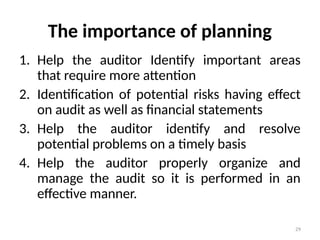
The importance of planning
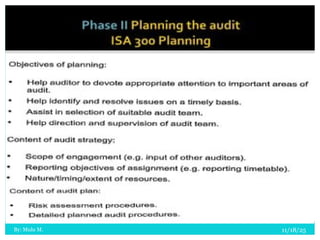
1. Help the auditor Identify important areas
that require more attention
2. Identification of potential risks having effect
on audit as well as financial statements
3. Help the auditor identify and resolve
potential problems on a timely basis
4. Help the auditor properly organize and
manage the audit so it is performed in an
effective manner.
29
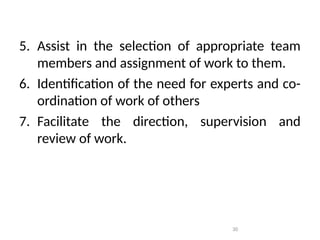
5. Assist in the selection of appropriate team
members and assignment of work to them.
6. Identification of the need for experts and co-
ordination of work of others
7. Facilitate the direction, supervision and
review of work.
30
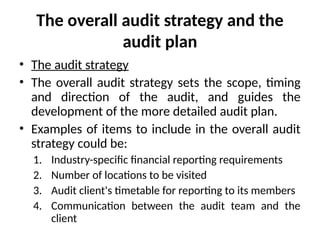
The overall audit strategy and the
audit plan
• The audit strategy
• The overall audit strategy sets the scope, timing
and direction of the audit, and guides the
development of the more detailed audit plan.
• Examples of items to include in the overall audit
strategy could be:
1. Industry-specific financial reporting requirements
2. Number of locations to be visited
3. Audit client's timetable for reporting to its members
4. Communication between the audit team and the
client
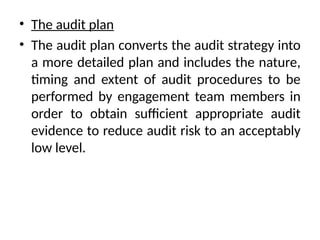
• The audit plan
• The audit plan converts the audit strategy into
a more detailed plan and includes the nature,
timing and extent of audit procedures to be
performed by engagement team members in
order to obtain sufficient appropriate audit
evidence to reduce audit risk to an acceptably
low level.
• Examples of items included in the audit plan
could be:
1. Timetable of planned audit work
2. Allocation of work to audit team members
3. Audit procedures for each major account area
(eg inventory, receivables, cash etc)
4. Materiality for the financial statements as a
whole and performance materiality
• Any changes made during the audit
engagement to the overall audit strategy or
audit plan, and the reasons for such changes,
shall be included in the audit documentation.
• You must understand the difference between
the audit strategy and the audit plan.
Introduction to risk
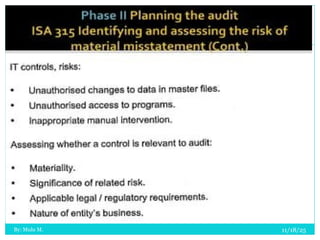
• A risk assessment carried out under the ISAs
helps the auditor to identify financial
statement areas susceptible to material
misstatement and provides a basis for
designing and performing further audit
procedures.
Overall Audit risk
• Audit risk is the risk that the auditor expresses
an inappropriate audit opinion when the
financial statements are materially misstated.
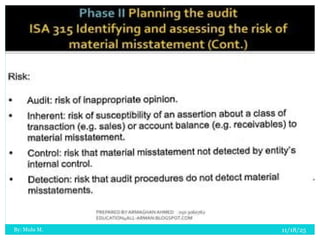
• It is a function of the risk of material
misstatement (inherent risk and control risk)
and the risk that the auditor will not detect
such misstatement (detection risk).
• Audit risk has two major components.
1.One is dependent on the entity, and is the risk of
material misstatement arising in the financial
statements (inherent risk and control risk).
2.The other is dependent on the auditor, and is the
risk that the auditor will not detect material
misstatements in the financial statements
(detection risk).
• Audit risk can be represented by the audit risk
model:
Audit risk =Inherent risk x control risk x detection risk
1. Inherent risk
• Inherent risk is the risk that items will be misstated due
to the characteristics of those items, such as the fact
they are estimates or that they are important items in
the accounts.
• It is a risk that a misstatement could be material
individually or when aggregated with other
misstatements, assuming there were no related
internal controls.
• The auditors must use their professional judgment and
all available knowledge to assess inherent risk. If no
such information or knowledge is available then the
inherent risk is high.
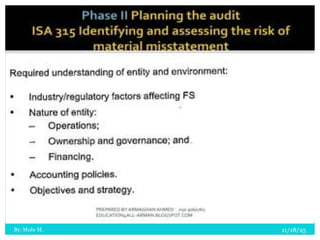
• Inherent risk is affected by the nature of the entity; for
example, the industry it is in and the regulations it falls
under, and also the nature of the strategies it adopts.
2. Control risk
• Control risk is the risk that a material
misstatement could occur that could be
material, individually or when aggregated
with other misstatements, that will not be
prevented or detected and corrected on a
timely basis by the entity's internal control.
3. Detection risk
• Detection risk is the risk that the procedures
performed by the auditor to reduce audit risk to
an acceptably low level will not detect a
misstatement that exists and that could be
material, individually or when aggregated with
other misstatements.
• This is the component of audit risk that the
auditors have a degree of control over, because,
if risk is too high to be tolerated, the auditors
can carry out more work to reduce this aspect of
audit risk and, therefore, audit risk as a whole.
• The following procedures therefore can help to
reduce detection risk:
– Adequate planning
– Assignment of more experienced personnel to the
engagement team
– The application of professional skepticism
– Increased supervision and review of the audit work
performed
• Auditors will want their overall audit risk to be at
an acceptable level, or it will not be worth them
carrying out the audit. In other words, if the
chance of them giving an inappropriate opinion
and being sued is high, it might be better not to
do the audit at all.
• The auditors will obviously consider how risky a
new audit client is during the acceptance process
and may decide not to go ahead with the
relationship.
• However, they will also consider audit risk for
each individual audit and will seek to manage the
risk.
• As we have seen above, it is not in the auditors'
power to affect inherent or control risk.
• These are risks integral to the client, and the
auditor cannot change the level of these risks.
• The auditors therefore manage overall audit risk
by manipulating detection risk, the only element
of audit risk they have control over.
• It is important to understand that there is not
a standard level of audit risk which is generally
considered by auditors to be acceptable. This
is a matter of audit judgment and so will vary
from firm to firm and audit to audit.
• Audit firms are likely to charge higher fees for
higher risk clients.
• Regardless of the risk level of the audit,
however, it is vital that audit firms always
carry out an audit of sufficient quality.
Materiality
• Materiality for the financial statements as a
whole and performance materiality must be
calculated at the planning stages of all audits.
• The calculation or estimation of materiality
should be based on experience and judgment.
• Materiality for the financial statements as a
whole must be reviewed throughout the audit
and revised if necessary.
• ISA 320 Materiality in planning and
performing an audit provides guidance to
auditors in this area and states the objective
of the auditor is to apply the concept of
materiality appropriately in planning and
performing the audit
• ISA320 does not define materiality but the
following is generally used to explain
materiality:
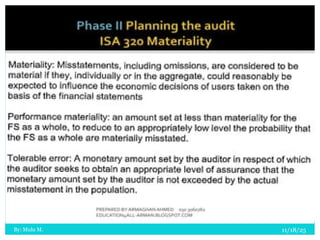
a) Misstatements are considered to be material if
they, individually or in aggregate, could
reasonably be expected to influence the
economic decisions of users.
b) Judgments about materiality are made in the
light of surrounding circumstances, and are
affected by the size and nature of a
misstatement or a combination of both.
c) Judgments about matters that are material to
users of financial statements are based on a
consideration of the common financial
information needs of users as a group.
• The materiality level will impact on the
auditors decisions relating to:
–How many items to examine
–Which items to examine
–Whether to use sampling techniques
–What level of misstatement is likely to result
in a modified audit opinion
Determining and calculating
materiality and performance
materiality when planning the audit
• During planning, the auditor must establish
materiality for the financial statements as a
whole(overall materiality), but must also set
performance materiality levels
• Determining materiality for the financial
statements as a whole involves the exercise of
professional judgment
• Generally, a percentage is applied to a chosen
benchmark as a starting point for determining
materiality for the financial statements as a
whole
• The following factors may affect the
identification of an appropriate benchmark:
– Elements of the financial statements (e.g. assets,
liabilities, equity, revenue, expenses)
– Whether there are items on which users tend to
focus
– Nature of the entity, industry and economic
environment
– Entity's ownership structure and financing
– Relative volatility of the benchmark
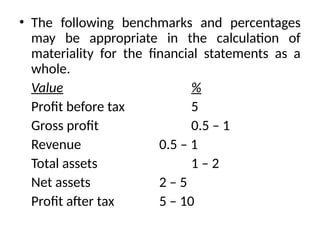
• The following benchmarks and percentages
may be appropriate in the calculation of
materiality for the financial statements as a
whole.
Value %
Profit before tax 5
Gross profit 0.5 – 1
Revenue 0.5 – 1
Total assets 1 – 2
Net assets 2 – 5
Profit after tax 5 – 10
• Performance materiality is the amount or
amounts set by the auditor at less than
materiality for the financial statements as a
whole to reduce to an appropriately low level
the probability that the aggregate of
uncorrected and undetected misstatements
exceeds materiality for the financial
statements as a whole.
• Performance materiality is what is applied
during the testing
chapter three new.ppt it is auditing principles

chapter three new.ppt it is auditing principles

  • 1.
    Modern Auditing: Modern Auditing: AssuranceServices and the Integrity Assurance Services and the Integrity of Financial Reporting, 8 of Financial Reporting, 8th th Edition Edition William C. Boynton William C. Boynton California Polytechnic State California Polytechnic State University at San Luis Obispo University at San Luis Obispo Raymond N. Johnson Raymond N. Johnson Portland State University Portland State University Chapter 3 – Client Acceptance and Planning the Audit
  • 2.
  • 3.
    Client Acceptance andRetention Client Acceptance and Retention
  • 4.
    Evaluating the Integrityof Evaluating the Integrity of Management Management • Communicate with the Predecessor Auditor • Make Inquiries of Other Third Parties • Review Previous Experience with Existing Clients
  • 5.
    Identifying Special Circumstances IdentifyingSpecial Circumstances and Unusual Risks and Unusual Risks • Identify Intended Users of Audited Statements • Assess Prospective Client’s Legal and Financial Stability • Identify Scope Limitations • Evaluate the Entity’s Financial Reporting Systems and Auditability
  • 6.
    Assessing Competence to AssessingCompetence to Perform the Audit Perform the Audit • Services Desired • Identify the Audit Team – Partner – Manager(s) – Senior(s) – Staff Assistants • Consider Need for Consultation and Specialists
  • 7.
    Evaluating Independence Evaluating Independence •Identify Circumstances Impairing Independence • Identify Professional Staff Financial and Business Relationships • Identify Conflicts of Interest with Other Clients
  • 8.
    Making the Decisionto Accept or Making the Decision to Accept or Decline the Audit Decline the Audit • Integrity of Management • Special Circumstances and Unusual Risks • Competence Issues • Independence Issues
  • 9.
    Preparing the EngagementLetter Preparing the Engagement Letter • Clear identification of entity and financial statements to be audited • Objective or purpose of the audit • Reference to professional standards to be followed • Explain nature and scope of audit and auditor’s responsibilities
  • 10.
    Preparing the EngagementLetter Preparing the Engagement Letter • Statement that not all material fraud may be detected • Reminder of management responsibility for financial statements and internal controls • Indicate potential request for written representations • Describe any auxiliary services to be provided
  • 11.
    Preparing the EngagementLetter Preparing the Engagement Letter • Basis on which fees will be computed and billing arrangements • Request to confirm terms of engagement by signing and returning a copy to the auditor
  • 12.
  • 13.
  • 14.
  • 15.
  • 16.
  • 17.
  • 18.
    Study Break Study Break 1.While evaluating the integrity of management, which would be considered to be the least useful? A. Inquiries of management B. Communications with preceding auditor C. Inquiries of other third parties D. Evaluate previous experiences with client A. Inquiries of management
  • 19.
    Study Break Study Break 2.Outside specialists include all of the following except: A. Appraisers B. Internal auditors C. Actuaries D. Attorneys B. Internal auditors
  • 20.
  • 21.
  • 22.
  • 23.
  • 24.
  • 25.
  • 26.
  • 27.
    AUDIT PLANNING • Auditplanning is a very important stage of the audit because it helps direct the focus of the audit. Within planning, risk is a key topic area • A risk assessment carried out helps the auditor to identify financial statement areas susceptible to material misstatement and provides a basis for designing and performing further audit procedures 27
  • 28.
    • Audit riskis the risk that the auditor expresses an inappropriate audit opinion when the financial statements are materially misstated. • Audit planning sets the direction for the audit, based on an assessment of the risks relevant to the entity 28
  • 29.
    The importance ofplanning 1. Help the auditor Identify important areas that require more attention 2. Identification of potential risks having effect on audit as well as financial statements 3. Help the auditor identify and resolve potential problems on a timely basis 4. Help the auditor properly organize and manage the audit so it is performed in an effective manner. 29
  • 30.
    5. Assist inthe selection of appropriate team members and assignment of work to them. 6. Identification of the need for experts and co- ordination of work of others 7. Facilitate the direction, supervision and review of work. 30
  • 31.
    The overall auditstrategy and the audit plan • The audit strategy • The overall audit strategy sets the scope, timing and direction of the audit, and guides the development of the more detailed audit plan. • Examples of items to include in the overall audit strategy could be: 1. Industry-specific financial reporting requirements 2. Number of locations to be visited 3. Audit client's timetable for reporting to its members 4. Communication between the audit team and the client
  • 32.
    • The auditplan • The audit plan converts the audit strategy into a more detailed plan and includes the nature, timing and extent of audit procedures to be performed by engagement team members in order to obtain sufficient appropriate audit evidence to reduce audit risk to an acceptably low level.
  • 33.
    • Examples ofitems included in the audit plan could be: 1. Timetable of planned audit work 2. Allocation of work to audit team members 3. Audit procedures for each major account area (eg inventory, receivables, cash etc) 4. Materiality for the financial statements as a whole and performance materiality • Any changes made during the audit engagement to the overall audit strategy or audit plan, and the reasons for such changes, shall be included in the audit documentation. • You must understand the difference between the audit strategy and the audit plan.
  • 34.
    Introduction to risk •A risk assessment carried out under the ISAs helps the auditor to identify financial statement areas susceptible to material misstatement and provides a basis for designing and performing further audit procedures.
  • 35.
    Overall Audit risk •Audit risk is the risk that the auditor expresses an inappropriate audit opinion when the financial statements are materially misstated. • It is a function of the risk of material misstatement (inherent risk and control risk) and the risk that the auditor will not detect such misstatement (detection risk).
  • 36.
    • Audit riskhas two major components. 1.One is dependent on the entity, and is the risk of material misstatement arising in the financial statements (inherent risk and control risk). 2.The other is dependent on the auditor, and is the risk that the auditor will not detect material misstatements in the financial statements (detection risk). • Audit risk can be represented by the audit risk model: Audit risk =Inherent risk x control risk x detection risk
  • 37.
    1. Inherent risk •Inherent risk is the risk that items will be misstated due to the characteristics of those items, such as the fact they are estimates or that they are important items in the accounts. • It is a risk that a misstatement could be material individually or when aggregated with other misstatements, assuming there were no related internal controls. • The auditors must use their professional judgment and all available knowledge to assess inherent risk. If no such information or knowledge is available then the inherent risk is high. • Inherent risk is affected by the nature of the entity; for example, the industry it is in and the regulations it falls under, and also the nature of the strategies it adopts.
  • 38.
    2. Control risk •Control risk is the risk that a material misstatement could occur that could be material, individually or when aggregated with other misstatements, that will not be prevented or detected and corrected on a timely basis by the entity's internal control.
  • 39.
    3. Detection risk •Detection risk is the risk that the procedures performed by the auditor to reduce audit risk to an acceptably low level will not detect a misstatement that exists and that could be material, individually or when aggregated with other misstatements. • This is the component of audit risk that the auditors have a degree of control over, because, if risk is too high to be tolerated, the auditors can carry out more work to reduce this aspect of audit risk and, therefore, audit risk as a whole.
  • 40.
    • The followingprocedures therefore can help to reduce detection risk: – Adequate planning – Assignment of more experienced personnel to the engagement team – The application of professional skepticism – Increased supervision and review of the audit work performed • Auditors will want their overall audit risk to be at an acceptable level, or it will not be worth them carrying out the audit. In other words, if the chance of them giving an inappropriate opinion and being sued is high, it might be better not to do the audit at all.
  • 41.
    • The auditorswill obviously consider how risky a new audit client is during the acceptance process and may decide not to go ahead with the relationship. • However, they will also consider audit risk for each individual audit and will seek to manage the risk. • As we have seen above, it is not in the auditors' power to affect inherent or control risk. • These are risks integral to the client, and the auditor cannot change the level of these risks. • The auditors therefore manage overall audit risk by manipulating detection risk, the only element of audit risk they have control over.
  • 42.
    • It isimportant to understand that there is not a standard level of audit risk which is generally considered by auditors to be acceptable. This is a matter of audit judgment and so will vary from firm to firm and audit to audit. • Audit firms are likely to charge higher fees for higher risk clients. • Regardless of the risk level of the audit, however, it is vital that audit firms always carry out an audit of sufficient quality.
  • 43.
    Materiality • Materiality forthe financial statements as a whole and performance materiality must be calculated at the planning stages of all audits. • The calculation or estimation of materiality should be based on experience and judgment. • Materiality for the financial statements as a whole must be reviewed throughout the audit and revised if necessary.
  • 44.
    • ISA 320Materiality in planning and performing an audit provides guidance to auditors in this area and states the objective of the auditor is to apply the concept of materiality appropriately in planning and performing the audit • ISA320 does not define materiality but the following is generally used to explain materiality:
  • 45.
    a) Misstatements areconsidered to be material if they, individually or in aggregate, could reasonably be expected to influence the economic decisions of users. b) Judgments about materiality are made in the light of surrounding circumstances, and are affected by the size and nature of a misstatement or a combination of both. c) Judgments about matters that are material to users of financial statements are based on a consideration of the common financial information needs of users as a group.
  • 46.
    • The materialitylevel will impact on the auditors decisions relating to: –How many items to examine –Which items to examine –Whether to use sampling techniques –What level of misstatement is likely to result in a modified audit opinion
  • 47.
    Determining and calculating materialityand performance materiality when planning the audit
  • 48.
    • During planning,the auditor must establish materiality for the financial statements as a whole(overall materiality), but must also set performance materiality levels • Determining materiality for the financial statements as a whole involves the exercise of professional judgment • Generally, a percentage is applied to a chosen benchmark as a starting point for determining materiality for the financial statements as a whole
  • 49.
    • The followingfactors may affect the identification of an appropriate benchmark: – Elements of the financial statements (e.g. assets, liabilities, equity, revenue, expenses) – Whether there are items on which users tend to focus – Nature of the entity, industry and economic environment – Entity's ownership structure and financing – Relative volatility of the benchmark
  • 50.
    • The followingbenchmarks and percentages may be appropriate in the calculation of materiality for the financial statements as a whole. Value % Profit before tax 5 Gross profit 0.5 – 1 Revenue 0.5 – 1 Total assets 1 – 2 Net assets 2 – 5 Profit after tax 5 – 10
  • 51.
    • Performance materialityis the amount or amounts set by the auditor at less than materiality for the financial statements as a whole to reduce to an appropriately low level the probability that the aggregate of uncorrected and undetected misstatements exceeds materiality for the financial statements as a whole. • Performance materiality is what is applied during the testing