PB604 - BUSINESS FINANCE
CHAPTER 1 : FINANCE MANAGEMENT
GROUP MEMBERS :
QURATULAINI BT HASRI (10DAT11F2009)
SHARIFAH NUR AFIZA BT SYED AHMAD MUSTAFA (10DAT11F2013)
NURAZARIAH BT RAHIMAN (10DAT11F2022)
NUR HUZAIFAH BT ZULKIFLI (10DAT11F2030)
1.3. DETERMINE THE DUTIES OF FINANCIAL
MANAGER IN
d) Monitoring & controlling
e) Involvement in financial market
MONITORING&CONTROLLING
Monitor competitor activity and stay
updated about latest industry trends.
Monitor and manage all expense within
the allotted budget.
Review financial data for accurancy,
correctness and completeness.
Oversee the overall corporate budgeting
preparation, management and
monitoring processes.
Review annual budgets and
recommend any charges if needed.
Ensure that the financial reports are
prepared and delivered on time.
Perform account reconciliation activities.
Ensure financial team follows company
policies and regulations.
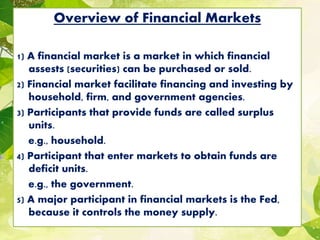
Overview of Financial Markets
1) A financial market is a market in which financial
assests (securities) can be purchased or sold.
2) Financial market facilitate financing and investing by
household, firm, and government agencies.
3) Participants that provide funds are called surplus
units.
e.g., household.
4) Participant that enter markets to obtain funds are
deficit units.
e.g., the government.
5) A major participant in financial markets is the Fed,
because it controls the money supply.
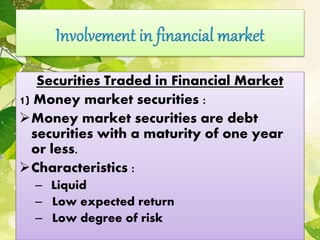
Securities Traded in Financial Market
1) Money market securities :
Money market securities are debt
securities with a maturity of one year
or less.
Characteristics :
– Liquid
– Low expected return
– Low degree of risk
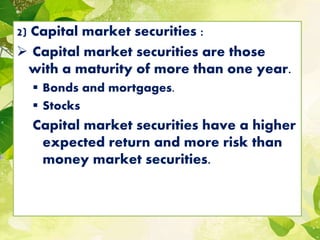
2) Capital market securities :
 Capital market securities are those
with a maturity of more than one year.
 Bonds and mortgages.
 Stocks
Capital market securities have a higher
expected return and more risk than
money market securities.
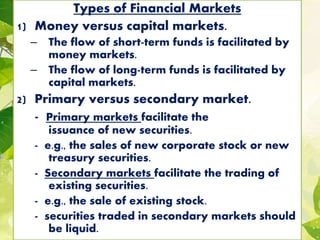
Types of Financial Markets
1) Money versus capital markets.
– The flow of short-term funds is facilitated by
money markets.
– The flow of long-term funds is facilitated by
capital markets.
2) Primary versus secondary market.
- Primary markets facilitate the
issuance of new securities.
- e.g., the sales of new corporate stock or new
treasury securities.
- Secondary markets facilitate the trading of
existing securities.
- e.g., the sale of existing stock.
- securities traded in secondary markets should
be liquid.
Business finance Chapter1 - Finance management

Business finance Chapter1 - Finance management

  • 1.
    PB604 - BUSINESSFINANCE CHAPTER 1 : FINANCE MANAGEMENT GROUP MEMBERS : QURATULAINI BT HASRI (10DAT11F2009) SHARIFAH NUR AFIZA BT SYED AHMAD MUSTAFA (10DAT11F2013) NURAZARIAH BT RAHIMAN (10DAT11F2022) NUR HUZAIFAH BT ZULKIFLI (10DAT11F2030)
  • 2.
    1.3. DETERMINE THEDUTIES OF FINANCIAL MANAGER IN d) Monitoring & controlling e) Involvement in financial market
  • 3.
    MONITORING&CONTROLLING Monitor competitor activityand stay updated about latest industry trends. Monitor and manage all expense within the allotted budget. Review financial data for accurancy, correctness and completeness. Oversee the overall corporate budgeting preparation, management and monitoring processes.
  • 4.
    Review annual budgetsand recommend any charges if needed. Ensure that the financial reports are prepared and delivered on time. Perform account reconciliation activities. Ensure financial team follows company policies and regulations.
  • 5.
    Overview of FinancialMarkets 1) A financial market is a market in which financial assests (securities) can be purchased or sold. 2) Financial market facilitate financing and investing by household, firm, and government agencies. 3) Participants that provide funds are called surplus units. e.g., household. 4) Participant that enter markets to obtain funds are deficit units. e.g., the government. 5) A major participant in financial markets is the Fed, because it controls the money supply.
  • 6.
    Securities Traded inFinancial Market 1) Money market securities : Money market securities are debt securities with a maturity of one year or less. Characteristics : – Liquid – Low expected return – Low degree of risk
  • 7.
    2) Capital marketsecurities :  Capital market securities are those with a maturity of more than one year.  Bonds and mortgages.  Stocks Capital market securities have a higher expected return and more risk than money market securities.
  • 8.
    Types of FinancialMarkets 1) Money versus capital markets. – The flow of short-term funds is facilitated by money markets. – The flow of long-term funds is facilitated by capital markets. 2) Primary versus secondary market. - Primary markets facilitate the issuance of new securities. - e.g., the sales of new corporate stock or new treasury securities. - Secondary markets facilitate the trading of existing securities. - e.g., the sale of existing stock. - securities traded in secondary markets should be liquid.