hanimnorzababa, politeknikmelaka
20-21 februari2012 1
Topic 6
AUDITING
COURSE LEARNING OUTCOMES (CLO)
Upon completion of this course, students should be able to :
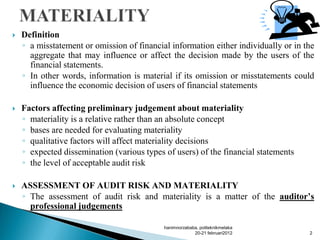
 Definition
◦ a misstatement or omission of financial information either individually or in the
aggregate that may influence or affect the decision made by the users of the
financial statements.
◦ In other words, information is material if its omission or misstatements could
influence the economic decision of users of financial statements
 Factors affecting preliminary judgement about materiality
◦ materiality is a relative rather than an absolute concept
◦ bases are needed for evaluating materiality
◦ qualitative factors will affect materiality decisions
◦ expected dissemination (various types of users) of the financial statements
◦ the level of acceptable audit risk
 ASSESSMENT OF AUDIT RISK AND MATERIALITY
◦ The assessment of audit risk and materiality is a matter of the auditor’s
professional judgements
hanimnorzababa, politeknikmelaka
20-21 februari2012 2
 MATERIALITY
◦ an item is material if its non-disclosure, misstatement or omission
would be likely to change the view given by the accounts. Whether
an item is material or not, the auditor will consider:
 Its absolute size
 Its nature – does it affect the SOCI or SFP? Are there
specific disclosure requirements?
 Its relative size – relative to the accounts as a whole, to
the balance of which it form a part, to corresponding
amounts in other periods
hanimnorzababa, politeknikmelaka
20-21 februari2012 3
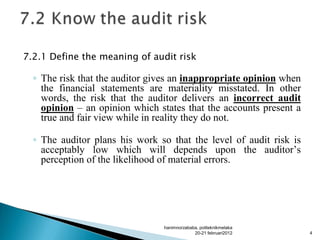
7.2.1 Define the meaning of audit risk
◦ The risk that the auditor gives an inappropriate opinion when
the financial statements are materiality misstated. In other
words, the risk that the auditor delivers an incorrect audit
opinion – an opinion which states that the accounts present a
true and fair view while in reality they do not.
◦ The auditor plans his work so that the level of audit risk is
acceptably low which will depends upon the auditor’s
perception of the likelihood of material errors.
hanimnorzababa, politeknikmelaka
20-21 februari2012 4
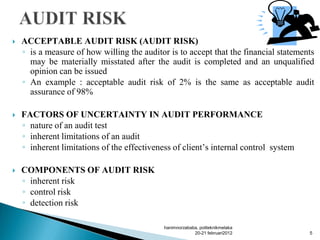
 ACCEPTABLE AUDIT RISK (AUDIT RISK)
◦ is a measure of how willing the auditor is to accept that the financial statements
may be materially misstated after the audit is completed and an unqualified
opinion can be issued
◦ An example : acceptable audit risk of 2% is the same as acceptable audit
assurance of 98%
 FACTORS OF UNCERTAINTY IN AUDIT PERFORMANCE
◦ nature of an audit test
◦ inherent limitations of an audit
◦ inherent limitations of the effectiveness of client’s internal control system
 COMPONENTS OF AUDIT RISK
◦ inherent risk
◦ control risk
◦ detection risk
hanimnorzababa, politeknikmelaka
20-21 februari2012 5
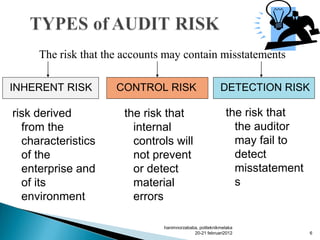
The risk that the accounts may contain misstatements
hanimnorzababa, politeknikmelaka
20-21 februari2012 6
INHERENT RISK CONTROL RISK DETECTION RISK
risk derived
from the
characteristics
of the
enterprise and
of its
environment
the risk that
internal
controls will
not prevent
or detect
material
errors
the risk that
the auditor
may fail to
detect
misstatement
s
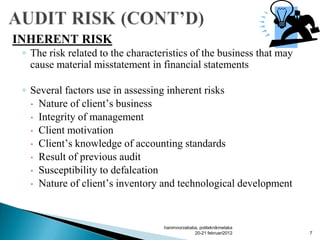
INHERENT RISK
◦ The risk related to the characteristics of the business that may
cause material misstatement in financial statements
◦ Several factors use in assessing inherent risks
 Nature of client’s business
 Integrity of management
 Client motivation
 Client’s knowledge of accounting standards
 Result of previous audit
 Susceptibility to defalcation
 Nature of client’s inventory and technological development
hanimnorzababa, politeknikmelaka
20-21 februari2012 7
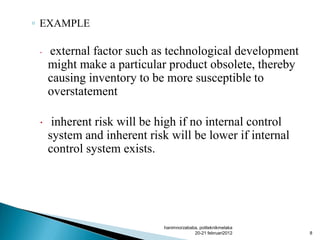
◦ EXAMPLE
 external factor such as technological development
might make a particular product obsolete, thereby
causing inventory to be more susceptible to
overstatement
 inherent risk will be high if no internal control
system and inherent risk will be lower if internal
control system exists.
hanimnorzababa, politeknikmelaka
20-21 februari2012 8
CONTROL RISK
◦ The risk that the client’s system of internal control will not prevent
or detect material errors or misstatements in the account balance or
class of transactions
◦ The control risk may exist due to the inherent limitation of internal
control system and inadequacy of the segregation of duties such as
human error, faulty judgement, teaming & lading
◦ Control risk will be higher if internal control system is not
effective and control risk will be lower if internal control risk is
effective
hanimnorzababa, politeknikmelaka
20-21 februari2012 9
DETECTION RISK
◦ The risk that any remaining material misstatement after assessing inherent and
control risks will not be detected by the auditor
◦ The risk that the auditor’s substantive procedures and review of financial
statements will not detect material errors or misstatements
◦ The auditor has to decide on the nature, extent, timing and cost of the audit in
the determination of the level of detection risk.
◦ Detection risk will be higher if the auditors are not competent and due care and
detection risk will be lower if the auditors are competent and exercise due care
hanimnorzababa, politeknikmelaka
20-21 februari2012
1
0
hanimnorzababa, politeknikmelaka
20-21 februari2012
1
1
hanimnorzababa, politeknikmelaka
20-21 februari2012
1
2
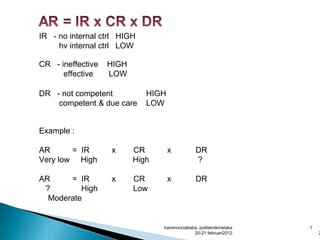
IR - no internal ctrl HIGH
hv internal ctrl LOW
CR - ineffective HIGH
effective LOW
DR - not competent HIGH
competent & due care LOW
Example :
AR = IR x CR x DR
Very low High High ?
AR = IR x CR x DR
? High Low
Moderate
hanimnorzababa, politeknikmelaka
20-21 februari2012
1
3
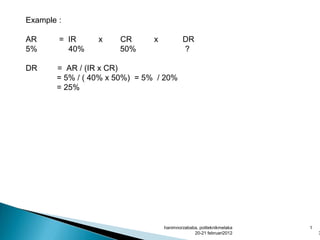
Example :
AR = IR x CR x DR
5% 40% 50% ?
DR = AR / (IR x CR)
= 5% / ( 40% x 50%) = 5% / 20%
= 25%
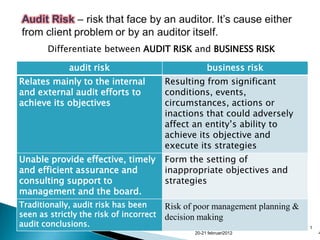
Differentiate between AUDIT RISK and BUSINESS RISK
hanimnorzababa, politeknikmelaka
20-21 februari2012
1
4
audit risk business risk
Relates mainly to the internal
and external audit efforts to
achieve its objectives
Resulting from significant
conditions, events,
circumstances, actions or
inactions that could adversely
affect an entity’s ability to
achieve its objective and
execute its strategies
Unable provide effective, timely
and efficient assurance and
consulting support to
management and the board.
Form the setting of
inappropriate objectives and
strategies
Traditionally, audit risk has been
seen as strictly the risk of incorrect
audit conclusions.
Risk of poor management planning &
decision making
hanimnorzababa, politeknikmelaka
20-21 februari2012
1
5
The relationship between audit materiality and audit risk

DPA 3043(AUDITING)-CHAPTER 6:Materiality and Risk

  • 1.
    hanimnorzababa, politeknikmelaka 20-21 februari20121 Topic 6 AUDITING COURSE LEARNING OUTCOMES (CLO) Upon completion of this course, students should be able to :
  • 2.
     Definition ◦ amisstatement or omission of financial information either individually or in the aggregate that may influence or affect the decision made by the users of the financial statements. ◦ In other words, information is material if its omission or misstatements could influence the economic decision of users of financial statements  Factors affecting preliminary judgement about materiality ◦ materiality is a relative rather than an absolute concept ◦ bases are needed for evaluating materiality ◦ qualitative factors will affect materiality decisions ◦ expected dissemination (various types of users) of the financial statements ◦ the level of acceptable audit risk  ASSESSMENT OF AUDIT RISK AND MATERIALITY ◦ The assessment of audit risk and materiality is a matter of the auditor’s professional judgements hanimnorzababa, politeknikmelaka 20-21 februari2012 2
  • 3.
     MATERIALITY ◦ anitem is material if its non-disclosure, misstatement or omission would be likely to change the view given by the accounts. Whether an item is material or not, the auditor will consider:  Its absolute size  Its nature – does it affect the SOCI or SFP? Are there specific disclosure requirements?  Its relative size – relative to the accounts as a whole, to the balance of which it form a part, to corresponding amounts in other periods hanimnorzababa, politeknikmelaka 20-21 februari2012 3
  • 4.
    7.2.1 Define themeaning of audit risk ◦ The risk that the auditor gives an inappropriate opinion when the financial statements are materiality misstated. In other words, the risk that the auditor delivers an incorrect audit opinion – an opinion which states that the accounts present a true and fair view while in reality they do not. ◦ The auditor plans his work so that the level of audit risk is acceptably low which will depends upon the auditor’s perception of the likelihood of material errors. hanimnorzababa, politeknikmelaka 20-21 februari2012 4
  • 5.
     ACCEPTABLE AUDITRISK (AUDIT RISK) ◦ is a measure of how willing the auditor is to accept that the financial statements may be materially misstated after the audit is completed and an unqualified opinion can be issued ◦ An example : acceptable audit risk of 2% is the same as acceptable audit assurance of 98%  FACTORS OF UNCERTAINTY IN AUDIT PERFORMANCE ◦ nature of an audit test ◦ inherent limitations of an audit ◦ inherent limitations of the effectiveness of client’s internal control system  COMPONENTS OF AUDIT RISK ◦ inherent risk ◦ control risk ◦ detection risk hanimnorzababa, politeknikmelaka 20-21 februari2012 5
  • 6.
    The risk thatthe accounts may contain misstatements hanimnorzababa, politeknikmelaka 20-21 februari2012 6 INHERENT RISK CONTROL RISK DETECTION RISK risk derived from the characteristics of the enterprise and of its environment the risk that internal controls will not prevent or detect material errors the risk that the auditor may fail to detect misstatement s
  • 7.
    INHERENT RISK ◦ Therisk related to the characteristics of the business that may cause material misstatement in financial statements ◦ Several factors use in assessing inherent risks  Nature of client’s business  Integrity of management  Client motivation  Client’s knowledge of accounting standards  Result of previous audit  Susceptibility to defalcation  Nature of client’s inventory and technological development hanimnorzababa, politeknikmelaka 20-21 februari2012 7
  • 8.
    ◦ EXAMPLE  externalfactor such as technological development might make a particular product obsolete, thereby causing inventory to be more susceptible to overstatement  inherent risk will be high if no internal control system and inherent risk will be lower if internal control system exists. hanimnorzababa, politeknikmelaka 20-21 februari2012 8
  • 9.
    CONTROL RISK ◦ Therisk that the client’s system of internal control will not prevent or detect material errors or misstatements in the account balance or class of transactions ◦ The control risk may exist due to the inherent limitation of internal control system and inadequacy of the segregation of duties such as human error, faulty judgement, teaming & lading ◦ Control risk will be higher if internal control system is not effective and control risk will be lower if internal control risk is effective hanimnorzababa, politeknikmelaka 20-21 februari2012 9
  • 10.
    DETECTION RISK ◦ Therisk that any remaining material misstatement after assessing inherent and control risks will not be detected by the auditor ◦ The risk that the auditor’s substantive procedures and review of financial statements will not detect material errors or misstatements ◦ The auditor has to decide on the nature, extent, timing and cost of the audit in the determination of the level of detection risk. ◦ Detection risk will be higher if the auditors are not competent and due care and detection risk will be lower if the auditors are competent and exercise due care hanimnorzababa, politeknikmelaka 20-21 februari2012 1 0
  • 11.
  • 12.
    hanimnorzababa, politeknikmelaka 20-21 februari2012 1 2 IR- no internal ctrl HIGH hv internal ctrl LOW CR - ineffective HIGH effective LOW DR - not competent HIGH competent & due care LOW Example : AR = IR x CR x DR Very low High High ? AR = IR x CR x DR ? High Low Moderate
  • 13.
    hanimnorzababa, politeknikmelaka 20-21 februari2012 1 3 Example: AR = IR x CR x DR 5% 40% 50% ? DR = AR / (IR x CR) = 5% / ( 40% x 50%) = 5% / 20% = 25%
  • 14.
    Differentiate between AUDITRISK and BUSINESS RISK hanimnorzababa, politeknikmelaka 20-21 februari2012 1 4 audit risk business risk Relates mainly to the internal and external audit efforts to achieve its objectives Resulting from significant conditions, events, circumstances, actions or inactions that could adversely affect an entity’s ability to achieve its objective and execute its strategies Unable provide effective, timely and efficient assurance and consulting support to management and the board. Form the setting of inappropriate objectives and strategies Traditionally, audit risk has been seen as strictly the risk of incorrect audit conclusions. Risk of poor management planning & decision making
  • 15.
    hanimnorzababa, politeknikmelaka 20-21 februari2012 1 5 Therelationship between audit materiality and audit risk