INSTRUCTION COURSE SLIT LAMP EXAMINATION MP STATE OPHTHALMIC CONFERENCE UJJAIN 2008
Presented by Dr. Sanjay Shrivastava Dr. Nikhilesh Trivedi  Dr. Kavita Kumar
Slit Lamp Examination  The science of examination with a slit lamp is called Biomicroscopy as it allows in vivo study of living tissues at high magnification.
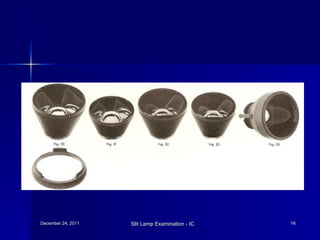
SLITLAMP EXAMINATION Permits detailed examination of various structures of and posterior segment of eye  Angle of anterior chamber with gonioscope  Measurement of intra ocular pressure  Endothelial cell counts
SLITLAMP EXAMINATION Photographic representation of every above  mentioned part of the eye  Modern slit lamp and its auxiliary devices provide magnified view of parts of eye from cornea to retina Measurement of Corneal thickness is also possible
Slit lamp is a misnomer In 1925 MAVAS introduced a term bio- microscopy defined as examination of the living eye by means of the corneal microscope and slit lamp. LITTMAN in1950 introduced the rotatory magnification charger based on the principle of GALILEAN telescope is the forerunner of current ZEISS slit lamp .
Ā 
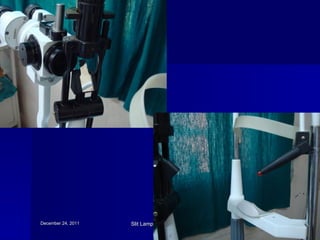
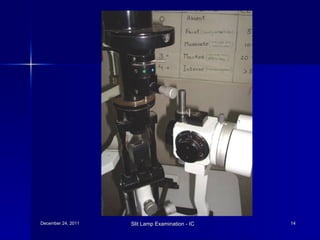
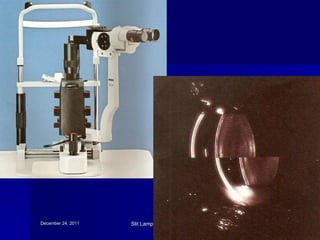
PARTS A. OBSERVTION SYSTEM B. ILLUMINATION SYSTEM C. MECHANICAL SYSTEM
Slit lamp
The Instrument
The  Instrument
Ā 
Ā 
Ā 
Ā 
Ā 
Ā 
Ā 
Ā 
Posterior Segment Examination with +78 D Lens
 OBSERVATION SYSTEM   a. Objective lenses -22 diopters b. Eye piece- 10 diopters
ILLUMINATION SYSTEM a. Light source  b. Condenser lens system c. Slit and other diaphgram d. Filters e. Projection lens f.  Reflecting mirror/prism2.
MECHANICAL SYSTEM A. Joy stick arrangement B. Up and down arrangement  C. Patient support arrangement D. Mechanical coupling
Slit Lamp Examination -Method Prerequisites – Preferably a dark room and slit lamp biomicroscope  Position – Patient is seated comfortably on an adjustable stool, with chin resting against chin rest and forehead against head rest bar.
PREPARATION A. Preliminary examination of eye ball B. Illumination of room. C. Preparation and management  of patients  D. Adjustment of instruments. E. Stereopsis
METHODS OF ILLUMINATION Diffuse illumination Sclerotic scatter Direct focal illumination Indirect illumination Retro-illumination Specular reflection
SET UP   1. Angle between  microscope and  illuminating system – 30 deg to 45  deg.  2. Slit width - widest. 3. Filters - diffusing filter 4. Magnification - low to medium  5. Illumination – low to high.
USE 1. Topography of pathological changes. 2. Entire surface of cornea, iris, lens can be viewed. 3. Folds of descemets membrane. 4. Corneal scar. 5. Whole configuration of lens. 6. Surface of adult nucleus.
SCLEROTIC   SCATTER Also called indirect lateral illumination-it is possible by concentrating the beam upon the spot at the side of the object it is proposed to examine Projecting the light upon sclera near the limbus,it is easy to examine the limbal portion of cornea,and if the incident ray is sufficient to induce total internal reflection,the whole of cornea including the opposite limbus ,is lit up.
USE 1. Corneal opacities 2. Keratocele 3. Interstitial deposits 4. Perforating scars
DIRECT   FOCAL ILLUMINATION BASIS OF ALL METHODS.
SET UP Slit beam is regulated until it coincides with exact focus of microscope.  Light - narrow slit at an oblique angle 30 deg to 45 deg
THREE SLIT BEAM EFFECTS OPTICAL SECTION PARALLELOPIPED CORNEAL  SECTION CONICAL BEAM EFFECT
I. OPTICAL SECTION Produced by a very narrow slit beam focused obliquely. It resemble a knife like histological section of tissue focused. Corneal section uses  changes in corneal curvature. change in corneal thickness. depth of corneal pathologies; foreign body localization.
OPTICAL SECTION   Corneal optic section showing; Tear layer-anterior most bright zone Epithelial layer-dark line immediately behind it. Bowmen’s membrane-a bright line. Stroma-wider granular and greyer zone. Descemets membrane and endothelial layers-posterior most bright zone.
II. PARELLOPIPED CORNEA 2-3 mm. wide focused slit beam. Because beam traverse cornea obliquely, shape of resulting rectangular block is paralellopiped prism. the ext. and internal surface of which slightly curved owing to anatomic shape of cornea
USES 1. Pathologies of epithelium and Stroma. 2. Corneal scar or infiltrates.  Appear  brighter. 3. Water clefts have low density so appear black.
III. CONICAL BEAM Small circular beam Used to detect the aqueous flare
INDIRECT ILLUMINATION Slit beam is focused at a point just behind a area to be examined.
SET UP   Angle between slit beam and  microscope is 30 deg  to 45 deg - Beam width - moderate  - Illumination - low medium or high
USES Corneal infiltration  Corneal microcysts Corneal vacuoles  Epithelial cells
RETROILLUMINATION Examination of normal or pathological structures in light reflected from tissue situated more posteriorly
RETROILLUMINATION
Direct retro illumination Observer in direct pathway of light Light is reflected from structures so pathology seen against illuminated background
Indirect retro illumination Observer is right angle to observed structures not in line so pathology seen against dark non illuminated background
Pathologies can be  1. Obstructive – seen as dark against light background eg pigment or blood filled vessels 2. Respersive –these scatter light but not obstruct completely seen as bright against dark background eg epithelial edema, precipitates.
Pathologies can be  3. Refractile – they distort the view of junction of illuminated and dark area because there refractive index is different from surroundings  eg Vacuoles.
SPECULAR REFLECTION   It is one of the most difficult methods. Not possible to use on all kind of slit lamps Reflection of light occurs when beam of light is incident on an optical surface called zone of discontinuity, such zones may be found in cornea and lens  When observer is placed in pathway of reflected light a dazzling reflex seen called specular reflection
SET UP Illuminating and viewing arms each forms and angle of about 30 deg to the central perpendicular  Slit beam height of 2 mm and focused onto the central corneal endothelium  Golden sheen with darker lines outline the hexagonal endothelial cells  Magnification of atleast 40X is needs to see endothelial pattern
USES Surface pathologies scatter the light irregularly. therefore create dark area in reflex. Using an eye piece reticule endothelial cells can be measured and counted and also used to study the tear film details .
Oscillating illumination of Koppe Slit beam is given an oscillatory movement by which it is often possible to see minute objects and filaments especially in the aqueous which would otherwise escapes detection
SPECIALISED USES  1. Gonioscopy  2. Fundus examination with focal  illumination  3. Pachymatery 4. Applanation tonometry  5. Ophthalmodynamometry
SPECIALISED USES   6. Slit lamp photography  7. As a delivery  system for argon  , diode and Nd YAG laser  8. Laser interferometry 9. Potential acuity meter test
END OF PART ONE THANKS

Sl exam pt i

  • 1.
    INSTRUCTION COURSE SLITLAMP EXAMINATION MP STATE OPHTHALMIC CONFERENCE UJJAIN 2008
  • 2.
    Presented by Dr.Sanjay Shrivastava Dr. Nikhilesh Trivedi Dr. Kavita Kumar
  • 3.
    Slit Lamp Examination The science of examination with a slit lamp is called Biomicroscopy as it allows in vivo study of living tissues at high magnification.
  • 4.
    SLITLAMP EXAMINATION Permitsdetailed examination of various structures of and posterior segment of eye Angle of anterior chamber with gonioscope Measurement of intra ocular pressure Endothelial cell counts
  • 5.
    SLITLAMP EXAMINATION Photographicrepresentation of every above mentioned part of the eye Modern slit lamp and its auxiliary devices provide magnified view of parts of eye from cornea to retina Measurement of Corneal thickness is also possible
  • 6.
    Slit lamp isa misnomer In 1925 MAVAS introduced a term bio- microscopy defined as examination of the living eye by means of the corneal microscope and slit lamp. LITTMAN in1950 introduced the rotatory magnification charger based on the principle of GALILEAN telescope is the forerunner of current ZEISS slit lamp .
  • 7.
  • 8.
    PARTS A. OBSERVTIONSYSTEM B. ILLUMINATION SYSTEM C. MECHANICAL SYSTEM
  • 9.
  • 10.
  • 11.
  • 12.
  • 13.
  • 14.
  • 15.
  • 16.
  • 17.
  • 18.
  • 19.
  • 20.
  • 21.
    OBSERVATION SYSTEM a. Objective lenses -22 diopters b. Eye piece- 10 diopters
  • 22.
    ILLUMINATION SYSTEM a.Light source b. Condenser lens system c. Slit and other diaphgram d. Filters e. Projection lens f. Reflecting mirror/prism2.
  • 23.
    MECHANICAL SYSTEM A.Joy stick arrangement B. Up and down arrangement C. Patient support arrangement D. Mechanical coupling
  • 24.
    Slit Lamp Examination-Method Prerequisites – Preferably a dark room and slit lamp biomicroscope Position – Patient is seated comfortably on an adjustable stool, with chin resting against chin rest and forehead against head rest bar.
  • 25.
    PREPARATION A. Preliminaryexamination of eye ball B. Illumination of room. C. Preparation and management of patients D. Adjustment of instruments. E. Stereopsis
  • 26.
    METHODS OF ILLUMINATIONDiffuse illumination Sclerotic scatter Direct focal illumination Indirect illumination Retro-illumination Specular reflection
  • 27.
    SET UP 1. Angle between microscope and illuminating system – 30 deg to 45 deg. 2. Slit width - widest. 3. Filters - diffusing filter 4. Magnification - low to medium 5. Illumination – low to high.
  • 28.
    USE 1. Topographyof pathological changes. 2. Entire surface of cornea, iris, lens can be viewed. 3. Folds of descemets membrane. 4. Corneal scar. 5. Whole configuration of lens. 6. Surface of adult nucleus.
  • 29.
    SCLEROTIC SCATTER Also called indirect lateral illumination-it is possible by concentrating the beam upon the spot at the side of the object it is proposed to examine Projecting the light upon sclera near the limbus,it is easy to examine the limbal portion of cornea,and if the incident ray is sufficient to induce total internal reflection,the whole of cornea including the opposite limbus ,is lit up.
  • 30.
    USE 1. Cornealopacities 2. Keratocele 3. Interstitial deposits 4. Perforating scars
  • 31.
    DIRECT FOCAL ILLUMINATION BASIS OF ALL METHODS.
  • 32.
    SET UP Slitbeam is regulated until it coincides with exact focus of microscope. Light - narrow slit at an oblique angle 30 deg to 45 deg
  • 33.
    THREE SLIT BEAMEFFECTS OPTICAL SECTION PARALLELOPIPED CORNEAL SECTION CONICAL BEAM EFFECT
  • 34.
    I. OPTICAL SECTIONProduced by a very narrow slit beam focused obliquely. It resemble a knife like histological section of tissue focused. Corneal section uses changes in corneal curvature. change in corneal thickness. depth of corneal pathologies; foreign body localization.
  • 35.
    OPTICAL SECTION Corneal optic section showing; Tear layer-anterior most bright zone Epithelial layer-dark line immediately behind it. Bowmen’s membrane-a bright line. Stroma-wider granular and greyer zone. Descemets membrane and endothelial layers-posterior most bright zone.
  • 36.
    II. PARELLOPIPED CORNEA2-3 mm. wide focused slit beam. Because beam traverse cornea obliquely, shape of resulting rectangular block is paralellopiped prism. the ext. and internal surface of which slightly curved owing to anatomic shape of cornea
  • 37.
    USES 1. Pathologiesof epithelium and Stroma. 2. Corneal scar or infiltrates. Appear brighter. 3. Water clefts have low density so appear black.
  • 38.
    III. CONICAL BEAMSmall circular beam Used to detect the aqueous flare
  • 39.
    INDIRECT ILLUMINATION Slitbeam is focused at a point just behind a area to be examined.
  • 40.
    SET UP Angle between slit beam and microscope is 30 deg to 45 deg - Beam width - moderate - Illumination - low medium or high
  • 41.
    USES Corneal infiltration Corneal microcysts Corneal vacuoles Epithelial cells
  • 42.
    RETROILLUMINATION Examination ofnormal or pathological structures in light reflected from tissue situated more posteriorly
  • 43.
  • 44.
    Direct retro illuminationObserver in direct pathway of light Light is reflected from structures so pathology seen against illuminated background
  • 45.
    Indirect retro illuminationObserver is right angle to observed structures not in line so pathology seen against dark non illuminated background
  • 46.
    Pathologies can be 1. Obstructive – seen as dark against light background eg pigment or blood filled vessels 2. Respersive –these scatter light but not obstruct completely seen as bright against dark background eg epithelial edema, precipitates.
  • 47.
    Pathologies can be 3. Refractile – they distort the view of junction of illuminated and dark area because there refractive index is different from surroundings eg Vacuoles.
  • 48.
    SPECULAR REFLECTION It is one of the most difficult methods. Not possible to use on all kind of slit lamps Reflection of light occurs when beam of light is incident on an optical surface called zone of discontinuity, such zones may be found in cornea and lens When observer is placed in pathway of reflected light a dazzling reflex seen called specular reflection
  • 49.
    SET UP Illuminatingand viewing arms each forms and angle of about 30 deg to the central perpendicular Slit beam height of 2 mm and focused onto the central corneal endothelium Golden sheen with darker lines outline the hexagonal endothelial cells Magnification of atleast 40X is needs to see endothelial pattern
  • 50.
    USES Surface pathologiesscatter the light irregularly. therefore create dark area in reflex. Using an eye piece reticule endothelial cells can be measured and counted and also used to study the tear film details .
  • 51.
    Oscillating illumination ofKoppe Slit beam is given an oscillatory movement by which it is often possible to see minute objects and filaments especially in the aqueous which would otherwise escapes detection
  • 52.
    SPECIALISED USES 1. Gonioscopy 2. Fundus examination with focal illumination 3. Pachymatery 4. Applanation tonometry 5. Ophthalmodynamometry
  • 53.
    SPECIALISED USES 6. Slit lamp photography 7. As a delivery system for argon , diode and Nd YAG laser 8. Laser interferometry 9. Potential acuity meter test
  • 54.
    END OF PARTONE THANKS