SLIT LAMP
PRESENTOR – DR. ANNIRUDH GUPTA
MORDERATOR- DR. VINEETA PAI
23- FEBRUARY 2024
INTRODUCTION
• Routine method of of examining the outer and
anterior segment of the eye.
• Consist of – low powered binocular compound
microscope linked to an adjustable bright light
source.
• Isolation of the layers or entity to be viewed is the
key to slit lamp biomicroscopy.
OPTICS OF COMPOUND MICROSCOPE.
HISTORY
• 1806- HIMLY used a simple convex lens (to create
focal illumination).
• 1823- PURKINJE used magnifying glasses (to
increase magnification).
• 1897- CZAPSKI: binocular stereoscopic microscope.
• 1911- GULLSTRAND designed the first slit lamp by
focusing the filament of the light bulb on the slit
aperture to create more focal illumination on
cornea.
SCHANZ-CZAPSKI INSTRUMENT FOR
STEREOSCOPIC EYE EXAMINATION.
HISTORY
• 1916- KOEPPE and HENKER –combined Gullstard’s
slit lamp on and articulated arm with stereoscopic
microscope both mounted on same stand
• 1920- VOGT- altered the optics: filament of light
focused on condensing lens rather than on cornea
which resulted in more homogenous bright light on
cornea.
1916- KOEPPE AND HENKER
SLIT LAMP
HISTORY
• 1933- GOLDMAN- introduced 3 control element for
cross-slide stage and combine swivel axis foe
microscope and illumination system in HAGG-
STREIT slit lamp.
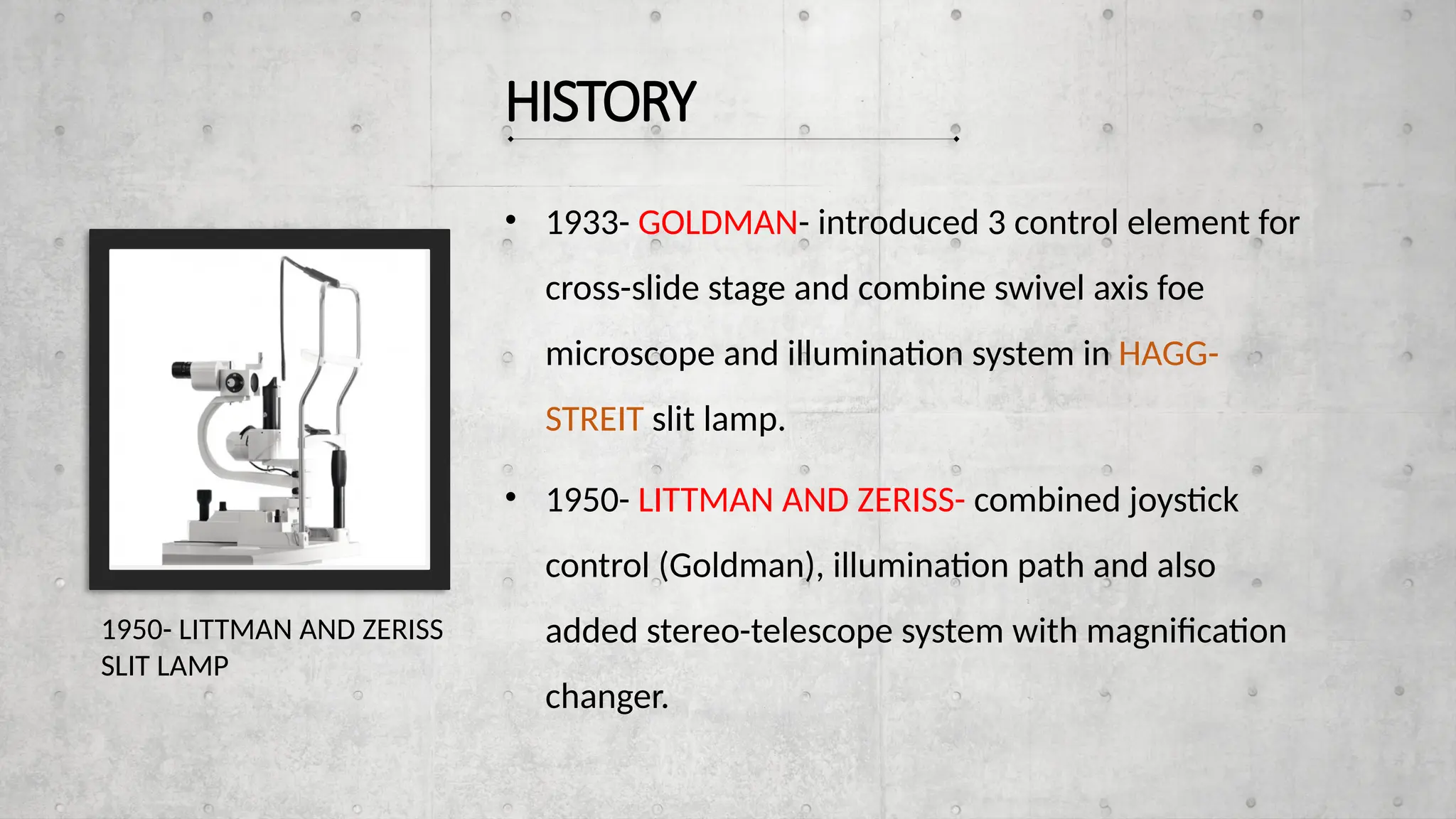
• 1950- LITTMAN AND ZERISS- combined joystick
control (Goldman), illumination path and also
added stereo-telescope system with magnification
changer.
1950- LITTMAN AND ZERISS
SLIT LAMP
Placeholder Title 08
HAGG-STREIT SLIT LAMP
LIGHT FROM ABOVE
ZEISS SLIT LAMP
LIGHT FROM BELOW
TYPES- ON BASIS OF ILLUMINATION
HAGGSTREIT
ABBRIVATIONS MEANING
B BULB
CL CONDENSING LENSES
OL OBJECTIVE LENS
M MIRROR
ZEISS
ABBRIVATIONS MEANING
B BULB
CL CONDENSING LENSES
OL OBJECTIVE LENS
M MIRROR
OPTICS OFSLITLAMP
• 2 Basicsystem-
• Illumination system
• Microscope system
• Alignmentissuchthatthepointonwhichmicroscopeis
focusedcorrespondstothepointonwhichlightis
focused.
• Thisisachievedbythemicroscopeandthelightning
systemhavingacommonfocalplane.
• Theircommonaxisofrotationalsoliesinthisfocalplane.
KOHLER’S PRINCIPLE OF ILLUMINATION.
• Light source is transmitted to objective lens by the collector system
and through slit aperture.
• Provides homogenous slit image even with a structured light source
PARTS OF SLIT LAMP.
• BASIC DESIGN-
• OBSERVATION SYSTEM
• ILLUMINATION SYSTEM
• MECHANICAL SUPPORT SYSTEM.
OBSERVATION SYSTEM
• Essentially a compound microscope with 2 optical
elements-
• Objective lens +22d
• Eye piece +10d
• Prism
• Provide lage working distance in front of
microscope for manupulation on patient eye
• Back vertex distance is 90-120 mm
• Lable it
MICROSCOPE SYSTEM
• Eyepiece system uses astronomical telescope
system
• Gallelian telescope system- sits between
objective and eyepiece lens, provides large
range of magnification
• Total magnification = magnification of ( objective
lens + telescope + magnification changer)
Placeholder Title 06
ASTRONOMICAL TELESCOPE GALLELIAN TELESCOPE
DIFFERENCE BETWEEN GALLELIAN AND ASTRONIMICAL TELESCOPE
PROPERTY GALLELIAN ASTRONOMICAL
Fo Convex (+ve) Convex (+ve)
Fi Concave (-ve) Convex (+ve)
TUBE LENGTH SHORT (Fo-Fi) long (Fo + Fi)
MAGNIFICATION Upto 4x Upto 10x
IMAGE Virtual and erect Real and inverted
FIELD SIZE Smaller Larger
Placeholder Title 03
ILLUMINATION
SYSTEM
FILTERS IN SLIT LAMP
• Diffuse- general overall observation of eye and adenexa.
• Cobalt blue- enhances view of fluorescein dye in tear film. Typically used
for fluorescein staining and gat.
• Red free filter- enhances view of blood vessels and hemorrhages.
• Neutral density- decrease maximum brightness for photosensitive
patients.
• Yellow filter- good for contrast enhancement.
MECHANICAL
SUPPORT SYSTEM
Placeholder Title 0
SLIT
LAMP
PARTS
TECHNIQUES OF EXAMINATION AND PRE-REQUISITES.
• Patient Adjustment- Chin Rest, Forehead Bar, Lateral Canthus
Alignment, Fixation Target.
• Observer Adjustment- Height Of Table, Eyepiece, I.P.D.
• Pre-requisite- Semi Dark Room, Start With Low Magnification
CHRONOLOGY OF EXAMINATION
1. LIDS AND LASHESH
2. CONJUNCTIVA
3. CORNEA AND TEAR FILM
4. AQUOUS HUMOUR
5. IRIS
6. LENS
7. ANTERIOR VITEROUS
METHOD OF ILLUMINATION.
1. DIRECT-
1. DIRECT DIFFUSE
2. DIRECT FOCAL
3. SPECULAR
4. TANGENTIAL
2. INDIRECT-
1. INDIRECT PROXIMAL
2. RETRO-ILLUMINATION
3. SCLEROTIC SCATTER
DIRECTDIFFUSE
• Facilitates simultaneous observation of large
areas at low magnification
• Initiating slit lamp examination in this manner
generates an early overall impression
Magnification Low (6-10x)
Diffuse illumination Medium intensity
Width Maximum
Angle 15 degrees
APPLICATION OF DIRECT DIFFUSE
• Gross general examination of anterior
segment of eye and adnexa.
• Provide useful introduction to overall
condition.
• RGP contrast lens fitting.
• Corneal epithelium staining for defects
and T.B.U.T. Using cobalt blue filter.
DIRECTFOCAL
Magnification 10x – 40x
Illumination Medium – high intensity
Width Narrow-Broad
Angle 45- 60 degrees
• Both slit beams and microscopes are focused at
same point
• Slit beam, angle and illumination can be varied
and one can move from a general view of
anterior segment to a 3-D optic section of
cornea, AC or lens
DIRECT FOCAL
• Dense opacities blocks light and casts shadow through stroma on to iris
and decemets membrane.
• Translucent refractive index (same at stroma), absorbs and reflects some
light
• Refractive index less than stroma, diverging cone of light in stroma
• Refractive index greater than stroma, converging cone of light in stroma
• Image
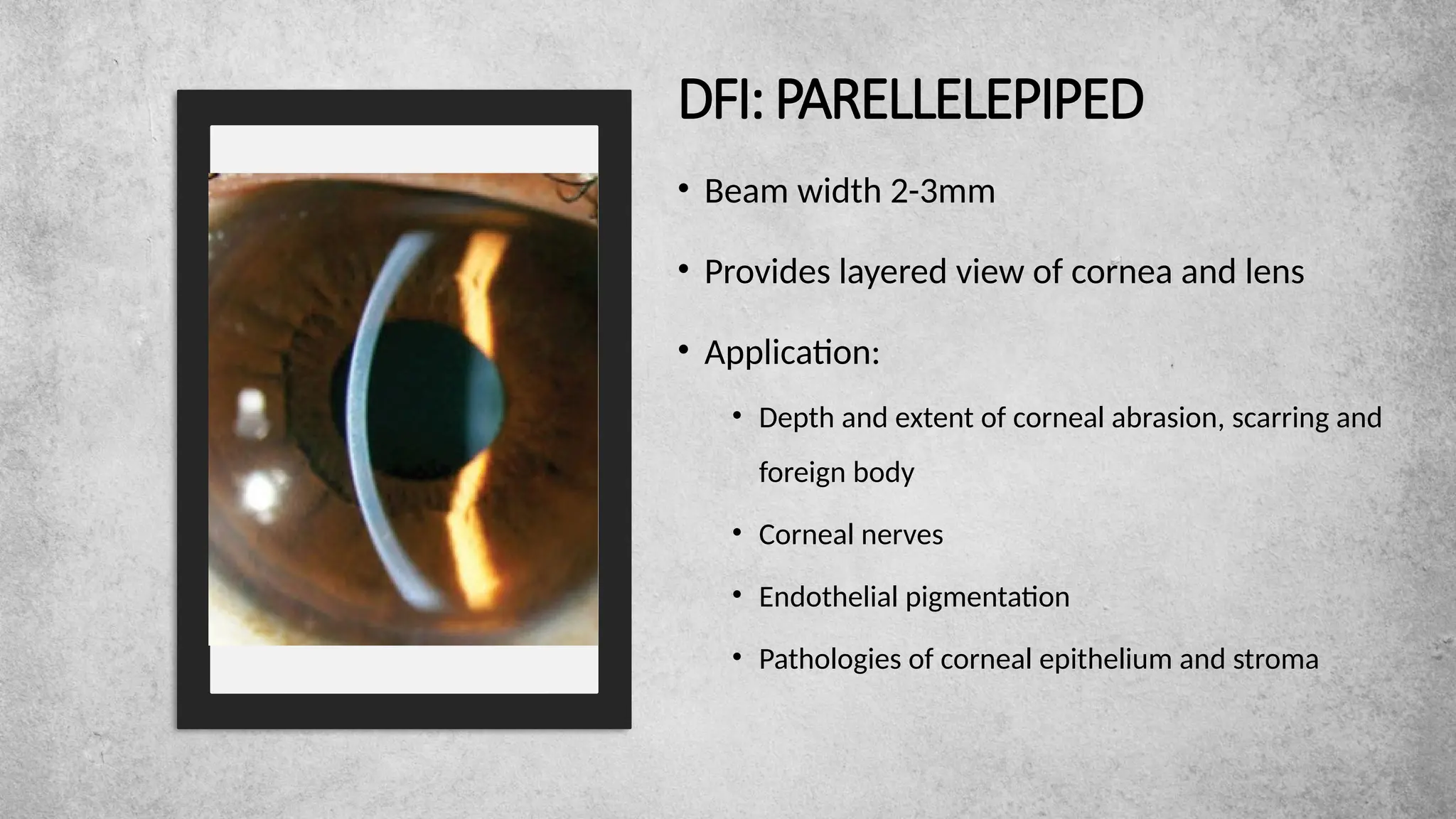
DFI:PARELLELEPIPED
• Beam width 2-3mm
• Provides layered view of cornea and lens
• Application:
• Depth and extent of corneal abrasion, scarring and
foreign body
• Corneal nerves
• Endothelial pigmentation
• Pathologies of corneal epithelium and stroma
DFI:OPTICALSECTION
• Width 0.2 – 0.3mm
• Height: full
• Magnification and illumination: medium to high
• Facilitates cross-sectional view of cornea and lens
• Optical section decreases scattering of light
• Maximises contrast between illumination section and
dark, unilluminated background
• Greater angular presentation, increase distance
between anterior and posterior surface of the structure
under study
APPLICATION
• Change in corneal curvature and thickness
• Depth of pathologies
• Anterior chamber angle grading (van herick’s grading)
• Lens: zone of discontinuity and lens opacities can be seen
• Image
Van Herick’s Grading
• Method of evaluation and AC angle
• The beam of light is used to estimate the ratio of corneal thickness to the
most peripheral part of the AC
• The light beam is projected at 1mm from the limbus at a 60 degree angle
from temporal side
• Image grade Ac depth/corneal thickness Remark
4 ≥ 1 Wide angle
3 ¼ - ½ Open angle
2 ¼ Narrow angle (gonio)
1 < ¼ Gonioscopy shows narrow
angle
DFI:CONICALBEAM
• SMALL CIRCULAR BEAM- PINPOINT OR PENCIL OF LIGHT
• SIZE = 1X3MM
• MAGNIFICATION AND ILLUMINATION = HIGH
• BEAM IS FOCUSED BETWEEN CORNEA AND ANTERIOR
LENS SURFACE.
• DARK ZONE BETWEEN CORNEA AND LENS IS OBSERVED
• PRINCIPLE = TYNDALL EFFECT.
• APPLICATION= DETECTION AND GRADING OF AQUOUS
FLARE AND CELLS.
STANDERDIZED UVIETIS NOMENCLATURE (S.U.N)
GRADING
GRADE FLARE CELLS PER FIELD
0 ABSENT 0
1+ FAINT, BARELY DETECTABLE 5-10
2+ MODERATE, IRIS & LENS DETAILS
CLEAR
10-20
3+ MARKED, IRIS AND LENS DETAILS
HAZY.
20-50
4+ INTENSE FLARE, FIBRINOUS
AQUOUS.
>50
• GRADING IS DONE AT 16X MAGNIFICATION
• BEAM SIZE OD 1X2MM
• IMAGE
SPECULARREFLECTION
• Normal light reflex bouncing off a surface.
• Smooth surface of cornea: plain mirror
• SUBJECT TO SNELL’S LAW <I = >r
• Patients’s gaze is directed to bisect the angle
between the axis of illumination and that of the
microscope. (45-60 degree).
• Monocular procedure.
SPECULAR REFLECTION
• WITH BEAM AT CENTER OF CORNEA, OBSERVER
SEES 3 LIGHTS-
• SLIT BEAM PARALLELEPIPED IN CORNEA.
• BEAM REFLECTED FROM IRIS NASAL TO
PARELLELEPIPED
• 1ST
PURKINJE IMAGE ‘CORNEAL LIGHT REFLEX’
TEMPORAL TO PARALLELEPIPED. • IMAGE
ANGLE 45-60 DEGREE
MAGNIFICATION MEDIUM TO HIGH
ILLUMINATION HIGH
SLIT H=3MM W=0.5MM
SPECULAR REFLECTION
• IMAGE
ANTERIOR POSTERIOR
INCREASE INTENSITY BECAUSE OF HIGHT
DIFFERENCE BETWEEN REFRACTIVE
INDEX OF AIR AND TEAR FILM
DECREASE INTENSITY BECAUSE OF
LESSER DIFFERENCE BETWEEN
REFRACTIVE INDEX OF ENDOTHELIUM
AND AQUOUS.
APPLICATION OF SPECULAR REFLECTION
• Endothelial Cell Density And Morphology
• Tear Film Evaluation.
• Evaluation Of D.M. Of Cornea.
• Guttae And KPs Appear As Non Reflective
Dark Areas
• IMAGE
BROAD TANGENTIAL
ILLUMINATION
• Wide Beam Oriented At Extremely Oblique
Illumination Angle 70-90 Degree
• Enhances Surface Irregularities By Creating
More Shadows, Used To Observe Surface
Texture.
• Greater Angle- Light Reflected And Scattered By
Cornea Decrease- Thus Reduced Glare.
BROAD TANGENTIAL ILLUMINATION
• APPLICATIONS
• ANTERIOR CORNEAL SURFACE IRREGULARITIES.
• POSTERIOR CORNEAL SURFACE AND DM FOLDS.
• IEIS AND ANTERIOR LENS SURFACE EXAMINATION.
• IMAGE
ANGLE 70-90 DEGREE
MAGNIFICATION LOW TO HIGH
ILLUMINATION LOW TO MEDIUM
SLIT WIDE
HEIGHT- NARROW
INDIRECTILLUMINATION
• Slit Beam Is Directed Adjacent To The Area Of
Interest To Illuminate It Indirectly.
• Beam Directed To Adjacent Area- Total Internal
Reflection Within Cornea- Light Spreads
Through Stroma-light Striking Opacity Scattered
And Some Reflected Back To Observer.
INDIRECT ILLUMINATION
• Applications
• Define An Opaque Area In Cornea And Identify
Details Within The Opacity.
• Location And Determinantion Of Size And Shape
Of Embedded Fb.
• Corneal Microcytes And Vacuoles.
• Observing Iris Sphincter. • IMAGE
ANGLE 30-45 DEGREE
MAGNIFICATION LOW TO HIGH
ILLUMINATION LOW TO MEDIUM
SLIT 2-3 MM WIDE
RETROILLUMINATION FROMIRIS
• METHOD OF EXAMINING A PARTICULAR PART
OF EYE BY LIGHT REFLECTED FROM A
STRUCTURE BEHIND IT.
• USED TO STUDY OPTICAL QUALITIES OF LESION.
ANGLE 15-30 DEGREE
MAGNIFICATION 16X – 25X
ILLUMINATION MODERATE
SLIT 3-3 MM WIDE
REDUCED HEIGHT
RETROILLUMINATION FROM
FUNDUS
• LIGHT ENTERS DILATED PUPIL- REFLECTED BACK
FROM RPE AND CHOROID- EMERGES FROM
PUPIL- RED REFLEX
ANGLE COAXIAL
MAGNIFICATION 16X – 25X
ILLUMINATION MODERATE TO HIGH
SLIT MODERATE WIDTH
APPLICATION OF RETRO ILLUMINATION
• EXAMINATION OF ANTERIOR VITEROUS, LENS
AND CORNEA.
• DENS SCAR AND OPACITIES (DARK AGAINST
RED BACKGROUND)
• TRANSPARENT AND TRANSLUCENT OBJECTS:
BRIGHT REFRACTIVE.
• EARLY KERATOCONUS: OIL DROP REFLEX
• CATARACT FORMATION AND SUBLUXATION
OF LENS.
• FINGERPRINT DYSTROPHY.
• IMAGE
SCLEROTICSCATTER
• TECHNIQUE FOR ILLUMINATING CORNEA
• PRINCIPLE: TOTAL INTERNAL REFLECTION.
• BEAM DIRECTED AT SCLERAL LIMBUS- ENTIRE
CORNEA ILLUMINATED
ANGLE 15 DEGREE
MAGNIFICATION LOW TO MEDIUM
ILLUMINATION HIGH
SLIT MEDIUM WIDTH
FULL HEIGHT.
APPLICATION OF SCLEROTIC SCATTER
• CORNEAL FOREIGN BODY.
• CORNEAL OPACITIES.
• SUBEPITHELIAL INFILTRATES.
• CORNEAL VERTICILLIA.
SEQUENCE OF SLIT LAMP EXAMINATION OF CORNEA
SEQUENCE AND TYPE OF ILLUMINATION TYPE OF INFORMATION ABOUT CORNEA
DIFFUSE GENERAL SURVEY AND LOCATION OF ABNORMALITY
SCLEROTIC SCATTER PATTERN OF ABNORMALITY
FOCAL SLIT DEPTH OF OPACITY
BROAD TANGENTIAL SURFACE DETAILS
PROXIMAL INTERNAL DETAILS
RETRO ILLUMINATION FROM IRIS OPTICAL QUALITIES
RETRO ILLUMINATION FROM FUNDUS OPTICAL QUALITIES
SPECULAR REFLECTION SURFACE IRREGULARITY, ENDOTHELIAL MOSAIC
COLOUR FILTERS GREEN ENHANCE VESSELS AND PIGMENTS
BLUE: ENHANCE FLUORESCENCE.
ACCESSORY DEVICES
• APPLANATION TONOMETRY
• GONIOSCOPY
• FUNDUS EXAMINATION
• PACHYMETRY
• SLIT LAMP PHOTOGRAPHY AND VIDEOGRAPHY
• LASER DELIVERY SYSTEM
• POTENTIAL ACUTY METER TEST

04. SLIT LAMP examination power point p

  • 1.
    SLIT LAMP PRESENTOR –DR. ANNIRUDH GUPTA MORDERATOR- DR. VINEETA PAI 23- FEBRUARY 2024
  • 2.
    INTRODUCTION • Routine methodof of examining the outer and anterior segment of the eye. • Consist of – low powered binocular compound microscope linked to an adjustable bright light source. • Isolation of the layers or entity to be viewed is the key to slit lamp biomicroscopy. OPTICS OF COMPOUND MICROSCOPE.
  • 3.
    HISTORY • 1806- HIMLYused a simple convex lens (to create focal illumination). • 1823- PURKINJE used magnifying glasses (to increase magnification). • 1897- CZAPSKI: binocular stereoscopic microscope. • 1911- GULLSTRAND designed the first slit lamp by focusing the filament of the light bulb on the slit aperture to create more focal illumination on cornea. SCHANZ-CZAPSKI INSTRUMENT FOR STEREOSCOPIC EYE EXAMINATION.
  • 4.
    HISTORY • 1916- KOEPPEand HENKER –combined Gullstard’s slit lamp on and articulated arm with stereoscopic microscope both mounted on same stand • 1920- VOGT- altered the optics: filament of light focused on condensing lens rather than on cornea which resulted in more homogenous bright light on cornea. 1916- KOEPPE AND HENKER SLIT LAMP
  • 5.
    HISTORY • 1933- GOLDMAN-introduced 3 control element for cross-slide stage and combine swivel axis foe microscope and illumination system in HAGG- STREIT slit lamp. • 1950- LITTMAN AND ZERISS- combined joystick control (Goldman), illumination path and also added stereo-telescope system with magnification changer. 1950- LITTMAN AND ZERISS SLIT LAMP
  • 6.
    Placeholder Title 08 HAGG-STREITSLIT LAMP LIGHT FROM ABOVE ZEISS SLIT LAMP LIGHT FROM BELOW TYPES- ON BASIS OF ILLUMINATION
  • 7.
    HAGGSTREIT ABBRIVATIONS MEANING B BULB CLCONDENSING LENSES OL OBJECTIVE LENS M MIRROR
  • 8.
    ZEISS ABBRIVATIONS MEANING B BULB CLCONDENSING LENSES OL OBJECTIVE LENS M MIRROR
  • 9.
    OPTICS OFSLITLAMP • 2Basicsystem- • Illumination system • Microscope system • Alignmentissuchthatthepointonwhichmicroscopeis focusedcorrespondstothepointonwhichlightis focused. • Thisisachievedbythemicroscopeandthelightning systemhavingacommonfocalplane. • Theircommonaxisofrotationalsoliesinthisfocalplane.
  • 10.
    KOHLER’S PRINCIPLE OFILLUMINATION. • Light source is transmitted to objective lens by the collector system and through slit aperture. • Provides homogenous slit image even with a structured light source PARTS OF SLIT LAMP. • BASIC DESIGN- • OBSERVATION SYSTEM • ILLUMINATION SYSTEM • MECHANICAL SUPPORT SYSTEM.
  • 11.
    OBSERVATION SYSTEM • Essentiallya compound microscope with 2 optical elements- • Objective lens +22d • Eye piece +10d • Prism • Provide lage working distance in front of microscope for manupulation on patient eye • Back vertex distance is 90-120 mm • Lable it
  • 12.
    MICROSCOPE SYSTEM • Eyepiecesystem uses astronomical telescope system • Gallelian telescope system- sits between objective and eyepiece lens, provides large range of magnification • Total magnification = magnification of ( objective lens + telescope + magnification changer)
  • 13.
    Placeholder Title 06 ASTRONOMICALTELESCOPE GALLELIAN TELESCOPE
  • 14.
    DIFFERENCE BETWEEN GALLELIANAND ASTRONIMICAL TELESCOPE PROPERTY GALLELIAN ASTRONOMICAL Fo Convex (+ve) Convex (+ve) Fi Concave (-ve) Convex (+ve) TUBE LENGTH SHORT (Fo-Fi) long (Fo + Fi) MAGNIFICATION Upto 4x Upto 10x IMAGE Virtual and erect Real and inverted FIELD SIZE Smaller Larger
  • 15.
  • 16.
    FILTERS IN SLITLAMP • Diffuse- general overall observation of eye and adenexa. • Cobalt blue- enhances view of fluorescein dye in tear film. Typically used for fluorescein staining and gat. • Red free filter- enhances view of blood vessels and hemorrhages. • Neutral density- decrease maximum brightness for photosensitive patients. • Yellow filter- good for contrast enhancement.
  • 17.
  • 18.
  • 19.
    TECHNIQUES OF EXAMINATIONAND PRE-REQUISITES. • Patient Adjustment- Chin Rest, Forehead Bar, Lateral Canthus Alignment, Fixation Target. • Observer Adjustment- Height Of Table, Eyepiece, I.P.D. • Pre-requisite- Semi Dark Room, Start With Low Magnification
  • 20.
    CHRONOLOGY OF EXAMINATION 1.LIDS AND LASHESH 2. CONJUNCTIVA 3. CORNEA AND TEAR FILM 4. AQUOUS HUMOUR 5. IRIS 6. LENS 7. ANTERIOR VITEROUS
  • 21.
    METHOD OF ILLUMINATION. 1.DIRECT- 1. DIRECT DIFFUSE 2. DIRECT FOCAL 3. SPECULAR 4. TANGENTIAL 2. INDIRECT- 1. INDIRECT PROXIMAL 2. RETRO-ILLUMINATION 3. SCLEROTIC SCATTER
  • 22.
    DIRECTDIFFUSE • Facilitates simultaneousobservation of large areas at low magnification • Initiating slit lamp examination in this manner generates an early overall impression Magnification Low (6-10x) Diffuse illumination Medium intensity Width Maximum Angle 15 degrees
  • 23.
    APPLICATION OF DIRECTDIFFUSE • Gross general examination of anterior segment of eye and adnexa. • Provide useful introduction to overall condition. • RGP contrast lens fitting. • Corneal epithelium staining for defects and T.B.U.T. Using cobalt blue filter.
  • 24.
    DIRECTFOCAL Magnification 10x –40x Illumination Medium – high intensity Width Narrow-Broad Angle 45- 60 degrees • Both slit beams and microscopes are focused at same point • Slit beam, angle and illumination can be varied and one can move from a general view of anterior segment to a 3-D optic section of cornea, AC or lens
  • 25.
    DIRECT FOCAL • Denseopacities blocks light and casts shadow through stroma on to iris and decemets membrane. • Translucent refractive index (same at stroma), absorbs and reflects some light • Refractive index less than stroma, diverging cone of light in stroma • Refractive index greater than stroma, converging cone of light in stroma • Image
  • 26.
    DFI:PARELLELEPIPED • Beam width2-3mm • Provides layered view of cornea and lens • Application: • Depth and extent of corneal abrasion, scarring and foreign body • Corneal nerves • Endothelial pigmentation • Pathologies of corneal epithelium and stroma
  • 27.
    DFI:OPTICALSECTION • Width 0.2– 0.3mm • Height: full • Magnification and illumination: medium to high • Facilitates cross-sectional view of cornea and lens • Optical section decreases scattering of light • Maximises contrast between illumination section and dark, unilluminated background • Greater angular presentation, increase distance between anterior and posterior surface of the structure under study
  • 28.
    APPLICATION • Change incorneal curvature and thickness • Depth of pathologies • Anterior chamber angle grading (van herick’s grading) • Lens: zone of discontinuity and lens opacities can be seen • Image
  • 29.
    Van Herick’s Grading •Method of evaluation and AC angle • The beam of light is used to estimate the ratio of corneal thickness to the most peripheral part of the AC • The light beam is projected at 1mm from the limbus at a 60 degree angle from temporal side • Image grade Ac depth/corneal thickness Remark 4 ≥ 1 Wide angle 3 ¼ - ½ Open angle 2 ¼ Narrow angle (gonio) 1 < ¼ Gonioscopy shows narrow angle
  • 30.
    DFI:CONICALBEAM • SMALL CIRCULARBEAM- PINPOINT OR PENCIL OF LIGHT • SIZE = 1X3MM • MAGNIFICATION AND ILLUMINATION = HIGH • BEAM IS FOCUSED BETWEEN CORNEA AND ANTERIOR LENS SURFACE. • DARK ZONE BETWEEN CORNEA AND LENS IS OBSERVED • PRINCIPLE = TYNDALL EFFECT. • APPLICATION= DETECTION AND GRADING OF AQUOUS FLARE AND CELLS.
  • 31.
    STANDERDIZED UVIETIS NOMENCLATURE(S.U.N) GRADING GRADE FLARE CELLS PER FIELD 0 ABSENT 0 1+ FAINT, BARELY DETECTABLE 5-10 2+ MODERATE, IRIS & LENS DETAILS CLEAR 10-20 3+ MARKED, IRIS AND LENS DETAILS HAZY. 20-50 4+ INTENSE FLARE, FIBRINOUS AQUOUS. >50 • GRADING IS DONE AT 16X MAGNIFICATION • BEAM SIZE OD 1X2MM • IMAGE
  • 32.
    SPECULARREFLECTION • Normal lightreflex bouncing off a surface. • Smooth surface of cornea: plain mirror • SUBJECT TO SNELL’S LAW <I = >r • Patients’s gaze is directed to bisect the angle between the axis of illumination and that of the microscope. (45-60 degree). • Monocular procedure.
  • 33.
    SPECULAR REFLECTION • WITHBEAM AT CENTER OF CORNEA, OBSERVER SEES 3 LIGHTS- • SLIT BEAM PARALLELEPIPED IN CORNEA. • BEAM REFLECTED FROM IRIS NASAL TO PARELLELEPIPED • 1ST PURKINJE IMAGE ‘CORNEAL LIGHT REFLEX’ TEMPORAL TO PARALLELEPIPED. • IMAGE ANGLE 45-60 DEGREE MAGNIFICATION MEDIUM TO HIGH ILLUMINATION HIGH SLIT H=3MM W=0.5MM
  • 34.
    SPECULAR REFLECTION • IMAGE ANTERIORPOSTERIOR INCREASE INTENSITY BECAUSE OF HIGHT DIFFERENCE BETWEEN REFRACTIVE INDEX OF AIR AND TEAR FILM DECREASE INTENSITY BECAUSE OF LESSER DIFFERENCE BETWEEN REFRACTIVE INDEX OF ENDOTHELIUM AND AQUOUS.
  • 35.
    APPLICATION OF SPECULARREFLECTION • Endothelial Cell Density And Morphology • Tear Film Evaluation. • Evaluation Of D.M. Of Cornea. • Guttae And KPs Appear As Non Reflective Dark Areas • IMAGE
  • 36.
    BROAD TANGENTIAL ILLUMINATION • WideBeam Oriented At Extremely Oblique Illumination Angle 70-90 Degree • Enhances Surface Irregularities By Creating More Shadows, Used To Observe Surface Texture. • Greater Angle- Light Reflected And Scattered By Cornea Decrease- Thus Reduced Glare.
  • 37.
    BROAD TANGENTIAL ILLUMINATION •APPLICATIONS • ANTERIOR CORNEAL SURFACE IRREGULARITIES. • POSTERIOR CORNEAL SURFACE AND DM FOLDS. • IEIS AND ANTERIOR LENS SURFACE EXAMINATION. • IMAGE ANGLE 70-90 DEGREE MAGNIFICATION LOW TO HIGH ILLUMINATION LOW TO MEDIUM SLIT WIDE HEIGHT- NARROW
  • 38.
    INDIRECTILLUMINATION • Slit BeamIs Directed Adjacent To The Area Of Interest To Illuminate It Indirectly. • Beam Directed To Adjacent Area- Total Internal Reflection Within Cornea- Light Spreads Through Stroma-light Striking Opacity Scattered And Some Reflected Back To Observer.
  • 39.
    INDIRECT ILLUMINATION • Applications •Define An Opaque Area In Cornea And Identify Details Within The Opacity. • Location And Determinantion Of Size And Shape Of Embedded Fb. • Corneal Microcytes And Vacuoles. • Observing Iris Sphincter. • IMAGE ANGLE 30-45 DEGREE MAGNIFICATION LOW TO HIGH ILLUMINATION LOW TO MEDIUM SLIT 2-3 MM WIDE
  • 40.
    RETROILLUMINATION FROMIRIS • METHODOF EXAMINING A PARTICULAR PART OF EYE BY LIGHT REFLECTED FROM A STRUCTURE BEHIND IT. • USED TO STUDY OPTICAL QUALITIES OF LESION. ANGLE 15-30 DEGREE MAGNIFICATION 16X – 25X ILLUMINATION MODERATE SLIT 3-3 MM WIDE REDUCED HEIGHT
  • 45.
    RETROILLUMINATION FROM FUNDUS • LIGHTENTERS DILATED PUPIL- REFLECTED BACK FROM RPE AND CHOROID- EMERGES FROM PUPIL- RED REFLEX ANGLE COAXIAL MAGNIFICATION 16X – 25X ILLUMINATION MODERATE TO HIGH SLIT MODERATE WIDTH
  • 46.
    APPLICATION OF RETROILLUMINATION • EXAMINATION OF ANTERIOR VITEROUS, LENS AND CORNEA. • DENS SCAR AND OPACITIES (DARK AGAINST RED BACKGROUND) • TRANSPARENT AND TRANSLUCENT OBJECTS: BRIGHT REFRACTIVE. • EARLY KERATOCONUS: OIL DROP REFLEX • CATARACT FORMATION AND SUBLUXATION OF LENS. • FINGERPRINT DYSTROPHY. • IMAGE
  • 47.
    SCLEROTICSCATTER • TECHNIQUE FORILLUMINATING CORNEA • PRINCIPLE: TOTAL INTERNAL REFLECTION. • BEAM DIRECTED AT SCLERAL LIMBUS- ENTIRE CORNEA ILLUMINATED ANGLE 15 DEGREE MAGNIFICATION LOW TO MEDIUM ILLUMINATION HIGH SLIT MEDIUM WIDTH FULL HEIGHT.
  • 48.
    APPLICATION OF SCLEROTICSCATTER • CORNEAL FOREIGN BODY. • CORNEAL OPACITIES. • SUBEPITHELIAL INFILTRATES. • CORNEAL VERTICILLIA.
  • 49.
    SEQUENCE OF SLITLAMP EXAMINATION OF CORNEA SEQUENCE AND TYPE OF ILLUMINATION TYPE OF INFORMATION ABOUT CORNEA DIFFUSE GENERAL SURVEY AND LOCATION OF ABNORMALITY SCLEROTIC SCATTER PATTERN OF ABNORMALITY FOCAL SLIT DEPTH OF OPACITY BROAD TANGENTIAL SURFACE DETAILS PROXIMAL INTERNAL DETAILS RETRO ILLUMINATION FROM IRIS OPTICAL QUALITIES RETRO ILLUMINATION FROM FUNDUS OPTICAL QUALITIES SPECULAR REFLECTION SURFACE IRREGULARITY, ENDOTHELIAL MOSAIC COLOUR FILTERS GREEN ENHANCE VESSELS AND PIGMENTS BLUE: ENHANCE FLUORESCENCE.
  • 50.
    ACCESSORY DEVICES • APPLANATIONTONOMETRY • GONIOSCOPY • FUNDUS EXAMINATION • PACHYMETRY • SLIT LAMP PHOTOGRAPHY AND VIDEOGRAPHY • LASER DELIVERY SYSTEM • POTENTIAL ACUTY METER TEST