SKIN AND ITS
APPENDAGES
SKIN
Skin is the outer covering of the body which
is in contact with the external environment
Functions
• Protection of underlying structures
• Excretion of salts & metabolites like urea
• Sensation
• Secretion of sweat & sebum
• Regulation of body temperature
• Synthesis of Vitamin D by action of UV
rays of sun
Epidermis
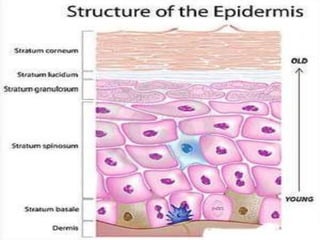
It is the most superficial layer of the skin, composed of
stratified epithelium. There is no blood vessels or nerve
endings in the epidermis. Colour of skin is affected by 3
main factors:
• Melanin, dark pigment secreted by melanocytes. It
protects the skin from harmful effects of sunlight.
• Level of oxygenation of hemoglobin
• Bile pigments in blood & carotene in subcutaneous fat
which give skin the yellow colour.
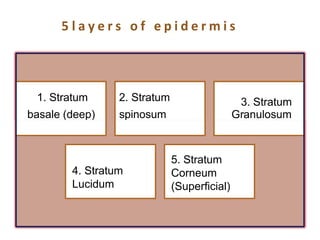
5 l a y e r s o f e p i d e r m i s
1. Stratum
basale (deep)
2. Stratum
spinosum
(Malpighian
layer)
3. Stratum
Granulosum
m
4. Stratum
Lucidum
5. Stratum
Corneum
(Superficial)
S t r a t u m Basale
• Deepest
• Double layered arrangement of cells
• Cells multiply in this layer also known as
Germinal layer/ Stratum Germinativum
• This layer is rich in melanin pigments
Stratum spinosum
• Several layers of polygonal keratinocytes
• Cells are attached to one another by
numerous Desmosomes
• Germinative zone
Stratum Granulosum
• Few (1-5) layers of flattened cells
• Cytoplasm contain granular material
Stratum Lucidum
• Lucid means Clear. Here the
cytoplasm of the cells is clear and
contain few nuclei in them
Stratum Corneum
• Superficial layer
• Made up of flattened scale like cells which are
constantly replaced. Containing a protein called
KERATIN
• Resistant to permeability
• The thickness of this layer is greatest where the
skin is exposed to maximal friction
Eg:- Soles and palms
• The superficial layer constantly sheds off &
replaced by proliferation of cells in deeper layers
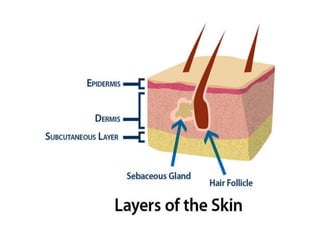
• Dermis is tough & elastic. It is the inner layer forms
true skin. Composed of collagen fibres interlaced
with elastic fibres .
• The structures in dermis are
• Blood vessels
• Lymph vessels
• Sensory nerve endings
• Sweat glands & their ducts
• Hair roots, hair follicles & erector pili muscles
• Sebaceous glands
Two secretions of skin are Sweat & Sebum
DERMIS
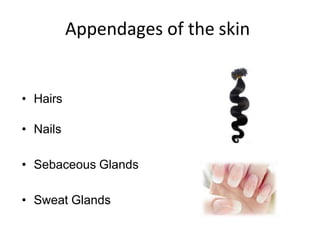
• Hairs
• Nails
• Sebaceous Glands
• Sweat Glands
Appendages of the skin
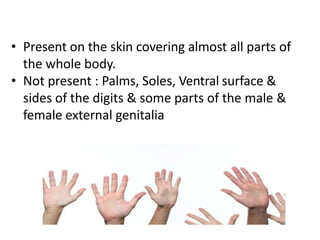
• Present on the skin covering almost all parts of
the whole body.
• Not present : Palms, Soles, Ventral surface &
sides of the digits & some parts of the male &
female external genitalia
Hair
• Hairs are formed by a down growth of epidermal
cells into the dermis or subcutaneous tissue
called hair follicles.
• At the base of follicle is the hair bulb, the hair is
formed by the multiplication of cells of the bulb,
and pushed upwards away from source of
nutrition, cells die & become keratinised.
• Colour of hair is genetically determined &
depends on the amount of melanin present.
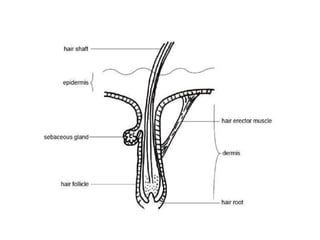
Parts of Hair
• The visible part – shaft
• Embedded part – root
• Expanded lower end of the root – bulb
• The bulb is generated invaginated from below
by part of the dermis – hair papilla
• Root is surrounded by a tubular sheath – hair
follicle
• Hair roots are attached obliquely to the skin.
Structure of hair shaft
Hair – Modified part of stratum corneum
Has outer cortex and inner medulla in large hairs,
no medulla in thin hairs
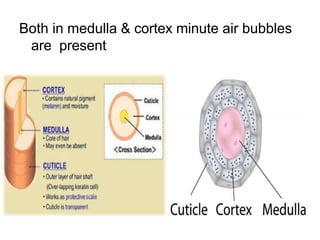
Both in medulla & cortex minute air bubbles
are present
Arrector Pili Muscles
• These are bands of smooth muscles
attached at one end to the dermis, just
below the dermal papilla & at the other
end to the connective tissue sheath of
the hair follicle
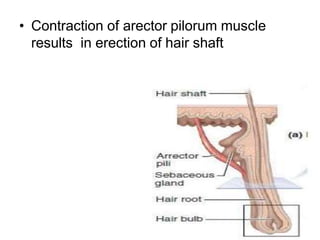
• Contraction of arector pilorum muscle
results in erection of hair shaft
• Seen in relation to the hair follicles.
• Found in dermis of the skin.
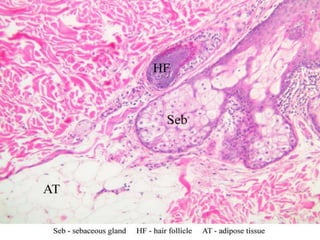
• Gland consists of a number of alveoli which is
connected to the ducts, & the Ducts open into the hair
follicle
• Is a holocrine gland
• Sebaceous gland is situated between the hair follicle
and the arrector pili muscle.
• Secretes sebum - Contains lipids & cholesterol
Functions of sebum
– Oily in nature, keep skin and hair soft
– Prevents dryness of skin
– Makes skin resistant to moisture
Sweat Glands
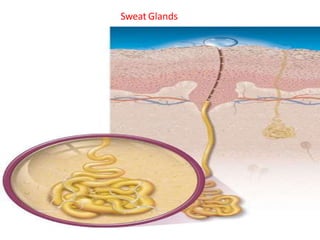
• Found in deeper parts of the dermis.
• It produce sweat or perspiration.
• Bodies of glands lie coiled in the subcutaneous
tissue.
• Some ducts open on to the skin surface &
others open into the hair follicles.
• Secretion of glands (sweat) has high water
content. Evaporation of sweat causes cooling of
the body.
• Sweat glands are more numerous in the palms
of hands & sole of feet.
Sweat Glands
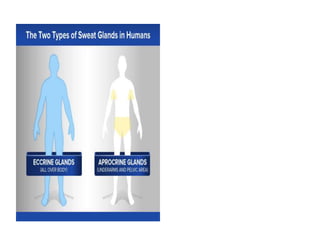
ECCRINE (Atypical)GLANDS
• Widely distributed
• Numerous on forehead, scalp, palms & soles
• Presents a highly coiled secretory portion called as
body within the dermis & a narrower ductal portion,
which opens on skin surface
• Secretions of sweat glands are clear,
colourless and hypotonic
APOCRINE (Typical)GLANDS
• Found in
Axilla, Areola, Perianal region, Prepuce scrotum,
Mons pubis etc.
These glands secrete a protein rich, milky fluid
which is initially odourless but acquires a distinct
odour due to bacterial decomposition
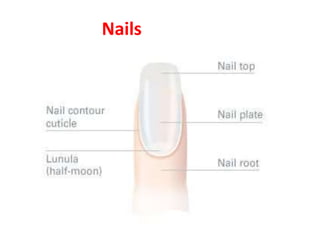
Nails
• Nails are plates of keratinised epithelial cells
• They form a protective covering on the
dorsal surface of fingers & toes.
• Consists of 3 parts
– Proximal part or root – it is implanted into a
groove on the skin.
– Exposed part or body
– Free distal border
• The root of nail is covered by Cuticle.
• And forms the hemispherical pale area called
lanula.
• The tissue on which the nail rest is the nail
bed which is composed of stratum basale
& stratum spinosum, highly vascular which
gives nail a pink colour.
Thank you

SKIN AND ITS APPENDAGES.pptx

  • 1.
  • 2.
    SKIN Skin is theouter covering of the body which is in contact with the external environment Functions • Protection of underlying structures • Excretion of salts & metabolites like urea • Sensation • Secretion of sweat & sebum • Regulation of body temperature • Synthesis of Vitamin D by action of UV rays of sun
  • 4.
    Epidermis It is themost superficial layer of the skin, composed of stratified epithelium. There is no blood vessels or nerve endings in the epidermis. Colour of skin is affected by 3 main factors: • Melanin, dark pigment secreted by melanocytes. It protects the skin from harmful effects of sunlight. • Level of oxygenation of hemoglobin • Bile pigments in blood & carotene in subcutaneous fat which give skin the yellow colour.
  • 6.
    5 l ay e r s o f e p i d e r m i s 1. Stratum basale (deep) 2. Stratum spinosum (Malpighian layer) 3. Stratum Granulosum m 4. Stratum Lucidum 5. Stratum Corneum (Superficial)
  • 7.
    S t ra t u m Basale • Deepest • Double layered arrangement of cells • Cells multiply in this layer also known as Germinal layer/ Stratum Germinativum • This layer is rich in melanin pigments
  • 8.
    Stratum spinosum • Severallayers of polygonal keratinocytes • Cells are attached to one another by numerous Desmosomes • Germinative zone
  • 9.
    Stratum Granulosum • Few(1-5) layers of flattened cells • Cytoplasm contain granular material
  • 10.
    Stratum Lucidum • Lucidmeans Clear. Here the cytoplasm of the cells is clear and contain few nuclei in them
  • 11.
    Stratum Corneum • Superficiallayer • Made up of flattened scale like cells which are constantly replaced. Containing a protein called KERATIN • Resistant to permeability • The thickness of this layer is greatest where the skin is exposed to maximal friction Eg:- Soles and palms • The superficial layer constantly sheds off & replaced by proliferation of cells in deeper layers
  • 12.
    • Dermis istough & elastic. It is the inner layer forms true skin. Composed of collagen fibres interlaced with elastic fibres . • The structures in dermis are • Blood vessels • Lymph vessels • Sensory nerve endings • Sweat glands & their ducts • Hair roots, hair follicles & erector pili muscles • Sebaceous glands Two secretions of skin are Sweat & Sebum DERMIS
  • 13.
    • Hairs • Nails •Sebaceous Glands • Sweat Glands Appendages of the skin
  • 15.
    • Present onthe skin covering almost all parts of the whole body. • Not present : Palms, Soles, Ventral surface & sides of the digits & some parts of the male & female external genitalia
  • 16.
    Hair • Hairs areformed by a down growth of epidermal cells into the dermis or subcutaneous tissue called hair follicles. • At the base of follicle is the hair bulb, the hair is formed by the multiplication of cells of the bulb, and pushed upwards away from source of nutrition, cells die & become keratinised. • Colour of hair is genetically determined & depends on the amount of melanin present.
  • 17.
    Parts of Hair •The visible part – shaft • Embedded part – root • Expanded lower end of the root – bulb • The bulb is generated invaginated from below by part of the dermis – hair papilla • Root is surrounded by a tubular sheath – hair follicle • Hair roots are attached obliquely to the skin.
  • 19.
    Structure of hairshaft Hair – Modified part of stratum corneum Has outer cortex and inner medulla in large hairs, no medulla in thin hairs
  • 20.
    Both in medulla& cortex minute air bubbles are present
  • 21.
    Arrector Pili Muscles •These are bands of smooth muscles attached at one end to the dermis, just below the dermal papilla & at the other end to the connective tissue sheath of the hair follicle
  • 22.
    • Contraction ofarector pilorum muscle results in erection of hair shaft
  • 24.
    • Seen inrelation to the hair follicles. • Found in dermis of the skin. • Gland consists of a number of alveoli which is connected to the ducts, & the Ducts open into the hair follicle • Is a holocrine gland • Sebaceous gland is situated between the hair follicle and the arrector pili muscle. • Secretes sebum - Contains lipids & cholesterol Functions of sebum – Oily in nature, keep skin and hair soft – Prevents dryness of skin – Makes skin resistant to moisture
  • 26.
    Sweat Glands • Foundin deeper parts of the dermis. • It produce sweat or perspiration. • Bodies of glands lie coiled in the subcutaneous tissue. • Some ducts open on to the skin surface & others open into the hair follicles. • Secretion of glands (sweat) has high water content. Evaporation of sweat causes cooling of the body. • Sweat glands are more numerous in the palms of hands & sole of feet.
  • 27.
  • 29.
    ECCRINE (Atypical)GLANDS • Widelydistributed • Numerous on forehead, scalp, palms & soles • Presents a highly coiled secretory portion called as body within the dermis & a narrower ductal portion, which opens on skin surface • Secretions of sweat glands are clear, colourless and hypotonic
  • 30.
    APOCRINE (Typical)GLANDS • Foundin Axilla, Areola, Perianal region, Prepuce scrotum, Mons pubis etc. These glands secrete a protein rich, milky fluid which is initially odourless but acquires a distinct odour due to bacterial decomposition
  • 31.
  • 32.
    • Nails areplates of keratinised epithelial cells • They form a protective covering on the dorsal surface of fingers & toes. • Consists of 3 parts – Proximal part or root – it is implanted into a groove on the skin. – Exposed part or body – Free distal border • The root of nail is covered by Cuticle. • And forms the hemispherical pale area called lanula.
  • 33.
    • The tissueon which the nail rest is the nail bed which is composed of stratum basale & stratum spinosum, highly vascular which gives nail a pink colour.
  • 34.