Dr. C.V. Suresh Babu’s
• Introduce the concept of
Self learning
• Know what works and
why it fails
• Know about the
Advantages and
Limitations of Self
Learning
• Definition
• What is Self Learning
• Why Self learning
• 7 Step Process for Self
Learning
• 7 Reasons for failure
• Power of Self-Learning
• Limitation of Self-
Discussio
n
(CentreforKnowledgeTransfer)
institute
“a process by which
individuals take the initiative,
with or without the assistance of
others, in
diagnosing their learning needs,
formulating learning goals,
identifying human and material
resources for learning, and
evaluating learning outcomes”.
Malcom Knowles
• Self-learning is a method of garnering
information and after processing and
retaining it without taking the help of
another individual.
• It is the responsibility of the learner to learn
and hold on to the knowledge without the
help of another human resource.
• It is a modern way of learning that helps a
person to teach himself skills and
knowledge that will prove relevant to his
daily activities.
• It has not replaced the instructional learning
process that has been used traditionally
instead has become an extra key that will
open the doors of knowledge for everyone
5
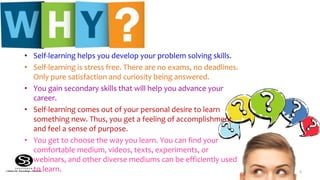
• Self-learning helps you develop your problem solving skills.
• Self-learning is stress free. There are no exams, no deadlines.
Only pure satisfaction and curiosity being answered.
• You gain secondary skills that will help you advance your
career.
• Self-learning comes out of your personal desire to learn
something new. Thus, you get a feeling of accomplishment
and feel a sense of purpose.
• You get to choose the way you learn. You can find your
comfortable medium, videos, texts, experiments, or
webinars, and other diverse mediums can be efficiently used
to learn. 6
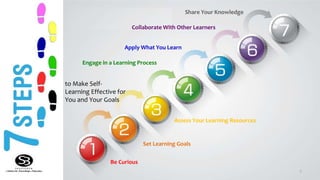
to Make Self-
Learning Effective for
You and Your Goals
7
Be Curious
Set Learning Goals
Assess Your Learning Resources
Engage in a Learning Process
Apply What You Learn
Collaborate With Other Learners
Share Your Knowledge
1. You’re anticipating hard work
2. You’re sleep deprived
3. You have a false sense of security
4. Not all study time is created equal
5. The planning fallacy
6. You think you have more study time than you do
7. You can’t get motivated or focused
(CentreforKnowledgeTransfer)
institute
• You Develop Strong Problem Solving Skills
• It is a Stress-Free Learning Process
• You Gain Other Skills in the Process
• The Learning Experience Becomes More Meaningful
• Learning is Now Led by Curiosity
• You Get to Choose Your Mode of Learning 9
• You do not have readymade material at your disposal and whatever
you need will have to be acquired through additional effort on your
part
• You will have to verify your study materials whereas in traditional
learning method these were already verified beforehand
• Working with others help in brainstorming which is not possible during
self-learning
• Teamwork encourages open communication that is not seen during
the process of self-learning
• There is no face-to-face interaction during self-learning
• The lack of transformational power is a serious limitation of self- 10

Self learning

  • 1.
  • 2.
    • Introduce theconcept of Self learning • Know what works and why it fails • Know about the Advantages and Limitations of Self Learning
  • 3.
    • Definition • Whatis Self Learning • Why Self learning • 7 Step Process for Self Learning • 7 Reasons for failure • Power of Self-Learning • Limitation of Self- Discussio n (CentreforKnowledgeTransfer) institute
  • 4.
    “a process bywhich individuals take the initiative, with or without the assistance of others, in diagnosing their learning needs, formulating learning goals, identifying human and material resources for learning, and evaluating learning outcomes”. Malcom Knowles
  • 5.
    • Self-learning isa method of garnering information and after processing and retaining it without taking the help of another individual. • It is the responsibility of the learner to learn and hold on to the knowledge without the help of another human resource. • It is a modern way of learning that helps a person to teach himself skills and knowledge that will prove relevant to his daily activities. • It has not replaced the instructional learning process that has been used traditionally instead has become an extra key that will open the doors of knowledge for everyone 5
  • 6.
    • Self-learning helpsyou develop your problem solving skills. • Self-learning is stress free. There are no exams, no deadlines. Only pure satisfaction and curiosity being answered. • You gain secondary skills that will help you advance your career. • Self-learning comes out of your personal desire to learn something new. Thus, you get a feeling of accomplishment and feel a sense of purpose. • You get to choose the way you learn. You can find your comfortable medium, videos, texts, experiments, or webinars, and other diverse mediums can be efficiently used to learn. 6
  • 7.
    to Make Self- LearningEffective for You and Your Goals 7 Be Curious Set Learning Goals Assess Your Learning Resources Engage in a Learning Process Apply What You Learn Collaborate With Other Learners Share Your Knowledge
  • 8.
    1. You’re anticipatinghard work 2. You’re sleep deprived 3. You have a false sense of security 4. Not all study time is created equal 5. The planning fallacy 6. You think you have more study time than you do 7. You can’t get motivated or focused (CentreforKnowledgeTransfer) institute
  • 9.
    • You DevelopStrong Problem Solving Skills • It is a Stress-Free Learning Process • You Gain Other Skills in the Process • The Learning Experience Becomes More Meaningful • Learning is Now Led by Curiosity • You Get to Choose Your Mode of Learning 9
  • 10.
    • You donot have readymade material at your disposal and whatever you need will have to be acquired through additional effort on your part • You will have to verify your study materials whereas in traditional learning method these were already verified beforehand • Working with others help in brainstorming which is not possible during self-learning • Teamwork encourages open communication that is not seen during the process of self-learning • There is no face-to-face interaction during self-learning • The lack of transformational power is a serious limitation of self- 10