Kingdom of Saudi Arabia
Al Imam Mohammad Ibn Saud Islamic University
College of Science
Department of Biology
Entomology
353 Bio
T. Amani Alsharidah
1441 – 2019
Lecture 9
Insect muscular system
Introduction
 Muscles power all the movements, external and internal, in insects.
 Insect muscles show high levels of homology to these vertebrate
 muscles in their structure, protein content, contractility and regulation.
 Insect muscles are mostly translucent, colourless or grey, though the flight
muscles often show a yellowish or brown tinge.
 In most skeletel muscles, especially those of the appendages, one end of the
muscle is attached to a movable part.
 Cuticular invaginations or apodemes, in the form of cords, bands or plate like
structures, may provide the true sites of attachment.
The cells that constitute this tissue are referred to as muscle fibers .
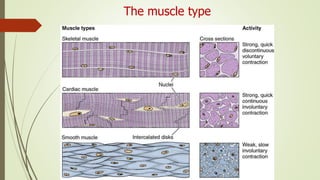
Classification of muscle tissue:
Three types of muscles are usually distinguished according to striations into
striated (skeletal and cardiac)and unstriated (smooth).
1. The most familiar is the skeletal ,voluntary .This type is named skeletal muscle
because it is connected to the skeleton and is concerned with body
movements.
2. The second type forms the contractile portion of the heart and is therefore
called cardiac muscle .It is striated but involuntary in action. They contract
spontaneously.
3. The third type is also involuntary and because it does not exhibit striations, it
is known as smooth muscle. It is found as part of the walls of the viscera.
The muscular Tissue
The muscle type
The muscular Tissue
 Each type of muscle has its own particular characteristics, but all types of
muscles exhibit common features which are:
 Muscle cells are elongated in shape.
1. The plasma membrane of the muscle fiber is called sarcolemma and its
cytoplasm is called sarcoplasm.
2. Organoids and inclusions are present in the cytoplasm (mitochondria and
smooth ER which is called sarcoplasmic reticulum).Glycogen is the main
muscle inclusions.
3. Muscle fibers are mesodermal in origin.
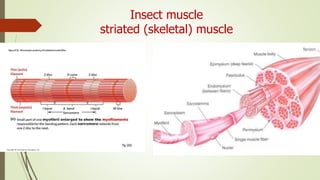
Insect muscle
 Vertebrates and many non-insect invertebrates have striated and smooth muscles, but
insects have only striated muscles.
 The entire muscle is enclosed by a sheath of dense CT called epimysium .
 Thin fibrous septa ,that constitute the perimysium exetnd the epimysium and divide the
muscle into bundles of muscles fibers called fascicles .
 The epimysium sends delicate CT sheets to surround individual muscle fibers in each
fascicle. These connective tissue sheets constitute the endomysium.
 Blood vessels and nerves penetrate the epimysium to the perimysium and endomysium
but Lymphatic vessels are only present in the epimysium and perimysium.
Insect muscle
 Skeletal muscle fibers :
 Long cylindrical cells, enclosed by the sarcolemma.
 The fibers are multinucleated ,pale oval nuclei that lie under its sarcolemma.
 The sarcoplasm is filled with numerous myofibrils.
 The myofibrils, Two principal types of myofilaments have been identified ;thick
and thin ones .
1. The thick filament is composed of a protein called myosin.
2. The thin myofilaments are attached to the Z line and are composed of a protein
called actin together with two other associated protein called tropomyosin and
troponin.
 Muscle contraction involves the sliding of filaments past each other, stimulated
by nerve impulses.
Insect muscle
striated (skeletal) muscle
Classification of skeletal muscle in insect
There are several different muscle types but in general it classified to:
1. Synchronous Skeletal Muscles :-
Vast majority of insect muscles are synchronous muscles. Each contraction is driven
by a single neural stimulus. The form and arrangement of the myofibrils in
synchronus muscles is very variable.
2. Asynchronous Skeletal Muscles :-
In these neural stimulation is asynchronous with respect to contraction. The
specialized asynchronous muscles typically have large cylindrical myofibrils, that’s
why they are sometimes called fibrillar.
Muscle attachments
 Vertebrates’ muscles work against an internal skeleton, but the muscles of insects
must attach to the inner surface of an external skeleton.
 As musculature is mesodermal and the exoskeleton is of ectodermal origin, fusion
must take place.
 This occurs by the growth of tonofibrillae, fine connecting fibrils that link the
epidermal end of the muscle to the epidermal layer.
 At the site of tonofibrillar attachment, the inner cuticle often is strengthened
through ridges or apodemes, which, when elongated into arms, are termed
apophyses.
 These muscle-attachment sites, often include resilin to give an elasticity that
resembles that of vertebrate tendons.
Function of muscular system
1. Support of the body.
2. Helps maintain posture.
3. Movement of the limbs, including ovipositor.
4. Movement of the wings-insects.
5. Movement of the viscera.
6. Locomotion.
7. Closure of spiracles.
8. Operation of various pumps such as cibarial pump and the pumping of the
poison glands.
9. Generation of heat by ‘shivering’.

Insect Muscular System

  • 1.
    Kingdom of SaudiArabia Al Imam Mohammad Ibn Saud Islamic University College of Science Department of Biology Entomology 353 Bio T. Amani Alsharidah 1441 – 2019
  • 2.
  • 3.
    Introduction  Muscles powerall the movements, external and internal, in insects.  Insect muscles show high levels of homology to these vertebrate  muscles in their structure, protein content, contractility and regulation.  Insect muscles are mostly translucent, colourless or grey, though the flight muscles often show a yellowish or brown tinge.  In most skeletel muscles, especially those of the appendages, one end of the muscle is attached to a movable part.  Cuticular invaginations or apodemes, in the form of cords, bands or plate like structures, may provide the true sites of attachment.
  • 4.
    The cells thatconstitute this tissue are referred to as muscle fibers . Classification of muscle tissue: Three types of muscles are usually distinguished according to striations into striated (skeletal and cardiac)and unstriated (smooth). 1. The most familiar is the skeletal ,voluntary .This type is named skeletal muscle because it is connected to the skeleton and is concerned with body movements. 2. The second type forms the contractile portion of the heart and is therefore called cardiac muscle .It is striated but involuntary in action. They contract spontaneously. 3. The third type is also involuntary and because it does not exhibit striations, it is known as smooth muscle. It is found as part of the walls of the viscera. The muscular Tissue
  • 5.
  • 6.
    The muscular Tissue Each type of muscle has its own particular characteristics, but all types of muscles exhibit common features which are:  Muscle cells are elongated in shape. 1. The plasma membrane of the muscle fiber is called sarcolemma and its cytoplasm is called sarcoplasm. 2. Organoids and inclusions are present in the cytoplasm (mitochondria and smooth ER which is called sarcoplasmic reticulum).Glycogen is the main muscle inclusions. 3. Muscle fibers are mesodermal in origin.
  • 7.
    Insect muscle  Vertebratesand many non-insect invertebrates have striated and smooth muscles, but insects have only striated muscles.  The entire muscle is enclosed by a sheath of dense CT called epimysium .  Thin fibrous septa ,that constitute the perimysium exetnd the epimysium and divide the muscle into bundles of muscles fibers called fascicles .  The epimysium sends delicate CT sheets to surround individual muscle fibers in each fascicle. These connective tissue sheets constitute the endomysium.  Blood vessels and nerves penetrate the epimysium to the perimysium and endomysium but Lymphatic vessels are only present in the epimysium and perimysium.
  • 8.
    Insect muscle  Skeletalmuscle fibers :  Long cylindrical cells, enclosed by the sarcolemma.  The fibers are multinucleated ,pale oval nuclei that lie under its sarcolemma.  The sarcoplasm is filled with numerous myofibrils.  The myofibrils, Two principal types of myofilaments have been identified ;thick and thin ones . 1. The thick filament is composed of a protein called myosin. 2. The thin myofilaments are attached to the Z line and are composed of a protein called actin together with two other associated protein called tropomyosin and troponin.  Muscle contraction involves the sliding of filaments past each other, stimulated by nerve impulses.
  • 9.
  • 10.
    Classification of skeletalmuscle in insect There are several different muscle types but in general it classified to: 1. Synchronous Skeletal Muscles :- Vast majority of insect muscles are synchronous muscles. Each contraction is driven by a single neural stimulus. The form and arrangement of the myofibrils in synchronus muscles is very variable. 2. Asynchronous Skeletal Muscles :- In these neural stimulation is asynchronous with respect to contraction. The specialized asynchronous muscles typically have large cylindrical myofibrils, that’s why they are sometimes called fibrillar.
  • 11.
    Muscle attachments  Vertebrates’muscles work against an internal skeleton, but the muscles of insects must attach to the inner surface of an external skeleton.  As musculature is mesodermal and the exoskeleton is of ectodermal origin, fusion must take place.  This occurs by the growth of tonofibrillae, fine connecting fibrils that link the epidermal end of the muscle to the epidermal layer.  At the site of tonofibrillar attachment, the inner cuticle often is strengthened through ridges or apodemes, which, when elongated into arms, are termed apophyses.  These muscle-attachment sites, often include resilin to give an elasticity that resembles that of vertebrate tendons.
  • 13.
    Function of muscularsystem 1. Support of the body. 2. Helps maintain posture. 3. Movement of the limbs, including ovipositor. 4. Movement of the wings-insects. 5. Movement of the viscera. 6. Locomotion. 7. Closure of spiracles. 8. Operation of various pumps such as cibarial pump and the pumping of the poison glands. 9. Generation of heat by ‘shivering’.

Editor's Notes