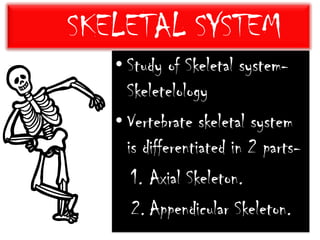
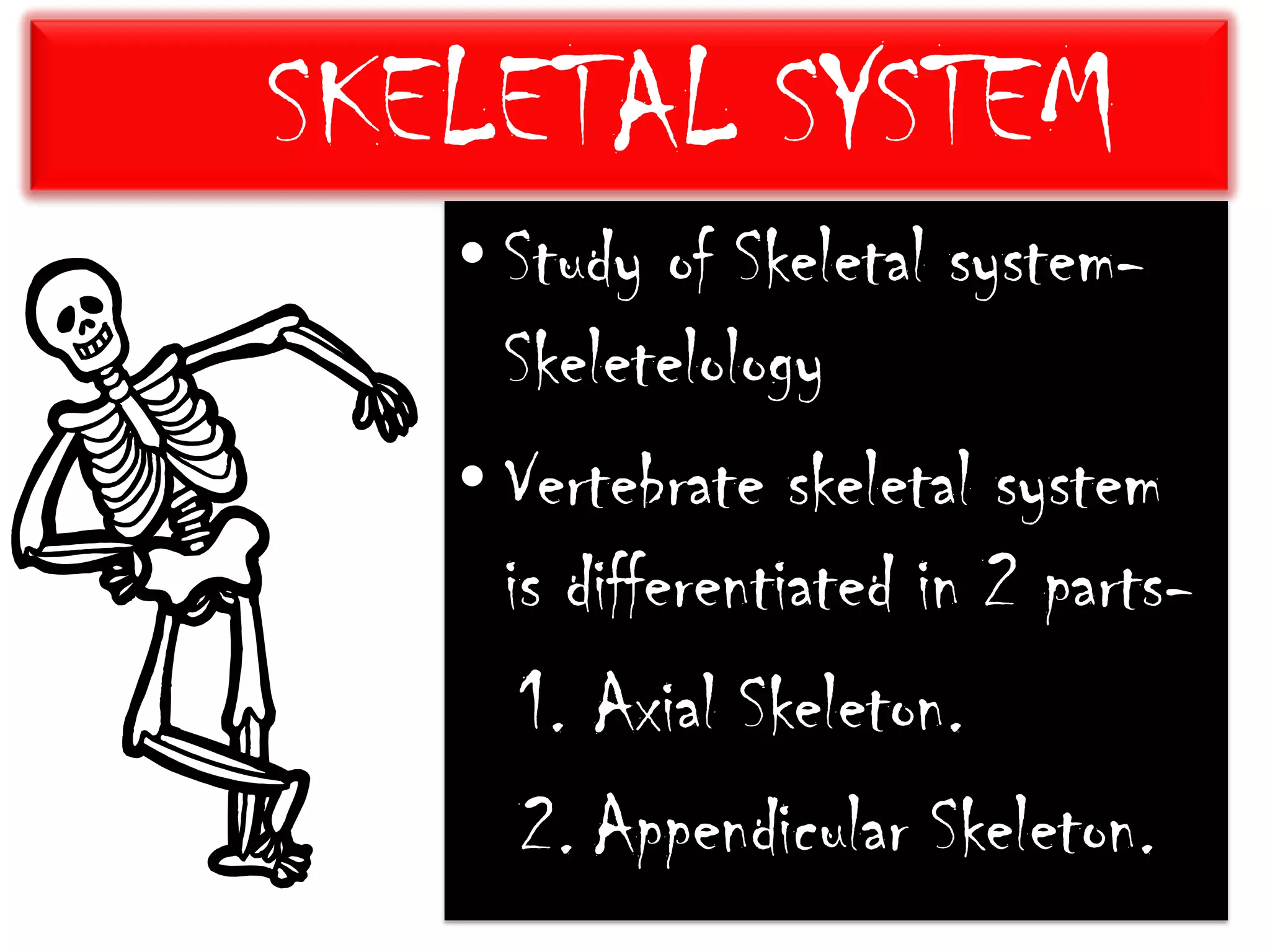
SKELETAL SYSTEMStudy of Skeletal system- Skeletelology
Vertebrate skeletal system is differentiated in 2 parts-Axial Skeleton. Appendicular Skeleton.
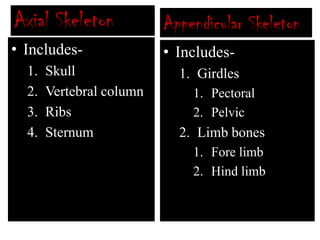
Axial SkeletonAppendicular SkeletonIncludes-SkullVertebral columnRibsSternumIncludes-GirdlesPectoralPelvicLimb bonesFore limbHind limb
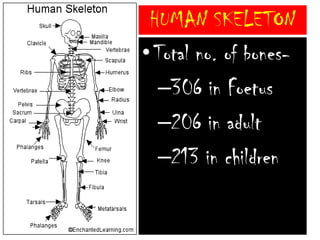
HUMAN SKELETONTotal no. of bones-306 in Foetus206 in adult 213 in children
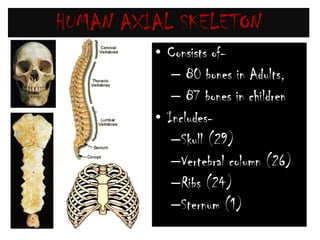
HUMAN AXIAL SKELETONConsists of- 80 bones in Adults, 87 bones in childrenIncludes-Skull (29)Vertebral column (26)Ribs (24)Sternum (1)
HUMAN SKULLStudy- CraniologyHuman skull is dicondylic, bear two condyles and Tropibasic( Interorbital orbital septum is present between 2 orbits).Jaw suspension is Craniostylic.
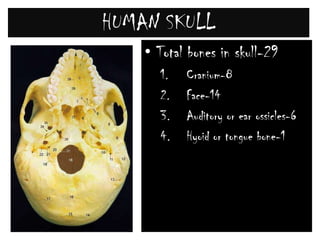
HUMAN SKULLTotal bones in skull-29Cranium-8Face-14Auditory or ear ossicles-6Hyoid or tongue bone-1
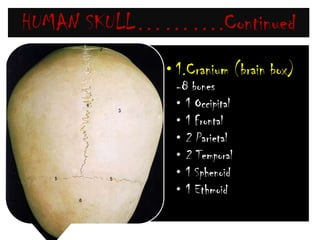
HUMAN SKULL……….Continued
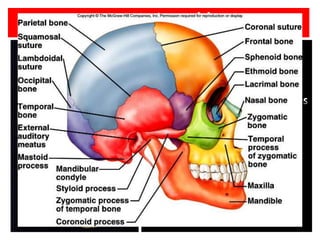
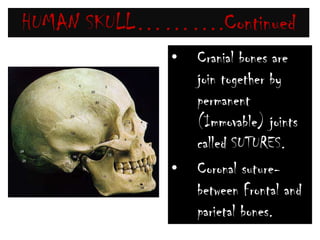
HUMAN SKULL……….ContinuedCranial bones are join together by permanent (Immovable) joints called SUTURES.Coronal suture-between Frontal and parietal bones.
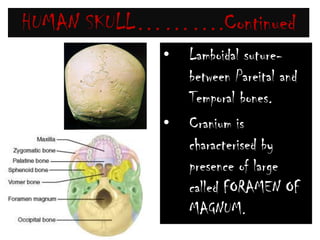
HUMAN SKULL……….ContinuedLamboidal suture-between Pareital and Temporal bones.Cranium is characterised by presence of large called FORAMEN OF MAGNUM.
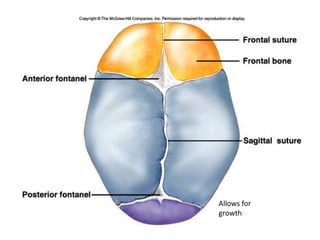
Allows forgrowth
HUMAN SKULL……….ContinuedFORAMEN OF MAGNUM is surrounded by 2 exooccipetal, 1 supra occipetal, 1 basioccipetal bones. It is the largest foramen of human body, Spinal cord comes out through this foramen.Pituitary gland is lodged in a depression called SELLA TURSICA  in Sphenoid bone of cranium.
HUMAN SKULL……….ContinuedFacial part -Consists of 14 bones-2 Nasal2 Inferior nasal conchae1 Vomar2 Lacrymal2 Zygomatic ( Cheek bones)2 Palatine (L Shaped)2 Maxilla (Upper jaw bones)1 Mandible (Largest bone of face & Hardest bone bone of human body)
HUMAN SKULL……….ContinuedSensory capsule or Ear ossicle -Consists of 6 small bones, 3 in each ear……….i.e. MIS1 Malleus(M) or Hammer shaped (Modified Articular)1 Incus (I) or Anvil shaped (Modified Quadrate)1 Stapes (S) or Stirrup shaped (Modified Hyomandibular)Note- Joint Between Malleus & Incus – Hinge jointJoint Between Incus & Stapes – Ball and Socket jointStapes is the smallest bone of human body.
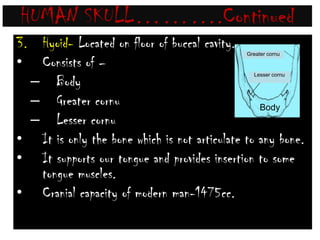
Greater cornuLesser cornuBodyHUMAN SKULL……….ContinuedHyoid- Located on floor of buccal cavity.Consists of – BodyGreater cornuLesser cornuIt is only the bone which is not articulate to any bone.It supports our tongue and provides insertion to some tongue muscles.Cranial capacity of modern man-1475cc.Fig. 7.6-2 : Human hyoid boneviewed from aboveGreater corn
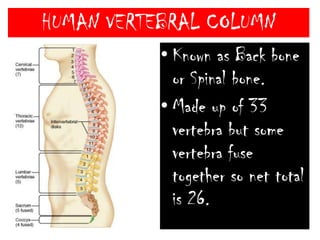
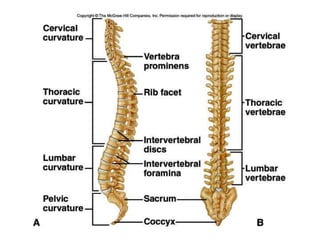
HUMAN VERTEBRAL COLUMNKnown as Back bone or Spinal bone.Made up of 33 vertebra but some vertebra fuse together so net total is 26.
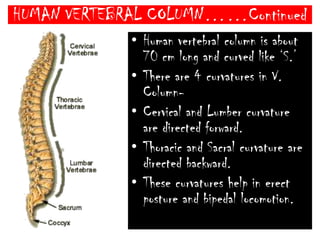
HUMAN VERTEBRAL COLUMN……ContinuedHuman vertebral column is about 70 cm long and curved like ‘S.’There are 4 curvatures in V. Column-Cervical and Lumber curvature are directed forward.Thoracic and Sacral curvature are directed backward.These curvatures help in erect posture and bipedal locomotion.
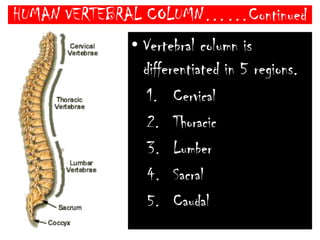
HUMAN VERTEBRAL COLUMN……ContinuedVertebral column is differentiated in 5 regions.CervicalThoracicLumberSacralCaudal
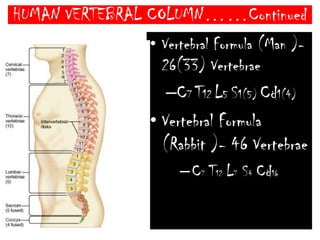
HUMAN VERTEBRAL COLUMN……ContinuedVertebral Formula (Man )- 26(33) VertebraeC7T12L5 S1(5)Cd1(4)Vertebral Formula (Rabbit )- 46 VertebraeC7T12L7S44Cd16
HUMAN VERTEBRAL COLUMN……ContinuedMammals are characterized by presence of 7 cervical vertebrae.Human, Rat, Rabbit, Giraffe all have 7 cervical vertebrae.Exceptions-Sea cow (Mantenee) and two toed sloth (Chloepus) have 6 cervical vertebrae.Ant bear(Tamandua)and has 8 and three toed sloth (Bradypus) has 9 cervical vertebrae.
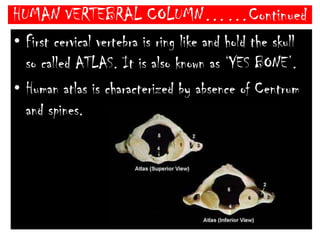
HUMAN VERTEBRAL COLUMN……ContinuedFirst cervical vertebra is ring like and hold the skull so called ATLAS. It is also known as ‘YES BONE’.Human atlas is characterized by absence of Centrum and spines.
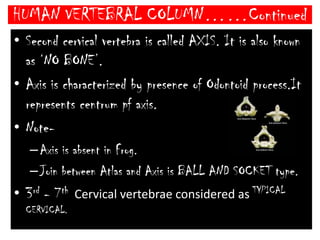
HUMAN VERTEBRAL COLUMN……ContinuedSecond cervical vertebra is called AXIS. It is also known as ‘NO BONE’.Axis is characterized by presence of Odontoidprocess.It represents centrumpf axis.Note- Axis is absent in Frog.Join between Atlas and Axis is BALL AND SOCKET type.3rd - 7th  Cervical vertebrae considered as TYPICAL CERVICAL.
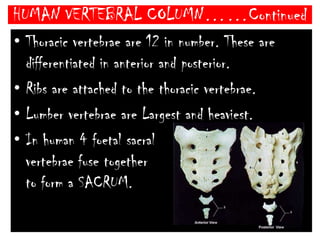
HUMAN VERTEBRAL COLUMN……ContinuedThoracic vertebrae are 12 in number. These are differentiated in anterior and posterior.Ribs are attached to the thoracic vertebrae.Lumber vertebrae are Largest and heaviest.In human 4 foetal sacral                       vertebrae fuse together                               to form a SACRUM.
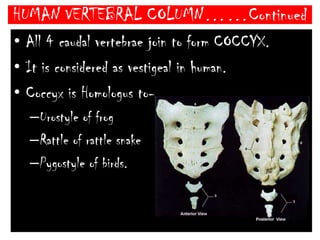
HUMAN VERTEBRAL COLUMN……ContinuedAll 4 caudal vertebrae join to form COCCYX.It is considered as vestigeal in human.Coccyx is Homologus to-Urostyle of frogRattle of rattle snakePygostyle of birds.
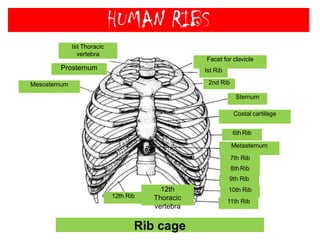
Ist ThoracicvertebraFacet for clavicleProsternumIst Rib2nd RibMesosternumSternumCostal cartilage6thRibMetasternum7th Rib8thRib9th Rib12th Thoracicvertebra10th Rib12th Rib11th RibRib cageHUMAN RIBS
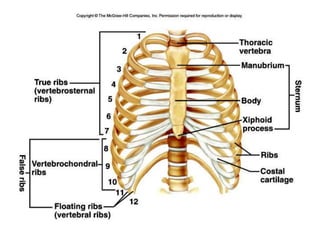
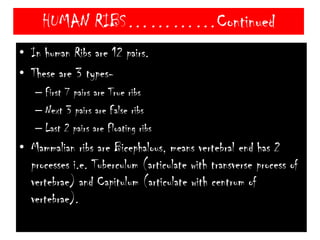
HUMAN RIBS…………ContinuedIn human Ribs are 12 pairs.These are 3 types-First 7 pairs are True ribsNext 3 pairs are False ribsLast 2 pairs are Floating ribsMammalian ribs are Bicephalous, means vertebral end has 2 processes i.e. Tuberculum (articulate with transverse process of vertebrae) and Capitulum (articulate with centrum of vertebrae).
HUMAN RIBS…………ContinuedFloating ribs protect kidneys.Note-Uncinate process is found in avian ribs.This process provide attachment surface for flight muscles.Cervical ribs are not ribs, these are backwardly directed processes in cervical vertebrae of birds.
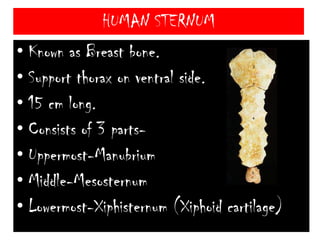
HUMAN STERNUMKnown as Breast bone.Support thorax on ventral side.15 cm long.Consists of 3 parts-Uppermost-ManubriumMiddle-MesosternumLowermost-Xiphisternum (Xiphoid cartilage)
HUMAN APPENDICULAR SKELETONTotal no. of bones-126Includes-Girdles (6) and Limb bones(120)GIRDLES-1.PECTORAL (2X2=4) 				2.PELVIC GIRDLE (1X2=2)
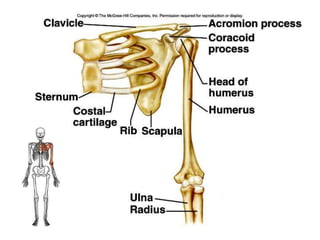
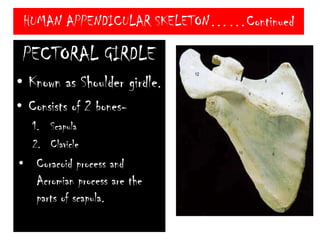
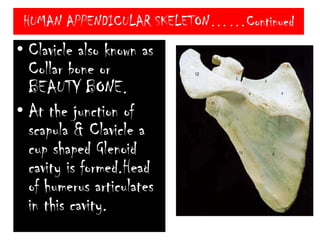
HUMAN APPENDICULAR SKELETON……ContinuedPECTORAL GIRDLEKnown as Shoulder girdle.Consists of 2 bones-ScapulaClavicleCoracoid process and Acromian process are the parts of scapula.
HUMAN APPENDICULAR SKELETON……ContinuedClavicle also known as Collar bone or BEAUTY BONE.At the junction of scapula & Clavicle a cup shaped Glenoid cavity is formed.Head of humerus articulates in this cavity.
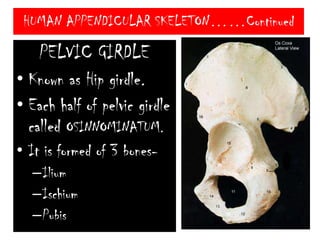
HUMAN APPENDICULAR SKELETON……ContinuedPELVIC GIRDLE Known as Hip girdle.Each half of pelvic girdle called OSINNOMINATUM.It is formed of 3 bones-IliumIschiumPubis
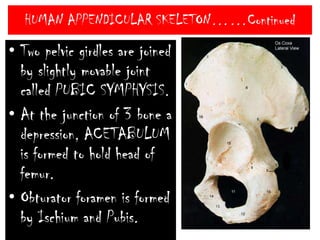
HUMAN APPENDICULAR SKELETON……ContinuedTwo pelvic girdles are joined by slightly movable joint called PUBIC SYMPHYSIS.At the junction of 3 bone a depression, ACETABULUM is formed to hold head of femur.Obturator foramen is formed by Ischium and Pubis.
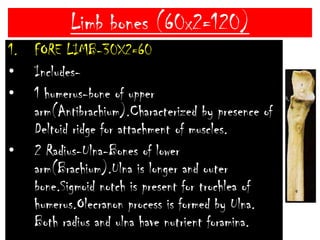
Limb bones (60x2=120)FORE LIMB-30X2=60Includes-1 humerus-bone of upper arm(Antibrachium).Characterized by presence of Deltoid ridge for attachment of muscles.2 Radius-Ulna-Bones of lower arm(Brachium).Ulna is longer and outer bone.Sigmoid notch is present for trochlea of humerus.Olecranon process is formed by Ulna. Both radius and ulna have nutrient foramina.
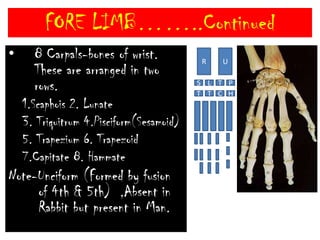
FORE LIMB……..Continued 8 Carpals-bones of wrist. These are arranged in two rows.1.Scaphois 2. Lunate3. Triquitrum 4.Pisciform(Sesamoid)5. Trapezium 6. Trapezoid 7.Capitate 8. HammateNote-Unciform (Formed by fusion of 4th & 5th)  ,Absent in Rabbit but present in Man.RUSLTPTTCH
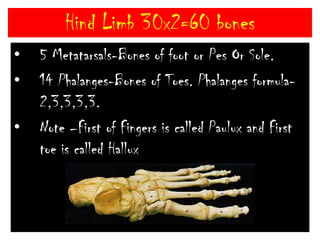
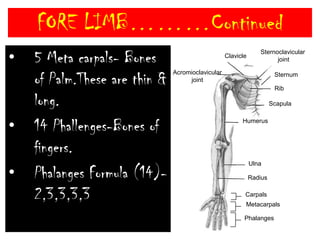
Sternoclavicular jointClavicleAcromioclavicularjointSternumRibScapulaHumerusUlnaRadiusCarpalsMetacarpalsPhalangesFORE LIMB………Continued5 Meta carpals- Bones of Palm.These are thin & long.14 Phallenges-Bones of fingers.Phalanges Formula (14)-2,3,3,3,3
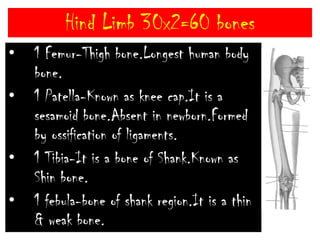
Hind Limb 30x2=60 bones1 Femur-Thigh bone.Longest human body bone.1 Patella-Known as knee cap.It is a sesamoidbone.Absent in newborn.Formed by ossification of ligaments.1 Tibia-It is a bone of Shank.Known as Shin bone.1 febula-bone of shank region.It is a thin & weak bone.
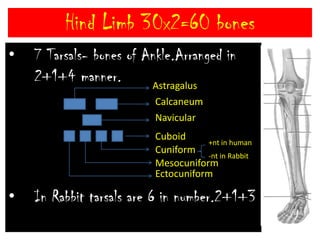
Hind Limb 30x2=60 bones7 Tarsals- bones of Ankle.Arranged in 2+1+4 manner.In Rabbit tarsals are 6 in number.2+1+3AstragalusCalcaneumNavicularCuboid+nt in humanCuniform-nt in RabbitMesocuniformEctocuniform

Human Skeletal System

  • 1.
    SKELETAL SYSTEMStudy ofSkeletal system- Skeletelology
  • 2.
    Vertebrate skeletal systemis differentiated in 2 parts-Axial Skeleton. Appendicular Skeleton.
  • 3.
    Axial SkeletonAppendicular SkeletonIncludes-SkullVertebralcolumnRibsSternumIncludes-GirdlesPectoralPelvicLimb bonesFore limbHind limb
  • 4.
    HUMAN SKELETONTotal no.of bones-306 in Foetus206 in adult 213 in children
  • 5.
    HUMAN AXIAL SKELETONConsistsof- 80 bones in Adults, 87 bones in childrenIncludes-Skull (29)Vertebral column (26)Ribs (24)Sternum (1)
  • 6.
    HUMAN SKULLStudy- CraniologyHumanskull is dicondylic, bear two condyles and Tropibasic( Interorbital orbital septum is present between 2 orbits).Jaw suspension is Craniostylic.
  • 7.
    HUMAN SKULLTotal bonesin skull-29Cranium-8Face-14Auditory or ear ossicles-6Hyoid or tongue bone-1
  • 8.
  • 9.
    HUMAN SKULL……….ContinuedCranial bonesare join together by permanent (Immovable) joints called SUTURES.Coronal suture-between Frontal and parietal bones.
  • 10.
    HUMAN SKULL……….ContinuedLamboidal suture-betweenPareital and Temporal bones.Cranium is characterised by presence of large called FORAMEN OF MAGNUM.
  • 11.
  • 12.
    HUMAN SKULL……….ContinuedFORAMEN OFMAGNUM is surrounded by 2 exooccipetal, 1 supra occipetal, 1 basioccipetal bones. It is the largest foramen of human body, Spinal cord comes out through this foramen.Pituitary gland is lodged in a depression called SELLA TURSICA in Sphenoid bone of cranium.
  • 13.
    HUMAN SKULL……….ContinuedFacial part-Consists of 14 bones-2 Nasal2 Inferior nasal conchae1 Vomar2 Lacrymal2 Zygomatic ( Cheek bones)2 Palatine (L Shaped)2 Maxilla (Upper jaw bones)1 Mandible (Largest bone of face & Hardest bone bone of human body)
  • 14.
    HUMAN SKULL……….ContinuedSensory capsuleor Ear ossicle -Consists of 6 small bones, 3 in each ear……….i.e. MIS1 Malleus(M) or Hammer shaped (Modified Articular)1 Incus (I) or Anvil shaped (Modified Quadrate)1 Stapes (S) or Stirrup shaped (Modified Hyomandibular)Note- Joint Between Malleus & Incus – Hinge jointJoint Between Incus & Stapes – Ball and Socket jointStapes is the smallest bone of human body.
  • 15.
    Greater cornuLesser cornuBodyHUMANSKULL……….ContinuedHyoid- Located on floor of buccal cavity.Consists of – BodyGreater cornuLesser cornuIt is only the bone which is not articulate to any bone.It supports our tongue and provides insertion to some tongue muscles.Cranial capacity of modern man-1475cc.Fig. 7.6-2 : Human hyoid boneviewed from aboveGreater corn
  • 16.
    HUMAN VERTEBRAL COLUMNKnownas Back bone or Spinal bone.Made up of 33 vertebra but some vertebra fuse together so net total is 26.
  • 18.
    HUMAN VERTEBRAL COLUMN……ContinuedHumanvertebral column is about 70 cm long and curved like ‘S.’There are 4 curvatures in V. Column-Cervical and Lumber curvature are directed forward.Thoracic and Sacral curvature are directed backward.These curvatures help in erect posture and bipedal locomotion.
  • 19.
    HUMAN VERTEBRAL COLUMN……ContinuedVertebralcolumn is differentiated in 5 regions.CervicalThoracicLumberSacralCaudal
  • 20.
    HUMAN VERTEBRAL COLUMN……ContinuedVertebralFormula (Man )- 26(33) VertebraeC7T12L5 S1(5)Cd1(4)Vertebral Formula (Rabbit )- 46 VertebraeC7T12L7S44Cd16
  • 21.
    HUMAN VERTEBRAL COLUMN……ContinuedMammalsare characterized by presence of 7 cervical vertebrae.Human, Rat, Rabbit, Giraffe all have 7 cervical vertebrae.Exceptions-Sea cow (Mantenee) and two toed sloth (Chloepus) have 6 cervical vertebrae.Ant bear(Tamandua)and has 8 and three toed sloth (Bradypus) has 9 cervical vertebrae.
  • 22.
    HUMAN VERTEBRAL COLUMN……ContinuedFirstcervical vertebra is ring like and hold the skull so called ATLAS. It is also known as ‘YES BONE’.Human atlas is characterized by absence of Centrum and spines.
  • 23.
    HUMAN VERTEBRAL COLUMN……ContinuedSecondcervical vertebra is called AXIS. It is also known as ‘NO BONE’.Axis is characterized by presence of Odontoidprocess.It represents centrumpf axis.Note- Axis is absent in Frog.Join between Atlas and Axis is BALL AND SOCKET type.3rd - 7th Cervical vertebrae considered as TYPICAL CERVICAL.
  • 24.
    HUMAN VERTEBRAL COLUMN……ContinuedThoracicvertebrae are 12 in number. These are differentiated in anterior and posterior.Ribs are attached to the thoracic vertebrae.Lumber vertebrae are Largest and heaviest.In human 4 foetal sacral vertebrae fuse together to form a SACRUM.
  • 25.
    HUMAN VERTEBRAL COLUMN……ContinuedAll4 caudal vertebrae join to form COCCYX.It is considered as vestigeal in human.Coccyx is Homologus to-Urostyle of frogRattle of rattle snakePygostyle of birds.
  • 27.
    Ist ThoracicvertebraFacet forclavicleProsternumIst Rib2nd RibMesosternumSternumCostal cartilage6thRibMetasternum7th Rib8thRib9th Rib12th Thoracicvertebra10th Rib12th Rib11th RibRib cageHUMAN RIBS
  • 28.
    HUMAN RIBS…………ContinuedIn humanRibs are 12 pairs.These are 3 types-First 7 pairs are True ribsNext 3 pairs are False ribsLast 2 pairs are Floating ribsMammalian ribs are Bicephalous, means vertebral end has 2 processes i.e. Tuberculum (articulate with transverse process of vertebrae) and Capitulum (articulate with centrum of vertebrae).
  • 29.
    HUMAN RIBS…………ContinuedFloating ribsprotect kidneys.Note-Uncinate process is found in avian ribs.This process provide attachment surface for flight muscles.Cervical ribs are not ribs, these are backwardly directed processes in cervical vertebrae of birds.
  • 30.
    HUMAN STERNUMKnown asBreast bone.Support thorax on ventral side.15 cm long.Consists of 3 parts-Uppermost-ManubriumMiddle-MesosternumLowermost-Xiphisternum (Xiphoid cartilage)
  • 31.
    HUMAN APPENDICULAR SKELETONTotalno. of bones-126Includes-Girdles (6) and Limb bones(120)GIRDLES-1.PECTORAL (2X2=4) 2.PELVIC GIRDLE (1X2=2)
  • 33.
    HUMAN APPENDICULAR SKELETON……ContinuedPECTORALGIRDLEKnown as Shoulder girdle.Consists of 2 bones-ScapulaClavicleCoracoid process and Acromian process are the parts of scapula.
  • 34.
    HUMAN APPENDICULAR SKELETON……ContinuedClaviclealso known as Collar bone or BEAUTY BONE.At the junction of scapula & Clavicle a cup shaped Glenoid cavity is formed.Head of humerus articulates in this cavity.
  • 35.
    HUMAN APPENDICULAR SKELETON……ContinuedPELVICGIRDLE Known as Hip girdle.Each half of pelvic girdle called OSINNOMINATUM.It is formed of 3 bones-IliumIschiumPubis
  • 36.
    HUMAN APPENDICULAR SKELETON……ContinuedTwopelvic girdles are joined by slightly movable joint called PUBIC SYMPHYSIS.At the junction of 3 bone a depression, ACETABULUM is formed to hold head of femur.Obturator foramen is formed by Ischium and Pubis.
  • 37.
    Limb bones (60x2=120)FORELIMB-30X2=60Includes-1 humerus-bone of upper arm(Antibrachium).Characterized by presence of Deltoid ridge for attachment of muscles.2 Radius-Ulna-Bones of lower arm(Brachium).Ulna is longer and outer bone.Sigmoid notch is present for trochlea of humerus.Olecranon process is formed by Ulna. Both radius and ulna have nutrient foramina.
  • 38.
    FORE LIMB……..Continued 8Carpals-bones of wrist. These are arranged in two rows.1.Scaphois 2. Lunate3. Triquitrum 4.Pisciform(Sesamoid)5. Trapezium 6. Trapezoid 7.Capitate 8. HammateNote-Unciform (Formed by fusion of 4th & 5th) ,Absent in Rabbit but present in Man.RUSLTPTTCH
  • 39.
    Sternoclavicular jointClavicleAcromioclavicularjointSternumRibScapulaHumerusUlnaRadiusCarpalsMetacarpalsPhalangesFORE LIMB………Continued5Meta carpals- Bones of Palm.These are thin & long.14 Phallenges-Bones of fingers.Phalanges Formula (14)-2,3,3,3,3
  • 40.
    Hind Limb 30x2=60bones1 Femur-Thigh bone.Longest human body bone.1 Patella-Known as knee cap.It is a sesamoidbone.Absent in newborn.Formed by ossification of ligaments.1 Tibia-It is a bone of Shank.Known as Shin bone.1 febula-bone of shank region.It is a thin & weak bone.
  • 41.
    Hind Limb 30x2=60bones7 Tarsals- bones of Ankle.Arranged in 2+1+4 manner.In Rabbit tarsals are 6 in number.2+1+3AstragalusCalcaneumNavicularCuboid+nt in humanCuniform-nt in RabbitMesocuniformEctocuniform