Support
System in
 Animals
• To move, muscles must work in concert with
  a skeleton.
• The skeleton provides a rigid structure to
  which muscles are attached.
• Muscles exert force only during contraction.
  Moving a body part back & forth requires
  two muscles attached to the same section
  of the skeleton.
• These two muscles are known as an
  antagonistic pair, which functions
  cooperatively. The nervous system
  coordinates these muscles.
The main function of a
          skeleton
• Support
• Protection
  – In many animals, the skeleton protects soft
    tissue.
  – For example, the vertebrate skull protects the
    brain whilst the ribs of terrestrial vertebrates
    forms a cage around the heart, lungs and other
    internal organs.
• Movement
Types of skeletons
• There are three types of skeletons, namely:
  – A Hydrostatic skeleton
  – An Exoskeleton , and
  – An Endoskeleton
Hydrostatic skeletons
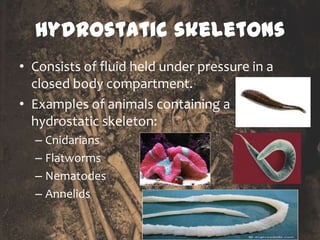
• Consists of fluid held under pressure in a
  closed body compartment.
• Examples of animals containing a
  hydrostatic skeleton:
  – Cnidarians
  – Flatworms
  – Nematodes
  – Annelids
Hydrostatic skeletons
• Movement and form is
  controlled by using muscles
  to change the shape of the
  fluid filled compartment.
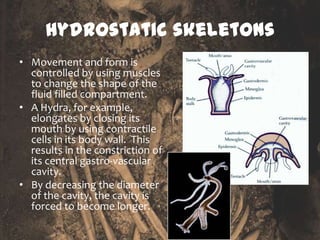
• A Hydra, for example,
  elongates by closing its
  mouth by using contractile
  cells in its body wall. This
  results in the constriction of
  its central gastro-vascular
  cavity.
• By decreasing the diameter
  of the cavity, the cavity is
  forced to become longer.
Body structure of a
      Hydra
Hydrostatic skeletons
• In planarians & other flatworms, the
  interstitial fluid is kept under pressure &
  functions as the main hydrostatic skeleton.
• Planarian movement results mainly from
  muscles in the body wall exerting localized
  forces against the hydrostatic skeleton.
Hydrostatic skeletons
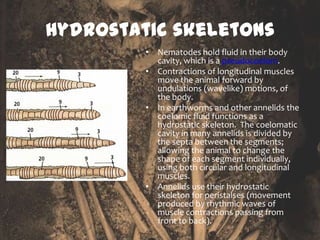
         • Nematodes hold fluid in their body
           cavity, which is a pseudocoelom.
         • Contractions of longitudinal muscles
           move the animal forward by
           undulations (wavelike) motions, of
           the body.
         • In earthworms and other annelids the
           coelomic fluid functions as a
           hydrostatic skeleton. The coelomatic
           cavity in many annelids is divided by
           the septa between the segments;
           allowing the animal to change the
           shape of each segment individually,
           using both circular and longitudinal
           muscles.
         • Annelids use their hydrostatic
           skeleton for peristalses (movement
           produced by rhythmic waves of
           muscle contractions passing from
           front to back).
Movement of a
         Nematode
• Nematode Movement.
Hydrostatic skeletons
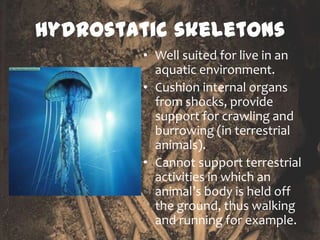
         • Well suited for live in an
           aquatic environment.
         • Cushion internal organs
           from shocks, provide
           support for crawling and
           burrowing (in terrestrial
           animals).
         • Cannot support terrestrial
           activities in which an
           animal’s body is held off
           the ground, thus walking
           and running for example.
Exoskeletons
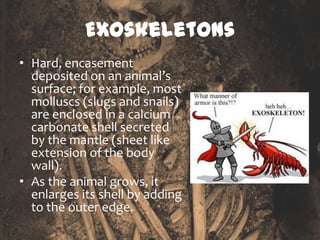
• Hard, encasement
  deposited on an animal’s
  surface; for example, most
  molluscs (slugs and snails)
  are enclosed in a calcium
  carbonate shell secreted
  by the mantle (sheet like
  extension of the body
  wall).
• As the animal grows, it
  enlarges its shell by adding
  to the outer edge.
Exoskeleton
• Jointed exoskeleton arthropods have a cuticle,
  which is secreted by the epidermis. Muscles are
  attached to knobs and plates of the cuticle that
  extend into the interior of the body.
• 30 – 50% of the cuticle consist of chitin, a
  polysaccharide similar to cellulose. Fibrils of
  chitin is embedded in a protein matrix, which
  forms a composite material that combines
  strength and flexibility.
Exoskeletons
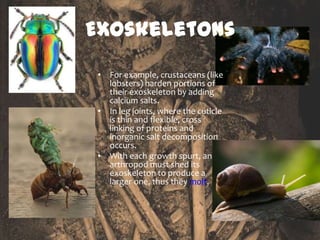
• For example, crustaceans (like
  lobsters) harden portions of
  their exoskeleton by adding
  calcium salts.
• In leg joints, where the cuticle
  is thin and flexible, cross
  linking of proteins and
  inorganic salt decomposition
  occurs.
• With each growth spurt, an
  arthropod must shed its
  exoskeleton to produce a
  larger one, thus they molt.
Endoskeletons
    • Consist of hard, supporting
      elements, such as bones which is
      buried within the soft tissue of
      animals.
    • Sponges are reinforced by hard,
      needle like structures of inorganic
      materials, or by softer fibres made
      of protein.
    • Echinoderms have an endoskeleton
      of hard plates called ossicles
      beneath their skin.
    • Ossicles are composed of
      magnesium carbonate, calcium
      carbonate crystals and are usually
      bound together by protein fibres.
Endoskeletons
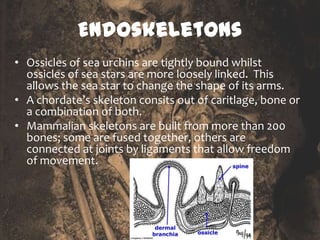
• Ossicles of sea urchins are tightly bound whilst
  ossicles of sea stars are more loosely linked. This
  allows the sea star to change the shape of its arms.
• A chordate’s skeleton consits out of caritlage, bone or
  a combination of both.
• Mammalian skeletons are built from more than 200
  bones; some are fused together, others are
  connected at joints by ligaments that allow freedom
  of movement.
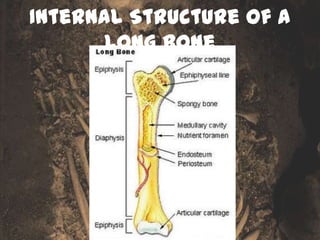
Internal Structure of a
       Long Bone
Name those Bones …
• Name those Bones …
Joints present in an
        endoskeleton
• Three types of joints
  can be distinguished in
  endoskeletons, namely:

  – Ball-and-socket joints
  – Hinge joints
  – Pivot joints
Joints in the Human Body
Ball-and-socket joints
• These joints are present where:
  – The humerus contacts the shoulder girdle
  – The femur contacts the pelvic girdle
• Enable us to rotate our arms and legs.
• Also allows for us to move our arms and legs
  in several planes.
Hinge joints
• Found between the humerus and the head
  of the ulna.
• Restricts movement to a single plane.
Pivot joints
• Allows us to rotate our forearm at the
  elbow.
• Movement of head from side to side.
Locomotion
• Requires that an animal expend energy to
  overcome two forces that tend to keep an
  organism stationary.
• These forces are:
  – Friction, and
  – Gravity.
• By exerting a force, energy is required which
  is produced during consuming cellular work.
Types of locomotion
• Locomotion can be accomplished by means
  of three methods, namely:
  – Swimming,
  – Locomotion on land, and
  – Flying.
Swimming as locomotive
        tool
• Overcoming gravity is easier in water, than it
  is for species who live on land. But, friction
  is a major problem for aquatic animals.
• A common adaptation for fast swimmers is a
  sleek, fusiform (torpedo like) shape.
Swimming as locomotive
           tool – diverse
            adaptations
• Insects and four-legged vertebrates use their
  legs as oars to push against the water.
• Squids, scallops and some cnidarians are jet-
  propelled; they take in water and squirt it
  out in bursts in order to move.
• Sharks and bony fish swim by moving their
  body and tail from side to side.
• Whales and dolphins move by undulating
  their body and tail up and down.
Locomotion on land
• Walking, running, hopping and crawling animals must be able to
  support themselves and move against gravity. Air poses relatively little
  resistance at moderate speeds.
• When a land animal walks, runs, or hop, its leg muscles expend energy
  not only to propel the animal, but also to keep it from falling down.
  With each step the leg muscles must overcome inertia by accelerating a
  leg from a standing start.
• Strong skeletal support and powerful muscles are important.
Locomotion on land -
     diverse adaptations
• Kangaroos have large, powerful
  muscles in their hind legs which is
  suitable for locomotion by hopping.
• As a kangaroo lands after each leap,
  tendons in its hind legs momentarily
  store energy. The farther the animal
  hops, the more energy the tendons
  store.
• Analogous to energy in a compressed
  spring, the energy stored in the
  tendons is available for the next jump
  and reduces the total amount of
  energy the animal must expend to
  travel.
Locomotion on land -
    diverse adaptations
• Legs of an insect, dog and human also retain
  some energy during walking and running,
  but in a smaller share.
• Another important prerequisite for walking,
  running and hopping is to maintain balance.
• A kangaroo’s large tail help balance its body
  during leaps and also forms a stable tripod
  with its hind legs when the animal sits and
  moves slowly.
Locomotion on land -
    diverse adaptations
• Bipedal animals (such as humans and birds)
  keep part of at least one foot on the ground
  when walking.
• When running:
  – All four feet (or both for bipeds) may be off the
    ground briefly, but at running speeds it is
    momentum more than foot contact that keeps
    the body upright.
Locomotion on land -
     diverse adaptations
• When crawling:
   – Much of the body is in contact
     with the ground, a crawling
     animal must exert
     considerable effort to
     overcome friction.
   – Earthworms crawl by means of
     peristalsis.
   – Many snakes crawl by
     undulating their entire body
     from side to side; assisted by
     large, moveable scales on its
     underside. When the snake’s
     body pushes against the
     ground, its scales tilt forward
     and then push backward
     against the ground.
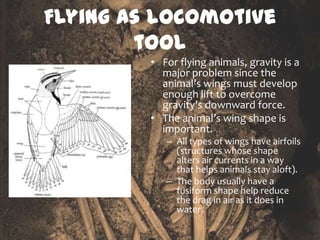
Flying as locomotive
        tool
         • For flying animals, gravity is a
           major problem since the
           animal’s wings must develop
           enough lift to overcome
           gravity’s downward force.
         • The animal’s wing shape is
           important.
            – All types of wings have airfoils
              (structures whose shape
              alters air currents in a way
              that helps animals stay aloft).
            – The body usually have a
              fusiform shape help reduce
              the drag in air as it does in
              water.
Flying as locomotive
           tool
• Flying animals are relatively light.
• Body masses range from less to a gram to
  about 20 kg (largest flying birds).
Flying as locomotive
     tool -adaptations
• Many structural adaptations contribute to a
  lower body mass.
• For example:
  – Birds have no urinary bladder or teeth, they have
    relatively large bones with air filled regions.
  – This lessen the bird’s weight.
Worksheets
• Complete the following worksheets for
  homework:
  – Diagram of the Human Skeleton
  – Fill in the missing words
  – Crossword one
  – Crossword two
References
•   Campbell, N. A., & Reece, J. B. (2008). Biology (8th ed.). San Francisco,
    California, United States of America: Benjamin Cummings.
•   Google images
•   Skeletal System Cloze (n.d.). Available from:
          http://www.bogglesworld.esl.com/skeletalsystem.htm
    (Accessed 29 April 2012)
•   Skeletal System Crossword 1 (n.d.). Available from:
          http://www.bogglesworld.esl.com/skeletalsystem.htm
    (Accessed 29 April 2012)
•   Skeletal System Crossword 2 (n.d.) Available from:
          http://www.bogglesworld.esl.com/skeletalsystem.htm
    (Accessed 29 April 2012)
•   Skeletal System Diagram (n.d.). Available from:
          http://www.bogglesworld.esl.com/skeletalsystem.htm
    (Accessed 29 April 2012)
•   You tube

Animal Support System

  • 1.
  • 2.
    • To move,muscles must work in concert with a skeleton. • The skeleton provides a rigid structure to which muscles are attached. • Muscles exert force only during contraction. Moving a body part back & forth requires two muscles attached to the same section of the skeleton. • These two muscles are known as an antagonistic pair, which functions cooperatively. The nervous system coordinates these muscles.
  • 3.
    The main functionof a skeleton • Support • Protection – In many animals, the skeleton protects soft tissue. – For example, the vertebrate skull protects the brain whilst the ribs of terrestrial vertebrates forms a cage around the heart, lungs and other internal organs. • Movement
  • 4.
    Types of skeletons •There are three types of skeletons, namely: – A Hydrostatic skeleton – An Exoskeleton , and – An Endoskeleton
  • 5.
    Hydrostatic skeletons • Consistsof fluid held under pressure in a closed body compartment. • Examples of animals containing a hydrostatic skeleton: – Cnidarians – Flatworms – Nematodes – Annelids
  • 6.
    Hydrostatic skeletons • Movementand form is controlled by using muscles to change the shape of the fluid filled compartment. • A Hydra, for example, elongates by closing its mouth by using contractile cells in its body wall. This results in the constriction of its central gastro-vascular cavity. • By decreasing the diameter of the cavity, the cavity is forced to become longer.
  • 7.
  • 8.
    Hydrostatic skeletons • Inplanarians & other flatworms, the interstitial fluid is kept under pressure & functions as the main hydrostatic skeleton. • Planarian movement results mainly from muscles in the body wall exerting localized forces against the hydrostatic skeleton.
  • 9.
    Hydrostatic skeletons • Nematodes hold fluid in their body cavity, which is a pseudocoelom. • Contractions of longitudinal muscles move the animal forward by undulations (wavelike) motions, of the body. • In earthworms and other annelids the coelomic fluid functions as a hydrostatic skeleton. The coelomatic cavity in many annelids is divided by the septa between the segments; allowing the animal to change the shape of each segment individually, using both circular and longitudinal muscles. • Annelids use their hydrostatic skeleton for peristalses (movement produced by rhythmic waves of muscle contractions passing from front to back).
  • 10.
    Movement of a Nematode • Nematode Movement.
  • 11.
    Hydrostatic skeletons • Well suited for live in an aquatic environment. • Cushion internal organs from shocks, provide support for crawling and burrowing (in terrestrial animals). • Cannot support terrestrial activities in which an animal’s body is held off the ground, thus walking and running for example.
  • 12.
    Exoskeletons • Hard, encasement deposited on an animal’s surface; for example, most molluscs (slugs and snails) are enclosed in a calcium carbonate shell secreted by the mantle (sheet like extension of the body wall). • As the animal grows, it enlarges its shell by adding to the outer edge.
  • 13.
    Exoskeleton • Jointed exoskeletonarthropods have a cuticle, which is secreted by the epidermis. Muscles are attached to knobs and plates of the cuticle that extend into the interior of the body. • 30 – 50% of the cuticle consist of chitin, a polysaccharide similar to cellulose. Fibrils of chitin is embedded in a protein matrix, which forms a composite material that combines strength and flexibility.
  • 14.
    Exoskeletons • For example,crustaceans (like lobsters) harden portions of their exoskeleton by adding calcium salts. • In leg joints, where the cuticle is thin and flexible, cross linking of proteins and inorganic salt decomposition occurs. • With each growth spurt, an arthropod must shed its exoskeleton to produce a larger one, thus they molt.
  • 15.
    Endoskeletons • Consist of hard, supporting elements, such as bones which is buried within the soft tissue of animals. • Sponges are reinforced by hard, needle like structures of inorganic materials, or by softer fibres made of protein. • Echinoderms have an endoskeleton of hard plates called ossicles beneath their skin. • Ossicles are composed of magnesium carbonate, calcium carbonate crystals and are usually bound together by protein fibres.
  • 16.
    Endoskeletons • Ossicles ofsea urchins are tightly bound whilst ossicles of sea stars are more loosely linked. This allows the sea star to change the shape of its arms. • A chordate’s skeleton consits out of caritlage, bone or a combination of both. • Mammalian skeletons are built from more than 200 bones; some are fused together, others are connected at joints by ligaments that allow freedom of movement.
  • 18.
  • 19.
    Name those Bones… • Name those Bones …
  • 20.
    Joints present inan endoskeleton • Three types of joints can be distinguished in endoskeletons, namely: – Ball-and-socket joints – Hinge joints – Pivot joints
  • 21.
    Joints in theHuman Body
  • 22.
    Ball-and-socket joints • Thesejoints are present where: – The humerus contacts the shoulder girdle – The femur contacts the pelvic girdle • Enable us to rotate our arms and legs. • Also allows for us to move our arms and legs in several planes.
  • 23.
    Hinge joints • Foundbetween the humerus and the head of the ulna. • Restricts movement to a single plane.
  • 24.
    Pivot joints • Allowsus to rotate our forearm at the elbow. • Movement of head from side to side.
  • 25.
    Locomotion • Requires thatan animal expend energy to overcome two forces that tend to keep an organism stationary. • These forces are: – Friction, and – Gravity. • By exerting a force, energy is required which is produced during consuming cellular work.
  • 26.
    Types of locomotion •Locomotion can be accomplished by means of three methods, namely: – Swimming, – Locomotion on land, and – Flying.
  • 27.
    Swimming as locomotive tool • Overcoming gravity is easier in water, than it is for species who live on land. But, friction is a major problem for aquatic animals. • A common adaptation for fast swimmers is a sleek, fusiform (torpedo like) shape.
  • 28.
    Swimming as locomotive tool – diverse adaptations • Insects and four-legged vertebrates use their legs as oars to push against the water. • Squids, scallops and some cnidarians are jet- propelled; they take in water and squirt it out in bursts in order to move. • Sharks and bony fish swim by moving their body and tail from side to side. • Whales and dolphins move by undulating their body and tail up and down.
  • 29.
    Locomotion on land •Walking, running, hopping and crawling animals must be able to support themselves and move against gravity. Air poses relatively little resistance at moderate speeds. • When a land animal walks, runs, or hop, its leg muscles expend energy not only to propel the animal, but also to keep it from falling down. With each step the leg muscles must overcome inertia by accelerating a leg from a standing start. • Strong skeletal support and powerful muscles are important.
  • 30.
    Locomotion on land- diverse adaptations • Kangaroos have large, powerful muscles in their hind legs which is suitable for locomotion by hopping. • As a kangaroo lands after each leap, tendons in its hind legs momentarily store energy. The farther the animal hops, the more energy the tendons store. • Analogous to energy in a compressed spring, the energy stored in the tendons is available for the next jump and reduces the total amount of energy the animal must expend to travel.
  • 31.
    Locomotion on land- diverse adaptations • Legs of an insect, dog and human also retain some energy during walking and running, but in a smaller share. • Another important prerequisite for walking, running and hopping is to maintain balance. • A kangaroo’s large tail help balance its body during leaps and also forms a stable tripod with its hind legs when the animal sits and moves slowly.
  • 32.
    Locomotion on land- diverse adaptations • Bipedal animals (such as humans and birds) keep part of at least one foot on the ground when walking. • When running: – All four feet (or both for bipeds) may be off the ground briefly, but at running speeds it is momentum more than foot contact that keeps the body upright.
  • 33.
    Locomotion on land- diverse adaptations • When crawling: – Much of the body is in contact with the ground, a crawling animal must exert considerable effort to overcome friction. – Earthworms crawl by means of peristalsis. – Many snakes crawl by undulating their entire body from side to side; assisted by large, moveable scales on its underside. When the snake’s body pushes against the ground, its scales tilt forward and then push backward against the ground.
  • 34.
    Flying as locomotive tool • For flying animals, gravity is a major problem since the animal’s wings must develop enough lift to overcome gravity’s downward force. • The animal’s wing shape is important. – All types of wings have airfoils (structures whose shape alters air currents in a way that helps animals stay aloft). – The body usually have a fusiform shape help reduce the drag in air as it does in water.
  • 35.
    Flying as locomotive tool • Flying animals are relatively light. • Body masses range from less to a gram to about 20 kg (largest flying birds).
  • 36.
    Flying as locomotive tool -adaptations • Many structural adaptations contribute to a lower body mass. • For example: – Birds have no urinary bladder or teeth, they have relatively large bones with air filled regions. – This lessen the bird’s weight.
  • 37.
    Worksheets • Complete thefollowing worksheets for homework: – Diagram of the Human Skeleton – Fill in the missing words – Crossword one – Crossword two
  • 38.
    References • Campbell, N. A., & Reece, J. B. (2008). Biology (8th ed.). San Francisco, California, United States of America: Benjamin Cummings. • Google images • Skeletal System Cloze (n.d.). Available from: http://www.bogglesworld.esl.com/skeletalsystem.htm (Accessed 29 April 2012) • Skeletal System Crossword 1 (n.d.). Available from: http://www.bogglesworld.esl.com/skeletalsystem.htm (Accessed 29 April 2012) • Skeletal System Crossword 2 (n.d.) Available from: http://www.bogglesworld.esl.com/skeletalsystem.htm (Accessed 29 April 2012) • Skeletal System Diagram (n.d.). Available from: http://www.bogglesworld.esl.com/skeletalsystem.htm (Accessed 29 April 2012) • You tube