INTRODUCTION
• Birds have evolved high performance Cardiovascular system
• Birds are homeothermic organisms and the cardiovascular system plays
a major role in conserving or removing body heat
• Our knowledge of cardiovascular structure and function is far more
limited in birds than mammals
CIRCULATORY SYSTEM
•Blood,
•Veins (carry blood from tissue to heart)
•Arteries (cary blood from heart to tissues),
•Capillaries
•Heart
FUNCTION
•Supply entire body with
•Nutrients
•Gases
•Hormones
•Remove metabolic wastes
•Regulation of body temperature
HEART
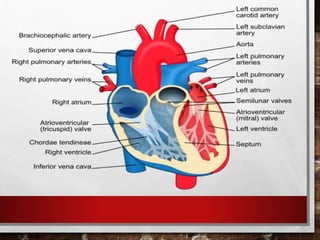
• 4- chambered heart, complete double circulation
• 1.5-2x larger than in comparable mammals
• Maintain higher metabolism
• Smaller birds have relatively larger hearts than larger birds
• Heart size increase with lattitude, altitude for same species
HEART CHAMBERS
• Atria
• Right
• Left= slightly than right atrium
• Ventricales
• Right
• Left= much bigger than right ventricals
HEART VALVES (4)
• Valves allow blood to flow in only one direction
• Right atrioventricular
• In birds, it is a single flap between right atrium and ventricles
• In mammals, it is a tricuspid valve (3 triangular flaps)
• Left atrioventricular valve (tricuspid valve)
• Three flaps between left atrium and ventricle
Continued
• Pulmonary valve
• A semilunar valve, tricuspid
• Origin of pulmonary artery
• Aortic valve
• A semilunar valve tricuspid
• Origin of aorta
HEART HISTOLOGY
• Three tissue layers
• Endocardium
• Most interior lining of the atria and vntricles
• Myocardiunm
• Middle layer
• Entirely cardiac muscle
• Epicardium
• Outer connective tissue layer
• Pericardium
• Connective tissue sac that enclose heart
• Pericardial space is filled with lymph fluid and termed pericardial fluid
MYOCARDIUM
• Entirely cardiac muscle
• Lattice-work appearance
• Striated like skeletal muscle muscle actin and myosin)
• Intercalated discs
• Dark area that searate fibers into cells
• Low impedence to action potentials so contraction can spread rapidly
HEART NERVES
• Has its own conduction system
• Sinoatrial node (SA node)
• Atrioventricular node (AV node)
• Right ring of purkinje fibers (AV bundle)
BLOOD
•Plasma
• Water (~85%)
• Protein (~9-11%)
• Glucose (blood glucose levels in birds are greater than in mammals
; about 200-400 mg/dl)
• Other constituents: amino acids, waste products, hormones,
antibodies and electrolytes
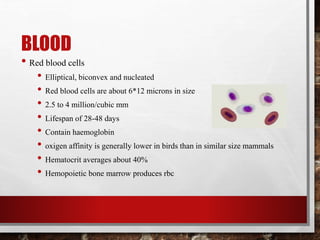
• Red blood cells
• Elliptical, biconvex and nucleated
• Red blood cells are about 6*12 microns in size
• 2.5 to 4 million/cubic mm
• Lifespan of 28-48 days
• Contain haemoglobin
• oxigen affinity is generally lower in birds than in similar size mammals
• Hematocrit averages about 40%
• Hemopoietic bone marrow produces rbc
BLOOD
CONTINUED
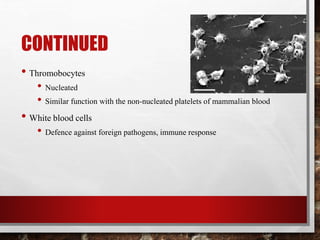
• Thromobocytes
• Nucleated
• Similar function with the non-nucleated platelets of mammalian blood
• White blood cells
• Defence against foreign pathogens, immune response
TYPES OF AVIAN WBC
1. Lymphocytes- most numerous white blood cells. Either T-
lymphocytes or B-lymphocytes produce antibodies; T-lymphocytes
attack infected or abnormal cells
2. Heterophil- second more numerous in most birds, phagocytic , use
their enzyme-containing granules to lyse ingested materials, motile
and can leave blood vessels to engulf foreign materials.
3. Monocytes- motile cells that can migrate using ameboid movements.
Monocytes are also phagocytic
4. Eosinophils- make up about 2 to 3% of the WBC population of halthy
birds
BLOOD VESSELS
• Blood pumped by the avian heart enters the blood vessels. The main
types are:
• Arteries - carry blood away from the heart & toward the body cells
• Arterioles - 'distribute' blood (that is, direct blood where needed with
more going to active tissues & organs & less to less active tissues &
organs) by vasodilating & vasoconstricting
• Capillaries - exchange of nutrients, gases, & waste products between
the blood & the body cells
• Venules (small veins) & veins- conduct blood back to the heart
THANK YOU

Avian circulatory system

  • 2.
    INTRODUCTION • Birds haveevolved high performance Cardiovascular system • Birds are homeothermic organisms and the cardiovascular system plays a major role in conserving or removing body heat • Our knowledge of cardiovascular structure and function is far more limited in birds than mammals
  • 3.
    CIRCULATORY SYSTEM •Blood, •Veins (carryblood from tissue to heart) •Arteries (cary blood from heart to tissues), •Capillaries •Heart
  • 4.
    FUNCTION •Supply entire bodywith •Nutrients •Gases •Hormones •Remove metabolic wastes •Regulation of body temperature
  • 5.
    HEART • 4- chamberedheart, complete double circulation • 1.5-2x larger than in comparable mammals • Maintain higher metabolism • Smaller birds have relatively larger hearts than larger birds • Heart size increase with lattitude, altitude for same species
  • 7.
    HEART CHAMBERS • Atria •Right • Left= slightly than right atrium • Ventricales • Right • Left= much bigger than right ventricals
  • 8.
    HEART VALVES (4) •Valves allow blood to flow in only one direction • Right atrioventricular • In birds, it is a single flap between right atrium and ventricles • In mammals, it is a tricuspid valve (3 triangular flaps) • Left atrioventricular valve (tricuspid valve) • Three flaps between left atrium and ventricle
  • 9.
    Continued • Pulmonary valve •A semilunar valve, tricuspid • Origin of pulmonary artery • Aortic valve • A semilunar valve tricuspid • Origin of aorta
  • 10.
    HEART HISTOLOGY • Threetissue layers • Endocardium • Most interior lining of the atria and vntricles • Myocardiunm • Middle layer • Entirely cardiac muscle • Epicardium • Outer connective tissue layer • Pericardium • Connective tissue sac that enclose heart • Pericardial space is filled with lymph fluid and termed pericardial fluid
  • 11.
    MYOCARDIUM • Entirely cardiacmuscle • Lattice-work appearance • Striated like skeletal muscle muscle actin and myosin) • Intercalated discs • Dark area that searate fibers into cells • Low impedence to action potentials so contraction can spread rapidly
  • 12.
    HEART NERVES • Hasits own conduction system • Sinoatrial node (SA node) • Atrioventricular node (AV node) • Right ring of purkinje fibers (AV bundle)
  • 13.
    BLOOD •Plasma • Water (~85%) •Protein (~9-11%) • Glucose (blood glucose levels in birds are greater than in mammals ; about 200-400 mg/dl) • Other constituents: amino acids, waste products, hormones, antibodies and electrolytes
  • 14.
    • Red bloodcells • Elliptical, biconvex and nucleated • Red blood cells are about 6*12 microns in size • 2.5 to 4 million/cubic mm • Lifespan of 28-48 days • Contain haemoglobin • oxigen affinity is generally lower in birds than in similar size mammals • Hematocrit averages about 40% • Hemopoietic bone marrow produces rbc BLOOD
  • 15.
    CONTINUED • Thromobocytes • Nucleated •Similar function with the non-nucleated platelets of mammalian blood • White blood cells • Defence against foreign pathogens, immune response
  • 16.
    TYPES OF AVIANWBC 1. Lymphocytes- most numerous white blood cells. Either T- lymphocytes or B-lymphocytes produce antibodies; T-lymphocytes attack infected or abnormal cells 2. Heterophil- second more numerous in most birds, phagocytic , use their enzyme-containing granules to lyse ingested materials, motile and can leave blood vessels to engulf foreign materials. 3. Monocytes- motile cells that can migrate using ameboid movements. Monocytes are also phagocytic 4. Eosinophils- make up about 2 to 3% of the WBC population of halthy birds
  • 17.
    BLOOD VESSELS • Bloodpumped by the avian heart enters the blood vessels. The main types are: • Arteries - carry blood away from the heart & toward the body cells • Arterioles - 'distribute' blood (that is, direct blood where needed with more going to active tissues & organs & less to less active tissues & organs) by vasodilating & vasoconstricting • Capillaries - exchange of nutrients, gases, & waste products between the blood & the body cells • Venules (small veins) & veins- conduct blood back to the heart
  • 18.