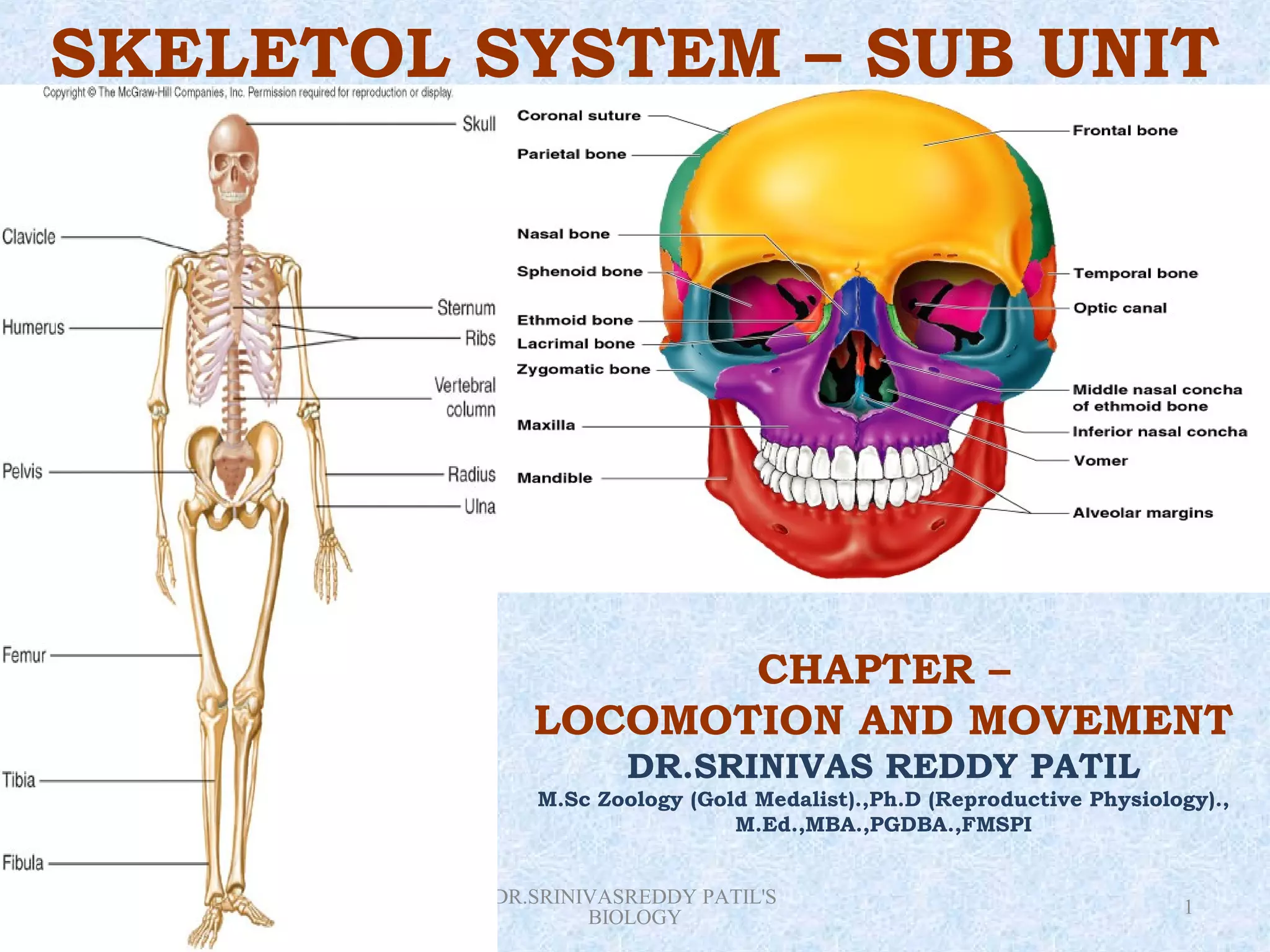
SKELETOL SYSTEM – SUB UNIT


                                       CHAPTER –
                                LOCOMOTION AND MOVEMENT
                                        DR.SRINIVAS REDDY PATIL
                                M.Sc Zoology (Gold Medalist).,Ph.D (Reproductive Physiology).,
                                                 M.Ed.,MBA.,PGDBA.,FMSPI


Saturday, February 9, 2013   DR.SRINIVASREDDY PATIL'S                                    1
                                     BIOLOGY
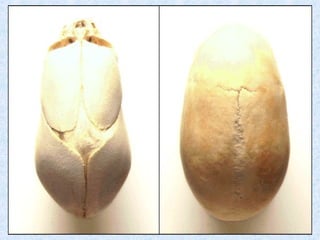
Fig. 6.10
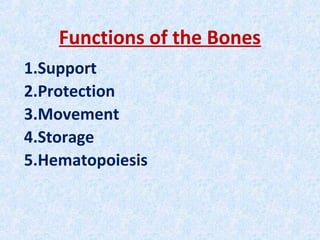
Functions of the Bones
1.Support
2.Protection
3.Movement
4.Storage
5.Hematopoiesis
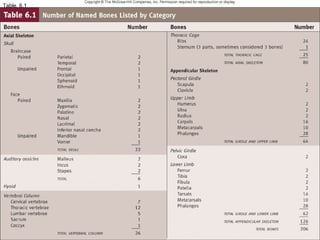
Table. 6.1
AXIAL SKELETON
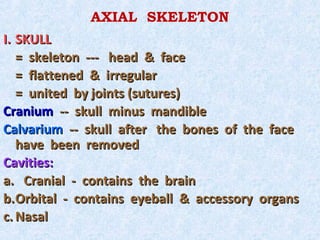
I. SKULL
   = skeleton --- head & face
   = flattened & irregular
   = united by joints (sutures)
Cranium -- skull minus mandible
Calvarium -- skull after the bones of the face
   have been removed
Cavities:
a. Cranial - contains the brain
b. Orbital - contains eyeball & accessory organs
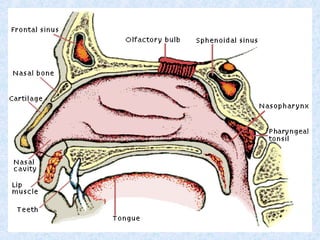
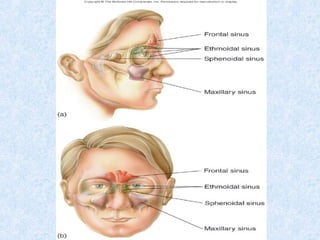
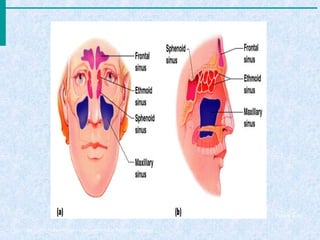
c. Nasal
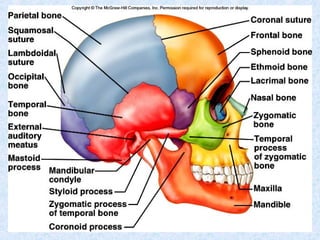
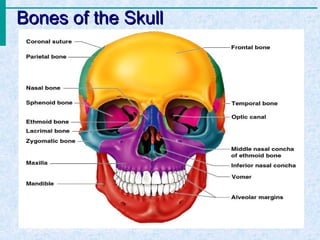
Bones of the Skull


                                                                           Figure 5.11

Copyright © 2003 Pearson Education, Inc. publishing as Benjamin Cummings
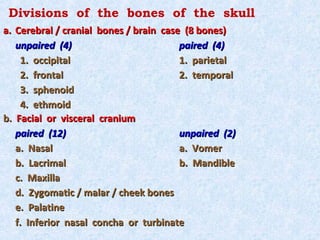
Divisions of the bones of the skull
a. Cerebral / cranial bones / brain case (8 bones)
   unpaired (4)                         paired (4)
     1. occipital                       1. parietal
     2. frontal                         2. temporal
     3. sphenoid
     4. ethmoid
b. Facial or visceral cranium
   paired (12)                          unpaired (2)
   a. Nasal                             a. Vomer
   b. Lacrimal                          b. Mandible
   c. Maxilla
   d. Zygomatic / malar / cheek bones
   e. Palatine
   f. Inferior nasal concha or turbinate
Fig. 6.13
Figure 5.10

Copyright © 2003 Pearson Education, Inc. publishing as Benjamin Cummings
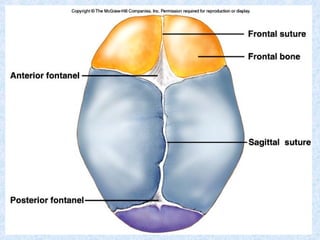
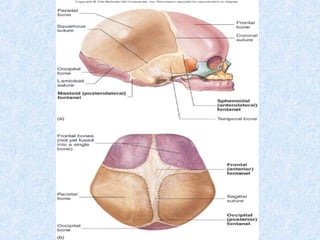
Fontanelle
=   membrane filled spaces found in the
    skull of newborn infants

    ex. 1. anterior = largest
        2. posterior
        3. anterolateral (sphenoidal)
        4. posterolateral (mastoid)
Allows for
growth
Fig. 6.37
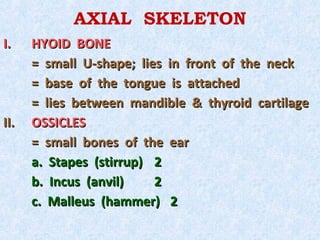
AXIAL SKELETON
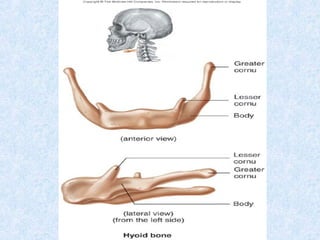
I.    HYOID BONE
      = small U-shape; lies in front of the neck
      = base of the tongue is attached
      = lies between mandible & thyroid cartilage
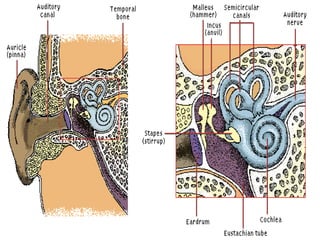
II.   OSSICLES
      = small bones of the ear
      a. Stapes (stirrup) 2
      b. Incus (anvil)    2
      c. Malleus (hammer) 2
Fig. 6.16
AXIAL SKELETON
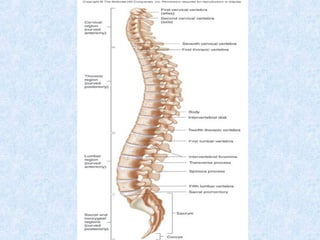
I.   VERTEBRAL COLUMN
     = long, curved, slightly movable pillar
     = united together by cartilage & ligaments
     = 71 – 75 cm. long
     = formed by series of bones -- vertebrae

FUNCTION:
1. support of the trunk
2. contains & protects the spinal cord & nerves
VERTEBRAL COLUMN
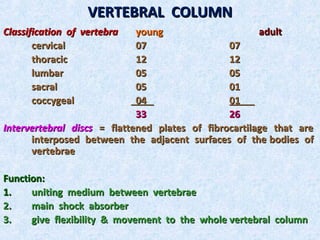
Classification of vertebra   young                     adult
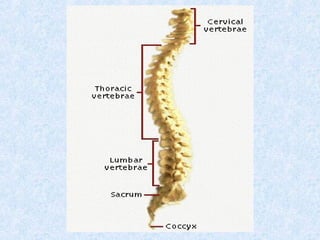
       cervical              07                 07
       thoracic              12                 12
       lumbar                05                 05
       sacral                05                 01
       coccygeal             04                 01
                             33                 26
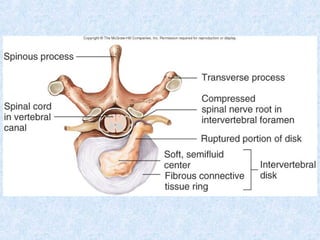
Intervertebral discs = flattened plates of fibrocartilage that are
      interposed between the adjacent surfaces of the bodies of
      vertebrae

Function:
1.    uniting medium between vertebrae
2.    main shock absorber
3.    give flexibility & movement to the whole vertebral column
VERTEBRAL COLUMN
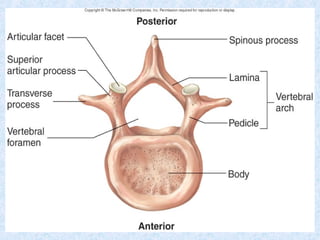
General parts of vertebrae
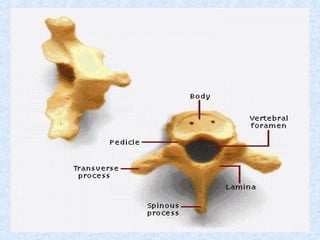
1. body
2. arch
3. pedicle or root
4. lamina
5. transverse process
6. articular process
7. spinous process
8. spinal or vertebral foramen
Special characteristics of individual vertebrae

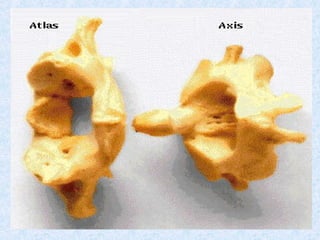
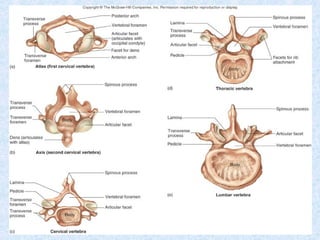
 a. Cervical vertebrae (7) = forms the
    skeleton of the neck, all have transverse
    foramen atypical cervical vertebrae:
    1. atlas -- 1st
    2. axis or epistropheus = 2nd
    3. 7th cervical vertebrae = spinous process
     not bifid, small transverse foramen

  b. Thoracic vertebrae (12) = costal pits -
    rib attachment = circular vertebral canal
c. Lumbar vertebrae (5) = presence of
   mamillary   &           accessory
   processes = triangular vertebral
   foramen

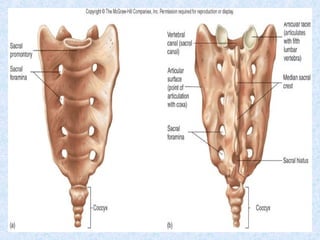
d. Sacrum = inverted triangular bone
  situated between hip bones

e. Coccygeal vertebrae (1) = 4 small
  incomplete vertebrae fused to form
  the coccyx / tail bone; triangular
Fig. 6.17
Fig. 6.18
Fig. 6.20
AXIAL SKELETON
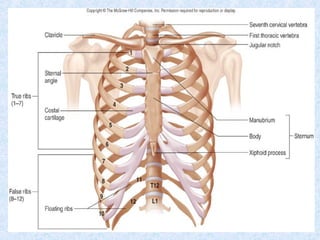
I. STERNUM (breast bone)
=   flat bone, found -- anterior thoracic
   wall
= composed of 2 plates of compact bone
   with a layer of spongy bone in
   between containing red bone marrow.
PARTS:
   a. Manubrium
   b. Corpus or body
   c. Xiphoid process
AXIAL SKELETON
I.    RIBS (12 pairs) = narrow arched flat bones with 2
      ends.
      1. vertebral - posterior; attaches with thoracic
      2. sternal - anterior; attaches with costal cartilages
Classification of ribs:
a.    Sternal or true ribs (1st to 7th) - ribs whose costal
      cartilages are directly attached to sternum
b. Asternal or false ribs (8th to 12th) - ribs whose costal
      cartilages are not attached directly to the sternum
      but to 7th
subdivisions: 1. false rib proper - 8th, 9th, 10th ribs
               2. floating or hanging ribs – 11th & 12th
Fig. 6.21
APPENDICULAR SKELETON
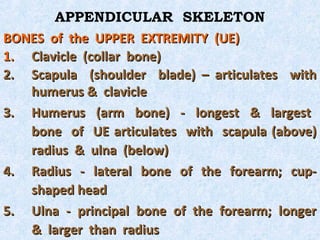
BONES of the UPPER EXTREMITY (UE)
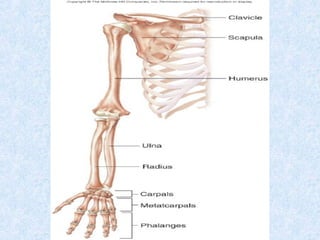
1. Clavicle (collar bone)
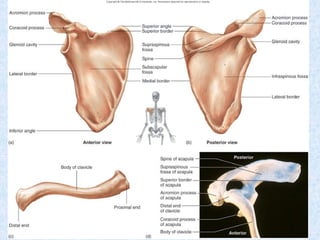
2. Scapula (shoulder blade) – articulates with
   humerus & clavicle
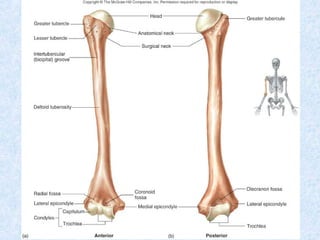
3. Humerus (arm bone) - longest & largest
   bone of UE articulates with scapula (above)
   radius & ulna (below)
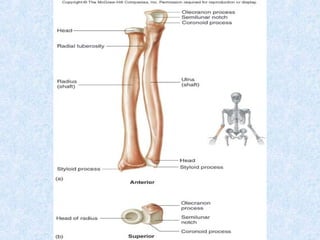
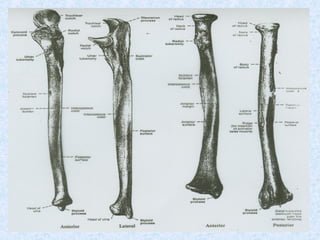
4. Radius - lateral bone of the forearm; cup-
   shaped head
5. Ulna - principal bone of the forearm; longer
   & larger than radius
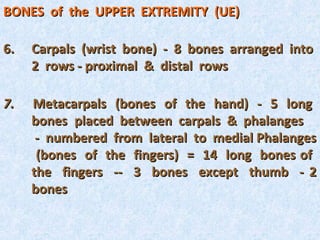
BONES of the UPPER EXTREMITY (UE)

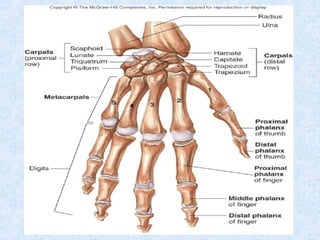
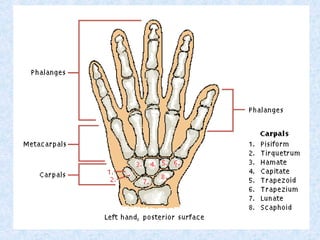
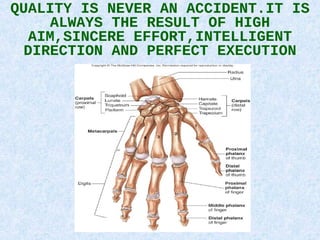
6.   Carpals (wrist bone) - 8 bones arranged into
     2 rows - proximal & distal rows

7.   Metacarpals (bones of the hand) - 5 long
     bones placed between carpals & phalanges
      - numbered from lateral to medial Phalanges
      (bones of the fingers) = 14 long bones of
     the fingers -- 3 bones except thumb - 2
     bones
Fig. 6.26
Fig. 6.22
Fig. 6.27
APPENDICULAR SKELETON
BONES of the LOWER EXTREMITY (LE)
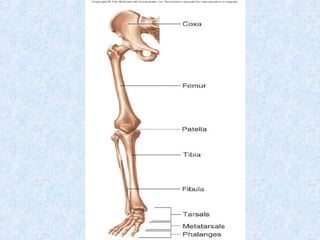
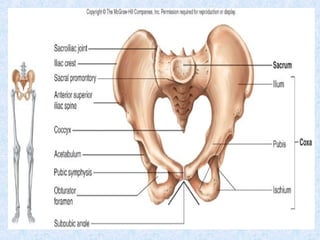
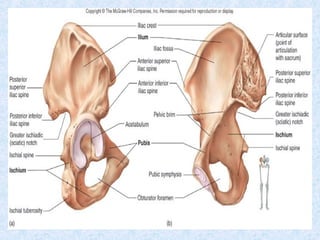
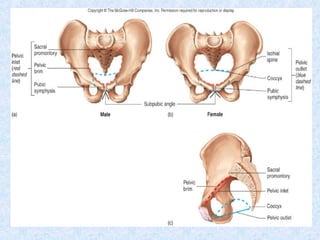
1. Hip bone (innominate bone)

        right & left hip bones + sacrum = pelvic girdle
            3 bones: 1. ilium*
                   2. ischium*       *Converge on acetabulum  a
                                     concave fossa -- articulates with
                   3. pubis*         head of femur  form hip joint
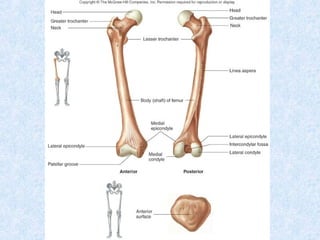
2. Femur (thigh) = longest, strongest, largest bone in        the
        body
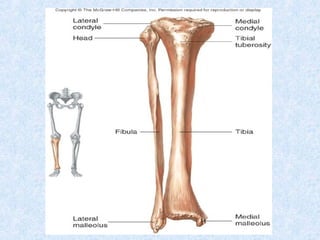
3. Tibia (shin bone) = long bone; anterior, medial,
              & larger of the 2 bones of the leg
4. Fibula (peroneal bone) = long slender bone placed
              parallel with the tibia but located laterally
Fig. 6.29
Fig. 6.30
Fig. 6.31
Fig. 6.32
Fig. 6.33
Fig. 6.34
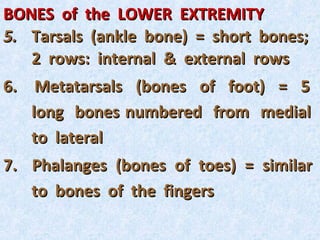
BONES of the LOWER EXTREMITY
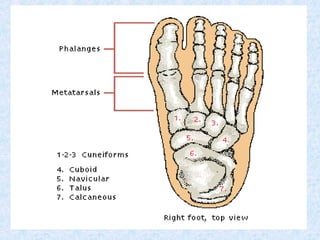
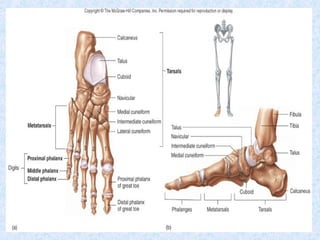
5. Tarsals (ankle bone) = short bones;
   2 rows: internal & external rows
6. Metatarsals (bones of foot) = 5
   long bones numbered from medial
   to lateral
7. Phalanges (bones of toes) = similar
   to bones of the fingers
Fig. 6.35
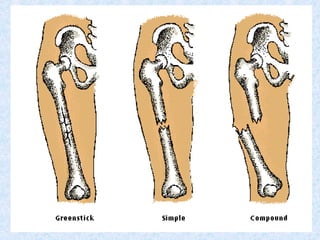
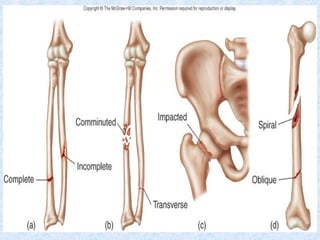
Common Fractures
greenstick fracture = the bone does not
break all of the way through.

simple, or closed     =   when the   bone
breaks but the skin does not.

compound, or open = when the broken
bone tears through the skin, introducing
the dangerous possibility of infection.

The area around a break swells and
discolors, but some fractures can be
detected only by X-ray.

The weakened bones of the elderly are
Fig. 6B
Fig. 6C
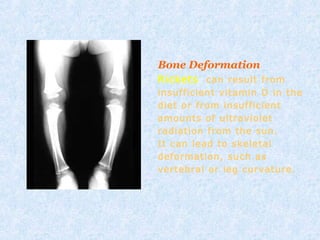
Bone Deformation
Rickets can result from
insufficient vitamin D in the
diet or from insufficient
amounts of ultraviolet
radiation from the sun.
It can lead to skeletal
deformation, such as
vertebral or leg curvature.
JOINTS
JOINTS
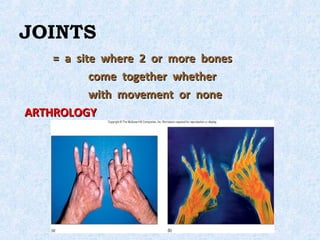
    = a site where 2 or more bones
           come together whether
           with movement or none
ARTHROLOGY
JOINTS
CLASSIFICATION:


1. Fibrous joints
      = articulating bone surfaces
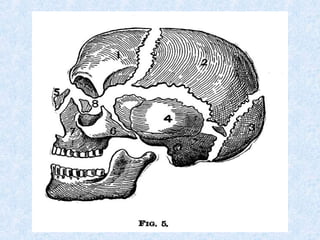
      = sutures of skull, inferior tibiofibular joints
      = very little movement possible
JOINT
CLASSIFICATION:      cont’n.
2. Cartilagenous joints
       2 types:
      a. Primary - united by a plate or bar of
              hyaline cartilage
      b. Secondary - united by a plate of
              fibrocartilage
              = articular surfaces of bones --
                 covered by a thin layer of hyaline
      cartilage
              = small amount of movement
JOINT
CLASSIFICATION:   cont’n.


1.   Synovial joints
     = articular surfaces of bones covered by
     thin layer of hyaline cartilage
     separated by a joint cavity
       = permits great degree of movement
JOINT
CLASSIFICATION ACCORDING to DEGREE of
      MOVEMENT

I.   Synarthroses
     = immovable joints
     = articulating surface is in direct contact

     = uniting medium: fibrous tissue
                  hyaline cartilage
                  fibrocartilage
JOINT
Synarthroses
 a. Sutures - bones of the skull
 b. Schindylosis - bony plate inserted into a
        cleft or fissure
      e.g.: vomer into maxilla, palatine bones
 c. Gomphosis - a conical process received into
      corresponding socket
      e.g.: root of teeth into alveolus of maxilla or mandible
 d. Synchondrosis - a cartilagenous medium which later
      may ossify
      e.g.: between epiphysis & diaphysis of long bone
JOINT
CLASSIFICATION ACCORDING to DEGREE of
      MOVEMENT (cont’n)
I.   Amphiarthroses
     = slightly movable joints
     = articulating surfaces connected by a wide
         disc of fibrocartilage
     a. Symphysis - uniting medium: fibrocartilage
                  e.g.: symphysis pubis
     b. Syndesmosis - large amount of fibrous connective
           tissue  wide membrane
                  e.g.: interosseous membrane
                       between radius & ulna
JOINT
CLASSIFICATION ACCORDING to DEGREE of
      MOVEMENT (cont’n)

I.      Diarthroses
        = freely movable joints
     Types:
        a. Articular surfaces covered by hyaline cartilage
           e.g.: sternoclavicular, acromioclavicular joints

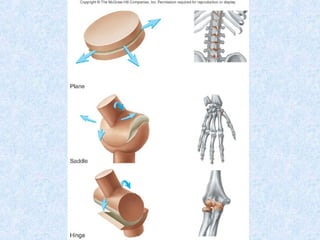
        b. Hinge joints (ginglymus)
            = flexion & extension movements possible
            e.g.: elbow, knee, ankle
Diarthroses
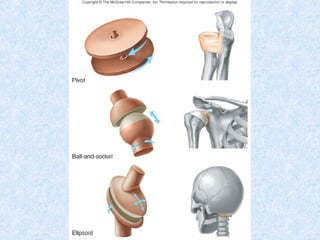
      c. Pivot joints (trochoid)
        = central body pivot surrounded by a bony
                ligamentous ring
        = possible movement is rotation only
          e.g.: atlantoaxial & superior radioulnar joints

      d. Condyloid
         = have 2 distinct convex surfaces that articulate
                with 2 concave surfaces
        = flexion, extension, adduction, abduction possible
         = small amount of rotation
          e.g.: metacarpophalangeal
                 metatarsophalangeal joints
Diarthroses
      e. Ellipsoid
        = elliptical convex articular surface that fit into an
                elliptical concave articular surface
        = F, E, add., abd. possible
        = rotation impossible
          e.g.: wrist joint

      f. Saddle joints
         = articular surfaces are reciprocally concavoconvex,
                 resembling saddle on a horse’s back
        = F, E, add., abd., rotation possible
           e.g.: carpometacarpal joint of thumb
Diarthroses

      g. Ball & socket joints
       = ball – shaped head of one bone fits into a
               socket – like concavity of another
       = free movements possible: F, E, add., abd., medial
               rotation, lateral rotation, circumduction
         e.g.: acetabulum of hip bone with head of thigh
               bone
Fig. 6.39a
Fig. 6.39b
POSSIBLE MOVEMENTS of JOINTS
1. Gliding - simple slipping or rubbing of the apposed
         flat surfaces
             - no angular or rotary movement
             e.g.: in between vertebral bodies
2. Angular - generally found in long bones
         a. Flexion - movement that forms an acute
             angulation between 2 approximating joints
             = angle is decreased
        b. Extension - movement that form an obtuse
             angulation between 2 parts
             = angle is increased
POSSIBLE MOVEMENTS of JOINTS (cont’n)

1.   Angular (cont’n)
     c. Abduction - movement that carries extremity
             away from the median plane of the body
     d. Adduction - movement that carries extremity
            towards the median plane of the body
4.   Circumduction
     - circular motion
5.   Rotation
     - movement along a central axis without the
     bones        being displaced from such axis
     - directed medially or laterally
POSSIBLE MOVEMENTS of JOINTS (cont’n)
6. Peculiar movements & positions
      forearm & hand
              a. Supination
              b. Pronation

     foot
            a. Inversion
               - plantar surface of the foot directed
                    towards the median plane
            b. Eversion
               - plantar surface of the foot directed
                    away from the median plane
QUALITY IS NEVER AN ACCIDENT.IT IS
     ALWAYS THE RESULT OF HIGH
  AIM,SINCERE EFFORT,INTELLIGENT
  DIRECTION AND PERFECT EXECUTION

Skeletol system advanced

  • 1.
    SKELETOL SYSTEM –SUB UNIT CHAPTER – LOCOMOTION AND MOVEMENT DR.SRINIVAS REDDY PATIL M.Sc Zoology (Gold Medalist).,Ph.D (Reproductive Physiology)., M.Ed.,MBA.,PGDBA.,FMSPI Saturday, February 9, 2013 DR.SRINIVASREDDY PATIL'S 1 BIOLOGY
  • 2.
  • 4.
    Functions of theBones 1.Support 2.Protection 3.Movement 4.Storage 5.Hematopoiesis
  • 5.
  • 7.
    AXIAL SKELETON I. SKULL = skeleton --- head & face = flattened & irregular = united by joints (sutures) Cranium -- skull minus mandible Calvarium -- skull after the bones of the face have been removed Cavities: a. Cranial - contains the brain b. Orbital - contains eyeball & accessory organs c. Nasal
  • 9.
    Bones of theSkull Figure 5.11 Copyright © 2003 Pearson Education, Inc. publishing as Benjamin Cummings
  • 10.
    Divisions of thebones of the skull a. Cerebral / cranial bones / brain case (8 bones) unpaired (4) paired (4) 1. occipital 1. parietal 2. frontal 2. temporal 3. sphenoid 4. ethmoid b. Facial or visceral cranium paired (12) unpaired (2) a. Nasal a. Vomer b. Lacrimal b. Mandible c. Maxilla d. Zygomatic / malar / cheek bones e. Palatine f. Inferior nasal concha or turbinate
  • 12.
  • 13.
    Figure 5.10 Copyright ©2003 Pearson Education, Inc. publishing as Benjamin Cummings
  • 14.
    Fontanelle = membrane filled spaces found in the skull of newborn infants ex. 1. anterior = largest 2. posterior 3. anterolateral (sphenoidal) 4. posterolateral (mastoid)
  • 15.
  • 17.
  • 18.
    AXIAL SKELETON I. HYOID BONE = small U-shape; lies in front of the neck = base of the tongue is attached = lies between mandible & thyroid cartilage II. OSSICLES = small bones of the ear a. Stapes (stirrup) 2 b. Incus (anvil) 2 c. Malleus (hammer) 2
  • 19.
  • 21.
    AXIAL SKELETON I. VERTEBRAL COLUMN = long, curved, slightly movable pillar = united together by cartilage & ligaments = 71 – 75 cm. long = formed by series of bones -- vertebrae FUNCTION: 1. support of the trunk 2. contains & protects the spinal cord & nerves
  • 22.
    VERTEBRAL COLUMN Classification ofvertebra young adult cervical 07 07 thoracic 12 12 lumbar 05 05 sacral 05 01 coccygeal 04 01 33 26 Intervertebral discs = flattened plates of fibrocartilage that are interposed between the adjacent surfaces of the bodies of vertebrae Function: 1. uniting medium between vertebrae 2. main shock absorber 3. give flexibility & movement to the whole vertebral column
  • 23.
    VERTEBRAL COLUMN General partsof vertebrae 1. body 2. arch 3. pedicle or root 4. lamina 5. transverse process 6. articular process 7. spinous process 8. spinal or vertebral foramen
  • 24.
    Special characteristics ofindividual vertebrae a. Cervical vertebrae (7) = forms the skeleton of the neck, all have transverse foramen atypical cervical vertebrae: 1. atlas -- 1st 2. axis or epistropheus = 2nd 3. 7th cervical vertebrae = spinous process not bifid, small transverse foramen b. Thoracic vertebrae (12) = costal pits - rib attachment = circular vertebral canal
  • 25.
    c. Lumbar vertebrae(5) = presence of mamillary & accessory processes = triangular vertebral foramen d. Sacrum = inverted triangular bone situated between hip bones e. Coccygeal vertebrae (1) = 4 small incomplete vertebrae fused to form the coccyx / tail bone; triangular
  • 29.
  • 30.
  • 32.
  • 33.
    AXIAL SKELETON I. STERNUM(breast bone) = flat bone, found -- anterior thoracic wall = composed of 2 plates of compact bone with a layer of spongy bone in between containing red bone marrow. PARTS: a. Manubrium b. Corpus or body c. Xiphoid process
  • 34.
    AXIAL SKELETON I. RIBS (12 pairs) = narrow arched flat bones with 2 ends. 1. vertebral - posterior; attaches with thoracic 2. sternal - anterior; attaches with costal cartilages Classification of ribs: a. Sternal or true ribs (1st to 7th) - ribs whose costal cartilages are directly attached to sternum b. Asternal or false ribs (8th to 12th) - ribs whose costal cartilages are not attached directly to the sternum but to 7th subdivisions: 1. false rib proper - 8th, 9th, 10th ribs 2. floating or hanging ribs – 11th & 12th
  • 35.
  • 36.
    APPENDICULAR SKELETON BONES ofthe UPPER EXTREMITY (UE) 1. Clavicle (collar bone) 2. Scapula (shoulder blade) – articulates with humerus & clavicle 3. Humerus (arm bone) - longest & largest bone of UE articulates with scapula (above) radius & ulna (below) 4. Radius - lateral bone of the forearm; cup- shaped head 5. Ulna - principal bone of the forearm; longer & larger than radius
  • 37.
    BONES of theUPPER EXTREMITY (UE) 6. Carpals (wrist bone) - 8 bones arranged into 2 rows - proximal & distal rows 7. Metacarpals (bones of the hand) - 5 long bones placed between carpals & phalanges - numbered from lateral to medial Phalanges (bones of the fingers) = 14 long bones of the fingers -- 3 bones except thumb - 2 bones
  • 40.
  • 41.
  • 42.
  • 45.
    APPENDICULAR SKELETON BONES ofthe LOWER EXTREMITY (LE) 1. Hip bone (innominate bone) right & left hip bones + sacrum = pelvic girdle 3 bones: 1. ilium* 2. ischium* *Converge on acetabulum  a concave fossa -- articulates with 3. pubis* head of femur  form hip joint 2. Femur (thigh) = longest, strongest, largest bone in the body 3. Tibia (shin bone) = long bone; anterior, medial, & larger of the 2 bones of the leg 4. Fibula (peroneal bone) = long slender bone placed parallel with the tibia but located laterally
  • 46.
  • 47.
  • 48.
  • 49.
  • 50.
  • 51.
  • 52.
    BONES of theLOWER EXTREMITY 5. Tarsals (ankle bone) = short bones; 2 rows: internal & external rows 6. Metatarsals (bones of foot) = 5 long bones numbered from medial to lateral 7. Phalanges (bones of toes) = similar to bones of the fingers
  • 54.
  • 55.
    Common Fractures greenstick fracture= the bone does not break all of the way through. simple, or closed = when the bone breaks but the skin does not. compound, or open = when the broken bone tears through the skin, introducing the dangerous possibility of infection. The area around a break swells and discolors, but some fractures can be detected only by X-ray. The weakened bones of the elderly are
  • 57.
  • 58.
  • 59.
    Bone Deformation Rickets canresult from insufficient vitamin D in the diet or from insufficient amounts of ultraviolet radiation from the sun. It can lead to skeletal deformation, such as vertebral or leg curvature.
  • 60.
  • 61.
    JOINTS = a site where 2 or more bones come together whether with movement or none ARTHROLOGY
  • 62.
    JOINTS CLASSIFICATION: 1. Fibrous joints = articulating bone surfaces = sutures of skull, inferior tibiofibular joints = very little movement possible
  • 64.
    JOINT CLASSIFICATION: cont’n. 2. Cartilagenous joints 2 types: a. Primary - united by a plate or bar of hyaline cartilage b. Secondary - united by a plate of fibrocartilage = articular surfaces of bones -- covered by a thin layer of hyaline cartilage = small amount of movement
  • 65.
    JOINT CLASSIFICATION: cont’n. 1. Synovial joints = articular surfaces of bones covered by thin layer of hyaline cartilage separated by a joint cavity = permits great degree of movement
  • 66.
    JOINT CLASSIFICATION ACCORDING toDEGREE of MOVEMENT I. Synarthroses = immovable joints = articulating surface is in direct contact = uniting medium: fibrous tissue hyaline cartilage fibrocartilage
  • 67.
    JOINT Synarthroses a. Sutures- bones of the skull b. Schindylosis - bony plate inserted into a cleft or fissure e.g.: vomer into maxilla, palatine bones c. Gomphosis - a conical process received into corresponding socket e.g.: root of teeth into alveolus of maxilla or mandible d. Synchondrosis - a cartilagenous medium which later may ossify e.g.: between epiphysis & diaphysis of long bone
  • 68.
    JOINT CLASSIFICATION ACCORDING toDEGREE of MOVEMENT (cont’n) I. Amphiarthroses = slightly movable joints = articulating surfaces connected by a wide disc of fibrocartilage a. Symphysis - uniting medium: fibrocartilage e.g.: symphysis pubis b. Syndesmosis - large amount of fibrous connective tissue  wide membrane e.g.: interosseous membrane between radius & ulna
  • 69.
    JOINT CLASSIFICATION ACCORDING toDEGREE of MOVEMENT (cont’n) I. Diarthroses = freely movable joints Types: a. Articular surfaces covered by hyaline cartilage e.g.: sternoclavicular, acromioclavicular joints b. Hinge joints (ginglymus) = flexion & extension movements possible e.g.: elbow, knee, ankle
  • 70.
    Diarthroses c. Pivot joints (trochoid) = central body pivot surrounded by a bony ligamentous ring = possible movement is rotation only e.g.: atlantoaxial & superior radioulnar joints d. Condyloid = have 2 distinct convex surfaces that articulate with 2 concave surfaces = flexion, extension, adduction, abduction possible = small amount of rotation e.g.: metacarpophalangeal metatarsophalangeal joints
  • 71.
    Diarthroses e. Ellipsoid = elliptical convex articular surface that fit into an elliptical concave articular surface = F, E, add., abd. possible = rotation impossible e.g.: wrist joint f. Saddle joints = articular surfaces are reciprocally concavoconvex, resembling saddle on a horse’s back = F, E, add., abd., rotation possible e.g.: carpometacarpal joint of thumb
  • 72.
    Diarthroses g. Ball & socket joints = ball – shaped head of one bone fits into a socket – like concavity of another = free movements possible: F, E, add., abd., medial rotation, lateral rotation, circumduction e.g.: acetabulum of hip bone with head of thigh bone
  • 73.
  • 74.
  • 75.
    POSSIBLE MOVEMENTS ofJOINTS 1. Gliding - simple slipping or rubbing of the apposed flat surfaces - no angular or rotary movement e.g.: in between vertebral bodies 2. Angular - generally found in long bones a. Flexion - movement that forms an acute angulation between 2 approximating joints = angle is decreased b. Extension - movement that form an obtuse angulation between 2 parts = angle is increased
  • 76.
    POSSIBLE MOVEMENTS ofJOINTS (cont’n) 1. Angular (cont’n) c. Abduction - movement that carries extremity away from the median plane of the body d. Adduction - movement that carries extremity towards the median plane of the body 4. Circumduction - circular motion 5. Rotation - movement along a central axis without the bones being displaced from such axis - directed medially or laterally
  • 77.
    POSSIBLE MOVEMENTS ofJOINTS (cont’n) 6. Peculiar movements & positions forearm & hand a. Supination b. Pronation foot a. Inversion - plantar surface of the foot directed towards the median plane b. Eversion - plantar surface of the foot directed away from the median plane
  • 78.
    QUALITY IS NEVERAN ACCIDENT.IT IS ALWAYS THE RESULT OF HIGH AIM,SINCERE EFFORT,INTELLIGENT DIRECTION AND PERFECT EXECUTION