PowerPoint®
Lecture Slide Presentation
by Patty Bostwick-Taylor,
Florence-Darlington Technical College
Copyright © 2009 Pearson Education, Inc., publishing as Benjamin Cummings
PART A
5
The Skeletal
System
Copyright © 2009 Pearson Education, Inc., publishing as Benjamin Cummings *
●Overview of the Skeletal System
●Skeleton (Greek) = “dried up body”
●Two subdivisions of the skeleton
●Axial skeleton – longitudinal axis of body
●Appendicular skeleton – limbs & girdles
●Parts of the skeletal system:
●Bones (skeleton)
●Joints
●Cartilages
●Ligaments
Copyright © 2009 Pearson Education, Inc., publishing as Benjamin Cummings *
A.Functions of Bones
1.Support
a.Form internal framework: supports body & cradles soft
organs
2.Protection
a.Ex: skull bones fused to enclose the brain
b.Ex: vertebrae surround spinal cord
c.Ex: rib cage encloses thoracic organs
3.Movement
a.Skeletal muscles attached to bone via tendons, move
body and its parts
b.Results in full body locomotion, fine movements, internal
movements
Copyright © 2009 Pearson Education, Inc., publishing as Benjamin Cummings *
Functions of Bones, continued…
4.Storage
a.Fat (marrow) in medullary cavities
b.Bones store minerals: calcium & phosphorus
i.Ca2+
needed for nervous impulses, muscle
contraction, blood clotting
ii.Hormones control movement of calcium to and from
bones and blood
5.Blood cell formation
a.AKA hematopoesis
b.Within marrow/medullary cavities
Copyright © 2009 Pearson Education, Inc., publishing as Benjamin Cummings *
B.Classification of Bones
1.The adult skeleton has 206
bones
2.Two basic types of bone
tissue:
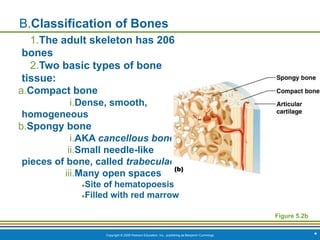
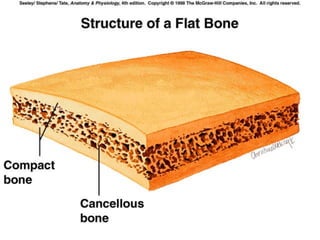
a.Compact bone
i.Dense, smooth,
homogeneous
b.Spongy bone
i.AKA cancellous bone
ii.Small needle-like
pieces of bone, called trabeculae
iii.Many open spaces
●Site of hematopoesis
●Filled with red marrow
Figure 5.2b
Copyright © 2009 Pearson Education, Inc., publishing as Benjamin Cummings *
Copyright © 2009 Pearson Education, Inc., publishing as Benjamin Cummings
Structure of Cancellous Bone
*
Copyright © 2009 Pearson Education, Inc., publishing as Benjamin Cummings
Structure of Compact Bone
*
Copyright © 2009 Pearson Education, Inc., publishing as Benjamin Cummings *
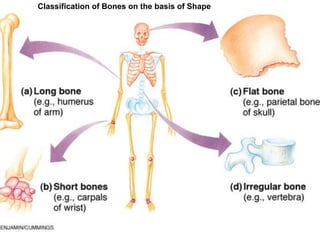
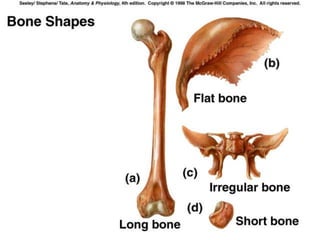
Figure 5.1
Classification of Bones on the basis of Shape
Copyright © 2009 Pearson Education, Inc., publishing as Benjamin Cummings *
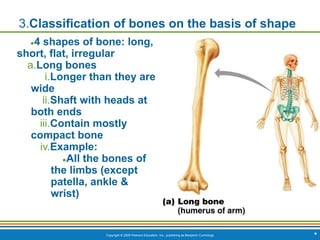
3.Classification of bones on the basis of shape
●4 shapes of bone: long,
short, flat, irregular
a.Long bones
i.Longer than they are
wide
ii.Shaft with heads at
both ends
iii.Contain mostly
compact bone
iv.Example:
●All the bones of
the limbs (except
patella, ankle &
wrist)
Copyright © 2009 Pearson Education, Inc., publishing as Benjamin Cummings *
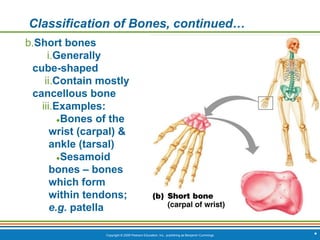
Classification of Bones, continued…
b.Short bones
i.Generally
cube-shaped
ii.Contain mostly
cancellous bone
iii.Examples:
●Bones of the
wrist (carpal) &
ankle (tarsal)
●Sesamoid
bones – bones
which form
within tendons;
e.g. patella
Copyright © 2009 Pearson Education, Inc., publishing as Benjamin Cummings *
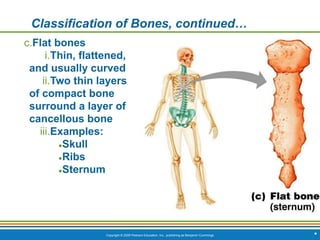
Classification of Bones, continued…
c.Flat bones
i.Thin, flattened,
and usually curved
ii.Two thin layers
of compact bone
surround a layer of
cancellous bone
iii.Examples:
●Skull
●Ribs
●Sternum
Copyright © 2009 Pearson Education, Inc., publishing as Benjamin Cummings *
Classification of Bones, continued…
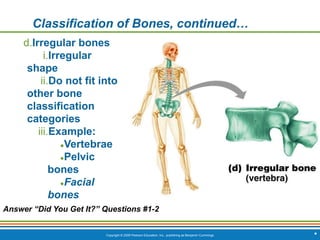
d.Irregular bones
i.Irregular
shape
ii.Do not fit into
other bone
classification
categories
iii.Example:
●Vertebrae
●Pelvic
bones
●Facial
bones
Answer “Did You Get It?” Questions #1-2
Copyright © 2009 Pearson Education, Inc., publishing as Benjamin Cummings *
Classification of Bones
Figure 5.1d
Copyright © 2009 Pearson Education, Inc., publishing as Benjamin Cummings *
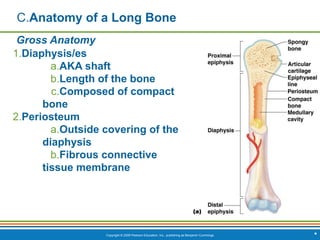
C.Anatomy of a Long Bone
Gross Anatomy
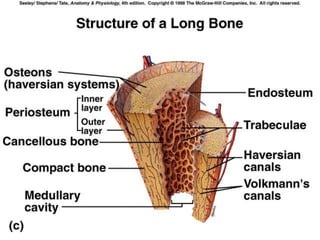
1.Diaphysis/es
a.AKA shaft
b.Length of the bone
c.Composed of compact
bone
2.Periosteum
a.Outside covering of the
diaphysis
b.Fibrous connective
tissue membrane
Copyright © 2009 Pearson Education, Inc., publishing as Benjamin Cummings *
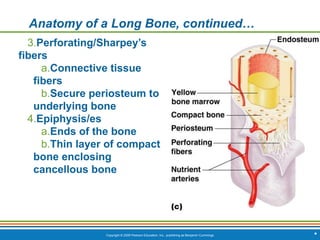
Anatomy of a Long Bone, continued…
3.Perforating/Sharpey’s
fibers
a.Connective tissue
fibers
b.Secure periosteum to
underlying bone
4.Epiphysis/es
a.Ends of the bone
b.Thin layer of compact
bone enclosing
cancellous bone
Copyright © 2009 Pearson Education, Inc., publishing as Benjamin Cummings *
Anatomy of a Long Bone, continued…
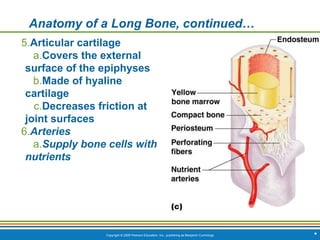
5.Articular cartilage
a.Covers the external
surface of the epiphyses
b.Made of hyaline
cartilage
c.Decreases friction at
joint surfaces
6.Arteries
a.Supply bone cells with
nutrients
Copyright © 2009 Pearson Education, Inc., publishing as Benjamin Cummings *
Anatomy of a Long Bone, continued…
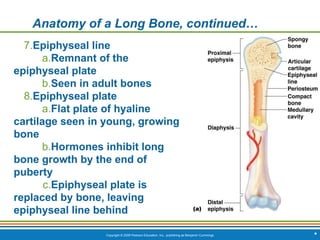
7.Epiphyseal line
a.Remnant of the
epiphyseal plate
b.Seen in adult bones
8.Epiphyseal plate
a.Flat plate of hyaline
cartilage seen in young, growing
bone
b.Hormones inhibit long
bone growth by the end of
puberty
c.Epiphyseal plate is
replaced by bone, leaving
epiphyseal line behind
Copyright © 2009 Pearson Education, Inc., publishing as Benjamin Cummings
*
Proximal End of a Long Bone
Copyright © 2009 Pearson Education, Inc., publishing as Benjamin Cummings
*
Epiphyseal Plate
Copyright © 2009 Pearson Education, Inc., publishing as Benjamin Cummings *
Anatomy of a Long Bone, continued…
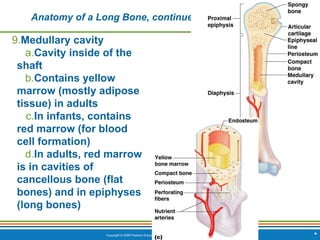
9.Medullary cavity
a.Cavity inside of the
shaft
b.Contains yellow
marrow (mostly adipose
tissue) in adults
c.In infants, contains
red marrow (for blood
cell formation)
d.In adults, red marrow
is in cavities of
cancellous bone (flat
bones) and in epiphyses
(long bones)
Copyright © 2009 Pearson Education, Inc., publishing as Benjamin Cummings *
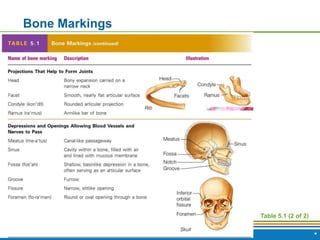
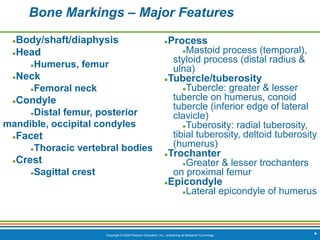
Bone Markings
1.Surface features of bones
a.Sites of attachments for muscles, tendons, and
ligaments
b.Passages for nerves and blood vessels
2.Categories of bone markings
a.Projections or processes—grow out from the bone
surface
i.All begin with T
b.Depressions or cavities—indentations
i.All begin with F (except facet)
Copyright © 2009 Pearson Education, Inc., publishing as Benjamin Cummings *
Bone Markings
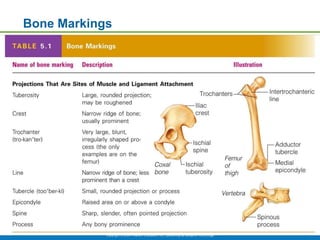
Table 5.1 (1 of 2)
Copyright © 2009 Pearson Education, Inc., publishing as Benjamin Cummings *
Bone Markings
Table 5.1 (2 of 2)
Copyright © 2009 Pearson Education, Inc., publishing as Benjamin Cummings *
Bone Markings – Major Features
●Body/shaft/diaphysis
●Head
●Humerus, femur
●Neck
●Femoral neck
●Condyle
●Distal femur, posterior
mandible, occipital condyles
●Facet
●Thoracic vertebral bodies
●Crest
●Sagittal crest
●Process
●Mastoid process (temporal),
styloid process (distal radius &
ulna)
●Tubercle/tuberosity
●Tubercle: greater & lesser
tubercle on humerus, conoid
tubercle (inferior edge of lateral
clavicle)
●Tuberosity: radial tuberosity,
tibial tuberosity, deltoid tuberosity
(humerus)
●Trochanter
●Greater & lesser trochanters
on proximal femur
●Epicondyle
●Lateral epicondyle of humerus
Copyright © 2009 Pearson Education, Inc., publishing as Benjamin Cummings *
Bone Markings – Major Features
●Foramen/foramina
●Mental foramen (lateral mandible)
●Canal/meatus
●Canal: carotid canal (base of skull)
●Meatus: external auditory meatus
●Fissure
●Superior orbital fissure, inferior orbital fissure
●Sinus
●Frontal sinus
●Fossa
●Olecranon fossa (posterior, distal humerus)
○Fovea capitus on femoral head (fovea smaller than
fossa)
Copyright © 2009 Pearson Education, Inc., publishing as Benjamin Cummings *
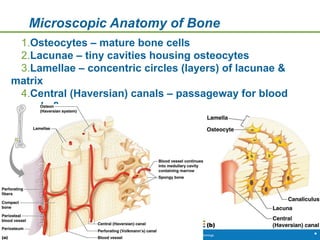
Microscopic Anatomy of Bone
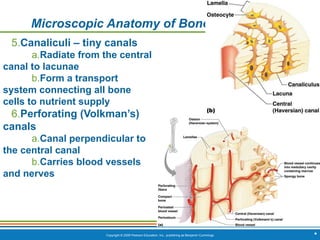
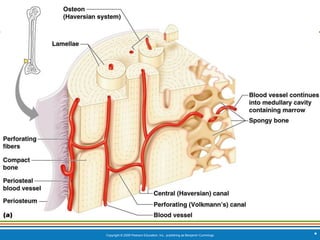
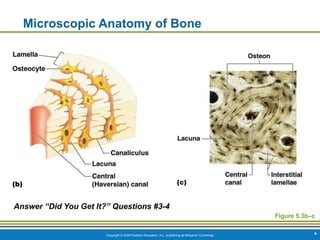
1.Osteocytes – mature bone cells
2.Lacunae – tiny cavities housing osteocytes
3.Lamellae – concentric circles (layers) of lacunae &
matrix
4.Central (Haversian) canals – passageway for blood
vessels & nerves
Copyright © 2009 Pearson Education, Inc., publishing as Benjamin Cummings *
Microscopic Anatomy of Bone
5.Canaliculi – tiny canals
a.Radiate from the central
canal to lacunae
b.Form a transport
system connecting all bone
cells to nutrient supply
6.Perforating (Volkman’s)
canals
a.Canal perpendicular to
the central canal
b.Carries blood vessels
and nerves
Copyright © 2009 Pearson Education, Inc., publishing as Benjamin Cummings *
Microscopic Anatomy of Bone
Copyright © 2009 Pearson Education, Inc., publishing as Benjamin Cummings *
Microscopic Anatomy of Bone
Figure 5.3b–c
Answer “Did You Get It?” Questions #3-4
Copyright © 2009 Pearson Education, Inc., publishing as Benjamin Cummings
Bone
starting
to replace
cartilage
Epiphys
eal
plate
cartilage
Articul
ar
cartila
ge
Spon
gy
bone
In a
child
In a
fetus
In an
embryo
New
bone
forming
Growt
h
in
bone
width
Growt
h
in
bone
lengt
h Epiphyseal
plate
cartilage
New
bone
forming
Blood
vesse
ls
Hyalin
e
cartila
ge
New center
of
bone
growth
Medulla
ry
cavity
Bone
collar
Hyalin
e
cartila
ge
model
(a
)
*
D.Bone Formation, Growth, and
Remodeling
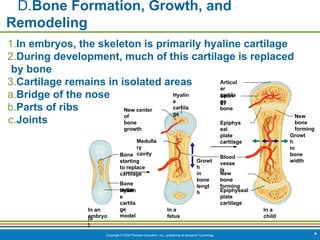
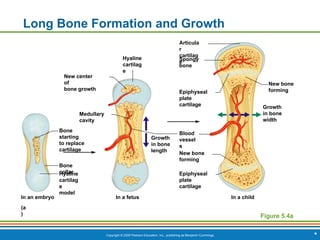
1.In embryos, the skeleton is primarily hyaline cartilage
2.During development, much of this cartilage is replaced
by bone
3.Cartilage remains in isolated areas
a.Bridge of the nose
b.Parts of ribs
c.Joints
Copyright © 2009 Pearson Education, Inc., publishing as Benjamin Cummings *
Bone Growth (Ossification)
●Ossification = process of bone formation
■Flat bones form on fibrous membranes
■Other bones develop from hyaline cartilage
models
4.Two phases:
a.Hyaline cartilage model covered with bone matrix
i.Done by osteoblasts = bone-forming cells
b.Hyaline cartilage model digested away, forming a
medullary cavity
i.Two locations remain as cartilage after
birth: articular cartilages (covering ends of bones) and
epiphyseal plates
Copyright © 2009 Pearson Education, Inc., publishing as Benjamin Cummings *
Long Bone Formation and Growth
Figure 5.4a
Bone
starting
to replace
cartilage
Epiphyseal
plate
cartilage
Articula
r
cartilag
e
Spongy
bone
In a child
In a fetus
In an embryo
New bone
forming
Growth
in bone
width
Growth
in bone
length
Epiphyseal
plate
cartilage
New bone
forming
Blood
vessel
s
Hyaline
cartilag
e
New center
of
bone growth
Medullary
cavity
Bone
collar
Hyaline
cartilag
e
model
(a
)
Copyright © 2009 Pearson Education, Inc., publishing as Benjamin Cummings *
Bone Growth (Ossification)
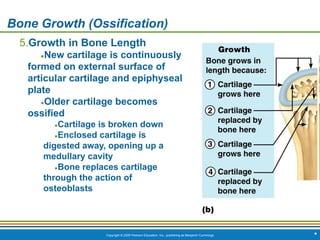
5.Growth in Bone Length
●New cartilage is continuously
formed on external surface of
articular cartilage and epiphyseal
plate
●Older cartilage becomes
ossified
●Cartilage is broken down
●Enclosed cartilage is
digested away, opening up a
medullary cavity
●Bone replaces cartilage
through the action of
osteoblasts
Copyright © 2009 Pearson Education, Inc., publishing as Benjamin Cummings *
Bone Growth (Ossification)
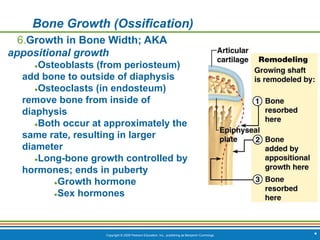
6.Growth in Bone Width; AKA
appositional growth
●Osteoblasts (from periosteum)
add bone to outside of diaphysis
●Osteoclasts (in endosteum)
remove bone from inside of
diaphysis
●Both occur at approximately the
same rate, resulting in larger
diameter
●Long-bone growth controlled by
hormones; ends in puberty
●Growth hormone
●Sex hormones
Copyright © 2009 Pearson Education, Inc., publishing as Benjamin Cummings *
Bone Growth (Ossification)
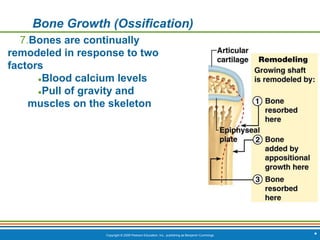
7.Bones are continually
remodeled in response to two
factors
●Blood calcium levels
●Pull of gravity and
muscles on the skeleton
Copyright © 2009 Pearson Education, Inc., publishing as Benjamin Cummings *
Types of Bone Cells
●Osteocytes — mature bone cells
●Osteoblasts — bone-forming cells
●Osteoclasts — bone-destroying cells
●Break down bone matrix for remodeling and release of
calcium in response to parathyroid hormone
●Bone remodeling is performed by both osteoblasts &
osteoclasts
Copyright © 2009 Pearson Education, Inc., publishing as Benjamin Cummings *
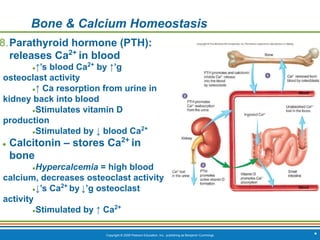
Bone & Calcium Homeostasis
8.Parathyroid hormone (PTH):
releases Ca2+
in blood
●↑’s blood Ca2+
by ↑’g
osteoclast activity
●↑ Ca resorption from urine in
kidney back into blood
●Stimulates vitamin D
production
●Stimulated by ↓ blood Ca2+
● Calcitonin – stores Ca2+
in
bone
●Hypercalcemia = high blood
calcium, decreases osteoclast activity
●↓’s Ca2+
by ↓’g osteoclast
activity
●Stimulated by ↑ Ca2+
Copyright © 2009 Pearson Education, Inc., publishing as Benjamin Cummings *
Bone Remodeling
9.Bone Remodeling = depositing new bone matrix in
a mature bone
a.In order to retain normal proportions &
strength during long-bone growth
b.In order to form projections where muscles
attach
c.Atrophy in bedridden or physically inactive
people
Copyright © 2009 Pearson Education, Inc., publishing as Benjamin Cummings *
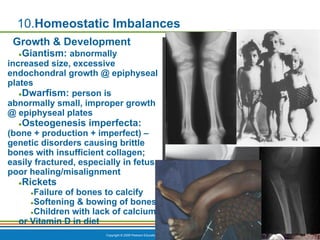
10.Homeostatic Imbalances
Growth & Development
●Giantism: abnormally
increased size, excessive
endochondral growth @ epiphyseal
plates
●Dwarfism: person is
abnormally small, improper growth
@ epiphyseal plates
●Osteogenesis imperfecta:
(bone + production + imperfect) –
genetic disorders causing brittle
bones with insufficient collagen;
easily fractured, especially in fetus;
poor healing/misalignment
●Rickets
●Failure of bones to calcify
●Softening & bowing of bones
●Children with lack of calcium
or Vitamin D in diet
Copyright © 2009 Pearson Education, Inc., publishing as Benjamin Cummings *
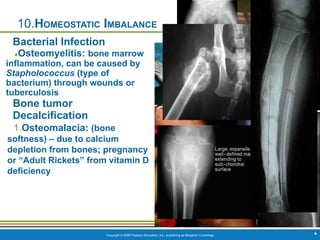
10.HOMEOSTATIC IMBALANCE
Bacterial Infection
●Osteomyelitis: bone marrow
inflammation, can be caused by
Stapholococcus (type of
bacterium) through wounds or
tuberculosis
Bone tumor
Decalcification
1.Osteomalacia: (bone
softness) – due to calcium
depletion from bones; pregnancy
or “Adult Rickets” from vitamin D
deficiency
Copyright © 2009 Pearson Education, Inc., publishing as Benjamin Cummings *
E.Bone Fractures – Homeostatic Imbalance
1.Fracture — break in a bone
2.Types of bone fractures
a.Closed (simple) fracture — break that does not
penetrate the skin
b.Open (compound) fracture — broken bone
penetrates through the skin
3.Bone fractures are treated by reduction and
immobilization: realignment of the broken bone
ends
a.Closed reduction: bones realigned via external
means
b.Open reduction: bones realigned via internal
surgery and secured with pins/wires/plates
Copyright © 2009 Pearson Education, Inc., publishing as Benjamin Cummings *
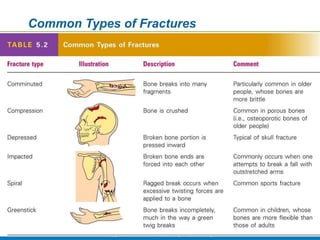
Common Types of Fractures
Table 5.2
Copyright © 2009 Pearson Education, Inc., publishing as Benjamin Cummings
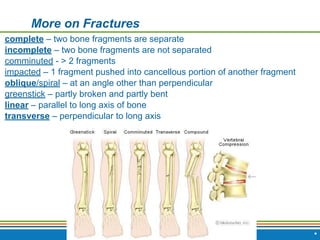
More on Fractures
complete – two bone fragments are separate
incomplete – two bone fragments are not separated
comminuted - > 2 fragments
impacted – 1 fragment pushed into cancellous portion of another fragment
oblique/spiral – at an angle other than perpendicular
greenstick – partly broken and partly bent
linear – parallel to long axis of bone
transverse – perpendicular to long axis
*
Copyright © 2009 Pearson Education, Inc., publishing as Benjamin Cummings
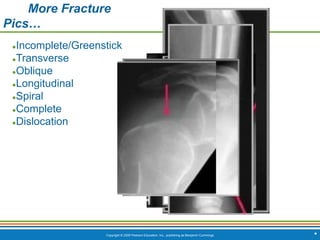
More Fracture
Pics…
●Incomplete/Greenstick
●Transverse
●Oblique
●Longitudinal
●Spiral
●Complete
●Dislocation
*
Copyright © 2009 Pearson Education, Inc., publishing as Benjamin Cummings
A Few More Notes on Fractures…
●Note: joint immobilization during mid-late bone healing
results in 3x decrease in strength
○Muscles lose mass (atrophy)
○Bone not subject to the stresses that helps it form
●Solution = walking cast
*
Copyright © 2009 Pearson Education, Inc., publishing as Benjamin Cummings *
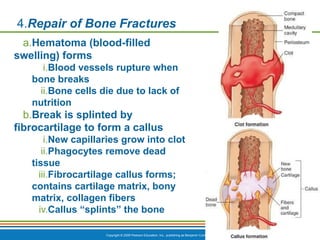
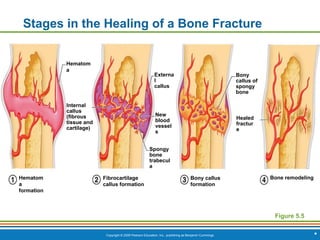
4.Repair of Bone Fractures
a.Hematoma (blood-filled
swelling) forms
i.Blood vessels rupture when
bone breaks
ii.Bone cells die due to lack of
nutrition
b.Break is splinted by
fibrocartilage to form a callus
i.New capillaries grow into clot
ii.Phagocytes remove dead
tissue
iii.Fibrocartilage callus forms;
contains cartilage matrix, bony
matrix, collagen fibers
iv.Callus “splints” the bone
Copyright © 2009 Pearson Education, Inc., publishing as Benjamin Cummings *
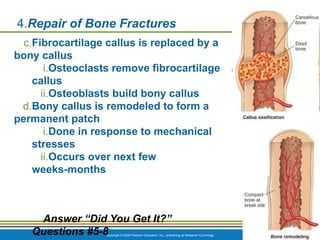
4.Repair of Bone Fractures
c.Fibrocartilage callus is replaced by a
bony callus
i.Osteoclasts remove fibrocartilage
callus
ii.Osteoblasts build bony callus
d.Bony callus is remodeled to form a
permanent patch
i.Done in response to mechanical
stresses
ii.Occurs over next few
weeks-months
Answer “Did You Get It?”
Questions #5-8
Copyright © 2009 Pearson Education, Inc., publishing as Benjamin Cummings *
Stages in the Healing of a Bone Fracture
Figure 5.5
Hematom
a
Externa
l
callus
Bony
callus of
spongy
bone
Healed
fractur
e
New
blood
vessel
s
Internal
callus
(fibrous
tissue and
cartilage)
Spongy
bone
trabecul
a
Hematom
a
formation
Fibrocartilage
callus formation
Bony callus
formation
Bone remodeling
Copyright © 2009 Pearson Education, Inc., publishing as Benjamin Cummings *
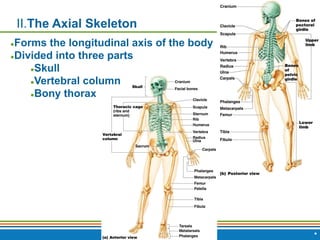
II.The Axial Skeleton
●Forms the longitudinal axis of the body
●Divided into three parts
●Skull
●Vertebral column
●Bony thorax
Copyright © 2009 Pearson Education, Inc., publishing as Benjamin Cummings
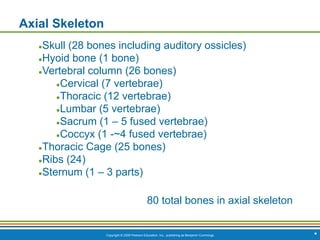
Axial Skeleton
●Skull (28 bones including auditory ossicles)
●Hyoid bone (1 bone)
●Vertebral column (26 bones)
●Cervical (7 vertebrae)
●Thoracic (12 vertebrae)
●Lumbar (5 vertebrae)
●Sacrum (1 – 5 fused vertebrae)
●Coccyx (1 -~4 fused vertebrae)
●Thoracic Cage (25 bones)
●Ribs (24)
●Sternum (1 – 3 parts)
80 total bones in axial skeleton
*
Copyright © 2009 Pearson Education, Inc., publishing as Benjamin Cummings *
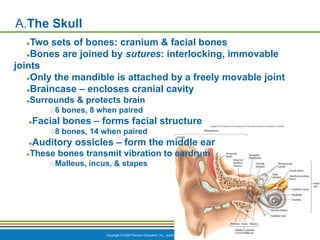
A.The Skull
●Two sets of bones: cranium & facial bones
●Bones are joined by sutures: interlocking, immovable
joints
●Only the mandible is attached by a freely movable joint
●Braincase – encloses cranial cavity
●Surrounds & protects brain
○6 bones, 8 when paired
●Facial bones – forms facial structure
○8 bones, 14 when paired
●Auditory ossicles – form the middle ear
●These bones transmit vibration to eardrum
○Malleus, incus, & stapes
Copyright © 2009 Pearson Education, Inc., publishing as Benjamin Cummings
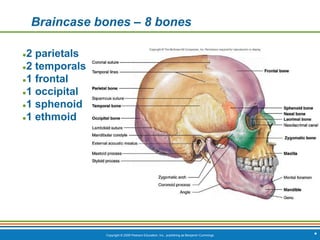
Braincase bones – 8 bones
●2 parietals
●2 temporals
●1 frontal
●1 occipital
●1 sphenoid
●1 ethmoid
*
Copyright © 2009 Pearson Education, Inc., publishing as Benjamin Cummings *
The Skull, continued…
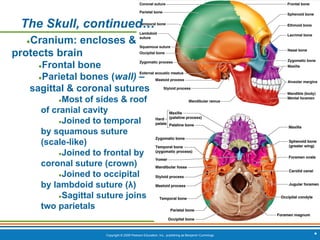
●Cranium: encloses &
protects brain
●Frontal bone
●Parietal bones (wall) –
sagittal & coronal sutures
●Most of sides & roof
of cranial cavity
●Joined to temporal
by squamous suture
(scale-like)
●Joined to frontal by
coronal suture (crown)
●Joined to occipital
by lambdoid suture (λ)
●Sagittal suture joins
two parietals
Copyright © 2009 Pearson Education, Inc., publishing as Benjamin Cummings *
The Skull, continued…
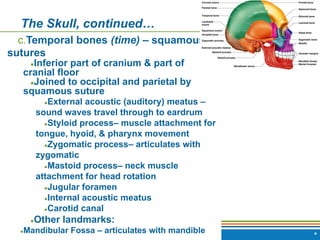
c.Temporal bones (time) – squamous
sutures
●Inferior part of cranium & part of
cranial floor
●Joined to occipital and parietal by
squamous suture
●External acoustic (auditory) meatus –
sound waves travel through to eardrum
●Styloid process– muscle attachment for
tongue, hyoid, & pharynx movement
●Zygomatic process– articulates with
zygomatic
●Mastoid process– neck muscle
attachment for head rotation
●Jugular foramen
●Internal acoustic meatus
●Carotid canal
●Other landmarks:
●Mandibular Fossa – articulates with mandible
Copyright © 2009 Pearson Education, Inc., publishing as Benjamin Cummings *
The Skull, continued…
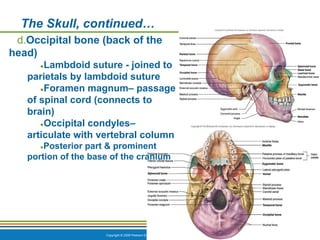
d.Occipital bone (back of the
head)
●Lambdoid suture - joined to
parietals by lambdoid suture
●Foramen magnum– passage
of spinal cord (connects to
brain)
●Occipital condyles–
articulate with vertebral column
●Posterior part & prominent
portion of the base of the cranium
Copyright © 2009 Pearson Education, Inc., publishing as Benjamin Cummings *
The Skull, continued…
e.Sphenoid bone (wedge-shaped)
●Sella turcica – contains pituitary
gland
●Foramen ovale
●Optic canal
●Superior orbital fissure
●Sphenoid sinuses
●Connects to all other cranial bones
Copyright © 2009 Pearson Education, Inc., publishing as Benjamin Cummings *
The Skull, continued…
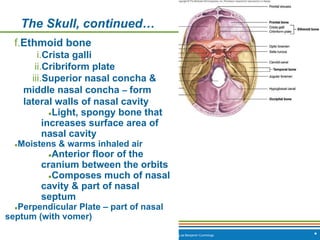
f.Ethmoid bone
i.Crista galli
ii.Cribriform plate
iii.Superior nasal concha &
middle nasal concha – form
lateral walls of nasal cavity
●Light, spongy bone that
increases surface area of
nasal cavity
●Moistens & warms inhaled air
●Anterior floor of the
cranium between the orbits
●Composes much of nasal
cavity & part of nasal
septum
●Perpendicular Plate – part of nasal
septum (with vomer)
Copyright © 2009 Pearson Education, Inc., publishing as Benjamin Cummings *
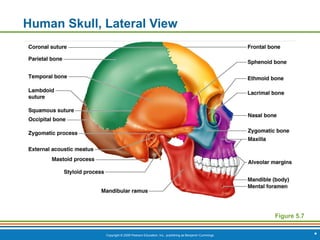
Human Skull, Lateral View
Figure 5.7
Copyright © 2009 Pearson Education, Inc., publishing as Benjamin Cummings *
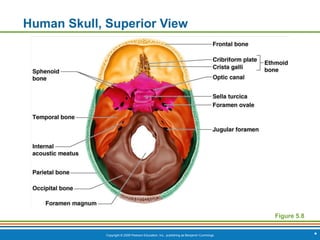
Human Skull, Superior View
Figure 5.8
Copyright © 2009 Pearson Education, Inc., publishing as Benjamin Cummings *
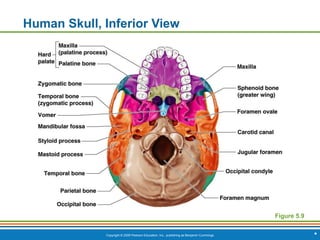
Human Skull, Inferior View
Figure 5.9
Copyright © 2009 Pearson Education, Inc., publishing as Benjamin Cummings *
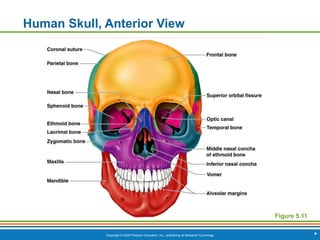
Human Skull, Anterior View
Figure 5.11
Copyright © 2009 Pearson Education, Inc., publishing as Benjamin Cummings *
The Skull, continued…
2.Facial bones: holds eyes & support facial muscles
a.Maxillae/maxilla
i.Maxillary bones
ii.Alveolar margin
iii.Palatine processes
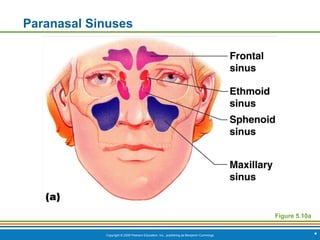
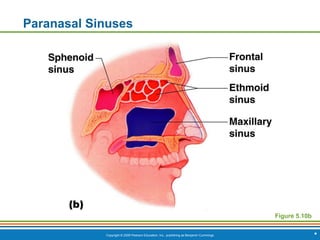
iv.Paranasal sinuses
●Hollow portions of bones surrounding the nasal cavity
●Functions of paranasal sinuses
●Lighten the skull
●Give resonance and amplification to voice
Copyright © 2009 Pearson Education, Inc., publishing as Benjamin Cummings *
Facial Bones, continued…
b.Palatine bones
c.Zygomatic bones
d.Lacrimal bones
e.Nasal bones
f.Vomer bone
g.Inferior nasal conchae
h.Mandible
i.Body
ii.Ramus/rami
iii.Alveoli
iv.Alveolar margin
Copyright © 2009 Pearson Education, Inc., publishing as Benjamin Cummings *
Paranasal Sinuses
Figure 5.10a
Copyright © 2009 Pearson Education, Inc., publishing as Benjamin Cummings *
Paranasal Sinuses
Figure 5.10b
Copyright © 2009 Pearson Education, Inc., publishing as Benjamin Cummings *
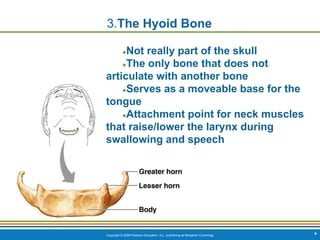
3.The Hyoid Bone
●Not really part of the skull
●The only bone that does not
articulate with another bone
●Serves as a moveable base for the
tongue
●Attachment point for neck muscles
that raise/lower the larynx during
swallowing and speech
Copyright © 2009 Pearson Education, Inc., publishing as Benjamin Cummings *
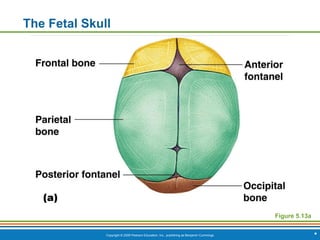
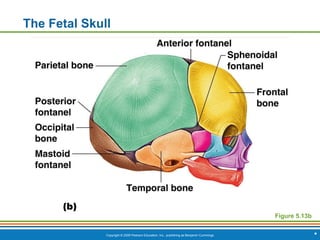
4.The Fetal Skull
●Infant’s face is very small compared to cranium
size
●Fetal skull is large compared to the infant’s total
body length
●Fontanels — fibrous membranes connecting the
cranial bones; AKA soft spots
●Allow skull to be compressed during child
birth
●Allow the brain to grow during latter
pregnancy and early infancy
●Convert to bone within 22-24 months after
birth
Copyright © 2009 Pearson Education, Inc., publishing as Benjamin Cummings *
The Fetal Skull
Figure 5.13a
Copyright © 2009 Pearson Education, Inc., publishing as Benjamin Cummings *
The Fetal Skull
Figure 5.13b
Copyright © 2009 Pearson Education, Inc., publishing as Benjamin Cummings *
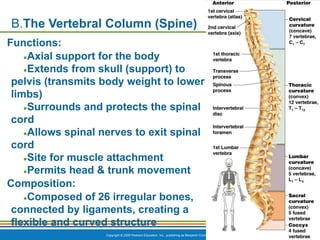
B.The Vertebral Column (Spine)
Functions:
●Axial support for the body
●Extends from skull (support) to
pelvis (transmits body weight to lower
limbs)
●Surrounds and protects the spinal
cord
●Allows spinal nerves to exit spinal
cord
●Site for muscle attachment
●Permits head & trunk movement
Composition:
●Composed of 26 irregular bones,
connected by ligaments, creating a
flexible and curved structure
Copyright © 2009 Pearson Education, Inc., publishing as Benjamin Cummings *
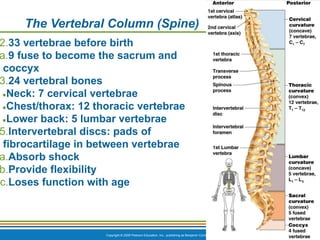
The Vertebral Column (Spine)
2.33 vertebrae before birth
a.9 fuse to become the sacrum and
coccyx
3.24 vertebral bones
●Neck: 7 cervical vertebrae
●Chest/thorax: 12 thoracic vertebrae
●Lower back: 5 lumbar vertebrae
5.Intervertebral discs: pads of
fibrocartilage in between vertebrae
a.Absorb shock
b.Provide flexibility
c.Loses function with age
Copyright © 2009 Pearson Education, Inc., publishing as Benjamin Cummings *
The Vertebral Column
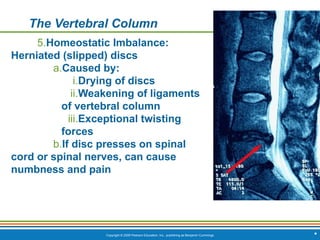
5.Homeostatic Imbalance:
Herniated (slipped) discs
a.Caused by:
i.Drying of discs
ii.Weakening of ligaments
of vertebral column
iii.Exceptional twisting
forces
b.If disc presses on spinal
cord or spinal nerves, can cause
numbness and pain
Copyright © 2009 Pearson Education, Inc., publishing as Benjamin Cummings
Vertebral Column Damage
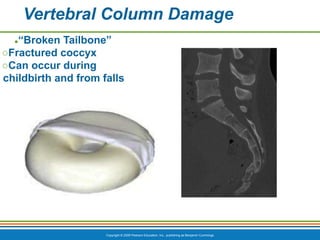
●“Broken Tailbone”
○Fractured coccyx
○Can occur during
childbirth and from falls
Copyright © 2009 Pearson Education, Inc., publishing as Benjamin Cummings *
The Vertebral Column
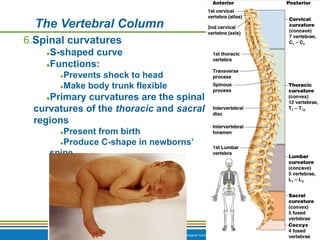
6.Spinal curvatures
●S-shaped curve
●Functions:
●Prevents shock to head
●Make body trunk flexible
●Primary curvatures are the spinal
curvatures of the thoracic and sacral
regions
●Present from birth
●Produce C-shape in newborns’
spine
Copyright © 2009 Pearson Education, Inc., publishing as Benjamin Cummings *
The Vertebral Column
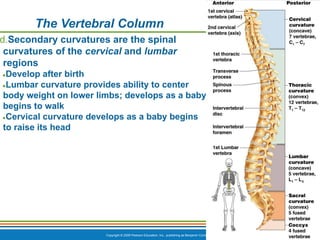
d.Secondary curvatures are the spinal
curvatures of the cervical and lumbar
regions
●Develop after birth
●Lumbar curvature provides ability to center
body weight on lower limbs; develops as a baby
begins to walk
●Cervical curvature develops as a baby begins
to raise its head
Copyright © 2009 Pearson Education, Inc., publishing as Benjamin Cummings *
The Vertebral Column
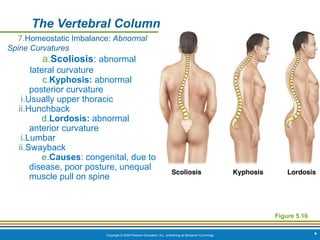
Figure 5.16
7.Homeostatic Imbalance: Abnormal
Spine Curvatures
a.Scoliosis: abnormal
lateral curvature
c.Kyphosis: abnormal
posterior curvature
i.Usually upper thoracic
ii.Hunchback
d.Lordosis: abnormal
anterior curvature
i.Lumbar
ii.Swayback
e.Causes: congenital, due to
disease, poor posture, unequal
muscle pull on spine
Copyright © 2009 Pearson Education, Inc., publishing as Benjamin Cummings
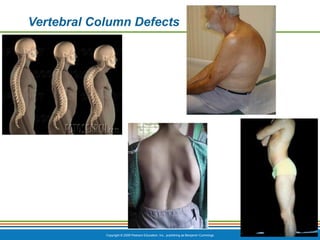
Vertebral Column Defects
Copyright © 2009 Pearson Education, Inc., publishing as Benjamin Cummings
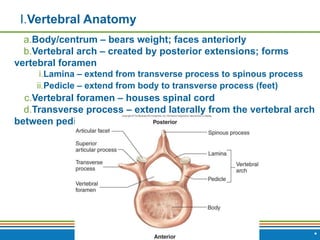
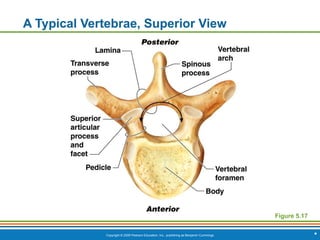
I.Vertebral Anatomy
a.Body/centrum – bears weight; faces anteriorly
b.Vertebral arch – created by posterior extensions; forms
vertebral foramen
i.Lamina – extend from transverse process to spinous process
ii.Pedicle – extend from body to transverse process (feet)
c.Vertebral foramen – houses spinal cord
d.Transverse process – extend laterally from the vertebral arch
between pedicle & lamina
*
Copyright © 2009 Pearson Education, Inc., publishing as Benjamin Cummings
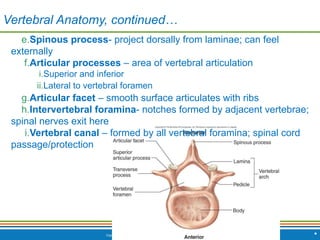
e.Spinous process- project dorsally from laminae; can feel
externally
f.Articular processes – area of vertebral articulation
i.Superior and inferior
ii.Lateral to vertebral foramen
g.Articular facet – smooth surface articulates with ribs
h.Intervertebral foramina- notches formed by adjacent vertebrae;
spinal nerves exit here
i.Vertebral canal – formed by all vertebral foramina; spinal cord
passage/protection
Vertebral Anatomy, continued…
*
Copyright © 2009 Pearson Education, Inc., publishing as Benjamin Cummings
Differences in Vertebrae
●Cervical (7: C1
-C7
)
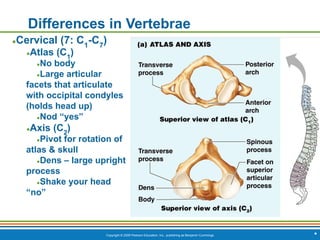
●Atlas (C1
)
●No body
●Large articular
facets that articulate
with occipital condyles
(holds head up)
●Nod “yes”
●Axis (C2
)
●Pivot for rotation of
atlas & skull
●Dens – large upright
process
●Shake your head
“no”
*
Copyright © 2009 Pearson Education, Inc., publishing as Benjamin Cummings
Differences in Vertebrae
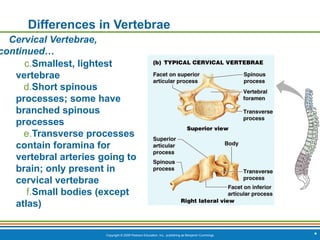
Cervical Vertebrae,
continued…
c.Smallest, lightest
vertebrae
d.Short spinous
processes; some have
branched spinous
processes
e.Transverse processes
contain foramina for
vertebral arteries going to
brain; only present in
cervical vertebrae
f.Small bodies (except
atlas)
*
Copyright © 2009 Pearson Education, Inc., publishing as Benjamin Cummings
Differences in Vertebrae
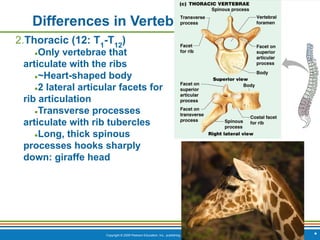
2.Thoracic (12: T1
-T12
)
●Only vertebrae that
articulate with the ribs
●~Heart-shaped body
●2 lateral articular facets for
rib articulation
●Transverse processes
articulate with rib tubercles
●Long, thick spinous
processes hooks sharply
down: giraffe head
*
Copyright © 2009 Pearson Education, Inc., publishing as Benjamin Cummings
Differences in Vertebrae
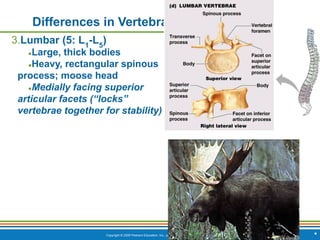
3.Lumbar (5: L1
-L5
)
●Large, thick bodies
●Heavy, rectangular spinous
process; moose head
●Medially facing superior
articular facets (“locks”
vertebrae together for stability)
*
Copyright © 2009 Pearson Education, Inc., publishing as Benjamin Cummings *
A Typical Vertebrae, Superior View
Figure 5.17
Copyright © 2009 Pearson Education, Inc., publishing as Benjamin Cummings *
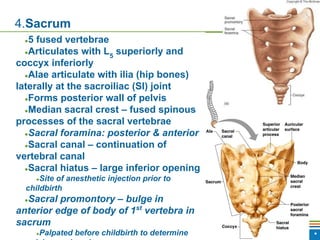
4.Sacrum
●5 fused vertebrae
●Articulates with L5
superiorly and
coccyx inferiorly
●Alae articulate with ilia (hip bones)
laterally at the sacroiliac (SI) joint
●Forms posterior wall of pelvis
●Median sacral crest – fused spinous
processes of the sacral vertebrae
●Sacral foramina: posterior & anterior
●Sacral canal – continuation of
vertebral canal
●Sacral hiatus – large inferior opening
●Site of anesthetic injection prior to
childbirth
●Sacral promontory – bulge in
anterior edge of body of 1st
vertebra in
sacrum
●Palpated before childbirth to determine
Copyright © 2009 Pearson Education, Inc., publishing as Benjamin Cummings *
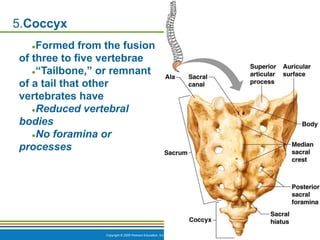
5.Coccyx
●Formed from the fusion
of three to five vertebrae
●“Tailbone,” or remnant
of a tail that other
vertebrates have
●Reduced vertebral
bodies
●No foramina or
processes
Copyright © 2009 Pearson Education, Inc., publishing as Benjamin Cummings *
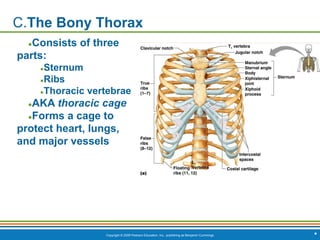
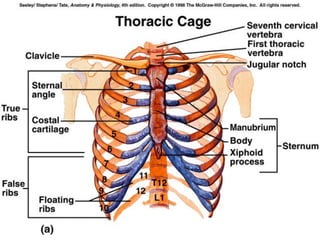
C.The Bony Thorax
●Consists of three
parts:
●Sternum
●Ribs
●Thoracic vertebrae
●AKA thoracic cage
●Forms a cage to
protect heart, lungs,
and major vessels
Copyright © 2009 Pearson Education, Inc., publishing as Benjamin Cummings *
The Bony Thorax, continued…
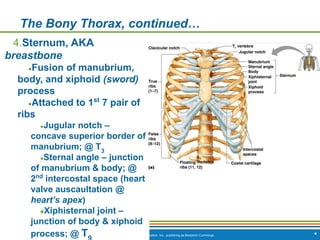
4.Sternum, AKA
breastbone
●Fusion of manubrium,
body, and xiphoid (sword)
process
●Attached to 1st
7 pair of
ribs
●Jugular notch –
concave superior border of
manubrium; @ T3
●Sternal angle – junction
of manubrium & body; @
2nd
intercostal space (heart
valve auscaultation @
heart’s apex)
●Xiphisternal joint –
junction of body & xiphoid
process; @ T
Copyright © 2009 Pearson Education, Inc., publishing as Benjamin Cummings *
The Bony Thorax,
continued…
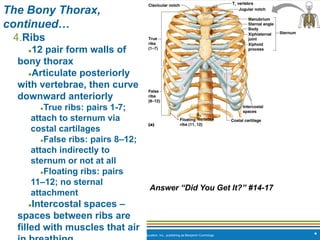
4.Ribs
●12 pair form walls of
bony thorax
●Articulate posteriorly
with vertebrae, then curve
downward anteriorly
●True ribs: pairs 1-7;
attach to sternum via
costal cartilages
●False ribs: pairs 8–12;
attach indirectly to
sternum or not at all
●Floating ribs: pairs
11–12; no sternal
attachment
●Intercostal spaces –
spaces between ribs are
filled with muscles that air
Answer “Did You Get It?” #14-17
Copyright © 2009 Pearson Education, Inc., publishing as Benjamin Cummings *
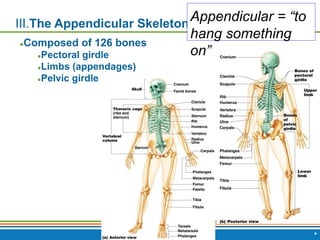
III.The Appendicular Skeleton
●Composed of 126 bones
●Pectoral girdle
●Limbs (appendages)
●Pelvic girdle
Appendicular = “to
hang something
on”
Copyright © 2009 Pearson Education, Inc., publishing as Benjamin Cummings *
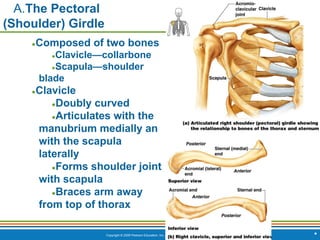
A.The Pectoral
(Shoulder) Girdle
●Composed of two bones
●Clavicle—collarbone
●Scapula—shoulder
blade
●Clavicle
●Doubly curved
●Articulates with the
manubrium medially an
with the scapula
laterally
●Forms shoulder joint
with scapula
●Braces arm away
from top of thorax
Copyright © 2009 Pearson Education, Inc., publishing as Benjamin Cummings
Pectoral Girdle
*
Copyright © 2009 Pearson Education, Inc., publishing as Benjamin Cummings *
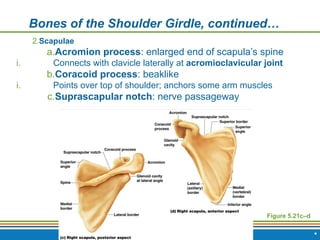
Bones of the Shoulder Girdle, continued…
Figure 5.21c–d
2.Scapulae
a.Acromion process: enlarged end of scapula’s spine
i. Connects with clavicle laterally at acromioclavicular joint
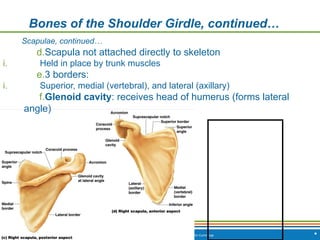
b.Coracoid process: beaklike
i. Points over top of shoulder; anchors some arm muscles
c.Suprascapular notch: nerve passageway
Copyright © 2009 Pearson Education, Inc., publishing as Benjamin Cummings *
Bones of the Shoulder Girdle, continued…
Scapulae, continued…
d.Scapula not attached directly to skeleton
i. Held in place by trunk muscles
e.3 borders:
i. Superior, medial (vertebral), and lateral (axillary)
f.Glenoid cavity: receives head of humerus (forms lateral
angle)
Copyright © 2009 Pearson Education, Inc., publishing as Benjamin Cummings *
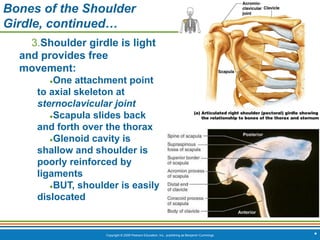
Bones of the Shoulder
Girdle, continued…
3.Shoulder girdle is light
and provides free
movement:
●One attachment point
to axial skeleton at
sternoclavicular joint
●Scapula slides back
and forth over the thorax
●Glenoid cavity is
shallow and shoulder is
poorly reinforced by
ligaments
●BUT, shoulder is easily
dislocated
Copyright © 2009 Pearson Education, Inc., publishing as Benjamin Cummings *
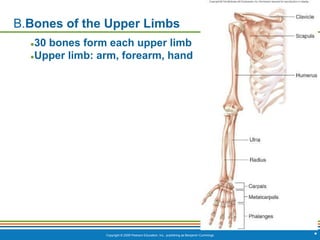
B.Bones of the Upper Limbs
●30 bones form each upper limb
●Upper limb: arm, forearm, hand
Copyright © 2009 Pearson Education, Inc., publishing as Benjamin Cummings *
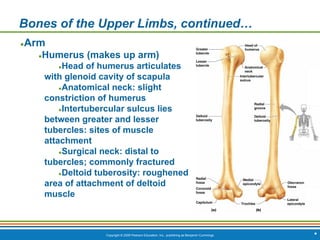
Bones of the Upper Limbs, continued…
●Arm
●Humerus (makes up arm)
●Head of humerus articulates
with glenoid cavity of scapula
●Anatomical neck: slight
constriction of humerus
●Intertubercular sulcus lies
between greater and lesser
tubercles: sites of muscle
attachment
●Surgical neck: distal to
tubercles; commonly fractured
●Deltoid tuberosity: roughened
area of attachment of deltoid
muscle
Copyright © 2009 Pearson Education, Inc., publishing as Benjamin Cummings *
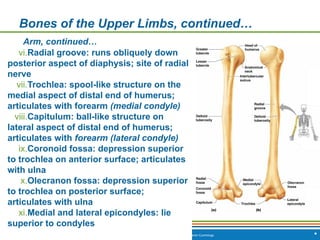
Bones of the Upper Limbs, continued…
Arm, continued…
vi.Radial groove: runs obliquely down
posterior aspect of diaphysis; site of radial
nerve
vii.Trochlea: spool-like structure on the
medial aspect of distal end of humerus;
articulates with forearm (medial condyle)
viii.Capitulum: ball-like structure on
lateral aspect of distal end of humerus;
articulates with forearm (lateral condyle)
ix.Coronoid fossa: depression superior
to trochlea on anterior surface; articulates
with ulna
x.Olecranon fossa: depression superior
to trochlea on posterior surface;
articulates with ulna
xi.Medial and lateral epicondyles: lie
superior to condyles
Copyright © 2009 Pearson Education, Inc., publishing as Benjamin Cummings *
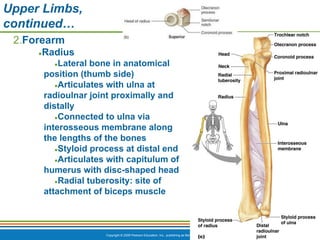
Upper Limbs,
continued…
2.Forearm
●Radius
●Lateral bone in anatomical
position (thumb side)
●Articulates with ulna at
radioulnar joint proximally and
distally
●Connected to ulna via
interosseous membrane along
the lengths of the bones
●Styloid process at distal end
●Articulates with capitulum of
humerus with disc-shaped head
●Radial tuberosity: site of
attachment of biceps muscle
Copyright © 2009 Pearson Education, Inc., publishing as Benjamin Cummings *
Bones of the Upper
Limbs, continued…
Forearm, continued…
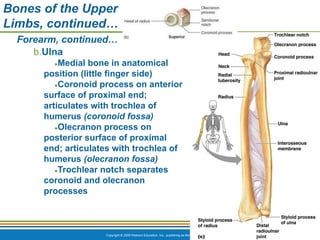
b.Ulna
●Medial bone in anatomical
position (little finger side)
●Coronoid process on anterior
surface of proximal end;
articulates with trochlea of
humerus (coronoid fossa)
●Olecranon process on
posterior surface of proximal
end; articulates with trochlea of
humerus (olecranon fossa)
●Trochlear notch separates
coronoid and olecranon
processes
Copyright © 2009 Pearson Education, Inc., publishing as Benjamin Cummings
*
Elbow Bone Landmarks
*
Copyright © 2009 Pearson Education, Inc., publishing as Benjamin Cummings *
Bones of the Upper Limbs, continued…
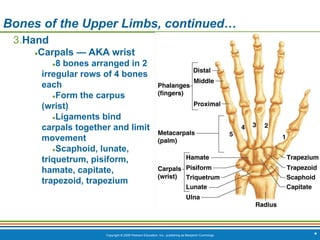
3.Hand
●Carpals — AKA wrist
●8 bones arranged in 2
irregular rows of 4 bones
each
●Form the carpus
(wrist)
●Ligaments bind
carpals together and limit
movement
●Scaphoid, lunate,
triquetrum, pisiform,
hamate, capitate,
trapezoid, trapezium
Copyright © 2009 Pearson Education, Inc., publishing as Benjamin Cummings *
Bones of the Upper
Limbs, continued…
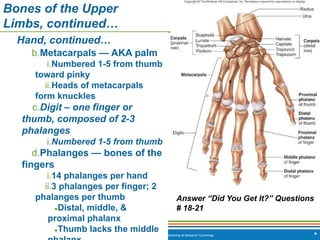
Hand, continued…
b.Metacarpals — AKA palm
i.Numbered 1-5 from thumb
toward pinky
ii.Heads of metacarpals
form knuckles
c.Digit – one finger or
thumb, composed of 2-3
phalanges
i.Numbered 1-5 from thumb
d.Phalanges — bones of the
fingers
i.14 phalanges per hand
ii.3 phalanges per finger; 2
phalanges per thumb
●Distal, middle, &
proximal phalanx
●Thumb lacks the middle
Answer “Did You Get It?” Questions
# 18-21
Copyright © 2009 Pearson Education, Inc., publishing as Benjamin Cummings *
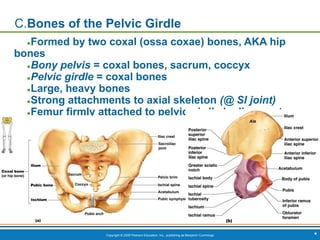
C.Bones of the Pelvic Girdle
●Formed by two coxal (ossa coxae) bones, AKA hip
bones
●Bony pelvis = coxal bones, sacrum, coccyx
●Pelvic girdle = coxal bones
●Large, heavy bones
●Strong attachments to axial skeleton (@ SI joint)
●Femur firmly attached to pelvic girdle by ligaments
Copyright © 2009 Pearson Education, Inc., publishing as Benjamin Cummings *
Bones of the Pelvic Girdle, continued…
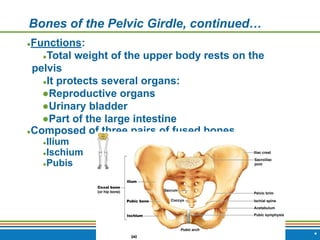
●Functions:
●Total weight of the upper body rests on the
pelvis
●It protects several organs:
●Reproductive organs
●Urinary bladder
●Part of the large intestine
●Composed of three pairs of fused bones
●Ilium
●Ischium
●Pubis
Copyright © 2009 Pearson Education, Inc., publishing as Benjamin Cummings *
Bones of the Pelvic Girdle, continued…
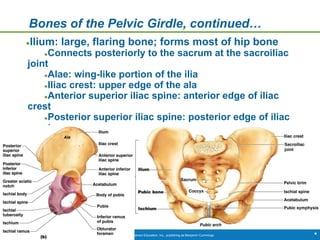
●Ilium: large, flaring bone; forms most of hip bone
●Connects posteriorly to the sacrum at the sacroiliac
joint
●Alae: wing-like portion of the ilia
●Iliac crest: upper edge of the ala
●Anterior superior iliac spine: anterior edge of iliac
crest
●Posterior superior iliac spine: posterior edge of iliac
crest
Copyright © 2009 Pearson Education, Inc., publishing as Benjamin Cummings *
Bones of the Pelvic Girdle, continued…
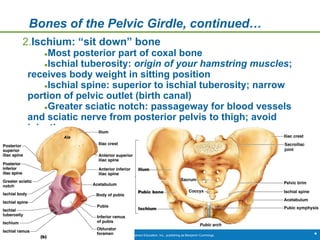
2.Ischium: “sit down” bone
●Most posterior part of coxal bone
●Ischial tuberosity: origin of your hamstring muscles;
receives body weight in sitting position
●Ischial spine: superior to ischial tuberosity; narrow
portion of pelvic outlet (birth canal)
●Greater sciatic notch: passageway for blood vessels
and sciatic nerve from posterior pelvis to thigh; avoid
injections
Copyright © 2009 Pearson Education, Inc., publishing as Benjamin Cummings *
Bones of the Pelvic Girdle, continued…
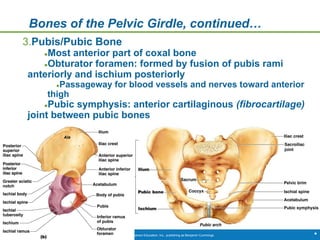
3.Pubis/Pubic Bone
●Most anterior part of coxal bone
●Obturator foramen: formed by fusion of pubis rami
anteriorly and ischium posteriorly
●Passageway for blood vessels and nerves toward anterior
thigh
●Pubic symphysis: anterior cartilaginous (fibrocartilage)
joint between pubic bones
Copyright © 2009 Pearson Education, Inc., publishing as Benjamin Cummings *
Bones of the Pelvic Girdle, continued…
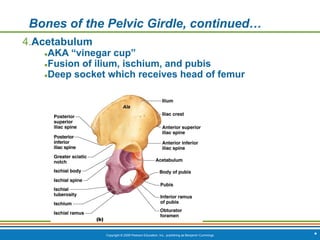
4.Acetabulum
●AKA “vinegar cup”
●Fusion of ilium, ischium, and pubis
●Deep socket which receives head of femur
Copyright © 2009 Pearson Education, Inc., publishing as Benjamin Cummings *
Bones of the Pelvic Girdle, continued…
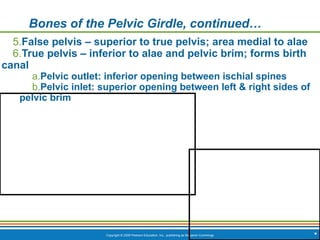
5.False pelvis – superior to true pelvis; area medial to alae
6.True pelvis – inferior to alae and pelvic brim; forms birth
canal
a.Pelvic outlet: inferior opening between ischial spines
b.Pelvic inlet: superior opening between left & right sides of
pelvic brim
Copyright © 2009 Pearson Education, Inc., publishing as Benjamin Cummings *
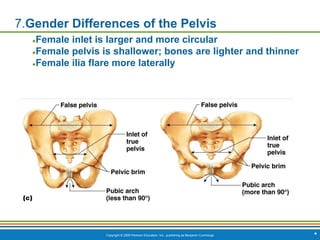
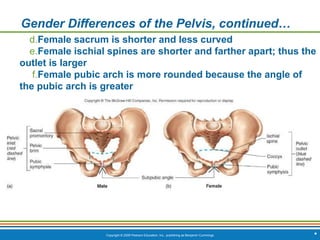
7.Gender Differences of the Pelvis
●Female inlet is larger and more circular
●Female pelvis is shallower; bones are lighter and thinner
●Female ilia flare more laterally
Copyright © 2009 Pearson Education, Inc., publishing as Benjamin Cummings *
Gender Differences of the Pelvis, continued…
d.Female sacrum is shorter and less curved
e.Female ischial spines are shorter and farther apart; thus the
outlet is larger
f.Female pubic arch is more rounded because the angle of
the pubic arch is greater
Copyright © 2009 Pearson Education, Inc., publishing as Benjamin Cummings *
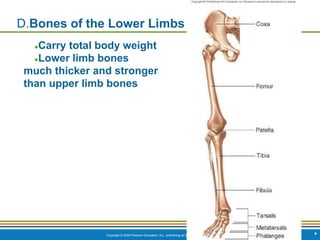
D.Bones of the Lower Limbs
●Carry total body weight
●Lower limb bones
much thicker and stronger
than upper limb bones
Copyright © 2009 Pearson Education, Inc., publishing as Benjamin Cummings *
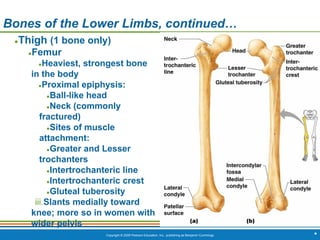
Bones of the Lower Limbs, continued…
●Thigh (1 bone only)
●Femur
●Heaviest, strongest bone
in the body
●Proximal epiphysis:
●Ball-like head
●Neck (commonly
fractured)
●Sites of muscle
attachment:
●Greater and Lesser
trochanters
●Intertrochanteric line
●Intertrochanteric crest
●Gluteal tuberosity
iii.Slants medially toward
knee; more so in women with
wider pelvis
Copyright © 2009 Pearson Education, Inc., publishing as Benjamin Cummings *
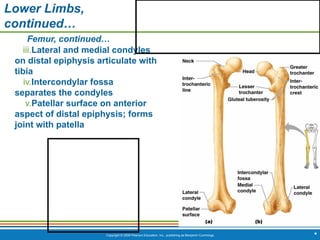
Lower Limbs,
continued…
Femur, continued…
iii.Lateral and medial condyles
on distal epiphysis articulate with
tibia
iv.Intercondylar fossa
separates the condyles
v.Patellar surface on anterior
aspect of distal epiphysis; forms
joint with patella
Copyright © 2009 Pearson Education, Inc., publishing as Benjamin Cummings *
Bones of the Lower Limbs, continued…
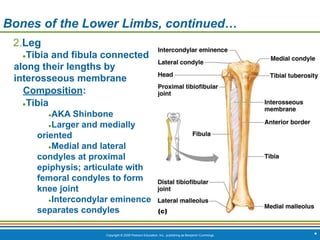
2.Leg
●Tibia and fibula connected
along their lengths by
interosseous membrane
Composition:
●Tibia
●AKA Shinbone
●Larger and medially
oriented
●Medial and lateral
condyles at proximal
epiphysis; articulate with
femoral condyles to form
knee joint
●Intercondylar eminence
separates condyles
Copyright © 2009 Pearson Education, Inc., publishing as Benjamin Cummings *
Bones of the Lower Limbs, continued…
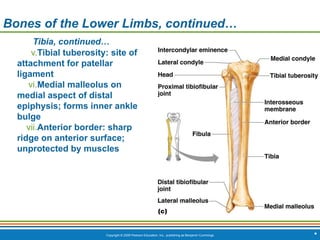
Tibia, continued…
v.Tibial tuberosity: site of
attachment for patellar
ligament
vi.Medial malleolus on
medial aspect of distal
epiphysis; forms inner ankle
bulge
vii.Anterior border: sharp
ridge on anterior surface;
unprotected by muscles
Copyright © 2009 Pearson Education, Inc., publishing as Benjamin Cummings *
Bones of the Lower Limbs, continued…
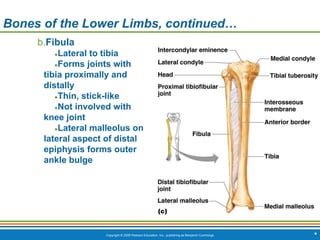
b.Fibula
●Lateral to tibia
●Forms joints with
tibia proximally and
distally
●Thin, stick-like
●Not involved with
knee joint
●Lateral malleolus on
lateral aspect of distal
epiphysis forms outer
ankle bulge
Copyright © 2009 Pearson Education, Inc., publishing as Benjamin Cummings *
Bones of the Lower Limbs, continued…
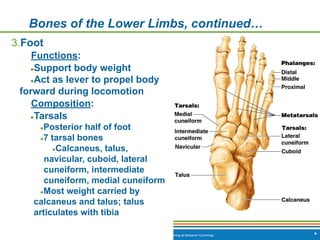
3.Foot
Functions:
●Support body weight
●Act as lever to propel body
forward during locomotion
Composition:
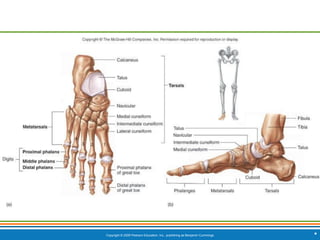
●Tarsals
●Posterior half of foot
●7 tarsal bones
●Calcaneus, talus,
navicular, cuboid, lateral
cuneiform, intermediate
cuneiform, medial cuneiform
●Most weight carried by
calcaneus and talus; talus
articulates with tibia
Copyright © 2009 Pearson Education, Inc., publishing as Benjamin Cummings *
Bones of the Lower Limbs, continued…
Foot, continued…
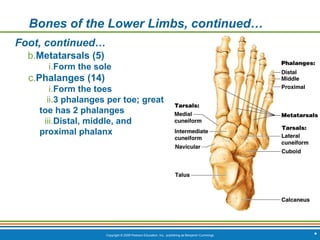
b.Metatarsals (5)
i.Form the sole
c.Phalanges (14)
i.Form the toes
ii.3 phalanges per toe; great
toe has 2 phalanges
iii.Distal, middle, and
proximal phalanx
Copyright © 2009 Pearson Education, Inc., publishing as Benjamin Cummings *
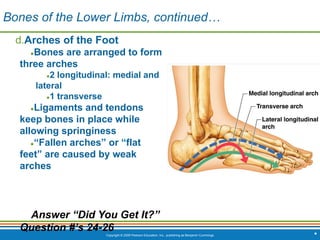
d.Arches of the Foot
●Bones are arranged to form
three arches
●2 longitudinal: medial and
lateral
●1 transverse
●Ligaments and tendons
keep bones in place while
allowing springiness
●“Fallen arches” or “flat
feet” are caused by weak
arches
Answer “Did You Get It?”
Question #’s 24-26
Bones of the Lower Limbs, continued…
Copyright © 2009 Pearson Education, Inc., publishing as Benjamin Cummings *
IV.Joints
●Articulation/joint = point where two bones meet
●Functions of joints:
●Hold bones together
●Allow for mobility
●Ways joints are classified:
●Functionally – based an amount of movement
●Structurally – based on type of tissue between the
bones
Copyright © 2009 Pearson Education, Inc., publishing as Benjamin Cummings *
Functional Classification of Joints
●Synarthroses
●Immovable joints
●Axial skeleton
●Some cartilaginous & fibrous joints
●Amphiarthroses
●Slightly moveable joints
●Axial skeleton
●Cartilaginous & some fibrous joints
●Diarthroses
●Freely moveable joints
●Common in the limbs
●Synovial joints
Copyright © 2009 Pearson Education, Inc., publishing as Benjamin Cummings *
Structural Classification of Joints
●Fibrous joints
a.Generally immovable
●Cartilaginous joints
a.Immovable or slightly moveable
●Synovial joints
a.Freely moveable
Copyright © 2009 Pearson Education, Inc., publishing as Benjamin Cummings *
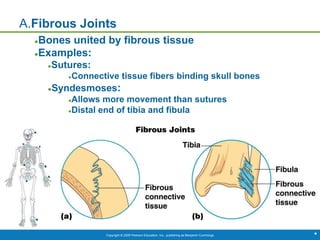
A.Fibrous Joints
●Bones united by fibrous tissue
●Examples:
●Sutures:
●Connective tissue fibers binding skull bones
●Syndesmoses:
●Allows more movement than sutures
●Distal end of tibia and fibula
Copyright © 2009 Pearson Education, Inc., publishing as Benjamin Cummings *
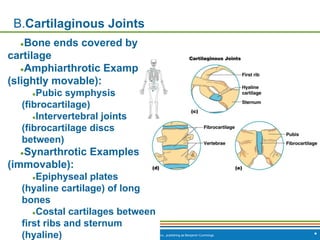
B.Cartilaginous Joints
●Bone ends covered by
cartilage
●Amphiarthrotic Examples
(slightly movable):
●Pubic symphysis
(fibrocartilage)
●Intervertebral joints
(fibrocartilage discs
between)
●Synarthrotic Examples
(immovable):
●Epiphyseal plates
(hyaline cartilage) of long
bones
●Costal cartilages between
first ribs and sternum
(hyaline)
Copyright © 2009 Pearson Education, Inc., publishing as Benjamin Cummings *
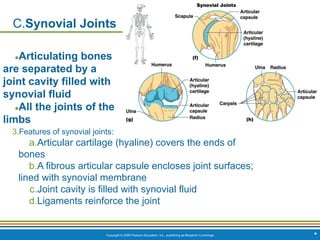
C.Synovial Joints
●Articulating bones
are separated by a
joint cavity filled with
synovial fluid
●All the joints of the
limbs
3.Features of synovial joints:
a.Articular cartilage (hyaline) covers the ends of
bones
b.A fibrous articular capsule encloses joint surfaces;
lined with synovial membrane
c.Joint cavity is filled with synovial fluid
d.Ligaments reinforce the joint
Copyright © 2009 Pearson Education, Inc., publishing as Benjamin Cummings *
Synovial Joints, continued…
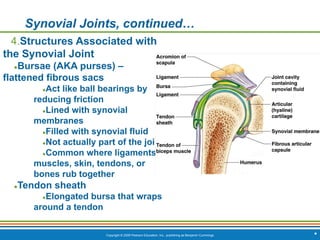
4.Structures Associated with
the Synovial Joint
●Bursae (AKA purses) –
flattened fibrous sacs
●Act like ball bearings by
reducing friction
●Lined with synovial
membranes
●Filled with synovial fluid
●Not actually part of the joint
●Common where ligaments,
muscles, skin, tendons, or
bones rub together
●Tendon sheath
●Elongated bursa that wraps
around a tendon
Copyright © 2009 Pearson Education, Inc., publishing as Benjamin Cummings *
Summary of Joint Classes
[Insert Table 5.3 here]
Table 5.3
Copyright © 2009 Pearson Education, Inc., publishing as Benjamin Cummings
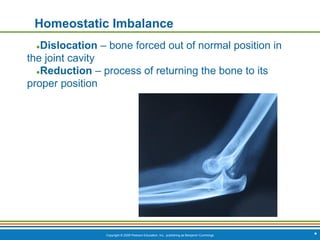
Homeostatic Imbalance
●Dislocation – bone forced out of normal position in
the joint cavity
●Reduction – process of returning the bone to its
proper position
*
Copyright © 2009 Pearson Education, Inc., publishing as Benjamin Cummings
D.Types of Synovial Joints
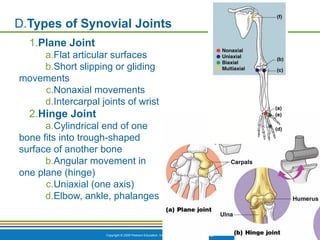
1.Plane Joint
a.Flat articular surfaces
b.Short slipping or gliding
movements
c.Nonaxial movements
d.Intercarpal joints of wrist
2.Hinge Joint
a.Cylindrical end of one
bone fits into trough-shaped
surface of another bone
b.Angular movement in
one plane (hinge)
c.Uniaxial (one axis)
d.Elbow, ankle, phalanges
*
Copyright © 2009 Pearson Education, Inc., publishing as Benjamin Cummings *
Types of Synovial Joints
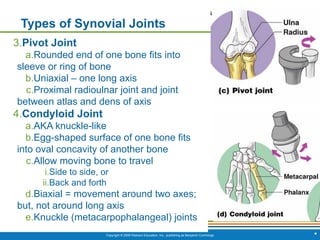
3.Pivot Joint
a.Rounded end of one bone fits into
sleeve or ring of bone
b.Uniaxial – one long axis
c.Proximal radioulnar joint and joint
between atlas and dens of axis
4.Condyloid Joint
a.AKA knuckle-like
b.Egg-shaped surface of one bone fits
into oval concavity of another bone
c.Allow moving bone to travel
i.Side to side, or
ii.Back and forth
d.Biaxial = movement around two axes;
but, not around long axis
e.Knuckle (metacarpophalangeal) joints
Copyright © 2009 Pearson Education, Inc., publishing as Benjamin Cummings *
Types of Synovial Joints
Figure 5.30d–f
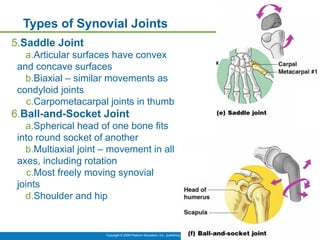
5.Saddle Joint
a.Articular surfaces have convex
and concave surfaces
b.Biaxial – similar movements as
condyloid joints
c.Carpometacarpal joints in thumb
6.Ball-and-Socket Joint
a.Spherical head of one bone fits
into round socket of another
b.Multiaxial joint – movement in all
axes, including rotation
c.Most freely moving synovial
joints
d.Shoulder and hip
Copyright © 2009 Pearson Education, Inc., publishing as Benjamin Cummings *
E.Homeostatic Imbalances of Joints
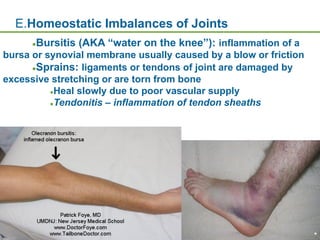
●Bursitis (AKA “water on the knee”): inflammation of a
bursa or synovial membrane usually caused by a blow or friction
●Sprains: ligaments or tendons of joint are damaged by
excessive stretching or are torn from bone
●Heal slowly due to poor vascular supply
●Tendonitis – inflammation of tendon sheaths
Copyright © 2009 Pearson Education, Inc., publishing as Benjamin Cummings *
Homeostatic Imbalances of Joints, continued…
3.Arthritis: inflammatory or degenerative diseases of
joints
●arth = joint; itis = inflammation
●Over 100 different types; most widespread crippling
disease in the United States
●Pain, stiffness, swelling of joint
●Acute arthritis caused by bacterial infection; treated
with antibiotics
●Chronic arthritis: osteoarthritis, rheumatoid arthritis,
gouty arthritis
Copyright © 2009 Pearson Education, Inc., publishing as Benjamin Cummings *
Homeostatic Imbalances of Joints, continued…
4.Chronic forms of arthritis
●Osteoarthritis (OA)
●Most common chronic arthritis
●Chronic degenerative condition related to normal aging
processes
●Erosion of articular cartilages, formation of bone spurs,
restricts joint movement, crepitus, painful
●Rheumatoid arthritis (RA)
●Chronic inflammatory disorder occurring between the ages
of 40-50; affects more women than men
●Mostly in hand, wrist, foot, and ankle joints (symmetrical)
●An autoimmune disease—the immune system attacks the
joints
●Symptoms begin with inflammation of synovial membranes,
accumulation of synovial fluid; inflammatory cells destroy
tissues
●Often leads to deformities
Copyright © 2009 Pearson Education, Inc., publishing as Benjamin Cummings *
Homeostatic Imbalances of Joints, continued…
c.Gouty arthritis (AKA Gout)
●Inflammation of joints is caused by a deposition of uric
acid crystals from the blood
●Extremely painful
●Typically affects a single joint, such as the great toe
●More common in men; after age of 30; probably genetic
●Can usually be controlled with diet
Copyright © 2009 Pearson Education, Inc., publishing as Benjamin Cummings *
V.Developmental Aspects of the Skeletal System
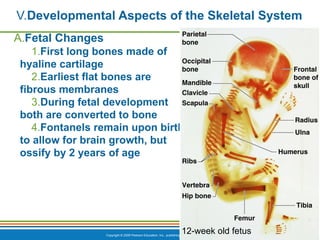
A.Fetal Changes
1.First long bones made of
hyaline cartilage
2.Earliest flat bones are
fibrous membranes
3.During fetal development
both are converted to bone
4.Fontanels remain upon birth
to allow for brain growth, but
ossify by 2 years of age
12-week old fetus
Copyright © 2009 Pearson Education, Inc., publishing as Benjamin Cummings *
B.Skeletal Changes Throughout Life
1.Adolescence
●Epiphyseal plates become ossified and long bone growth
ends
●Size of cranium in relationship to body
●2 years old—skull is ¾ of adult size
●8 or 9 years old—skull is near adult size and proportion
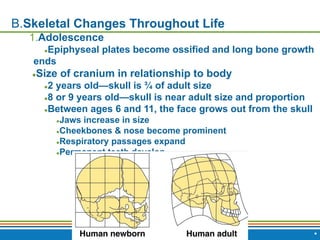
●Between ages 6 and 11, the face grows out from the skull
●Jaws increase in size
●Cheekbones & nose become prominent
●Respiratory passages expand
●Permanent teeth develop
Copyright © 2009 Pearson Education, Inc., publishing as Benjamin Cummings *
Skeletal Changes Throughout Life, continued…
3.Curvatures of the spine
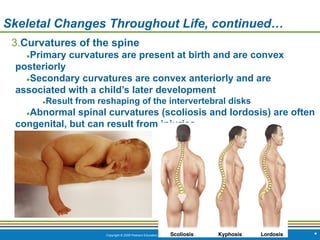
●Primary curvatures are present at birth and are convex
posteriorly
●Secondary curvatures are convex anteriorly and are
associated with a child’s later development
●Result from reshaping of the intervertebral disks
●Abnormal spinal curvatures (scoliosis and lordosis) are often
congenital, but can result from injuries
Copyright © 2009 Pearson Education, Inc., publishing as Benjamin Cummings
Skeletal Changes Throughout Life, continued…
4.Skeletal growth changes body proportions
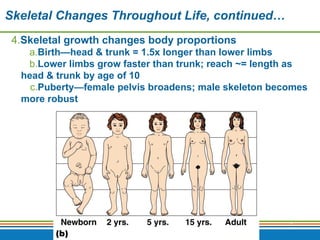
a.Birth—head & trunk = 1.5x longer than lower limbs
b.Lower limbs grow faster than trunk; reach ~= length as
head & trunk by age of 10
c.Puberty—female pelvis broadens; male skeleton becomes
more robust
*
Copyright © 2009 Pearson Education, Inc., publishing as Benjamin Cummings *
Skeletal Changes Throughout Life, continued…
5.Osteoporosis
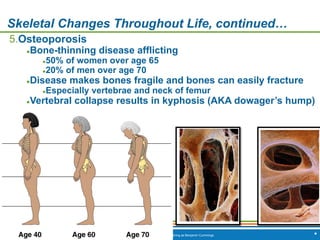
●Bone-thinning disease afflicting
●50% of women over age 65
●20% of men over age 70
●Disease makes bones fragile and bones can easily fracture
●Especially vertebrae and neck of femur
●Vertebral collapse results in kyphosis (AKA dowager’s hump)
Copyright © 2009 Pearson Education, Inc., publishing as Benjamin Cummings
Skeletal Changes Throughout Life, continued…
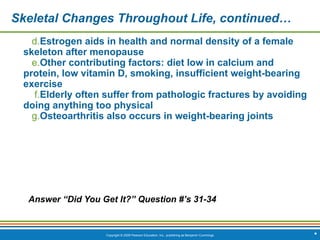
d.Estrogen aids in health and normal density of a female
skeleton after menopause
e.Other contributing factors: diet low in calcium and
protein, low vitamin D, smoking, insufficient weight-bearing
exercise
f.Elderly often suffer from pathologic fractures by avoiding
doing anything too physical
g.Osteoarthritis also occurs in weight-bearing joints
Answer “Did You Get It?” Question #’s 31-34
*

Ch. 5 Lecture - Skeletal System (marieb).ppt.pdf

  • 1.
    PowerPoint® Lecture Slide Presentation byPatty Bostwick-Taylor, Florence-Darlington Technical College Copyright © 2009 Pearson Education, Inc., publishing as Benjamin Cummings PART A 5 The Skeletal System
  • 2.
    Copyright © 2009Pearson Education, Inc., publishing as Benjamin Cummings * ●Overview of the Skeletal System ●Skeleton (Greek) = “dried up body” ●Two subdivisions of the skeleton ●Axial skeleton – longitudinal axis of body ●Appendicular skeleton – limbs & girdles ●Parts of the skeletal system: ●Bones (skeleton) ●Joints ●Cartilages ●Ligaments
  • 3.
    Copyright © 2009Pearson Education, Inc., publishing as Benjamin Cummings * A.Functions of Bones 1.Support a.Form internal framework: supports body & cradles soft organs 2.Protection a.Ex: skull bones fused to enclose the brain b.Ex: vertebrae surround spinal cord c.Ex: rib cage encloses thoracic organs 3.Movement a.Skeletal muscles attached to bone via tendons, move body and its parts b.Results in full body locomotion, fine movements, internal movements
  • 4.
    Copyright © 2009Pearson Education, Inc., publishing as Benjamin Cummings * Functions of Bones, continued… 4.Storage a.Fat (marrow) in medullary cavities b.Bones store minerals: calcium & phosphorus i.Ca2+ needed for nervous impulses, muscle contraction, blood clotting ii.Hormones control movement of calcium to and from bones and blood 5.Blood cell formation a.AKA hematopoesis b.Within marrow/medullary cavities
  • 5.
    Copyright © 2009Pearson Education, Inc., publishing as Benjamin Cummings * B.Classification of Bones 1.The adult skeleton has 206 bones 2.Two basic types of bone tissue: a.Compact bone i.Dense, smooth, homogeneous b.Spongy bone i.AKA cancellous bone ii.Small needle-like pieces of bone, called trabeculae iii.Many open spaces ●Site of hematopoesis ●Filled with red marrow Figure 5.2b
  • 6.
    Copyright © 2009Pearson Education, Inc., publishing as Benjamin Cummings *
  • 7.
    Copyright © 2009Pearson Education, Inc., publishing as Benjamin Cummings Structure of Cancellous Bone *
  • 8.
    Copyright © 2009Pearson Education, Inc., publishing as Benjamin Cummings Structure of Compact Bone *
  • 9.
    Copyright © 2009Pearson Education, Inc., publishing as Benjamin Cummings *
  • 10.
    Copyright © 2009Pearson Education, Inc., publishing as Benjamin Cummings * Figure 5.1 Classification of Bones on the basis of Shape
  • 11.
    Copyright © 2009Pearson Education, Inc., publishing as Benjamin Cummings * 3.Classification of bones on the basis of shape ●4 shapes of bone: long, short, flat, irregular a.Long bones i.Longer than they are wide ii.Shaft with heads at both ends iii.Contain mostly compact bone iv.Example: ●All the bones of the limbs (except patella, ankle & wrist)
  • 12.
    Copyright © 2009Pearson Education, Inc., publishing as Benjamin Cummings * Classification of Bones, continued… b.Short bones i.Generally cube-shaped ii.Contain mostly cancellous bone iii.Examples: ●Bones of the wrist (carpal) & ankle (tarsal) ●Sesamoid bones – bones which form within tendons; e.g. patella
  • 13.
    Copyright © 2009Pearson Education, Inc., publishing as Benjamin Cummings * Classification of Bones, continued… c.Flat bones i.Thin, flattened, and usually curved ii.Two thin layers of compact bone surround a layer of cancellous bone iii.Examples: ●Skull ●Ribs ●Sternum
  • 14.
    Copyright © 2009Pearson Education, Inc., publishing as Benjamin Cummings * Classification of Bones, continued… d.Irregular bones i.Irregular shape ii.Do not fit into other bone classification categories iii.Example: ●Vertebrae ●Pelvic bones ●Facial bones Answer “Did You Get It?” Questions #1-2
  • 15.
    Copyright © 2009Pearson Education, Inc., publishing as Benjamin Cummings * Classification of Bones Figure 5.1d
  • 16.
    Copyright © 2009Pearson Education, Inc., publishing as Benjamin Cummings * C.Anatomy of a Long Bone Gross Anatomy 1.Diaphysis/es a.AKA shaft b.Length of the bone c.Composed of compact bone 2.Periosteum a.Outside covering of the diaphysis b.Fibrous connective tissue membrane
  • 17.
    Copyright © 2009Pearson Education, Inc., publishing as Benjamin Cummings * Anatomy of a Long Bone, continued… 3.Perforating/Sharpey’s fibers a.Connective tissue fibers b.Secure periosteum to underlying bone 4.Epiphysis/es a.Ends of the bone b.Thin layer of compact bone enclosing cancellous bone
  • 18.
    Copyright © 2009Pearson Education, Inc., publishing as Benjamin Cummings * Anatomy of a Long Bone, continued… 5.Articular cartilage a.Covers the external surface of the epiphyses b.Made of hyaline cartilage c.Decreases friction at joint surfaces 6.Arteries a.Supply bone cells with nutrients
  • 19.
    Copyright © 2009Pearson Education, Inc., publishing as Benjamin Cummings *
  • 20.
    Copyright © 2009Pearson Education, Inc., publishing as Benjamin Cummings * Anatomy of a Long Bone, continued… 7.Epiphyseal line a.Remnant of the epiphyseal plate b.Seen in adult bones 8.Epiphyseal plate a.Flat plate of hyaline cartilage seen in young, growing bone b.Hormones inhibit long bone growth by the end of puberty c.Epiphyseal plate is replaced by bone, leaving epiphyseal line behind
  • 21.
    Copyright © 2009Pearson Education, Inc., publishing as Benjamin Cummings * Proximal End of a Long Bone
  • 22.
    Copyright © 2009Pearson Education, Inc., publishing as Benjamin Cummings * Epiphyseal Plate
  • 23.
    Copyright © 2009Pearson Education, Inc., publishing as Benjamin Cummings * Anatomy of a Long Bone, continued… 9.Medullary cavity a.Cavity inside of the shaft b.Contains yellow marrow (mostly adipose tissue) in adults c.In infants, contains red marrow (for blood cell formation) d.In adults, red marrow is in cavities of cancellous bone (flat bones) and in epiphyses (long bones)
  • 24.
    Copyright © 2009Pearson Education, Inc., publishing as Benjamin Cummings * Bone Markings 1.Surface features of bones a.Sites of attachments for muscles, tendons, and ligaments b.Passages for nerves and blood vessels 2.Categories of bone markings a.Projections or processes—grow out from the bone surface i.All begin with T b.Depressions or cavities—indentations i.All begin with F (except facet)
  • 25.
    Copyright © 2009Pearson Education, Inc., publishing as Benjamin Cummings * Bone Markings Table 5.1 (1 of 2)
  • 26.
    Copyright © 2009Pearson Education, Inc., publishing as Benjamin Cummings * Bone Markings Table 5.1 (2 of 2)
  • 27.
    Copyright © 2009Pearson Education, Inc., publishing as Benjamin Cummings * Bone Markings – Major Features ●Body/shaft/diaphysis ●Head ●Humerus, femur ●Neck ●Femoral neck ●Condyle ●Distal femur, posterior mandible, occipital condyles ●Facet ●Thoracic vertebral bodies ●Crest ●Sagittal crest ●Process ●Mastoid process (temporal), styloid process (distal radius & ulna) ●Tubercle/tuberosity ●Tubercle: greater & lesser tubercle on humerus, conoid tubercle (inferior edge of lateral clavicle) ●Tuberosity: radial tuberosity, tibial tuberosity, deltoid tuberosity (humerus) ●Trochanter ●Greater & lesser trochanters on proximal femur ●Epicondyle ●Lateral epicondyle of humerus
  • 28.
    Copyright © 2009Pearson Education, Inc., publishing as Benjamin Cummings * Bone Markings – Major Features ●Foramen/foramina ●Mental foramen (lateral mandible) ●Canal/meatus ●Canal: carotid canal (base of skull) ●Meatus: external auditory meatus ●Fissure ●Superior orbital fissure, inferior orbital fissure ●Sinus ●Frontal sinus ●Fossa ●Olecranon fossa (posterior, distal humerus) ○Fovea capitus on femoral head (fovea smaller than fossa)
  • 29.
    Copyright © 2009Pearson Education, Inc., publishing as Benjamin Cummings * Microscopic Anatomy of Bone 1.Osteocytes – mature bone cells 2.Lacunae – tiny cavities housing osteocytes 3.Lamellae – concentric circles (layers) of lacunae & matrix 4.Central (Haversian) canals – passageway for blood vessels & nerves
  • 30.
    Copyright © 2009Pearson Education, Inc., publishing as Benjamin Cummings * Microscopic Anatomy of Bone 5.Canaliculi – tiny canals a.Radiate from the central canal to lacunae b.Form a transport system connecting all bone cells to nutrient supply 6.Perforating (Volkman’s) canals a.Canal perpendicular to the central canal b.Carries blood vessels and nerves
  • 31.
    Copyright © 2009Pearson Education, Inc., publishing as Benjamin Cummings * Microscopic Anatomy of Bone
  • 32.
    Copyright © 2009Pearson Education, Inc., publishing as Benjamin Cummings * Microscopic Anatomy of Bone Figure 5.3b–c Answer “Did You Get It?” Questions #3-4
  • 33.
    Copyright © 2009Pearson Education, Inc., publishing as Benjamin Cummings Bone starting to replace cartilage Epiphys eal plate cartilage Articul ar cartila ge Spon gy bone In a child In a fetus In an embryo New bone forming Growt h in bone width Growt h in bone lengt h Epiphyseal plate cartilage New bone forming Blood vesse ls Hyalin e cartila ge New center of bone growth Medulla ry cavity Bone collar Hyalin e cartila ge model (a ) * D.Bone Formation, Growth, and Remodeling 1.In embryos, the skeleton is primarily hyaline cartilage 2.During development, much of this cartilage is replaced by bone 3.Cartilage remains in isolated areas a.Bridge of the nose b.Parts of ribs c.Joints
  • 34.
    Copyright © 2009Pearson Education, Inc., publishing as Benjamin Cummings * Bone Growth (Ossification) ●Ossification = process of bone formation ■Flat bones form on fibrous membranes ■Other bones develop from hyaline cartilage models 4.Two phases: a.Hyaline cartilage model covered with bone matrix i.Done by osteoblasts = bone-forming cells b.Hyaline cartilage model digested away, forming a medullary cavity i.Two locations remain as cartilage after birth: articular cartilages (covering ends of bones) and epiphyseal plates
  • 35.
    Copyright © 2009Pearson Education, Inc., publishing as Benjamin Cummings * Long Bone Formation and Growth Figure 5.4a Bone starting to replace cartilage Epiphyseal plate cartilage Articula r cartilag e Spongy bone In a child In a fetus In an embryo New bone forming Growth in bone width Growth in bone length Epiphyseal plate cartilage New bone forming Blood vessel s Hyaline cartilag e New center of bone growth Medullary cavity Bone collar Hyaline cartilag e model (a )
  • 36.
    Copyright © 2009Pearson Education, Inc., publishing as Benjamin Cummings * Bone Growth (Ossification) 5.Growth in Bone Length ●New cartilage is continuously formed on external surface of articular cartilage and epiphyseal plate ●Older cartilage becomes ossified ●Cartilage is broken down ●Enclosed cartilage is digested away, opening up a medullary cavity ●Bone replaces cartilage through the action of osteoblasts
  • 37.
    Copyright © 2009Pearson Education, Inc., publishing as Benjamin Cummings * Bone Growth (Ossification) 6.Growth in Bone Width; AKA appositional growth ●Osteoblasts (from periosteum) add bone to outside of diaphysis ●Osteoclasts (in endosteum) remove bone from inside of diaphysis ●Both occur at approximately the same rate, resulting in larger diameter ●Long-bone growth controlled by hormones; ends in puberty ●Growth hormone ●Sex hormones
  • 38.
    Copyright © 2009Pearson Education, Inc., publishing as Benjamin Cummings * Bone Growth (Ossification) 7.Bones are continually remodeled in response to two factors ●Blood calcium levels ●Pull of gravity and muscles on the skeleton
  • 39.
    Copyright © 2009Pearson Education, Inc., publishing as Benjamin Cummings * Types of Bone Cells ●Osteocytes — mature bone cells ●Osteoblasts — bone-forming cells ●Osteoclasts — bone-destroying cells ●Break down bone matrix for remodeling and release of calcium in response to parathyroid hormone ●Bone remodeling is performed by both osteoblasts & osteoclasts
  • 40.
    Copyright © 2009Pearson Education, Inc., publishing as Benjamin Cummings * Bone & Calcium Homeostasis 8.Parathyroid hormone (PTH): releases Ca2+ in blood ●↑’s blood Ca2+ by ↑’g osteoclast activity ●↑ Ca resorption from urine in kidney back into blood ●Stimulates vitamin D production ●Stimulated by ↓ blood Ca2+ ● Calcitonin – stores Ca2+ in bone ●Hypercalcemia = high blood calcium, decreases osteoclast activity ●↓’s Ca2+ by ↓’g osteoclast activity ●Stimulated by ↑ Ca2+
  • 41.
    Copyright © 2009Pearson Education, Inc., publishing as Benjamin Cummings * Bone Remodeling 9.Bone Remodeling = depositing new bone matrix in a mature bone a.In order to retain normal proportions & strength during long-bone growth b.In order to form projections where muscles attach c.Atrophy in bedridden or physically inactive people
  • 42.
    Copyright © 2009Pearson Education, Inc., publishing as Benjamin Cummings * 10.Homeostatic Imbalances Growth & Development ●Giantism: abnormally increased size, excessive endochondral growth @ epiphyseal plates ●Dwarfism: person is abnormally small, improper growth @ epiphyseal plates ●Osteogenesis imperfecta: (bone + production + imperfect) – genetic disorders causing brittle bones with insufficient collagen; easily fractured, especially in fetus; poor healing/misalignment ●Rickets ●Failure of bones to calcify ●Softening & bowing of bones ●Children with lack of calcium or Vitamin D in diet
  • 43.
    Copyright © 2009Pearson Education, Inc., publishing as Benjamin Cummings * 10.HOMEOSTATIC IMBALANCE Bacterial Infection ●Osteomyelitis: bone marrow inflammation, can be caused by Stapholococcus (type of bacterium) through wounds or tuberculosis Bone tumor Decalcification 1.Osteomalacia: (bone softness) – due to calcium depletion from bones; pregnancy or “Adult Rickets” from vitamin D deficiency
  • 44.
    Copyright © 2009Pearson Education, Inc., publishing as Benjamin Cummings * E.Bone Fractures – Homeostatic Imbalance 1.Fracture — break in a bone 2.Types of bone fractures a.Closed (simple) fracture — break that does not penetrate the skin b.Open (compound) fracture — broken bone penetrates through the skin 3.Bone fractures are treated by reduction and immobilization: realignment of the broken bone ends a.Closed reduction: bones realigned via external means b.Open reduction: bones realigned via internal surgery and secured with pins/wires/plates
  • 45.
    Copyright © 2009Pearson Education, Inc., publishing as Benjamin Cummings * Common Types of Fractures Table 5.2
  • 46.
    Copyright © 2009Pearson Education, Inc., publishing as Benjamin Cummings More on Fractures complete – two bone fragments are separate incomplete – two bone fragments are not separated comminuted - > 2 fragments impacted – 1 fragment pushed into cancellous portion of another fragment oblique/spiral – at an angle other than perpendicular greenstick – partly broken and partly bent linear – parallel to long axis of bone transverse – perpendicular to long axis *
  • 47.
    Copyright © 2009Pearson Education, Inc., publishing as Benjamin Cummings More Fracture Pics… ●Incomplete/Greenstick ●Transverse ●Oblique ●Longitudinal ●Spiral ●Complete ●Dislocation *
  • 48.
    Copyright © 2009Pearson Education, Inc., publishing as Benjamin Cummings A Few More Notes on Fractures… ●Note: joint immobilization during mid-late bone healing results in 3x decrease in strength ○Muscles lose mass (atrophy) ○Bone not subject to the stresses that helps it form ●Solution = walking cast *
  • 49.
    Copyright © 2009Pearson Education, Inc., publishing as Benjamin Cummings * 4.Repair of Bone Fractures a.Hematoma (blood-filled swelling) forms i.Blood vessels rupture when bone breaks ii.Bone cells die due to lack of nutrition b.Break is splinted by fibrocartilage to form a callus i.New capillaries grow into clot ii.Phagocytes remove dead tissue iii.Fibrocartilage callus forms; contains cartilage matrix, bony matrix, collagen fibers iv.Callus “splints” the bone
  • 50.
    Copyright © 2009Pearson Education, Inc., publishing as Benjamin Cummings * 4.Repair of Bone Fractures c.Fibrocartilage callus is replaced by a bony callus i.Osteoclasts remove fibrocartilage callus ii.Osteoblasts build bony callus d.Bony callus is remodeled to form a permanent patch i.Done in response to mechanical stresses ii.Occurs over next few weeks-months Answer “Did You Get It?” Questions #5-8
  • 51.
    Copyright © 2009Pearson Education, Inc., publishing as Benjamin Cummings * Stages in the Healing of a Bone Fracture Figure 5.5 Hematom a Externa l callus Bony callus of spongy bone Healed fractur e New blood vessel s Internal callus (fibrous tissue and cartilage) Spongy bone trabecul a Hematom a formation Fibrocartilage callus formation Bony callus formation Bone remodeling
  • 52.
    Copyright © 2009Pearson Education, Inc., publishing as Benjamin Cummings * II.The Axial Skeleton ●Forms the longitudinal axis of the body ●Divided into three parts ●Skull ●Vertebral column ●Bony thorax
  • 53.
    Copyright © 2009Pearson Education, Inc., publishing as Benjamin Cummings Axial Skeleton ●Skull (28 bones including auditory ossicles) ●Hyoid bone (1 bone) ●Vertebral column (26 bones) ●Cervical (7 vertebrae) ●Thoracic (12 vertebrae) ●Lumbar (5 vertebrae) ●Sacrum (1 – 5 fused vertebrae) ●Coccyx (1 -~4 fused vertebrae) ●Thoracic Cage (25 bones) ●Ribs (24) ●Sternum (1 – 3 parts) 80 total bones in axial skeleton *
  • 54.
    Copyright © 2009Pearson Education, Inc., publishing as Benjamin Cummings * A.The Skull ●Two sets of bones: cranium & facial bones ●Bones are joined by sutures: interlocking, immovable joints ●Only the mandible is attached by a freely movable joint ●Braincase – encloses cranial cavity ●Surrounds & protects brain ○6 bones, 8 when paired ●Facial bones – forms facial structure ○8 bones, 14 when paired ●Auditory ossicles – form the middle ear ●These bones transmit vibration to eardrum ○Malleus, incus, & stapes
  • 55.
    Copyright © 2009Pearson Education, Inc., publishing as Benjamin Cummings Braincase bones – 8 bones ●2 parietals ●2 temporals ●1 frontal ●1 occipital ●1 sphenoid ●1 ethmoid *
  • 56.
    Copyright © 2009Pearson Education, Inc., publishing as Benjamin Cummings * The Skull, continued… ●Cranium: encloses & protects brain ●Frontal bone ●Parietal bones (wall) – sagittal & coronal sutures ●Most of sides & roof of cranial cavity ●Joined to temporal by squamous suture (scale-like) ●Joined to frontal by coronal suture (crown) ●Joined to occipital by lambdoid suture (λ) ●Sagittal suture joins two parietals
  • 57.
    Copyright © 2009Pearson Education, Inc., publishing as Benjamin Cummings * The Skull, continued… c.Temporal bones (time) – squamous sutures ●Inferior part of cranium & part of cranial floor ●Joined to occipital and parietal by squamous suture ●External acoustic (auditory) meatus – sound waves travel through to eardrum ●Styloid process– muscle attachment for tongue, hyoid, & pharynx movement ●Zygomatic process– articulates with zygomatic ●Mastoid process– neck muscle attachment for head rotation ●Jugular foramen ●Internal acoustic meatus ●Carotid canal ●Other landmarks: ●Mandibular Fossa – articulates with mandible
  • 58.
    Copyright © 2009Pearson Education, Inc., publishing as Benjamin Cummings * The Skull, continued… d.Occipital bone (back of the head) ●Lambdoid suture - joined to parietals by lambdoid suture ●Foramen magnum– passage of spinal cord (connects to brain) ●Occipital condyles– articulate with vertebral column ●Posterior part & prominent portion of the base of the cranium
  • 59.
    Copyright © 2009Pearson Education, Inc., publishing as Benjamin Cummings * The Skull, continued… e.Sphenoid bone (wedge-shaped) ●Sella turcica – contains pituitary gland ●Foramen ovale ●Optic canal ●Superior orbital fissure ●Sphenoid sinuses ●Connects to all other cranial bones
  • 60.
    Copyright © 2009Pearson Education, Inc., publishing as Benjamin Cummings * The Skull, continued… f.Ethmoid bone i.Crista galli ii.Cribriform plate iii.Superior nasal concha & middle nasal concha – form lateral walls of nasal cavity ●Light, spongy bone that increases surface area of nasal cavity ●Moistens & warms inhaled air ●Anterior floor of the cranium between the orbits ●Composes much of nasal cavity & part of nasal septum ●Perpendicular Plate – part of nasal septum (with vomer)
  • 61.
    Copyright © 2009Pearson Education, Inc., publishing as Benjamin Cummings * Human Skull, Lateral View Figure 5.7
  • 62.
    Copyright © 2009Pearson Education, Inc., publishing as Benjamin Cummings * Human Skull, Superior View Figure 5.8
  • 63.
    Copyright © 2009Pearson Education, Inc., publishing as Benjamin Cummings * Human Skull, Inferior View Figure 5.9
  • 64.
    Copyright © 2009Pearson Education, Inc., publishing as Benjamin Cummings * Human Skull, Anterior View Figure 5.11
  • 65.
    Copyright © 2009Pearson Education, Inc., publishing as Benjamin Cummings * The Skull, continued… 2.Facial bones: holds eyes & support facial muscles a.Maxillae/maxilla i.Maxillary bones ii.Alveolar margin iii.Palatine processes iv.Paranasal sinuses ●Hollow portions of bones surrounding the nasal cavity ●Functions of paranasal sinuses ●Lighten the skull ●Give resonance and amplification to voice
  • 66.
    Copyright © 2009Pearson Education, Inc., publishing as Benjamin Cummings * Facial Bones, continued… b.Palatine bones c.Zygomatic bones d.Lacrimal bones e.Nasal bones f.Vomer bone g.Inferior nasal conchae h.Mandible i.Body ii.Ramus/rami iii.Alveoli iv.Alveolar margin
  • 67.
    Copyright © 2009Pearson Education, Inc., publishing as Benjamin Cummings * Paranasal Sinuses Figure 5.10a
  • 68.
    Copyright © 2009Pearson Education, Inc., publishing as Benjamin Cummings * Paranasal Sinuses Figure 5.10b
  • 69.
    Copyright © 2009Pearson Education, Inc., publishing as Benjamin Cummings * 3.The Hyoid Bone ●Not really part of the skull ●The only bone that does not articulate with another bone ●Serves as a moveable base for the tongue ●Attachment point for neck muscles that raise/lower the larynx during swallowing and speech
  • 70.
    Copyright © 2009Pearson Education, Inc., publishing as Benjamin Cummings * 4.The Fetal Skull ●Infant’s face is very small compared to cranium size ●Fetal skull is large compared to the infant’s total body length ●Fontanels — fibrous membranes connecting the cranial bones; AKA soft spots ●Allow skull to be compressed during child birth ●Allow the brain to grow during latter pregnancy and early infancy ●Convert to bone within 22-24 months after birth
  • 71.
    Copyright © 2009Pearson Education, Inc., publishing as Benjamin Cummings * The Fetal Skull Figure 5.13a
  • 72.
    Copyright © 2009Pearson Education, Inc., publishing as Benjamin Cummings * The Fetal Skull Figure 5.13b
  • 73.
    Copyright © 2009Pearson Education, Inc., publishing as Benjamin Cummings * B.The Vertebral Column (Spine) Functions: ●Axial support for the body ●Extends from skull (support) to pelvis (transmits body weight to lower limbs) ●Surrounds and protects the spinal cord ●Allows spinal nerves to exit spinal cord ●Site for muscle attachment ●Permits head & trunk movement Composition: ●Composed of 26 irregular bones, connected by ligaments, creating a flexible and curved structure
  • 74.
    Copyright © 2009Pearson Education, Inc., publishing as Benjamin Cummings * The Vertebral Column (Spine) 2.33 vertebrae before birth a.9 fuse to become the sacrum and coccyx 3.24 vertebral bones ●Neck: 7 cervical vertebrae ●Chest/thorax: 12 thoracic vertebrae ●Lower back: 5 lumbar vertebrae 5.Intervertebral discs: pads of fibrocartilage in between vertebrae a.Absorb shock b.Provide flexibility c.Loses function with age
  • 75.
    Copyright © 2009Pearson Education, Inc., publishing as Benjamin Cummings * The Vertebral Column 5.Homeostatic Imbalance: Herniated (slipped) discs a.Caused by: i.Drying of discs ii.Weakening of ligaments of vertebral column iii.Exceptional twisting forces b.If disc presses on spinal cord or spinal nerves, can cause numbness and pain
  • 76.
    Copyright © 2009Pearson Education, Inc., publishing as Benjamin Cummings Vertebral Column Damage ●“Broken Tailbone” ○Fractured coccyx ○Can occur during childbirth and from falls
  • 77.
    Copyright © 2009Pearson Education, Inc., publishing as Benjamin Cummings * The Vertebral Column 6.Spinal curvatures ●S-shaped curve ●Functions: ●Prevents shock to head ●Make body trunk flexible ●Primary curvatures are the spinal curvatures of the thoracic and sacral regions ●Present from birth ●Produce C-shape in newborns’ spine
  • 78.
    Copyright © 2009Pearson Education, Inc., publishing as Benjamin Cummings * The Vertebral Column d.Secondary curvatures are the spinal curvatures of the cervical and lumbar regions ●Develop after birth ●Lumbar curvature provides ability to center body weight on lower limbs; develops as a baby begins to walk ●Cervical curvature develops as a baby begins to raise its head
  • 79.
    Copyright © 2009Pearson Education, Inc., publishing as Benjamin Cummings * The Vertebral Column Figure 5.16 7.Homeostatic Imbalance: Abnormal Spine Curvatures a.Scoliosis: abnormal lateral curvature c.Kyphosis: abnormal posterior curvature i.Usually upper thoracic ii.Hunchback d.Lordosis: abnormal anterior curvature i.Lumbar ii.Swayback e.Causes: congenital, due to disease, poor posture, unequal muscle pull on spine
  • 80.
    Copyright © 2009Pearson Education, Inc., publishing as Benjamin Cummings Vertebral Column Defects
  • 81.
    Copyright © 2009Pearson Education, Inc., publishing as Benjamin Cummings I.Vertebral Anatomy a.Body/centrum – bears weight; faces anteriorly b.Vertebral arch – created by posterior extensions; forms vertebral foramen i.Lamina – extend from transverse process to spinous process ii.Pedicle – extend from body to transverse process (feet) c.Vertebral foramen – houses spinal cord d.Transverse process – extend laterally from the vertebral arch between pedicle & lamina *
  • 82.
    Copyright © 2009Pearson Education, Inc., publishing as Benjamin Cummings e.Spinous process- project dorsally from laminae; can feel externally f.Articular processes – area of vertebral articulation i.Superior and inferior ii.Lateral to vertebral foramen g.Articular facet – smooth surface articulates with ribs h.Intervertebral foramina- notches formed by adjacent vertebrae; spinal nerves exit here i.Vertebral canal – formed by all vertebral foramina; spinal cord passage/protection Vertebral Anatomy, continued… *
  • 83.
    Copyright © 2009Pearson Education, Inc., publishing as Benjamin Cummings Differences in Vertebrae ●Cervical (7: C1 -C7 ) ●Atlas (C1 ) ●No body ●Large articular facets that articulate with occipital condyles (holds head up) ●Nod “yes” ●Axis (C2 ) ●Pivot for rotation of atlas & skull ●Dens – large upright process ●Shake your head “no” *
  • 84.
    Copyright © 2009Pearson Education, Inc., publishing as Benjamin Cummings Differences in Vertebrae Cervical Vertebrae, continued… c.Smallest, lightest vertebrae d.Short spinous processes; some have branched spinous processes e.Transverse processes contain foramina for vertebral arteries going to brain; only present in cervical vertebrae f.Small bodies (except atlas) *
  • 85.
    Copyright © 2009Pearson Education, Inc., publishing as Benjamin Cummings Differences in Vertebrae 2.Thoracic (12: T1 -T12 ) ●Only vertebrae that articulate with the ribs ●~Heart-shaped body ●2 lateral articular facets for rib articulation ●Transverse processes articulate with rib tubercles ●Long, thick spinous processes hooks sharply down: giraffe head *
  • 86.
    Copyright © 2009Pearson Education, Inc., publishing as Benjamin Cummings Differences in Vertebrae 3.Lumbar (5: L1 -L5 ) ●Large, thick bodies ●Heavy, rectangular spinous process; moose head ●Medially facing superior articular facets (“locks” vertebrae together for stability) *
  • 87.
    Copyright © 2009Pearson Education, Inc., publishing as Benjamin Cummings * A Typical Vertebrae, Superior View Figure 5.17
  • 88.
    Copyright © 2009Pearson Education, Inc., publishing as Benjamin Cummings * 4.Sacrum ●5 fused vertebrae ●Articulates with L5 superiorly and coccyx inferiorly ●Alae articulate with ilia (hip bones) laterally at the sacroiliac (SI) joint ●Forms posterior wall of pelvis ●Median sacral crest – fused spinous processes of the sacral vertebrae ●Sacral foramina: posterior & anterior ●Sacral canal – continuation of vertebral canal ●Sacral hiatus – large inferior opening ●Site of anesthetic injection prior to childbirth ●Sacral promontory – bulge in anterior edge of body of 1st vertebra in sacrum ●Palpated before childbirth to determine
  • 89.
    Copyright © 2009Pearson Education, Inc., publishing as Benjamin Cummings * 5.Coccyx ●Formed from the fusion of three to five vertebrae ●“Tailbone,” or remnant of a tail that other vertebrates have ●Reduced vertebral bodies ●No foramina or processes
  • 90.
    Copyright © 2009Pearson Education, Inc., publishing as Benjamin Cummings * C.The Bony Thorax ●Consists of three parts: ●Sternum ●Ribs ●Thoracic vertebrae ●AKA thoracic cage ●Forms a cage to protect heart, lungs, and major vessels
  • 91.
    Copyright © 2009Pearson Education, Inc., publishing as Benjamin Cummings *
  • 92.
    Copyright © 2009Pearson Education, Inc., publishing as Benjamin Cummings * The Bony Thorax, continued… 4.Sternum, AKA breastbone ●Fusion of manubrium, body, and xiphoid (sword) process ●Attached to 1st 7 pair of ribs ●Jugular notch – concave superior border of manubrium; @ T3 ●Sternal angle – junction of manubrium & body; @ 2nd intercostal space (heart valve auscaultation @ heart’s apex) ●Xiphisternal joint – junction of body & xiphoid process; @ T
  • 93.
    Copyright © 2009Pearson Education, Inc., publishing as Benjamin Cummings * The Bony Thorax, continued… 4.Ribs ●12 pair form walls of bony thorax ●Articulate posteriorly with vertebrae, then curve downward anteriorly ●True ribs: pairs 1-7; attach to sternum via costal cartilages ●False ribs: pairs 8–12; attach indirectly to sternum or not at all ●Floating ribs: pairs 11–12; no sternal attachment ●Intercostal spaces – spaces between ribs are filled with muscles that air Answer “Did You Get It?” #14-17
  • 94.
    Copyright © 2009Pearson Education, Inc., publishing as Benjamin Cummings * III.The Appendicular Skeleton ●Composed of 126 bones ●Pectoral girdle ●Limbs (appendages) ●Pelvic girdle Appendicular = “to hang something on”
  • 95.
    Copyright © 2009Pearson Education, Inc., publishing as Benjamin Cummings * A.The Pectoral (Shoulder) Girdle ●Composed of two bones ●Clavicle—collarbone ●Scapula—shoulder blade ●Clavicle ●Doubly curved ●Articulates with the manubrium medially an with the scapula laterally ●Forms shoulder joint with scapula ●Braces arm away from top of thorax
  • 96.
    Copyright © 2009Pearson Education, Inc., publishing as Benjamin Cummings Pectoral Girdle *
  • 97.
    Copyright © 2009Pearson Education, Inc., publishing as Benjamin Cummings * Bones of the Shoulder Girdle, continued… Figure 5.21c–d 2.Scapulae a.Acromion process: enlarged end of scapula’s spine i. Connects with clavicle laterally at acromioclavicular joint b.Coracoid process: beaklike i. Points over top of shoulder; anchors some arm muscles c.Suprascapular notch: nerve passageway
  • 98.
    Copyright © 2009Pearson Education, Inc., publishing as Benjamin Cummings * Bones of the Shoulder Girdle, continued… Scapulae, continued… d.Scapula not attached directly to skeleton i. Held in place by trunk muscles e.3 borders: i. Superior, medial (vertebral), and lateral (axillary) f.Glenoid cavity: receives head of humerus (forms lateral angle)
  • 99.
    Copyright © 2009Pearson Education, Inc., publishing as Benjamin Cummings * Bones of the Shoulder Girdle, continued… 3.Shoulder girdle is light and provides free movement: ●One attachment point to axial skeleton at sternoclavicular joint ●Scapula slides back and forth over the thorax ●Glenoid cavity is shallow and shoulder is poorly reinforced by ligaments ●BUT, shoulder is easily dislocated
  • 100.
    Copyright © 2009Pearson Education, Inc., publishing as Benjamin Cummings * B.Bones of the Upper Limbs ●30 bones form each upper limb ●Upper limb: arm, forearm, hand
  • 101.
    Copyright © 2009Pearson Education, Inc., publishing as Benjamin Cummings * Bones of the Upper Limbs, continued… ●Arm ●Humerus (makes up arm) ●Head of humerus articulates with glenoid cavity of scapula ●Anatomical neck: slight constriction of humerus ●Intertubercular sulcus lies between greater and lesser tubercles: sites of muscle attachment ●Surgical neck: distal to tubercles; commonly fractured ●Deltoid tuberosity: roughened area of attachment of deltoid muscle
  • 102.
    Copyright © 2009Pearson Education, Inc., publishing as Benjamin Cummings * Bones of the Upper Limbs, continued… Arm, continued… vi.Radial groove: runs obliquely down posterior aspect of diaphysis; site of radial nerve vii.Trochlea: spool-like structure on the medial aspect of distal end of humerus; articulates with forearm (medial condyle) viii.Capitulum: ball-like structure on lateral aspect of distal end of humerus; articulates with forearm (lateral condyle) ix.Coronoid fossa: depression superior to trochlea on anterior surface; articulates with ulna x.Olecranon fossa: depression superior to trochlea on posterior surface; articulates with ulna xi.Medial and lateral epicondyles: lie superior to condyles
  • 103.
    Copyright © 2009Pearson Education, Inc., publishing as Benjamin Cummings * Upper Limbs, continued… 2.Forearm ●Radius ●Lateral bone in anatomical position (thumb side) ●Articulates with ulna at radioulnar joint proximally and distally ●Connected to ulna via interosseous membrane along the lengths of the bones ●Styloid process at distal end ●Articulates with capitulum of humerus with disc-shaped head ●Radial tuberosity: site of attachment of biceps muscle
  • 104.
    Copyright © 2009Pearson Education, Inc., publishing as Benjamin Cummings * Bones of the Upper Limbs, continued… Forearm, continued… b.Ulna ●Medial bone in anatomical position (little finger side) ●Coronoid process on anterior surface of proximal end; articulates with trochlea of humerus (coronoid fossa) ●Olecranon process on posterior surface of proximal end; articulates with trochlea of humerus (olecranon fossa) ●Trochlear notch separates coronoid and olecranon processes
  • 105.
    Copyright © 2009Pearson Education, Inc., publishing as Benjamin Cummings * Elbow Bone Landmarks *
  • 106.
    Copyright © 2009Pearson Education, Inc., publishing as Benjamin Cummings * Bones of the Upper Limbs, continued… 3.Hand ●Carpals — AKA wrist ●8 bones arranged in 2 irregular rows of 4 bones each ●Form the carpus (wrist) ●Ligaments bind carpals together and limit movement ●Scaphoid, lunate, triquetrum, pisiform, hamate, capitate, trapezoid, trapezium
  • 107.
    Copyright © 2009Pearson Education, Inc., publishing as Benjamin Cummings * Bones of the Upper Limbs, continued… Hand, continued… b.Metacarpals — AKA palm i.Numbered 1-5 from thumb toward pinky ii.Heads of metacarpals form knuckles c.Digit – one finger or thumb, composed of 2-3 phalanges i.Numbered 1-5 from thumb d.Phalanges — bones of the fingers i.14 phalanges per hand ii.3 phalanges per finger; 2 phalanges per thumb ●Distal, middle, & proximal phalanx ●Thumb lacks the middle Answer “Did You Get It?” Questions # 18-21
  • 108.
    Copyright © 2009Pearson Education, Inc., publishing as Benjamin Cummings * C.Bones of the Pelvic Girdle ●Formed by two coxal (ossa coxae) bones, AKA hip bones ●Bony pelvis = coxal bones, sacrum, coccyx ●Pelvic girdle = coxal bones ●Large, heavy bones ●Strong attachments to axial skeleton (@ SI joint) ●Femur firmly attached to pelvic girdle by ligaments
  • 109.
    Copyright © 2009Pearson Education, Inc., publishing as Benjamin Cummings * Bones of the Pelvic Girdle, continued… ●Functions: ●Total weight of the upper body rests on the pelvis ●It protects several organs: ●Reproductive organs ●Urinary bladder ●Part of the large intestine ●Composed of three pairs of fused bones ●Ilium ●Ischium ●Pubis
  • 110.
    Copyright © 2009Pearson Education, Inc., publishing as Benjamin Cummings * Bones of the Pelvic Girdle, continued… ●Ilium: large, flaring bone; forms most of hip bone ●Connects posteriorly to the sacrum at the sacroiliac joint ●Alae: wing-like portion of the ilia ●Iliac crest: upper edge of the ala ●Anterior superior iliac spine: anterior edge of iliac crest ●Posterior superior iliac spine: posterior edge of iliac crest
  • 111.
    Copyright © 2009Pearson Education, Inc., publishing as Benjamin Cummings * Bones of the Pelvic Girdle, continued… 2.Ischium: “sit down” bone ●Most posterior part of coxal bone ●Ischial tuberosity: origin of your hamstring muscles; receives body weight in sitting position ●Ischial spine: superior to ischial tuberosity; narrow portion of pelvic outlet (birth canal) ●Greater sciatic notch: passageway for blood vessels and sciatic nerve from posterior pelvis to thigh; avoid injections
  • 112.
    Copyright © 2009Pearson Education, Inc., publishing as Benjamin Cummings * Bones of the Pelvic Girdle, continued… 3.Pubis/Pubic Bone ●Most anterior part of coxal bone ●Obturator foramen: formed by fusion of pubis rami anteriorly and ischium posteriorly ●Passageway for blood vessels and nerves toward anterior thigh ●Pubic symphysis: anterior cartilaginous (fibrocartilage) joint between pubic bones
  • 113.
    Copyright © 2009Pearson Education, Inc., publishing as Benjamin Cummings * Bones of the Pelvic Girdle, continued… 4.Acetabulum ●AKA “vinegar cup” ●Fusion of ilium, ischium, and pubis ●Deep socket which receives head of femur
  • 114.
    Copyright © 2009Pearson Education, Inc., publishing as Benjamin Cummings * Bones of the Pelvic Girdle, continued… 5.False pelvis – superior to true pelvis; area medial to alae 6.True pelvis – inferior to alae and pelvic brim; forms birth canal a.Pelvic outlet: inferior opening between ischial spines b.Pelvic inlet: superior opening between left & right sides of pelvic brim
  • 115.
    Copyright © 2009Pearson Education, Inc., publishing as Benjamin Cummings * 7.Gender Differences of the Pelvis ●Female inlet is larger and more circular ●Female pelvis is shallower; bones are lighter and thinner ●Female ilia flare more laterally
  • 116.
    Copyright © 2009Pearson Education, Inc., publishing as Benjamin Cummings * Gender Differences of the Pelvis, continued… d.Female sacrum is shorter and less curved e.Female ischial spines are shorter and farther apart; thus the outlet is larger f.Female pubic arch is more rounded because the angle of the pubic arch is greater
  • 117.
    Copyright © 2009Pearson Education, Inc., publishing as Benjamin Cummings * D.Bones of the Lower Limbs ●Carry total body weight ●Lower limb bones much thicker and stronger than upper limb bones
  • 118.
    Copyright © 2009Pearson Education, Inc., publishing as Benjamin Cummings * Bones of the Lower Limbs, continued… ●Thigh (1 bone only) ●Femur ●Heaviest, strongest bone in the body ●Proximal epiphysis: ●Ball-like head ●Neck (commonly fractured) ●Sites of muscle attachment: ●Greater and Lesser trochanters ●Intertrochanteric line ●Intertrochanteric crest ●Gluteal tuberosity iii.Slants medially toward knee; more so in women with wider pelvis
  • 119.
    Copyright © 2009Pearson Education, Inc., publishing as Benjamin Cummings * Lower Limbs, continued… Femur, continued… iii.Lateral and medial condyles on distal epiphysis articulate with tibia iv.Intercondylar fossa separates the condyles v.Patellar surface on anterior aspect of distal epiphysis; forms joint with patella
  • 120.
    Copyright © 2009Pearson Education, Inc., publishing as Benjamin Cummings * Bones of the Lower Limbs, continued… 2.Leg ●Tibia and fibula connected along their lengths by interosseous membrane Composition: ●Tibia ●AKA Shinbone ●Larger and medially oriented ●Medial and lateral condyles at proximal epiphysis; articulate with femoral condyles to form knee joint ●Intercondylar eminence separates condyles
  • 121.
    Copyright © 2009Pearson Education, Inc., publishing as Benjamin Cummings * Bones of the Lower Limbs, continued… Tibia, continued… v.Tibial tuberosity: site of attachment for patellar ligament vi.Medial malleolus on medial aspect of distal epiphysis; forms inner ankle bulge vii.Anterior border: sharp ridge on anterior surface; unprotected by muscles
  • 122.
    Copyright © 2009Pearson Education, Inc., publishing as Benjamin Cummings * Bones of the Lower Limbs, continued… b.Fibula ●Lateral to tibia ●Forms joints with tibia proximally and distally ●Thin, stick-like ●Not involved with knee joint ●Lateral malleolus on lateral aspect of distal epiphysis forms outer ankle bulge
  • 123.
    Copyright © 2009Pearson Education, Inc., publishing as Benjamin Cummings * Bones of the Lower Limbs, continued… 3.Foot Functions: ●Support body weight ●Act as lever to propel body forward during locomotion Composition: ●Tarsals ●Posterior half of foot ●7 tarsal bones ●Calcaneus, talus, navicular, cuboid, lateral cuneiform, intermediate cuneiform, medial cuneiform ●Most weight carried by calcaneus and talus; talus articulates with tibia
  • 124.
    Copyright © 2009Pearson Education, Inc., publishing as Benjamin Cummings *
  • 125.
    Copyright © 2009Pearson Education, Inc., publishing as Benjamin Cummings * Bones of the Lower Limbs, continued… Foot, continued… b.Metatarsals (5) i.Form the sole c.Phalanges (14) i.Form the toes ii.3 phalanges per toe; great toe has 2 phalanges iii.Distal, middle, and proximal phalanx
  • 126.
    Copyright © 2009Pearson Education, Inc., publishing as Benjamin Cummings *
  • 127.
    Copyright © 2009Pearson Education, Inc., publishing as Benjamin Cummings * d.Arches of the Foot ●Bones are arranged to form three arches ●2 longitudinal: medial and lateral ●1 transverse ●Ligaments and tendons keep bones in place while allowing springiness ●“Fallen arches” or “flat feet” are caused by weak arches Answer “Did You Get It?” Question #’s 24-26 Bones of the Lower Limbs, continued…
  • 128.
    Copyright © 2009Pearson Education, Inc., publishing as Benjamin Cummings * IV.Joints ●Articulation/joint = point where two bones meet ●Functions of joints: ●Hold bones together ●Allow for mobility ●Ways joints are classified: ●Functionally – based an amount of movement ●Structurally – based on type of tissue between the bones
  • 129.
    Copyright © 2009Pearson Education, Inc., publishing as Benjamin Cummings * Functional Classification of Joints ●Synarthroses ●Immovable joints ●Axial skeleton ●Some cartilaginous & fibrous joints ●Amphiarthroses ●Slightly moveable joints ●Axial skeleton ●Cartilaginous & some fibrous joints ●Diarthroses ●Freely moveable joints ●Common in the limbs ●Synovial joints
  • 130.
    Copyright © 2009Pearson Education, Inc., publishing as Benjamin Cummings * Structural Classification of Joints ●Fibrous joints a.Generally immovable ●Cartilaginous joints a.Immovable or slightly moveable ●Synovial joints a.Freely moveable
  • 131.
    Copyright © 2009Pearson Education, Inc., publishing as Benjamin Cummings * A.Fibrous Joints ●Bones united by fibrous tissue ●Examples: ●Sutures: ●Connective tissue fibers binding skull bones ●Syndesmoses: ●Allows more movement than sutures ●Distal end of tibia and fibula
  • 132.
    Copyright © 2009Pearson Education, Inc., publishing as Benjamin Cummings * B.Cartilaginous Joints ●Bone ends covered by cartilage ●Amphiarthrotic Examples (slightly movable): ●Pubic symphysis (fibrocartilage) ●Intervertebral joints (fibrocartilage discs between) ●Synarthrotic Examples (immovable): ●Epiphyseal plates (hyaline cartilage) of long bones ●Costal cartilages between first ribs and sternum (hyaline)
  • 133.
    Copyright © 2009Pearson Education, Inc., publishing as Benjamin Cummings * C.Synovial Joints ●Articulating bones are separated by a joint cavity filled with synovial fluid ●All the joints of the limbs 3.Features of synovial joints: a.Articular cartilage (hyaline) covers the ends of bones b.A fibrous articular capsule encloses joint surfaces; lined with synovial membrane c.Joint cavity is filled with synovial fluid d.Ligaments reinforce the joint
  • 134.
    Copyright © 2009Pearson Education, Inc., publishing as Benjamin Cummings * Synovial Joints, continued… 4.Structures Associated with the Synovial Joint ●Bursae (AKA purses) – flattened fibrous sacs ●Act like ball bearings by reducing friction ●Lined with synovial membranes ●Filled with synovial fluid ●Not actually part of the joint ●Common where ligaments, muscles, skin, tendons, or bones rub together ●Tendon sheath ●Elongated bursa that wraps around a tendon
  • 135.
    Copyright © 2009Pearson Education, Inc., publishing as Benjamin Cummings * Summary of Joint Classes [Insert Table 5.3 here] Table 5.3
  • 136.
    Copyright © 2009Pearson Education, Inc., publishing as Benjamin Cummings Homeostatic Imbalance ●Dislocation – bone forced out of normal position in the joint cavity ●Reduction – process of returning the bone to its proper position *
  • 137.
    Copyright © 2009Pearson Education, Inc., publishing as Benjamin Cummings D.Types of Synovial Joints 1.Plane Joint a.Flat articular surfaces b.Short slipping or gliding movements c.Nonaxial movements d.Intercarpal joints of wrist 2.Hinge Joint a.Cylindrical end of one bone fits into trough-shaped surface of another bone b.Angular movement in one plane (hinge) c.Uniaxial (one axis) d.Elbow, ankle, phalanges *
  • 138.
    Copyright © 2009Pearson Education, Inc., publishing as Benjamin Cummings * Types of Synovial Joints 3.Pivot Joint a.Rounded end of one bone fits into sleeve or ring of bone b.Uniaxial – one long axis c.Proximal radioulnar joint and joint between atlas and dens of axis 4.Condyloid Joint a.AKA knuckle-like b.Egg-shaped surface of one bone fits into oval concavity of another bone c.Allow moving bone to travel i.Side to side, or ii.Back and forth d.Biaxial = movement around two axes; but, not around long axis e.Knuckle (metacarpophalangeal) joints
  • 139.
    Copyright © 2009Pearson Education, Inc., publishing as Benjamin Cummings * Types of Synovial Joints Figure 5.30d–f 5.Saddle Joint a.Articular surfaces have convex and concave surfaces b.Biaxial – similar movements as condyloid joints c.Carpometacarpal joints in thumb 6.Ball-and-Socket Joint a.Spherical head of one bone fits into round socket of another b.Multiaxial joint – movement in all axes, including rotation c.Most freely moving synovial joints d.Shoulder and hip
  • 140.
    Copyright © 2009Pearson Education, Inc., publishing as Benjamin Cummings * E.Homeostatic Imbalances of Joints ●Bursitis (AKA “water on the knee”): inflammation of a bursa or synovial membrane usually caused by a blow or friction ●Sprains: ligaments or tendons of joint are damaged by excessive stretching or are torn from bone ●Heal slowly due to poor vascular supply ●Tendonitis – inflammation of tendon sheaths
  • 141.
    Copyright © 2009Pearson Education, Inc., publishing as Benjamin Cummings * Homeostatic Imbalances of Joints, continued… 3.Arthritis: inflammatory or degenerative diseases of joints ●arth = joint; itis = inflammation ●Over 100 different types; most widespread crippling disease in the United States ●Pain, stiffness, swelling of joint ●Acute arthritis caused by bacterial infection; treated with antibiotics ●Chronic arthritis: osteoarthritis, rheumatoid arthritis, gouty arthritis
  • 142.
    Copyright © 2009Pearson Education, Inc., publishing as Benjamin Cummings * Homeostatic Imbalances of Joints, continued… 4.Chronic forms of arthritis ●Osteoarthritis (OA) ●Most common chronic arthritis ●Chronic degenerative condition related to normal aging processes ●Erosion of articular cartilages, formation of bone spurs, restricts joint movement, crepitus, painful ●Rheumatoid arthritis (RA) ●Chronic inflammatory disorder occurring between the ages of 40-50; affects more women than men ●Mostly in hand, wrist, foot, and ankle joints (symmetrical) ●An autoimmune disease—the immune system attacks the joints ●Symptoms begin with inflammation of synovial membranes, accumulation of synovial fluid; inflammatory cells destroy tissues ●Often leads to deformities
  • 143.
    Copyright © 2009Pearson Education, Inc., publishing as Benjamin Cummings * Homeostatic Imbalances of Joints, continued… c.Gouty arthritis (AKA Gout) ●Inflammation of joints is caused by a deposition of uric acid crystals from the blood ●Extremely painful ●Typically affects a single joint, such as the great toe ●More common in men; after age of 30; probably genetic ●Can usually be controlled with diet
  • 144.
    Copyright © 2009Pearson Education, Inc., publishing as Benjamin Cummings * V.Developmental Aspects of the Skeletal System A.Fetal Changes 1.First long bones made of hyaline cartilage 2.Earliest flat bones are fibrous membranes 3.During fetal development both are converted to bone 4.Fontanels remain upon birth to allow for brain growth, but ossify by 2 years of age 12-week old fetus
  • 145.
    Copyright © 2009Pearson Education, Inc., publishing as Benjamin Cummings * B.Skeletal Changes Throughout Life 1.Adolescence ●Epiphyseal plates become ossified and long bone growth ends ●Size of cranium in relationship to body ●2 years old—skull is ¾ of adult size ●8 or 9 years old—skull is near adult size and proportion ●Between ages 6 and 11, the face grows out from the skull ●Jaws increase in size ●Cheekbones & nose become prominent ●Respiratory passages expand ●Permanent teeth develop
  • 146.
    Copyright © 2009Pearson Education, Inc., publishing as Benjamin Cummings * Skeletal Changes Throughout Life, continued… 3.Curvatures of the spine ●Primary curvatures are present at birth and are convex posteriorly ●Secondary curvatures are convex anteriorly and are associated with a child’s later development ●Result from reshaping of the intervertebral disks ●Abnormal spinal curvatures (scoliosis and lordosis) are often congenital, but can result from injuries
  • 147.
    Copyright © 2009Pearson Education, Inc., publishing as Benjamin Cummings Skeletal Changes Throughout Life, continued… 4.Skeletal growth changes body proportions a.Birth—head & trunk = 1.5x longer than lower limbs b.Lower limbs grow faster than trunk; reach ~= length as head & trunk by age of 10 c.Puberty—female pelvis broadens; male skeleton becomes more robust *
  • 148.
    Copyright © 2009Pearson Education, Inc., publishing as Benjamin Cummings * Skeletal Changes Throughout Life, continued… 5.Osteoporosis ●Bone-thinning disease afflicting ●50% of women over age 65 ●20% of men over age 70 ●Disease makes bones fragile and bones can easily fracture ●Especially vertebrae and neck of femur ●Vertebral collapse results in kyphosis (AKA dowager’s hump)
  • 149.
    Copyright © 2009Pearson Education, Inc., publishing as Benjamin Cummings Skeletal Changes Throughout Life, continued… d.Estrogen aids in health and normal density of a female skeleton after menopause e.Other contributing factors: diet low in calcium and protein, low vitamin D, smoking, insufficient weight-bearing exercise f.Elderly often suffer from pathologic fractures by avoiding doing anything too physical g.Osteoarthritis also occurs in weight-bearing joints Answer “Did You Get It?” Question #’s 31-34 *