Essentials of Human Anatomy & Physiology
Seventh Edition
Elaine N. Marieb
Chapter 5
The Skeletal System
Slides 5.1 – 5.77
Lecture Slides in PowerPoint by Jerry L. Cook
Copyright © 2003 Pearson Education, Inc. publishing as Benjamin Cummings
You don’t want to
make errors,
because one thing
you do wrong could
cost this patient his
or her life.
The Skeletal System
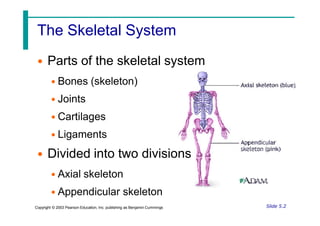
• Parts of the skeletal system
• Bones (skeleton)
• Joints
• Cartilages
• Ligaments
• Divided into two divisions
• Axial skeleton
• Appendicular skeleton
Slide 5.2
Copyright © 2003 Pearson Education, Inc. publishing as Benjamin Cummings
Functions of Bones
• Support of the body
• Protection of soft organs
• Movement due to attached skeletal
muscles
• Storage of minerals (Ca and P) and fats
• Blood cell formation - hematopoiesis
Slide 5.3
Copyright © 2003 Pearson Education, Inc. publishing as Benjamin Cummings
Bones of the Human Body
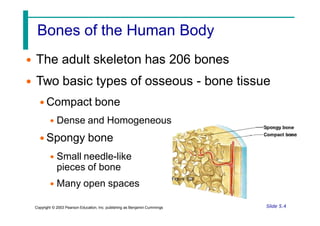
• The adult skeleton has 206 bones
• Two basic types of osseous - bone tissue
• Compact bone
• Dense and Homogeneous
• Spongy bone
• Small needle-like
pieces of bone
• Many open spaces
Figure 5.2b
Slide 5.4
Copyright © 2003 Pearson Education, Inc. publishing as Benjamin Cummings
Classification of Bones
• Bones are classifies according to shape
into four groups:
• Long bones
• Typically longer than wide
• Have a shaft with heads at both ends
• Contain mostly compact bone
• Examples: Femur, humerus
Slide 5.5
Copyright © 2003 Pearson Education, Inc. publishing as Benjamin Cummings
Classification of Bones
• Short bones
• Generally cube-shape
• Contain mostly spongy bone
• Examples: Carpals, tarsals
• Sesamoid bones – form within tendons
• Examples: patella or kneecap
Slide 5.6
Copyright © 2003 Pearson Education, Inc. publishing as Benjamin Cummings
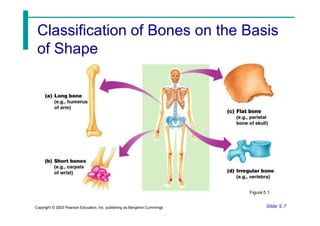
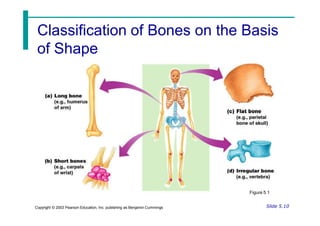
Classification of Bones on the Basis
of Shape
Figure 5.1
Slide 5.7
Copyright © 2003 Pearson Education, Inc. publishing as Benjamin Cummings
Classification of Bones
• Flat bones
• Thin and flattened
• Usually curved
• Thin layers of compact bone around a layer
of spongy bone
• Examples: Skull, ribs, sternum
Slide 5.8
Copyright © 2003 Pearson Education, Inc. publishing as Benjamin Cummings
Classification of Bones
• Irregular bones
• Irregular shape
• Do not fit into other bone classification
categories
• Example: Vertebrae and hip
Slide 5.9
Copyright © 2003 Pearson Education, Inc. publishing as Benjamin Cummings
Classification of Bones on the Basis
of Shape
Figure 5.1
Slide 5.10
Copyright © 2003 Pearson Education, Inc. publishing as Benjamin Cummings
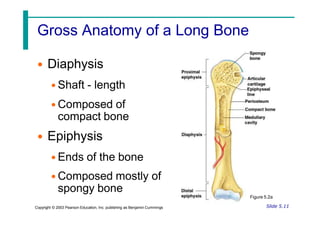
Gross Anatomy of a Long Bone
• Diaphysis
• Shaft - length
• Composed of
compact bone
• Epiphysis
• Ends of the bone
• Composed mostly of
spongy bone
Slide 5.11
Copyright © 2003 Pearson Education, Inc. publishing as Benjamin Cummings
Figure 5.2a
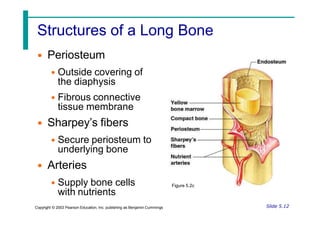
Structures of a Long Bone
• Periosteum
• Outside covering of
the diaphysis
• Fibrous connective
tissue membrane
• Sharpey’s fibers
• Secure periosteum to
underlying bone
• Arteries
• Supply bone cells
with nutrients
Slide 5.12
Copyright © 2003 Pearson Education, Inc. publishing as Benjamin Cummings
Figure 5.2c
Structures of a Long Bone
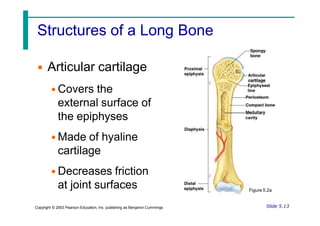
• Articular cartilage
• Covers the
external surface of
the epiphyses
• Made of hyaline
cartilage
• Decreases friction
at joint surfaces
Slide 5.13
Copyright © 2003 Pearson Education, Inc. publishing as Benjamin Cummings
Figure 5.2a
Structures of a Long Bone
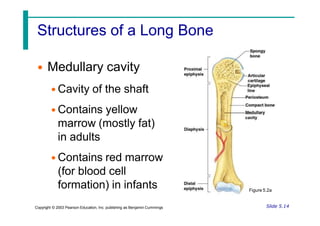
• Medullary cavity
• Cavity of the shaft
• Contains yellow
marrow (mostly fat)
in adults
• Contains red marrow
(for blood cell
formation) in infants Figure 5.2a
Slide 5.14
Copyright © 2003 Pearson Education, Inc. publishing as Benjamin Cummings
Bone Markings
• Surface features of bones
• Sites of attachments for muscles, tendons,
and ligaments
• Passages for nerves and blood vessels
• Categories of bone markings
• Projections or processes – grow out from the
bone surface
• Depressions or cavities – indentations
Slide 5.15
Copyright © 2003 Pearson Education, Inc. publishing as Benjamin Cummings
Microscopic Anatomy of Bone
• Osteon (Haversian System)
• A unit of bone
• Central (Haversian) canal
• Opening in the center of an osteon
• Carries blood vessels and nerves
• Perforating (Volkman’s) canal
• Canal perpendicular to the central canal
• Carries blood vessels and nerves
Slide 5.16
Copyright © 2003 Pearson Education, Inc. publishing as Benjamin Cummings
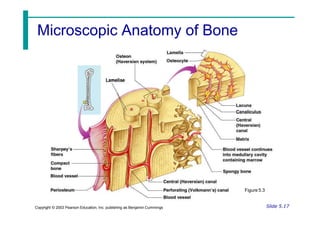
Microscopic Anatomy of Bone
Figure 5.3
Slide 5.17
Copyright © 2003 Pearson Education, Inc. publishing as Benjamin Cummings
Microscopic Anatomy of Bone
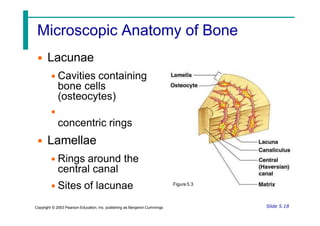
• Lacunae
• Cavities containing
bone cells
(osteocytes)
•
concentric rings
• Lamellae
• Rings around the
central canal
• Sites of lacunae Figure 5.3
Slide 5.18
Copyright © 2003 Pearson Education, Inc. publishing as Benjamin Cummings
Microscopic Anatomy of Bone
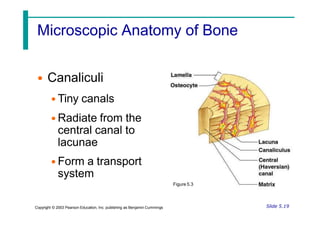
• Canaliculi
• Tiny canals
• Radiate from the
central canal to
lacunae
• Form a transport
system
Figure 5.3
Slide 5.19
Copyright © 2003 Pearson Education, Inc. publishing as Benjamin Cummings
Changes in the Human Skeleton
• In embryos, the skeleton is primarily hyaline
cartilage
• During development, much of this cartilage
is replaced by bone
• Cartilage remains in isolated areas
• Bridge of the nose
• Parts of ribs
• Joints
Slide 5.20
Copyright © 2003 Pearson Education, Inc. publishing as Benjamin Cummings
Bone Growth
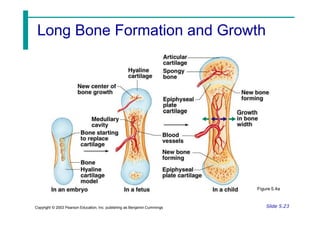
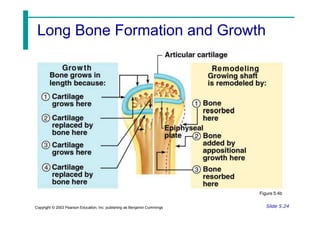
• Epiphyseal plates allow for growth of long
bone during childhood
• New cartilage is continuously formed
• Older cartilage becomes ossified
• Cartilage is broken down
• Bone replaces cartilage
• Process of bone formation – ossification done
by bone-forming cells called osteoblasts
Slide 5.21
Copyright © 2003 Pearson Education, Inc. publishing as Benjamin Cummings
Bone Growth
• Bones are remodeled and lengthened until
growth stops
• Bones change shape somewhat
• Bones grow in width – appositional growth
• Growth due to growth hormones and sex
hormones
•Bones are remodeled continually in response to:
• Calcium levels in blood and pull of gravity and
muscles on the bones Slide 5.22
Copyright © 2003 Pearson Education, Inc. publishing as Benjamin Cummings
Long Bone Formation and Growth
Figure 5.4a
Slide 5.23
Copyright © 2003 Pearson Education, Inc. publishing as Benjamin Cummings
Long Bone Formation and Growth
Figure 5.4b
Slide 5.24
Copyright © 2003 Pearson Education, Inc. publishing as Benjamin Cummings
Types of Bone Cells
• Osteocytes
• Mature bone cells
• Osteoblasts
• Bone-forming cells
• Osteoclasts
• Bone-destroying cells
• Break down bone matrix for remodeling and
release of calcium
• Bone remodeling is a process by both
osteoblasts and osteoclasts
Slide 5.25
Copyright © 2003 Pearson Education, Inc. publishing as Benjamin Cummings
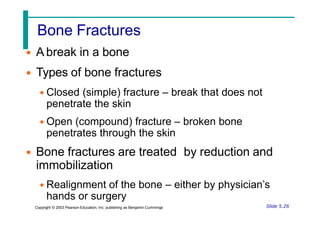
Bone Fractures
• A break in a bone
• Types of bone fractures
• Closed (simple) fracture – break that does not
penetrate the skin
• Open (compound) fracture – broken bone
penetrates through the skin
• Bone fractures are treated by reduction and
immobilization
• Realignment of the bone – either by physician’s
hands or surgery
Slide 5.26
Copyright © 2003 Pearson Education, Inc. publishing as Benjamin Cummings
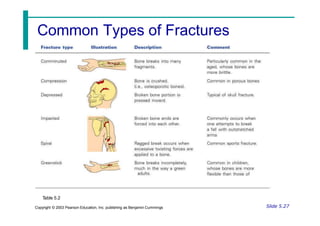
Common Types of Fractures
T
able 5.2
Slide 5.27
Copyright © 2003 Pearson Education, Inc. publishing as Benjamin Cummings
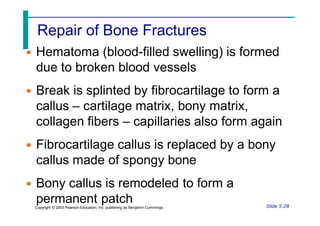
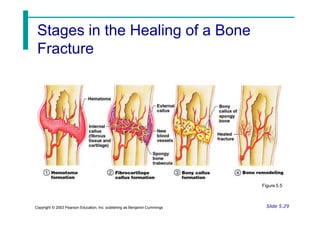
Repair of Bone Fractures
• Hematoma (blood-filled swelling) is formed
Slide 5.28
Copyright © 2003 Pearson Education, Inc. publishing as Benjamin Cummings
due to broken blood vessels
• Break is splinted by fibrocartilage to form a
callus – cartilage matrix, bony matrix,
collagen fibers – capillaries also form again
• Fibrocartilage callus is replaced by a bony
callus made of spongy bone
• Bony callus is remodeled to form a
permanent patch
Stages in the Healing of a Bone
Fracture
Figure 5.5
Slide 5.29
Copyright © 2003 Pearson Education, Inc. publishing as Benjamin Cummings
The Axial Skeleton
• Forms the longitudinal part of the body
• Divided into three parts
• Skull
• Vertebral column
• Bony thorax
Slide 5.30
Copyright © 2003 Pearson Education, Inc. publishing as Benjamin Cummings
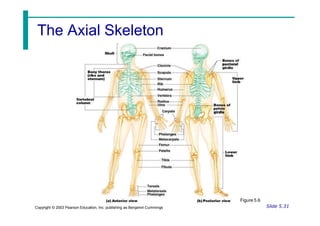
The Axial Skeleton
Figure 5.6
Slide 5.31
Copyright © 2003 Pearson Education, Inc. publishing as Benjamin Cummings
The Skull
• Two sets of bones
• Cranium
• Facial bones
• Bones are joined by sutures –
interlocking, immovable joints
• Only the mandible is attached by a
freely movable joint
Slide 5.32
Copyright © 2003 Pearson Education, Inc. publishing as Benjamin Cummings
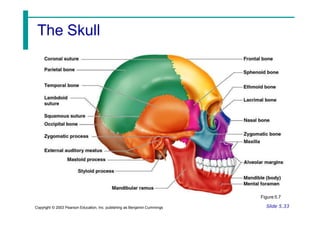
The Skull
Figure 5.7
Slide 5.33
Copyright © 2003 Pearson Education, Inc. publishing as Benjamin Cummings
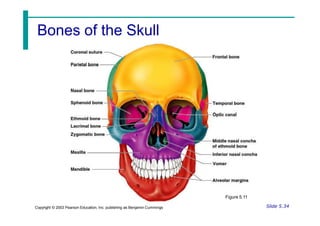
Bones of the Skull
Figure 5.11
Slide 5.34
Copyright © 2003 Pearson Education, Inc. publishing as Benjamin Cummings
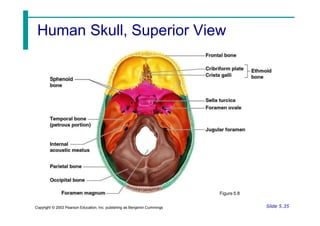
Human Skull, Superior View
Figure 5.8
Slide 5.35
Copyright © 2003 Pearson Education, Inc. publishing as Benjamin Cummings
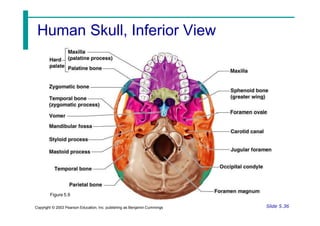
Human Skull, Inferior View
Figure 5.9
Slide 5.36
Copyright © 2003 Pearson Education, Inc. publishing as Benjamin Cummings
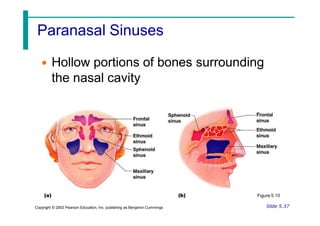
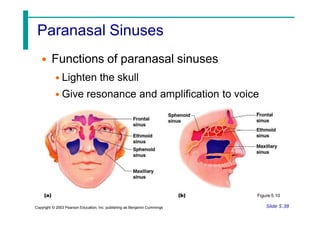
Paranasal Sinuses
• Hollow portions of bones surrounding
the nasal cavity
Figure 5.10
Slide 5.37
Copyright © 2003 Pearson Education, Inc. publishing as Benjamin Cummings
Paranasal Sinuses
• Functions of paranasal sinuses
• Lighten the skull
• Give resonance and amplification to voice
Figure 5.10
Slide 5.38
Copyright © 2003 Pearson Education, Inc. publishing as Benjamin Cummings
The Hyoid Bone
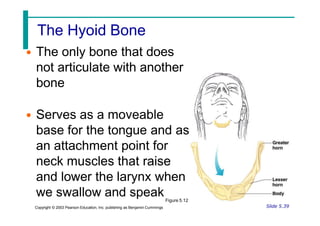
• The only bone that does
not articulate with another
bone
• Serves as a moveable
base for the tongue and as
an attachment point for
neck muscles that raise
and lower the larynx when
we swallow and speakFigure 5.12
Slide 5.39
Copyright © 2003 Pearson Education, Inc. publishing as Benjamin Cummings
The Fetal Skull
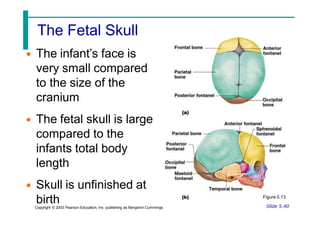
• The infant’s face is
very small compared
to the size of the
cranium
• The fetal skull is large
compared to the
infants total body
length
• Skull is unfinished at
birth Slide 5.40
Copyright © 2003 Pearson Education, Inc. publishing as Benjamin Cummings
Figure 5.13
The Fetal Skull
g
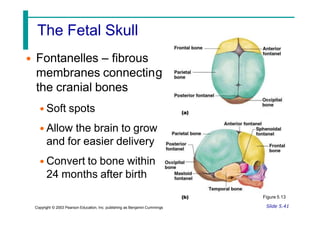
• Fontanelles – fibrous
membranes connectin
the cranial bones
• Soft spots
• Allow the brain to grow
and for easier delivery
• Convert to bone within
24 months after birth
Figure 5.13
Slide 5.41
Copyright © 2003 Pearson Education, Inc. publishing as Benjamin Cummings
The Vertebral Column – Spine
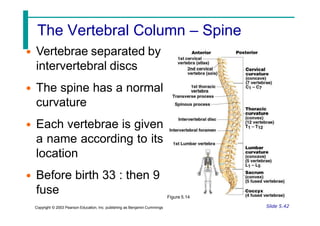
• Vertebrae separated by
intervertebral discs
• The spine has a normal
curvature
• Each vertebrae is given
a name according to its
location
• Before birth 33 : then 9
fuse
Slide 5.42
Copyright © 2003 Pearson Education, Inc. publishing as Benjamin Cummings
Figure 5.14
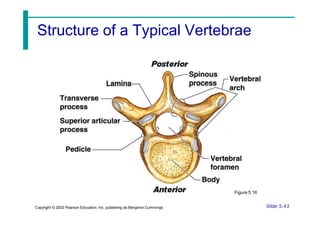
Structure of a Typical Vertebrae
Figure 5.16
Slide 5.43
Copyright © 2003 Pearson Education, Inc. publishing as Benjamin Cummings
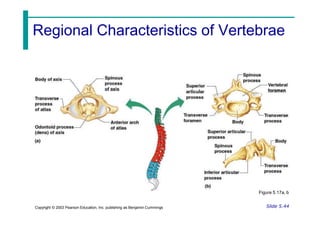
Regional Characteristics of Vertebrae
Figure 5.17a, b
Slide 5.44
Copyright © 2003 Pearson Education, Inc. publishing as Benjamin Cummings
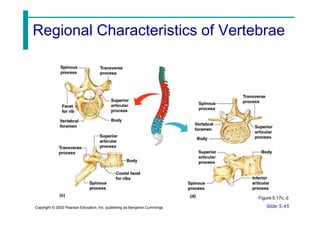
Regional Characteristics of Vertebrae
Figure 5.17c, d
Slide 5.45
Copyright © 2003 Pearson Education, Inc. publishing as Benjamin Cummings
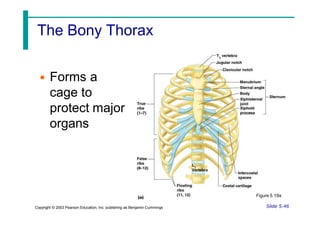
The Bony Thorax
• Forms a
cage to
protect major
organs
Figure 5.19a
Slide 5.46
Copyright © 2003 Pearson Education, Inc. publishing as Benjamin Cummings
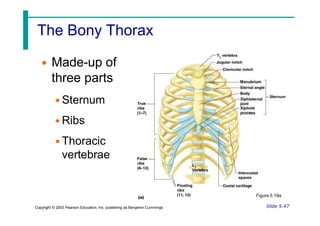
The Bony Thorax
• Made-up of
three parts
• Sternum
• Ribs
• Thoracic
vertebrae
Figure 5.19a
Slide 5.47
Copyright © 2003 Pearson Education, Inc. publishing as Benjamin Cummings
The Appendicular Skeleton
• 126 bones of the:
• Limbs (appendages)
• Pectoral girdle
• Pelvic girdle
Slide 5.48
Copyright © 2003 Pearson Education, Inc. publishing as Benjamin Cummings
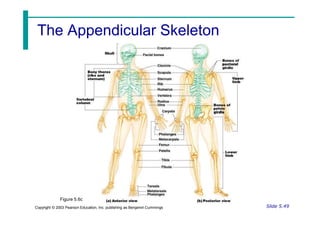
The Appendicular Skeleton
Figure 5.6c
Slide 5.49
Copyright © 2003 Pearson Education, Inc. publishing as Benjamin Cummings
The Pectoral (Shoulder) Girdle
• Composed of two bones
• Clavicle – collarbone and Scapula – shoulder blade
• These bones allow the upper limb to have
exceptionally free movement due to:
• Each shoulder girdle attaches to the axial skeleton
at only one point
• Loose attachment of the scapula allows it to slide
back and forth against the thorax as muscles act
• The glenoid cavity is shallow, and the shoulder joint
Slide 5.50
is poorly reinforces by ligaments
Bones of the Shoulder Girdle
Figure 5.20a, b
Slide 5.51
Copyright © 2003 Pearson Education, Inc. publishing as Benjamin Cummings
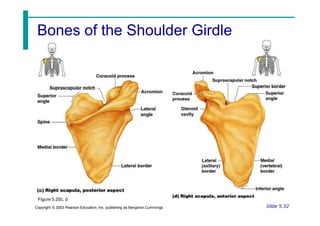
Bones of the Shoulder Girdle
Figure 5.20c, d
Slide 5.52
Copyright © 2003 Pearson Education, Inc. publishing as Benjamin Cummings
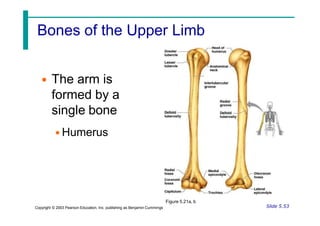
Bones of the Upper Limb
Slide 5.53
• The arm is
formed by a
single bone
• Humerus
Figure 5.21a, b
Copyright © 2003 Pearson Education, Inc. publishing as Benjamin Cummings
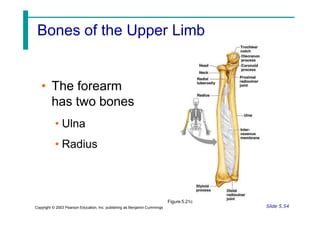
Bones of the Upper Limb
• The forearm
has two bones
• Ulna
• Radius
Slide 5.54
Copyright © 2003 Pearson Education, Inc. publishing as Benjamin Cummings
Figure 5.21c
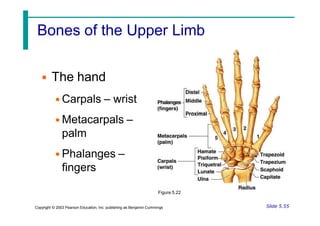
Bones of the Upper Limb
• The hand
• Carpals – wrist
• Metacarpals –
palm
• Phalanges –
fingers
Slide 5.55
Copyright © 2003 Pearson Education, Inc. publishing as Benjamin Cummings
Figure 5.22
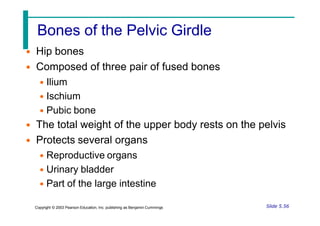
Bones of the Pelvic Girdle
• Hip bones
• Composed of three pair of fused bones
• Ilium
• Ischium
• Pubic bone
• The total weight of the upper body rests on the pelvis
• Protects several organs
• Reproductive organs
• Urinary bladder
• Part of the large intestine
Slide 5.56
Copyright © 2003 Pearson Education, Inc. publishing as Benjamin Cummings
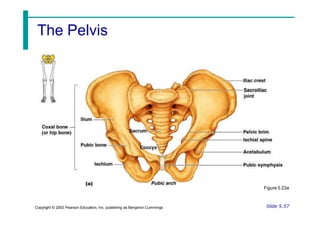
The Pelvis
Figure 5.23a
Slide 5.57
Copyright © 2003 Pearson Education, Inc. publishing as Benjamin Cummings
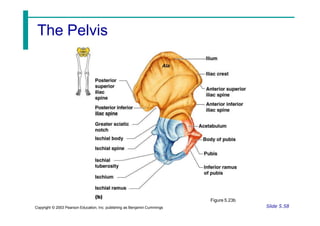
The Pelvis
Figure 5.23b
Slide 5.58
Copyright © 2003 Pearson Education, Inc. publishing as Benjamin Cummings
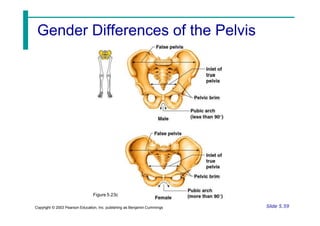
Gender Differences of the Pelvis
Figure 5.23c
Slide 5.59
Copyright © 2003 Pearson Education, Inc. publishing as Benjamin Cummings
Bones of the Lower Limbs
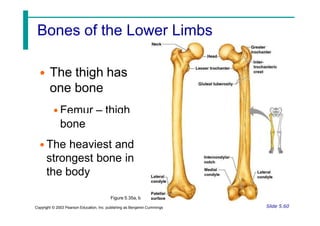
• The thigh has
one bone
• Femur – thigh
bone
• The heaviest and
strongest bone in
the body
Figure 5.35a, b
Slide 5.60
Copyright © 2003 Pearson Education, Inc. publishing as Benjamin Cummings
Bones of the Lower Limbs
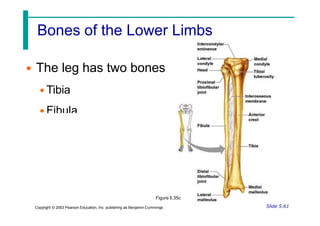
• The leg has two bones
• Tibia
• Fibula
Figure 5.35c
Slide 5.61
Copyright © 2003 Pearson Education, Inc. publishing as Benjamin Cummings
Bones of the Lower Limbs
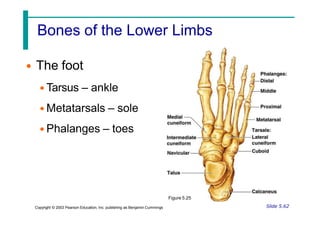
• The foot
• Tarsus – ankle
• Metatarsals – sole
• Phalanges – toes
Figure 5.25
Slide 5.62
Copyright © 2003 Pearson Education, Inc. publishing as Benjamin Cummings
Arches of the Foot
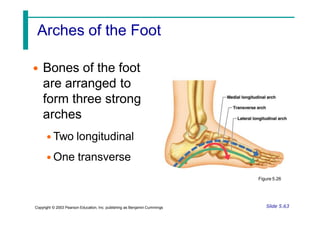
• Bones of the foot
are arranged to
form three strong
arches
• Two longitudinal
• One transverse
Figure 5.26
Slide 5.63
Copyright © 2003 Pearson Education, Inc. publishing as Benjamin Cummings
Joints
• Articulations of bones
• Functions of joints
• Hold bones together
• Allow for mobility
• Ways joints are classified
• Functionally
• Structurally
Slide 5.64
Copyright © 2003 Pearson Education, Inc. publishing as Benjamin Cummings
Functional Classification of Joints
• Synarthroses – immovable joints
• Amphiarthroses – slightly moveable
joints
• Diarthroses – freely moveable joints
Slide 5.65
Copyright © 2003 Pearson Education, Inc. publishing as Benjamin Cummings
Structural Classification of Joints
• Fibrous joints
• Generally immovable
• Cartilaginous joints
• Immovable or slightly moveable
• Synovial joints
• Freely moveable
Slide 5.66
Copyright © 2003 Pearson Education, Inc. publishing as Benjamin Cummings
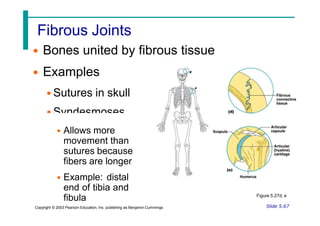
Fibrous Joints
• Bones united by fibrous tissue
• Examples
• Sutures in skull
• Syndesmoses
• Allows more
movement than
sutures because
fibers are longer
• Example: distal
end of tibia and
fibula Figure 5.27d, e
Slide 5.67
Copyright © 2003 Pearson Education, Inc. publishing as Benjamin Cummings
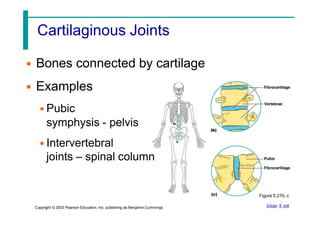
Cartilaginous Joints
• Bones connected by cartilage
• Examples
• Pubic
Figure 5.27b, c
Slide 5.68
Copyright © 2003 Pearson Education, Inc. publishing as Benjamin Cummings
symphysis - pelvis
• Intervertebral
joints – spinal column
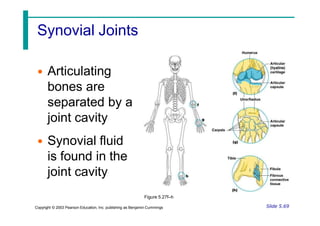
Synovial Joints
• Articulating
bones are
separated by a
joint cavity
• Synovial fluid
is found in the
joint cavity
Slide 5.69
Copyright © 2003 Pearson Education, Inc. publishing as Benjamin Cummings
Figure 5.27f–h
Features of Synovial Joints
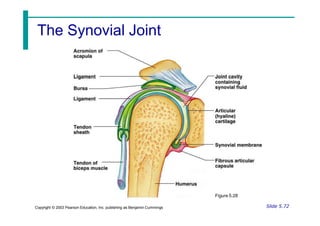
• Articular cartilage (hyaline cartilage)
covers the ends of bones
• Joint surfaces are enclosed by a fibrous
articular capsule
• Have a joint cavity filled with synovial
fluid
• Ligaments reinforce the joint
Slide 5.70
Copyright © 2003 Pearson Education, Inc. publishing as Benjamin Cummings
Structures Associated with the Synovial
Joint
• Bursae – flattened fibrous sacs
• Lined with synovial membranes
• Filled with synovial fluid
• Not actually part of the joint and common where
ligaments, muscles, skin, tendons, or bones rub
together
• Tendon sheath
• Elongated bursa that wraps around a tendon
Slide 5.71
Copyright © 2003 Pearson Education, Inc. publishing as Benjamin Cummings
The Synovial Joint
Figure 5.28
Slide 5.72
Copyright © 2003 Pearson Education, Inc. publishing as Benjamin Cummings
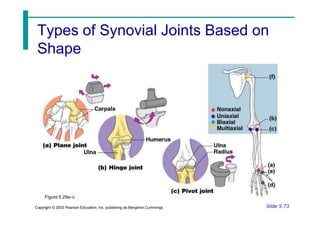
Types of Synovial Joints Based on
Shape
Figure 5.29a–c
Slide 5.73
Copyright © 2003 Pearson Education, Inc. publishing as Benjamin Cummings
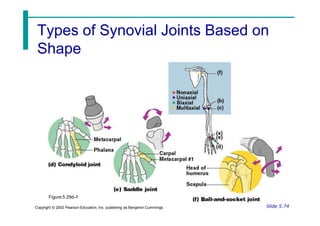
Types of Synovial Joints Based on
Shape
Figure 5.29d–f
Slide 5.74
Copyright © 2003 Pearson Education, Inc. publishing as Benjamin Cummings
Inflammatory Conditions Associated
with Joints
• Bursitis – inflammation of a bursa usually caused
by a blow or friction to the knee
• Tendonitis – inflammation of tendon sheaths -
sprain
• Arthritis – inflammatory or degenerative diseases
of joints
• Over 100 different types
• The most widespread crippling disease in the
United States
Slide 5.75
Copyright © 2003 Pearson Education, Inc. publishing as Benjamin Cummings
Clinical Forms of Arthritis
• Osteoarthritis – wear-and-tear arthritis
• Most common chronic arthritis
• Probably related to normal aging processes
• Rheumatoid arthritis
• An autoimmune disease – the immune system
attacks the joints
• Symptoms begin with bilateral inflammation of
certain joints
• Often leads to deformities
Slide 5.76
Copyright © 2003 Pearson Education, Inc. publishing as Benjamin Cummings
Clinical Forms of Arthritis
• Gouty Arthritis - Gout
• Inflammation of joints is caused by an
accumulation in blood and deposition of
urate crystals (uric acid) from the blood
• Usually affects only one joint
• Can usually be controlled with diet
Slide 5.77
Copyright © 2003 Pearson Education, Inc. publishing as Benjamin Cummings

Skeletal System anatomy and physiology ppt

  • 1.
    Essentials of HumanAnatomy & Physiology Seventh Edition Elaine N. Marieb Chapter 5 The Skeletal System Slides 5.1 – 5.77 Lecture Slides in PowerPoint by Jerry L. Cook Copyright © 2003 Pearson Education, Inc. publishing as Benjamin Cummings You don’t want to make errors, because one thing you do wrong could cost this patient his or her life.
  • 2.
    The Skeletal System •Parts of the skeletal system • Bones (skeleton) • Joints • Cartilages • Ligaments • Divided into two divisions • Axial skeleton • Appendicular skeleton Slide 5.2 Copyright © 2003 Pearson Education, Inc. publishing as Benjamin Cummings
  • 3.
    Functions of Bones •Support of the body • Protection of soft organs • Movement due to attached skeletal muscles • Storage of minerals (Ca and P) and fats • Blood cell formation - hematopoiesis Slide 5.3 Copyright © 2003 Pearson Education, Inc. publishing as Benjamin Cummings
  • 4.
    Bones of theHuman Body • The adult skeleton has 206 bones • Two basic types of osseous - bone tissue • Compact bone • Dense and Homogeneous • Spongy bone • Small needle-like pieces of bone • Many open spaces Figure 5.2b Slide 5.4 Copyright © 2003 Pearson Education, Inc. publishing as Benjamin Cummings
  • 5.
    Classification of Bones •Bones are classifies according to shape into four groups: • Long bones • Typically longer than wide • Have a shaft with heads at both ends • Contain mostly compact bone • Examples: Femur, humerus Slide 5.5 Copyright © 2003 Pearson Education, Inc. publishing as Benjamin Cummings
  • 6.
    Classification of Bones •Short bones • Generally cube-shape • Contain mostly spongy bone • Examples: Carpals, tarsals • Sesamoid bones – form within tendons • Examples: patella or kneecap Slide 5.6 Copyright © 2003 Pearson Education, Inc. publishing as Benjamin Cummings
  • 7.
    Classification of Boneson the Basis of Shape Figure 5.1 Slide 5.7 Copyright © 2003 Pearson Education, Inc. publishing as Benjamin Cummings
  • 8.
    Classification of Bones •Flat bones • Thin and flattened • Usually curved • Thin layers of compact bone around a layer of spongy bone • Examples: Skull, ribs, sternum Slide 5.8 Copyright © 2003 Pearson Education, Inc. publishing as Benjamin Cummings
  • 9.
    Classification of Bones •Irregular bones • Irregular shape • Do not fit into other bone classification categories • Example: Vertebrae and hip Slide 5.9 Copyright © 2003 Pearson Education, Inc. publishing as Benjamin Cummings
  • 10.
    Classification of Boneson the Basis of Shape Figure 5.1 Slide 5.10 Copyright © 2003 Pearson Education, Inc. publishing as Benjamin Cummings
  • 11.
    Gross Anatomy ofa Long Bone • Diaphysis • Shaft - length • Composed of compact bone • Epiphysis • Ends of the bone • Composed mostly of spongy bone Slide 5.11 Copyright © 2003 Pearson Education, Inc. publishing as Benjamin Cummings Figure 5.2a
  • 12.
    Structures of aLong Bone • Periosteum • Outside covering of the diaphysis • Fibrous connective tissue membrane • Sharpey’s fibers • Secure periosteum to underlying bone • Arteries • Supply bone cells with nutrients Slide 5.12 Copyright © 2003 Pearson Education, Inc. publishing as Benjamin Cummings Figure 5.2c
  • 13.
    Structures of aLong Bone • Articular cartilage • Covers the external surface of the epiphyses • Made of hyaline cartilage • Decreases friction at joint surfaces Slide 5.13 Copyright © 2003 Pearson Education, Inc. publishing as Benjamin Cummings Figure 5.2a
  • 14.
    Structures of aLong Bone • Medullary cavity • Cavity of the shaft • Contains yellow marrow (mostly fat) in adults • Contains red marrow (for blood cell formation) in infants Figure 5.2a Slide 5.14 Copyright © 2003 Pearson Education, Inc. publishing as Benjamin Cummings
  • 15.
    Bone Markings • Surfacefeatures of bones • Sites of attachments for muscles, tendons, and ligaments • Passages for nerves and blood vessels • Categories of bone markings • Projections or processes – grow out from the bone surface • Depressions or cavities – indentations Slide 5.15 Copyright © 2003 Pearson Education, Inc. publishing as Benjamin Cummings
  • 16.
    Microscopic Anatomy ofBone • Osteon (Haversian System) • A unit of bone • Central (Haversian) canal • Opening in the center of an osteon • Carries blood vessels and nerves • Perforating (Volkman’s) canal • Canal perpendicular to the central canal • Carries blood vessels and nerves Slide 5.16 Copyright © 2003 Pearson Education, Inc. publishing as Benjamin Cummings
  • 17.
    Microscopic Anatomy ofBone Figure 5.3 Slide 5.17 Copyright © 2003 Pearson Education, Inc. publishing as Benjamin Cummings
  • 18.
    Microscopic Anatomy ofBone • Lacunae • Cavities containing bone cells (osteocytes) • concentric rings • Lamellae • Rings around the central canal • Sites of lacunae Figure 5.3 Slide 5.18 Copyright © 2003 Pearson Education, Inc. publishing as Benjamin Cummings
  • 19.
    Microscopic Anatomy ofBone • Canaliculi • Tiny canals • Radiate from the central canal to lacunae • Form a transport system Figure 5.3 Slide 5.19 Copyright © 2003 Pearson Education, Inc. publishing as Benjamin Cummings
  • 20.
    Changes in theHuman Skeleton • In embryos, the skeleton is primarily hyaline cartilage • During development, much of this cartilage is replaced by bone • Cartilage remains in isolated areas • Bridge of the nose • Parts of ribs • Joints Slide 5.20 Copyright © 2003 Pearson Education, Inc. publishing as Benjamin Cummings
  • 21.
    Bone Growth • Epiphysealplates allow for growth of long bone during childhood • New cartilage is continuously formed • Older cartilage becomes ossified • Cartilage is broken down • Bone replaces cartilage • Process of bone formation – ossification done by bone-forming cells called osteoblasts Slide 5.21 Copyright © 2003 Pearson Education, Inc. publishing as Benjamin Cummings
  • 22.
    Bone Growth • Bonesare remodeled and lengthened until growth stops • Bones change shape somewhat • Bones grow in width – appositional growth • Growth due to growth hormones and sex hormones •Bones are remodeled continually in response to: • Calcium levels in blood and pull of gravity and muscles on the bones Slide 5.22 Copyright © 2003 Pearson Education, Inc. publishing as Benjamin Cummings
  • 23.
    Long Bone Formationand Growth Figure 5.4a Slide 5.23 Copyright © 2003 Pearson Education, Inc. publishing as Benjamin Cummings
  • 24.
    Long Bone Formationand Growth Figure 5.4b Slide 5.24 Copyright © 2003 Pearson Education, Inc. publishing as Benjamin Cummings
  • 25.
    Types of BoneCells • Osteocytes • Mature bone cells • Osteoblasts • Bone-forming cells • Osteoclasts • Bone-destroying cells • Break down bone matrix for remodeling and release of calcium • Bone remodeling is a process by both osteoblasts and osteoclasts Slide 5.25 Copyright © 2003 Pearson Education, Inc. publishing as Benjamin Cummings
  • 26.
    Bone Fractures • Abreak in a bone • Types of bone fractures • Closed (simple) fracture – break that does not penetrate the skin • Open (compound) fracture – broken bone penetrates through the skin • Bone fractures are treated by reduction and immobilization • Realignment of the bone – either by physician’s hands or surgery Slide 5.26 Copyright © 2003 Pearson Education, Inc. publishing as Benjamin Cummings
  • 27.
    Common Types ofFractures T able 5.2 Slide 5.27 Copyright © 2003 Pearson Education, Inc. publishing as Benjamin Cummings
  • 28.
    Repair of BoneFractures • Hematoma (blood-filled swelling) is formed Slide 5.28 Copyright © 2003 Pearson Education, Inc. publishing as Benjamin Cummings due to broken blood vessels • Break is splinted by fibrocartilage to form a callus – cartilage matrix, bony matrix, collagen fibers – capillaries also form again • Fibrocartilage callus is replaced by a bony callus made of spongy bone • Bony callus is remodeled to form a permanent patch
  • 29.
    Stages in theHealing of a Bone Fracture Figure 5.5 Slide 5.29 Copyright © 2003 Pearson Education, Inc. publishing as Benjamin Cummings
  • 30.
    The Axial Skeleton •Forms the longitudinal part of the body • Divided into three parts • Skull • Vertebral column • Bony thorax Slide 5.30 Copyright © 2003 Pearson Education, Inc. publishing as Benjamin Cummings
  • 31.
    The Axial Skeleton Figure5.6 Slide 5.31 Copyright © 2003 Pearson Education, Inc. publishing as Benjamin Cummings
  • 32.
    The Skull • Twosets of bones • Cranium • Facial bones • Bones are joined by sutures – interlocking, immovable joints • Only the mandible is attached by a freely movable joint Slide 5.32 Copyright © 2003 Pearson Education, Inc. publishing as Benjamin Cummings
  • 33.
    The Skull Figure 5.7 Slide5.33 Copyright © 2003 Pearson Education, Inc. publishing as Benjamin Cummings
  • 34.
    Bones of theSkull Figure 5.11 Slide 5.34 Copyright © 2003 Pearson Education, Inc. publishing as Benjamin Cummings
  • 35.
    Human Skull, SuperiorView Figure 5.8 Slide 5.35 Copyright © 2003 Pearson Education, Inc. publishing as Benjamin Cummings
  • 36.
    Human Skull, InferiorView Figure 5.9 Slide 5.36 Copyright © 2003 Pearson Education, Inc. publishing as Benjamin Cummings
  • 37.
    Paranasal Sinuses • Hollowportions of bones surrounding the nasal cavity Figure 5.10 Slide 5.37 Copyright © 2003 Pearson Education, Inc. publishing as Benjamin Cummings
  • 38.
    Paranasal Sinuses • Functionsof paranasal sinuses • Lighten the skull • Give resonance and amplification to voice Figure 5.10 Slide 5.38 Copyright © 2003 Pearson Education, Inc. publishing as Benjamin Cummings
  • 39.
    The Hyoid Bone •The only bone that does not articulate with another bone • Serves as a moveable base for the tongue and as an attachment point for neck muscles that raise and lower the larynx when we swallow and speakFigure 5.12 Slide 5.39 Copyright © 2003 Pearson Education, Inc. publishing as Benjamin Cummings
  • 40.
    The Fetal Skull •The infant’s face is very small compared to the size of the cranium • The fetal skull is large compared to the infants total body length • Skull is unfinished at birth Slide 5.40 Copyright © 2003 Pearson Education, Inc. publishing as Benjamin Cummings Figure 5.13
  • 41.
    The Fetal Skull g •Fontanelles – fibrous membranes connectin the cranial bones • Soft spots • Allow the brain to grow and for easier delivery • Convert to bone within 24 months after birth Figure 5.13 Slide 5.41 Copyright © 2003 Pearson Education, Inc. publishing as Benjamin Cummings
  • 42.
    The Vertebral Column– Spine • Vertebrae separated by intervertebral discs • The spine has a normal curvature • Each vertebrae is given a name according to its location • Before birth 33 : then 9 fuse Slide 5.42 Copyright © 2003 Pearson Education, Inc. publishing as Benjamin Cummings Figure 5.14
  • 43.
    Structure of aTypical Vertebrae Figure 5.16 Slide 5.43 Copyright © 2003 Pearson Education, Inc. publishing as Benjamin Cummings
  • 44.
    Regional Characteristics ofVertebrae Figure 5.17a, b Slide 5.44 Copyright © 2003 Pearson Education, Inc. publishing as Benjamin Cummings
  • 45.
    Regional Characteristics ofVertebrae Figure 5.17c, d Slide 5.45 Copyright © 2003 Pearson Education, Inc. publishing as Benjamin Cummings
  • 46.
    The Bony Thorax •Forms a cage to protect major organs Figure 5.19a Slide 5.46 Copyright © 2003 Pearson Education, Inc. publishing as Benjamin Cummings
  • 47.
    The Bony Thorax •Made-up of three parts • Sternum • Ribs • Thoracic vertebrae Figure 5.19a Slide 5.47 Copyright © 2003 Pearson Education, Inc. publishing as Benjamin Cummings
  • 48.
    The Appendicular Skeleton •126 bones of the: • Limbs (appendages) • Pectoral girdle • Pelvic girdle Slide 5.48 Copyright © 2003 Pearson Education, Inc. publishing as Benjamin Cummings
  • 49.
    The Appendicular Skeleton Figure5.6c Slide 5.49 Copyright © 2003 Pearson Education, Inc. publishing as Benjamin Cummings
  • 50.
    The Pectoral (Shoulder)Girdle • Composed of two bones • Clavicle – collarbone and Scapula – shoulder blade • These bones allow the upper limb to have exceptionally free movement due to: • Each shoulder girdle attaches to the axial skeleton at only one point • Loose attachment of the scapula allows it to slide back and forth against the thorax as muscles act • The glenoid cavity is shallow, and the shoulder joint Slide 5.50 is poorly reinforces by ligaments
  • 51.
    Bones of theShoulder Girdle Figure 5.20a, b Slide 5.51 Copyright © 2003 Pearson Education, Inc. publishing as Benjamin Cummings
  • 52.
    Bones of theShoulder Girdle Figure 5.20c, d Slide 5.52 Copyright © 2003 Pearson Education, Inc. publishing as Benjamin Cummings
  • 53.
    Bones of theUpper Limb Slide 5.53 • The arm is formed by a single bone • Humerus Figure 5.21a, b Copyright © 2003 Pearson Education, Inc. publishing as Benjamin Cummings
  • 54.
    Bones of theUpper Limb • The forearm has two bones • Ulna • Radius Slide 5.54 Copyright © 2003 Pearson Education, Inc. publishing as Benjamin Cummings Figure 5.21c
  • 55.
    Bones of theUpper Limb • The hand • Carpals – wrist • Metacarpals – palm • Phalanges – fingers Slide 5.55 Copyright © 2003 Pearson Education, Inc. publishing as Benjamin Cummings Figure 5.22
  • 56.
    Bones of thePelvic Girdle • Hip bones • Composed of three pair of fused bones • Ilium • Ischium • Pubic bone • The total weight of the upper body rests on the pelvis • Protects several organs • Reproductive organs • Urinary bladder • Part of the large intestine Slide 5.56 Copyright © 2003 Pearson Education, Inc. publishing as Benjamin Cummings
  • 57.
    The Pelvis Figure 5.23a Slide5.57 Copyright © 2003 Pearson Education, Inc. publishing as Benjamin Cummings
  • 58.
    The Pelvis Figure 5.23b Slide5.58 Copyright © 2003 Pearson Education, Inc. publishing as Benjamin Cummings
  • 59.
    Gender Differences ofthe Pelvis Figure 5.23c Slide 5.59 Copyright © 2003 Pearson Education, Inc. publishing as Benjamin Cummings
  • 60.
    Bones of theLower Limbs • The thigh has one bone • Femur – thigh bone • The heaviest and strongest bone in the body Figure 5.35a, b Slide 5.60 Copyright © 2003 Pearson Education, Inc. publishing as Benjamin Cummings
  • 61.
    Bones of theLower Limbs • The leg has two bones • Tibia • Fibula Figure 5.35c Slide 5.61 Copyright © 2003 Pearson Education, Inc. publishing as Benjamin Cummings
  • 62.
    Bones of theLower Limbs • The foot • Tarsus – ankle • Metatarsals – sole • Phalanges – toes Figure 5.25 Slide 5.62 Copyright © 2003 Pearson Education, Inc. publishing as Benjamin Cummings
  • 63.
    Arches of theFoot • Bones of the foot are arranged to form three strong arches • Two longitudinal • One transverse Figure 5.26 Slide 5.63 Copyright © 2003 Pearson Education, Inc. publishing as Benjamin Cummings
  • 64.
    Joints • Articulations ofbones • Functions of joints • Hold bones together • Allow for mobility • Ways joints are classified • Functionally • Structurally Slide 5.64 Copyright © 2003 Pearson Education, Inc. publishing as Benjamin Cummings
  • 65.
    Functional Classification ofJoints • Synarthroses – immovable joints • Amphiarthroses – slightly moveable joints • Diarthroses – freely moveable joints Slide 5.65 Copyright © 2003 Pearson Education, Inc. publishing as Benjamin Cummings
  • 66.
    Structural Classification ofJoints • Fibrous joints • Generally immovable • Cartilaginous joints • Immovable or slightly moveable • Synovial joints • Freely moveable Slide 5.66 Copyright © 2003 Pearson Education, Inc. publishing as Benjamin Cummings
  • 67.
    Fibrous Joints • Bonesunited by fibrous tissue • Examples • Sutures in skull • Syndesmoses • Allows more movement than sutures because fibers are longer • Example: distal end of tibia and fibula Figure 5.27d, e Slide 5.67 Copyright © 2003 Pearson Education, Inc. publishing as Benjamin Cummings
  • 68.
    Cartilaginous Joints • Bonesconnected by cartilage • Examples • Pubic Figure 5.27b, c Slide 5.68 Copyright © 2003 Pearson Education, Inc. publishing as Benjamin Cummings symphysis - pelvis • Intervertebral joints – spinal column
  • 69.
    Synovial Joints • Articulating bonesare separated by a joint cavity • Synovial fluid is found in the joint cavity Slide 5.69 Copyright © 2003 Pearson Education, Inc. publishing as Benjamin Cummings Figure 5.27f–h
  • 70.
    Features of SynovialJoints • Articular cartilage (hyaline cartilage) covers the ends of bones • Joint surfaces are enclosed by a fibrous articular capsule • Have a joint cavity filled with synovial fluid • Ligaments reinforce the joint Slide 5.70 Copyright © 2003 Pearson Education, Inc. publishing as Benjamin Cummings
  • 71.
    Structures Associated withthe Synovial Joint • Bursae – flattened fibrous sacs • Lined with synovial membranes • Filled with synovial fluid • Not actually part of the joint and common where ligaments, muscles, skin, tendons, or bones rub together • Tendon sheath • Elongated bursa that wraps around a tendon Slide 5.71 Copyright © 2003 Pearson Education, Inc. publishing as Benjamin Cummings
  • 72.
    The Synovial Joint Figure5.28 Slide 5.72 Copyright © 2003 Pearson Education, Inc. publishing as Benjamin Cummings
  • 73.
    Types of SynovialJoints Based on Shape Figure 5.29a–c Slide 5.73 Copyright © 2003 Pearson Education, Inc. publishing as Benjamin Cummings
  • 74.
    Types of SynovialJoints Based on Shape Figure 5.29d–f Slide 5.74 Copyright © 2003 Pearson Education, Inc. publishing as Benjamin Cummings
  • 75.
    Inflammatory Conditions Associated withJoints • Bursitis – inflammation of a bursa usually caused by a blow or friction to the knee • Tendonitis – inflammation of tendon sheaths - sprain • Arthritis – inflammatory or degenerative diseases of joints • Over 100 different types • The most widespread crippling disease in the United States Slide 5.75 Copyright © 2003 Pearson Education, Inc. publishing as Benjamin Cummings
  • 76.
    Clinical Forms ofArthritis • Osteoarthritis – wear-and-tear arthritis • Most common chronic arthritis • Probably related to normal aging processes • Rheumatoid arthritis • An autoimmune disease – the immune system attacks the joints • Symptoms begin with bilateral inflammation of certain joints • Often leads to deformities Slide 5.76 Copyright © 2003 Pearson Education, Inc. publishing as Benjamin Cummings
  • 77.
    Clinical Forms ofArthritis • Gouty Arthritis - Gout • Inflammation of joints is caused by an accumulation in blood and deposition of urate crystals (uric acid) from the blood • Usually affects only one joint • Can usually be controlled with diet Slide 5.77 Copyright © 2003 Pearson Education, Inc. publishing as Benjamin Cummings