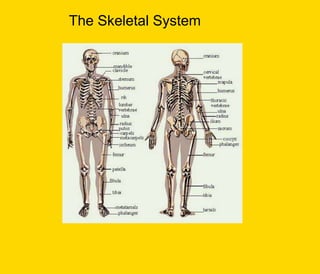
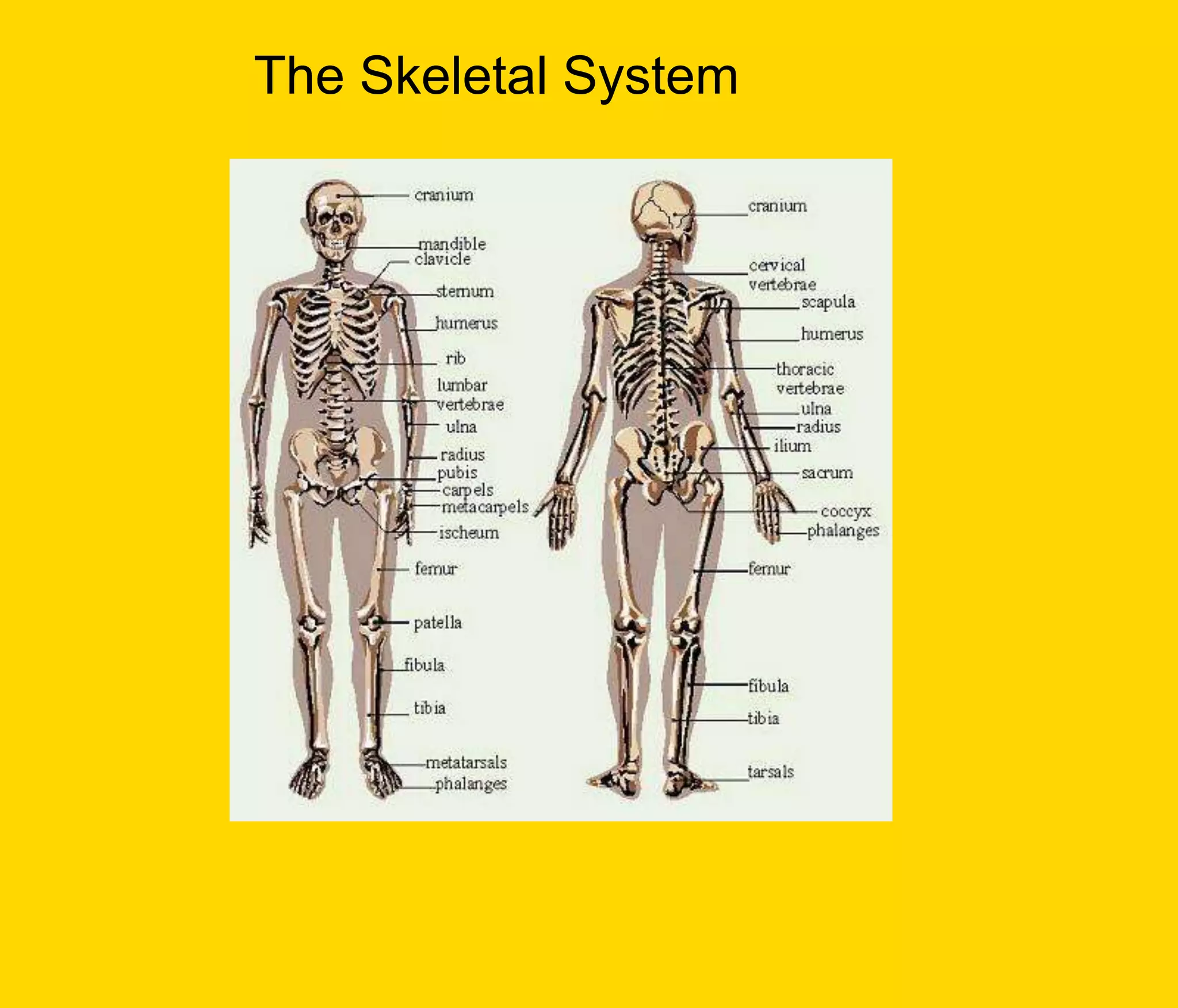
The Skeletal System
What is the Skeletal system?

 Your Skeletal system is all of the bones in the body and the tissues such as
 tendons, ligaments and cartilage that connect them.
 Your teeth are also considered part of your skeletal system but they are not counted as
 bones. Your teeth are made of enamel and dentin. Enamel is the strongest substance
 in your body.


How does the Skeletal System help us?

The main job of the skeleton is to provide support for our body
Your skeleton also helps protect your internal organs and fragile body tissues
Bones provide the structure for muscles to attach so that our bodies are able to move.
Our bones have red bone marrow that make blood
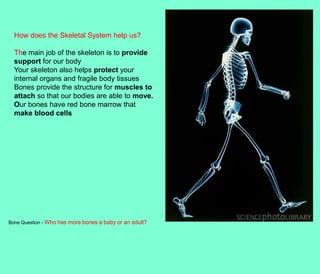
How does the Skeletal System help us?

  The main job of the skeleton is to provide
  support for our body
  Your skeleton also helps protect your
  internal organs and fragile body tissues
  Bones provide the structure for muscles to
  attach so that our bodies are able to move.
  Our bones have red bone marrow that
  make blood cells


Bone Question - Who has more bones a baby or an adult?
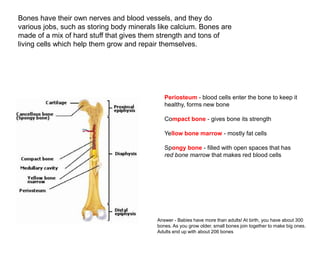
Bones have their own nerves and blood vessels, and they do
various jobs, such as storing body minerals like calcium. Bones are
made of a mix of hard stuff that gives them strength and tons of
living cells which help them grow and repair themselves.


                                              Periosteum - blood cells enter the bone to keep it
                                              healthy, forms new bone

                                              Compact bone - gives bone its strength

                                              Yellow bone marrow - mostly fat cells

                                              Spongy bone - filled with open spaces that has
                                              red bone marrow that makes red blood cells


                                           Answer - Babies have more than adults! At birth, you have about 300
                                           bones. As you grow older, small bones join together to make big ones.
                                           Adults end up with about 206 bones
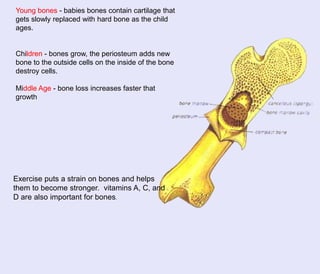
Young bones - babies bones contain cartilage that
gets slowly replaced with hard bone as the child
ages.


Children - bones grow, the periosteum adds new
bone to the outside cells on the inside of the bone
destroy cells.

Middle Age - bone loss increases faster that
growth


Exercise puts a strain on bones and helps
them to become stronger. vitamins A, C, and
D are also important for bones.
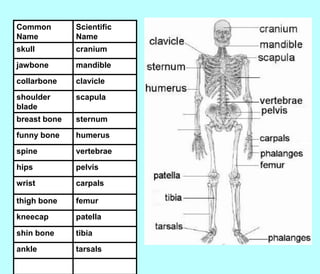
Common        Scientific
Name          Name
skull         cranium
jawbone       mandible
collarbone    clavicle
shoulder      scapula
blade
breast bone   sternum
funny bone    humerus
spine         vertebrae
hips          pelvis
wrist         carpals

thigh bone    femur
kneecap       patella

shin bone     tibia
ankle         tarsals
Bone Joints
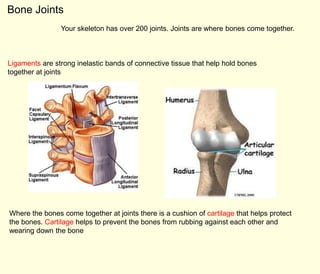
                Your skeleton has over 200 joints. Joints are where bones come together.


Ligaments are strong inelastic bands of connective tissue that help hold bones
together at joints


Where the bones come together at joints there is a cushion of cartilage that helps protect
the bones. Cartilage helps to prevent the bones from rubbing against each other and
wearing down the bone
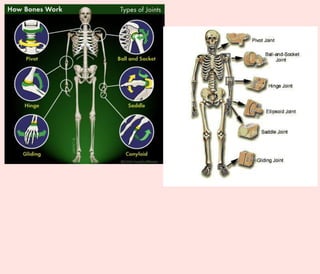
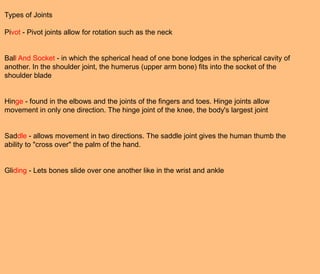
Types of Joints

Pivot - Pivot joints allow for rotation such as the neck


Ball And Socket - in which the spherical head of one bone lodges in the spherical cavity of
another. In the shoulder joint, the humerus (upper arm bone) fits into the socket of the
shoulder blade


Hinge - found in the elbows and the joints of the fingers and toes. Hinge joints allow
movement in only one direction. The hinge joint of the knee, the body's largest joint


Saddle - allows movement in two directions. The saddle joint gives the human thumb the
ability to "cross over" the palm of the hand.


Gliding - Lets bones slide over one another like in the wrist and ankle
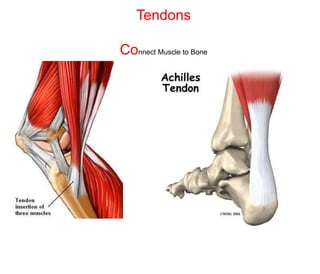
Tendons

Connect Muscle to Bone

Bone presentation

  • 1.
  • 2.
    What is theSkeletal system? Your Skeletal system is all of the bones in the body and the tissues such as tendons, ligaments and cartilage that connect them. Your teeth are also considered part of your skeletal system but they are not counted as bones. Your teeth are made of enamel and dentin. Enamel is the strongest substance in your body. How does the Skeletal System help us? The main job of the skeleton is to provide support for our body Your skeleton also helps protect your internal organs and fragile body tissues Bones provide the structure for muscles to attach so that our bodies are able to move. Our bones have red bone marrow that make blood
  • 3.
    How does theSkeletal System help us? The main job of the skeleton is to provide support for our body Your skeleton also helps protect your internal organs and fragile body tissues Bones provide the structure for muscles to attach so that our bodies are able to move. Our bones have red bone marrow that make blood cells Bone Question - Who has more bones a baby or an adult?
  • 4.
    Bones have theirown nerves and blood vessels, and they do various jobs, such as storing body minerals like calcium. Bones are made of a mix of hard stuff that gives them strength and tons of living cells which help them grow and repair themselves. Periosteum - blood cells enter the bone to keep it healthy, forms new bone Compact bone - gives bone its strength Yellow bone marrow - mostly fat cells Spongy bone - filled with open spaces that has red bone marrow that makes red blood cells Answer - Babies have more than adults! At birth, you have about 300 bones. As you grow older, small bones join together to make big ones. Adults end up with about 206 bones
  • 5.
    Young bones -babies bones contain cartilage that gets slowly replaced with hard bone as the child ages. Children - bones grow, the periosteum adds new bone to the outside cells on the inside of the bone destroy cells. Middle Age - bone loss increases faster that growth Exercise puts a strain on bones and helps them to become stronger. vitamins A, C, and D are also important for bones.
  • 6.
    Common Scientific Name Name skull cranium jawbone mandible collarbone clavicle shoulder scapula blade breast bone sternum funny bone humerus spine vertebrae hips pelvis wrist carpals thigh bone femur kneecap patella shin bone tibia ankle tarsals
  • 7.
    Bone Joints Your skeleton has over 200 joints. Joints are where bones come together. Ligaments are strong inelastic bands of connective tissue that help hold bones together at joints Where the bones come together at joints there is a cushion of cartilage that helps protect the bones. Cartilage helps to prevent the bones from rubbing against each other and wearing down the bone
  • 9.
    Types of Joints Pivot- Pivot joints allow for rotation such as the neck Ball And Socket - in which the spherical head of one bone lodges in the spherical cavity of another. In the shoulder joint, the humerus (upper arm bone) fits into the socket of the shoulder blade Hinge - found in the elbows and the joints of the fingers and toes. Hinge joints allow movement in only one direction. The hinge joint of the knee, the body's largest joint Saddle - allows movement in two directions. The saddle joint gives the human thumb the ability to "cross over" the palm of the hand. Gliding - Lets bones slide over one another like in the wrist and ankle
  • 10.