General rules for drawing Lewis structure 
The following is a list of rules that can be used to determine the Lewis structure of a molecule: 
1.Count up the total number of valence electrons. First add up the group numbers of all atoms in the 
molecule. If the molecule is an anion, add one electron for each unit of charge on the anion. If it is a cation, 
subtract one electron for each unit of charge on the cation. 
2.Calculate the total number of electrons that would be needed for each atom to have an octet (or doublet 
for H). 
3.Subtract the result of step 1 from the result of step 2. This is the total number of shared or bonding 
electrons. 
4.Assign two bonding electrons to each bond. 
5.If bonding electrons remain, assign them in pairs making some of the bonds double or triple bonds. 
(Usually, only C,N,O, and S can form double bonds, and only C and N can form triple bonds). There may be 
more than one way to do this. Keep all possible structures that result. 
6.Assign remaining electrons as lone pairs, giving octets to all atoms except H. 
7.Determine the formal charges and put them next to the appropriate atoms. (A formal charge of 0 need 
not be written explicitly). Check that the formal charges add up to the total charge on the molecule/ion. Do 
this for all structures obtained in step 5. The structure with the smallest formal charges should be 
considered as the preferred structure. 
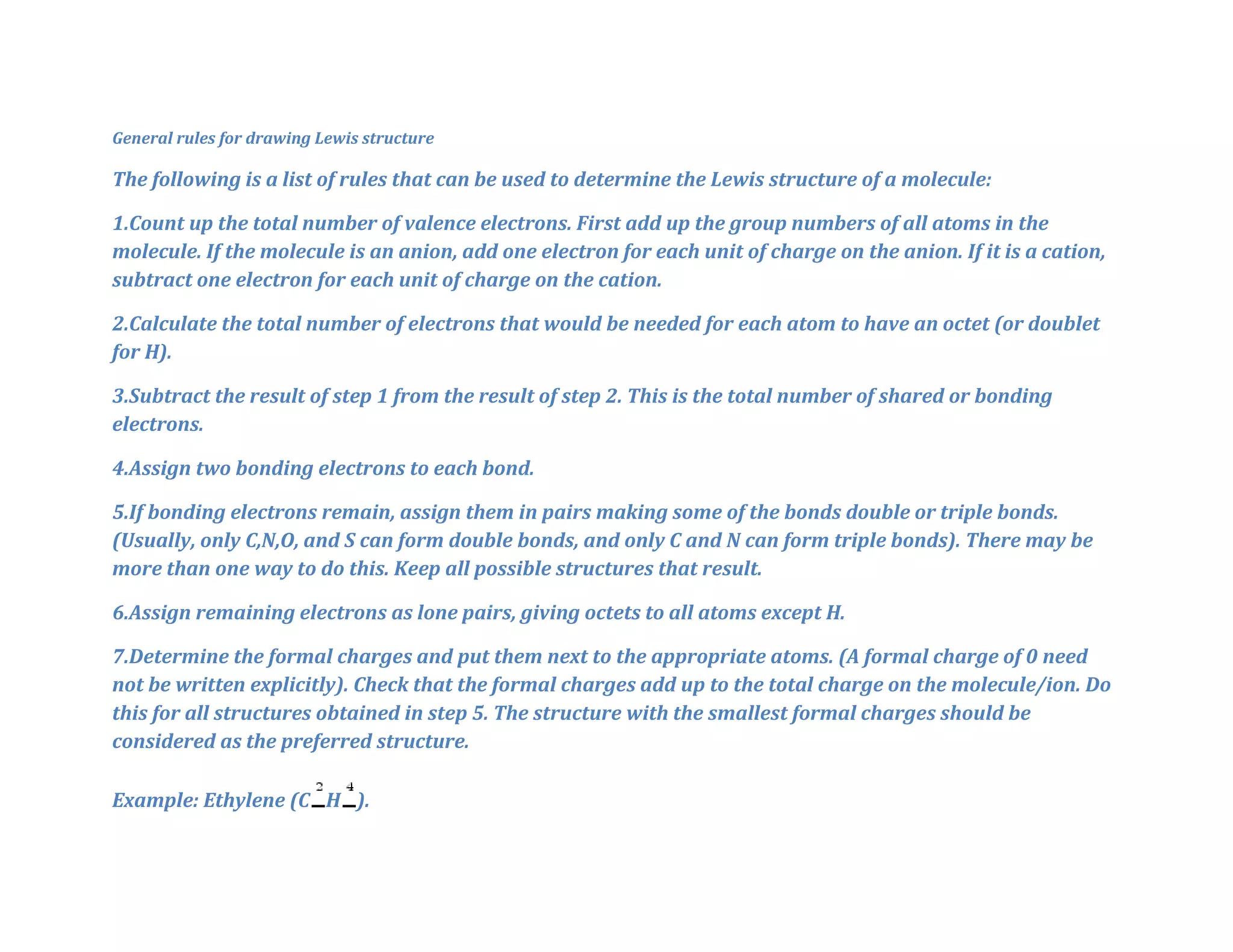
Example: Ethylene (C H ).
Step 1: Total valence electrons = 2 4 + 4 = 12 
Step 2: Total electrons needed for octets/doublets = 2 8 + 4 2 = 24 
Step 3: Total shared/bonding electrons = 24 - 12 = 12. Total electrons in lone pairs = 12 - 12 = 0. 
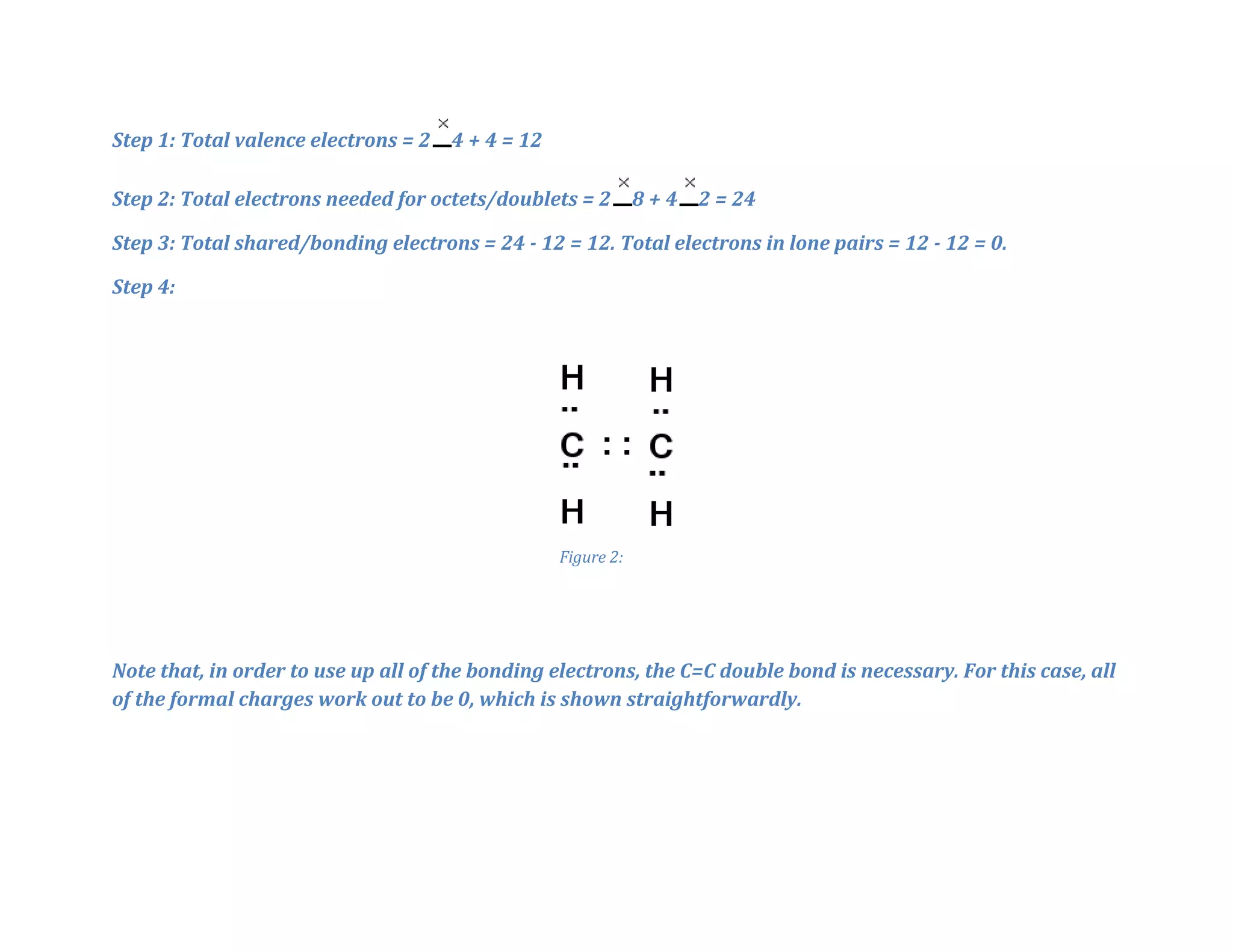
Step 4: 
Figure 2: 
Note that, in order to use up all of the bonding electrons, the C=C double bond is necessary. For this case, all 
of the formal charges work out to be 0, which is shown straightforwardly.

General rules in lewis stucture

  • 1.
    General rules fordrawing Lewis structure The following is a list of rules that can be used to determine the Lewis structure of a molecule: 1.Count up the total number of valence electrons. First add up the group numbers of all atoms in the molecule. If the molecule is an anion, add one electron for each unit of charge on the anion. If it is a cation, subtract one electron for each unit of charge on the cation. 2.Calculate the total number of electrons that would be needed for each atom to have an octet (or doublet for H). 3.Subtract the result of step 1 from the result of step 2. This is the total number of shared or bonding electrons. 4.Assign two bonding electrons to each bond. 5.If bonding electrons remain, assign them in pairs making some of the bonds double or triple bonds. (Usually, only C,N,O, and S can form double bonds, and only C and N can form triple bonds). There may be more than one way to do this. Keep all possible structures that result. 6.Assign remaining electrons as lone pairs, giving octets to all atoms except H. 7.Determine the formal charges and put them next to the appropriate atoms. (A formal charge of 0 need not be written explicitly). Check that the formal charges add up to the total charge on the molecule/ion. Do this for all structures obtained in step 5. The structure with the smallest formal charges should be considered as the preferred structure. Example: Ethylene (C H ).
  • 2.
    Step 1: Totalvalence electrons = 2 4 + 4 = 12 Step 2: Total electrons needed for octets/doublets = 2 8 + 4 2 = 24 Step 3: Total shared/bonding electrons = 24 - 12 = 12. Total electrons in lone pairs = 12 - 12 = 0. Step 4: Figure 2: Note that, in order to use up all of the bonding electrons, the C=C double bond is necessary. For this case, all of the formal charges work out to be 0, which is shown straightforwardly.