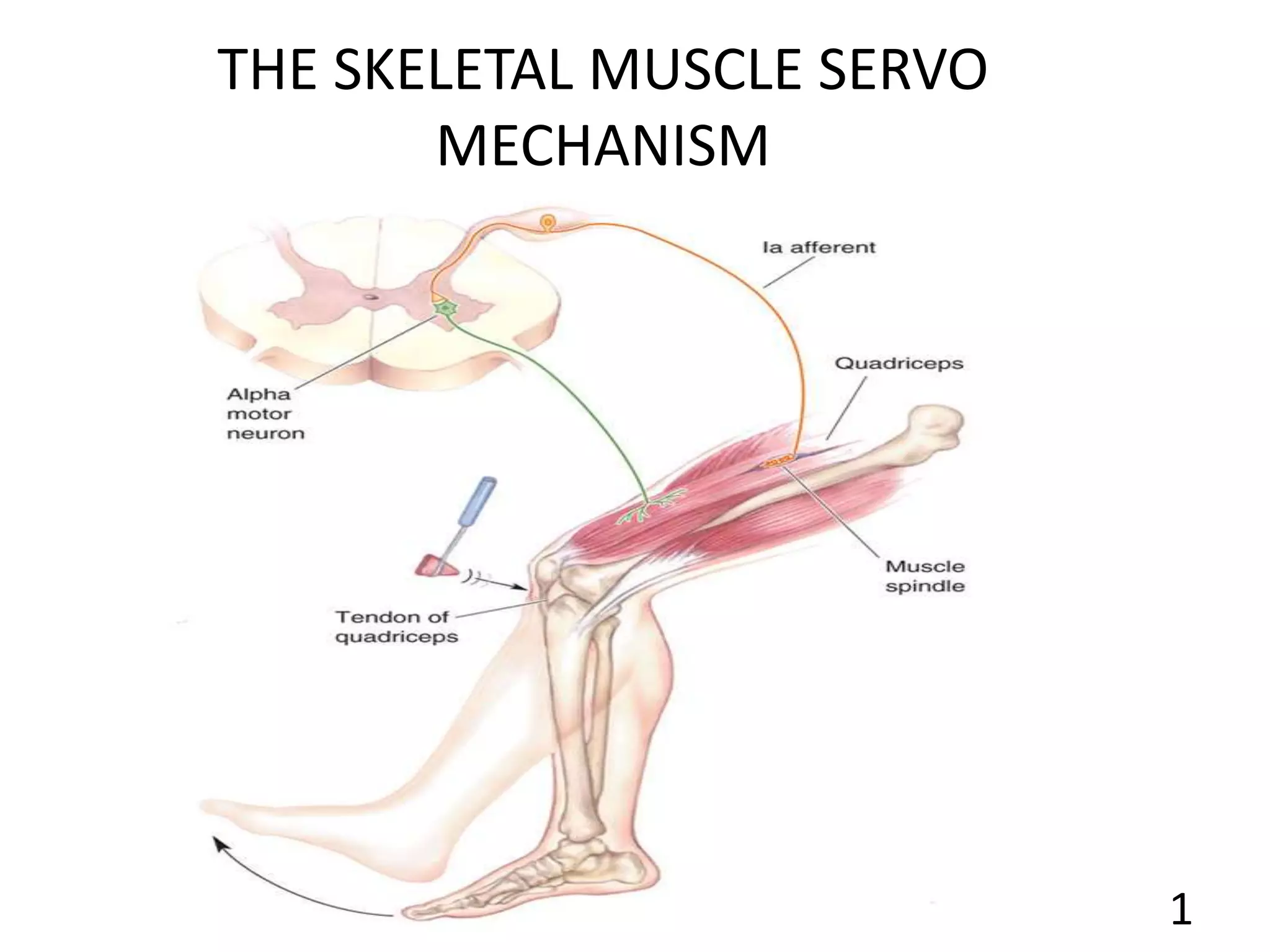
THE SKELETAL MUSCLE SERVO
MECHANISM
1
CONTENTS
• DEFINITION
• ANATOMY
• MECHANISM
• ALPHA LOOP CONTROL
• GAMMA LOOP CONTROL
• SCHEMATIC DIAGRAM
2
SERVO MECHANISM
• servomechanism, automatic device used to
correct the performance of a mechanism by
means of an error-sensing feedback. The term
servomechanism properly applies only to
systems in which the feedback and error-
correction signals control mechanical position
or one of its derivatives such as velocity or
acceleration.
3
ANATOMY
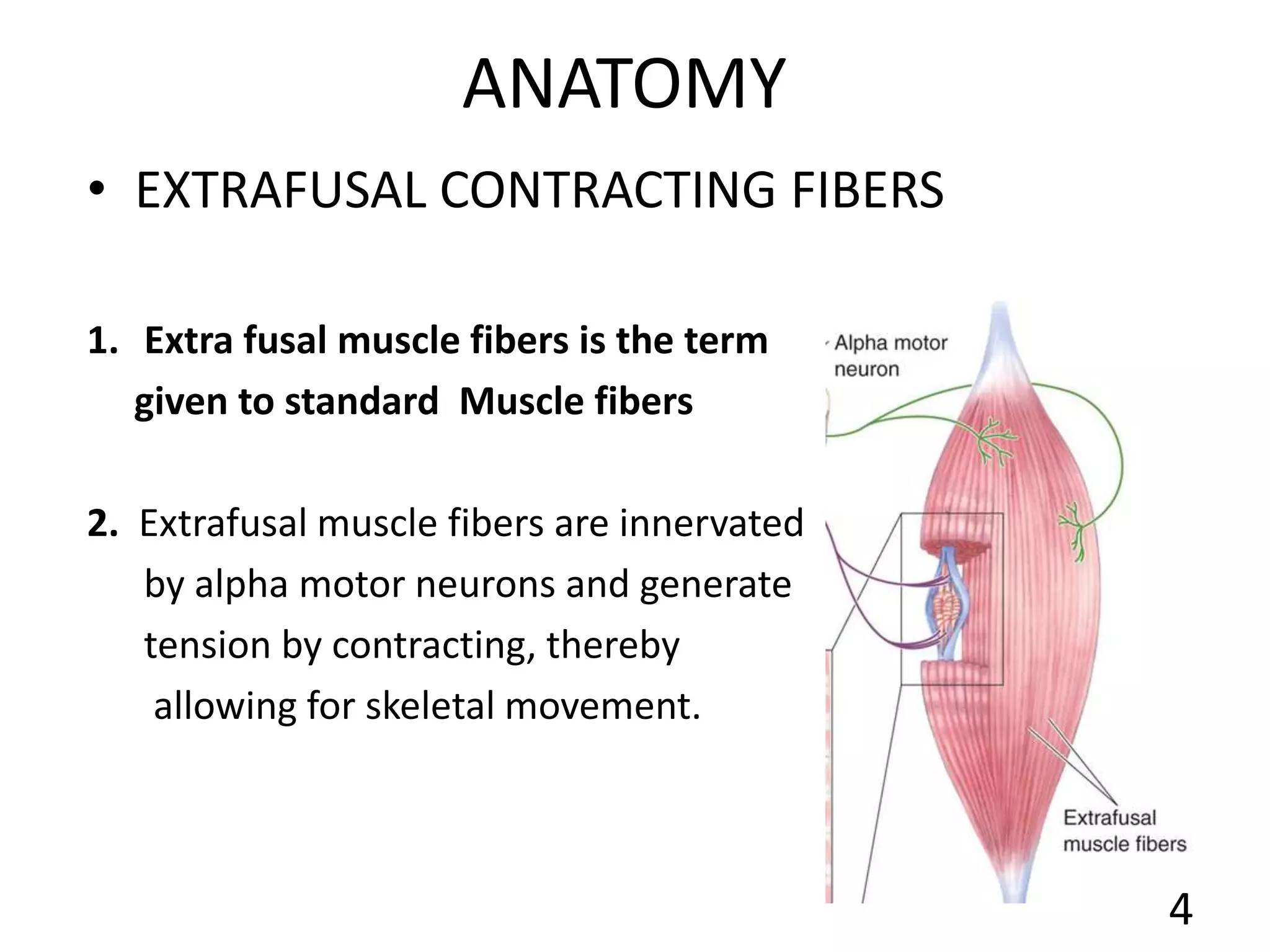
• EXTRAFUSAL CONTRACTING FIBERS
1. Extra fusal muscle fibers is the term
given to standard Muscle fibers
2. Extrafusal muscle fibers are innervated
by alpha motor neurons and generate
tension by contracting, thereby
allowing for skeletal movement.
4
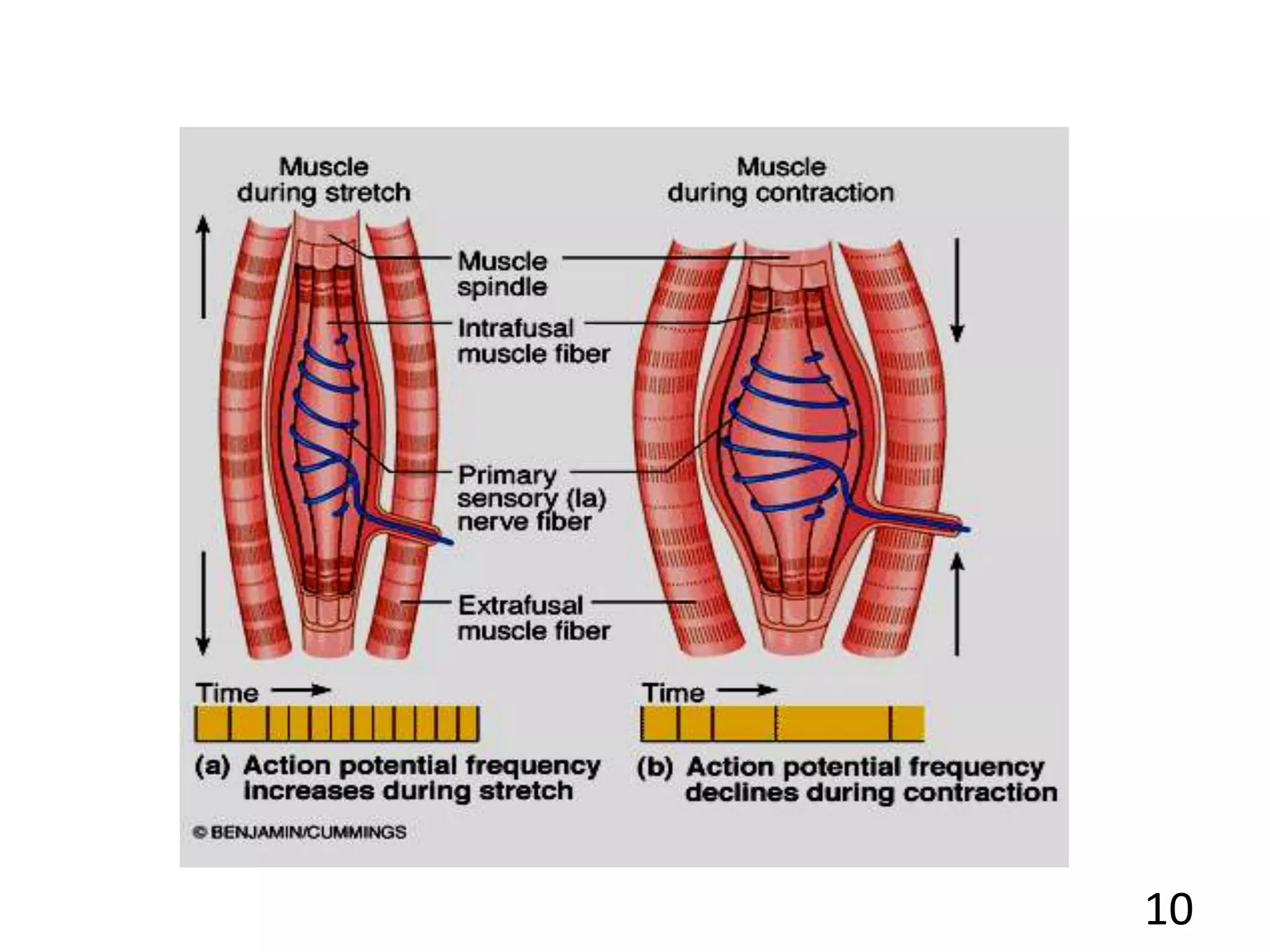
INTRAFUSAL MUSCLE FIBER
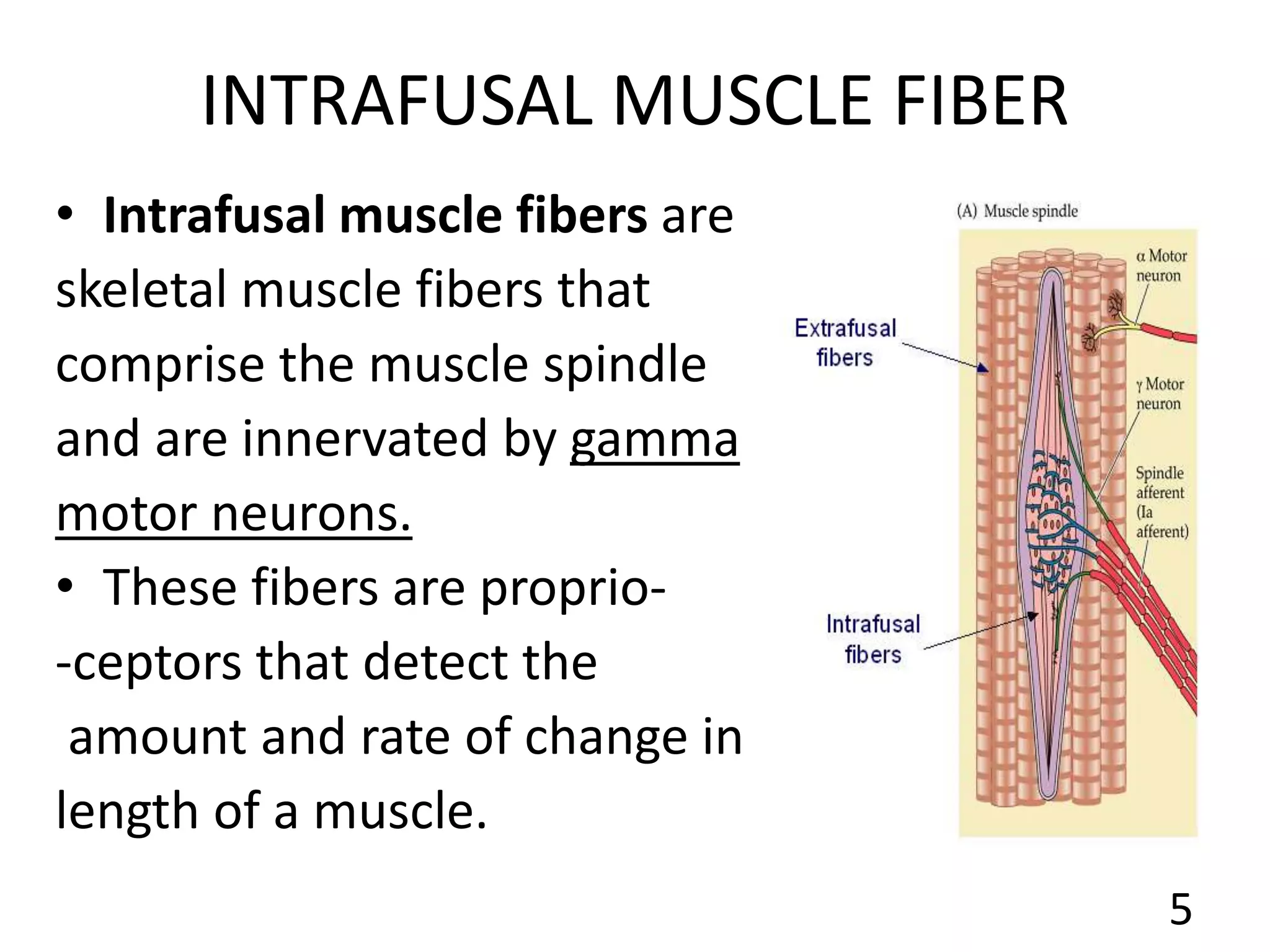
• Intrafusal muscle fibers are
skeletal muscle fibers that
comprise the muscle spindle
and are innervated by gamma
motor neurons.
• These fibers are proprio-
-ceptors that detect the
amount and rate of change in
length of a muscle.
5
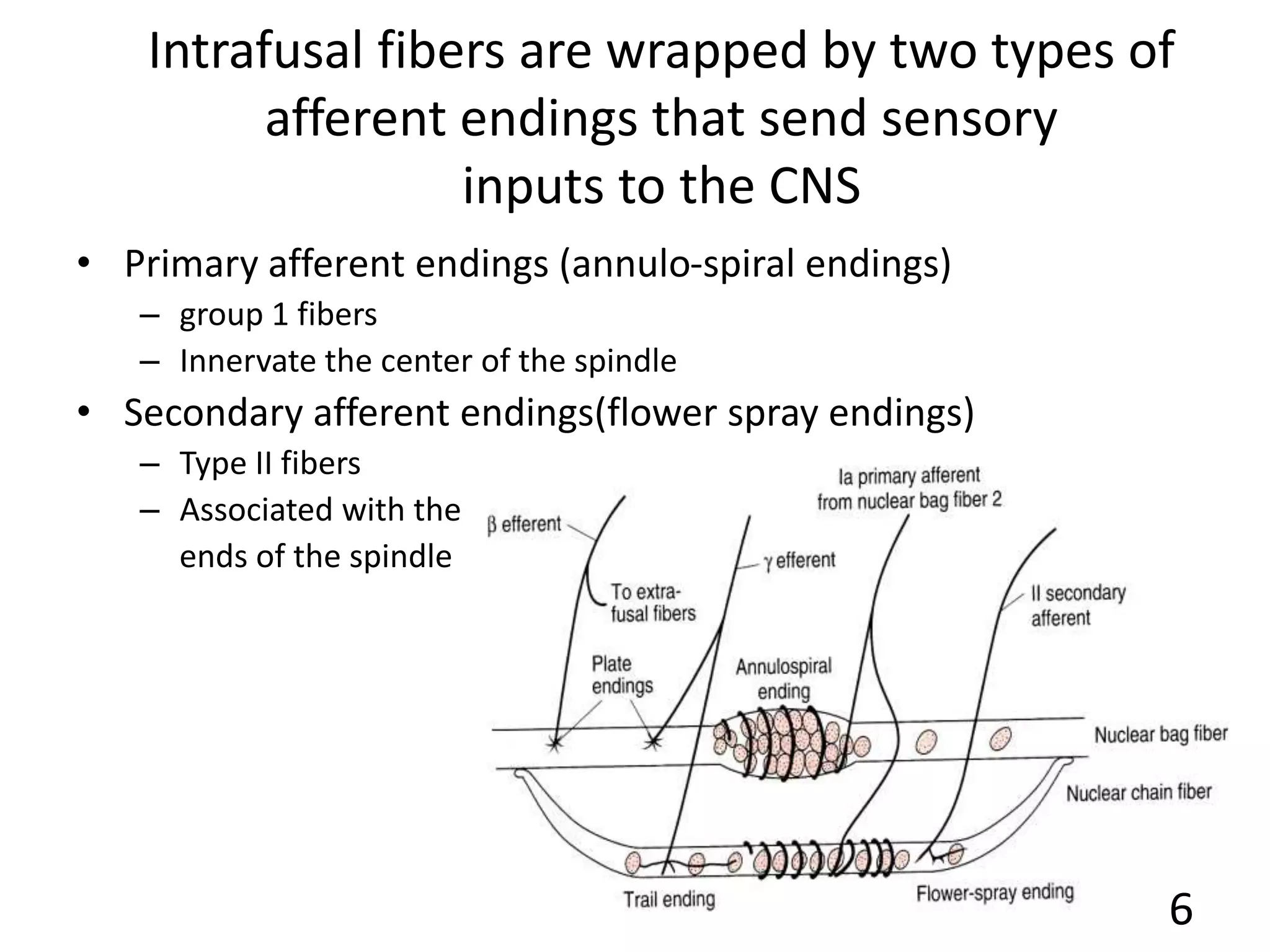
Intrafusal fibers are wrapped by two types of
afferent endings that send sensory
inputs to the CNS
• Primary afferent endings (annulo-spiral endings)
– group 1 fibers
– Innervate the center of the spindle
• Secondary afferent endings(flower spray endings)
– Type II fibers
– Associated with the
ends of the spindle
6
MECHANISM
• The extrafusal fibres are attached to bone
through tendons exhibit a finite spring
stiffnesss,and which are embedded in golgi
tendon organs
• These organs are mechano receptors sensitive
to the total muscle tension.
7
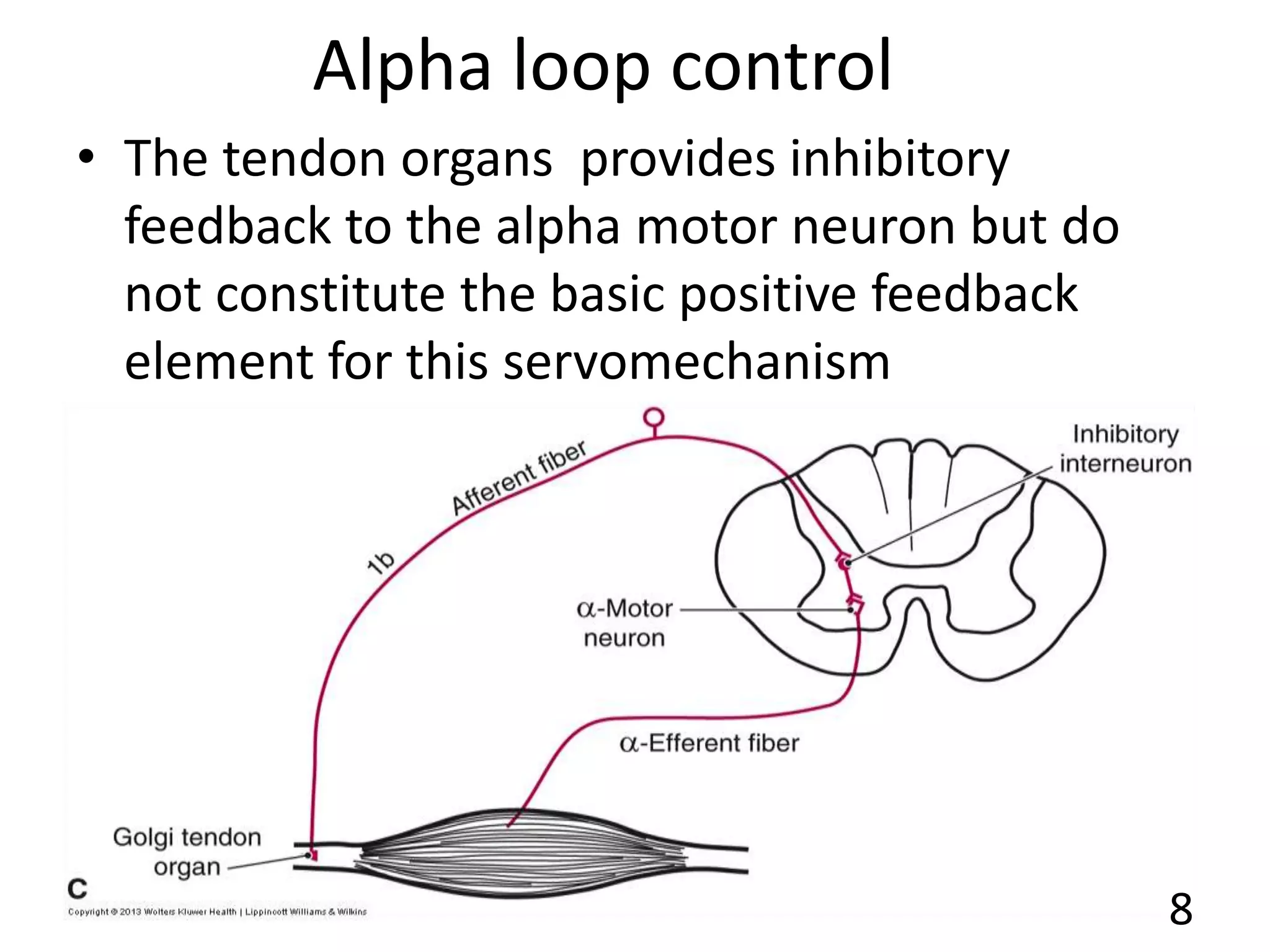
Alpha loop control
• The tendon organs provides inhibitory
feedback to the alpha motor neuron but do
not constitute the basic positive feedback
element for this servomechanism
8
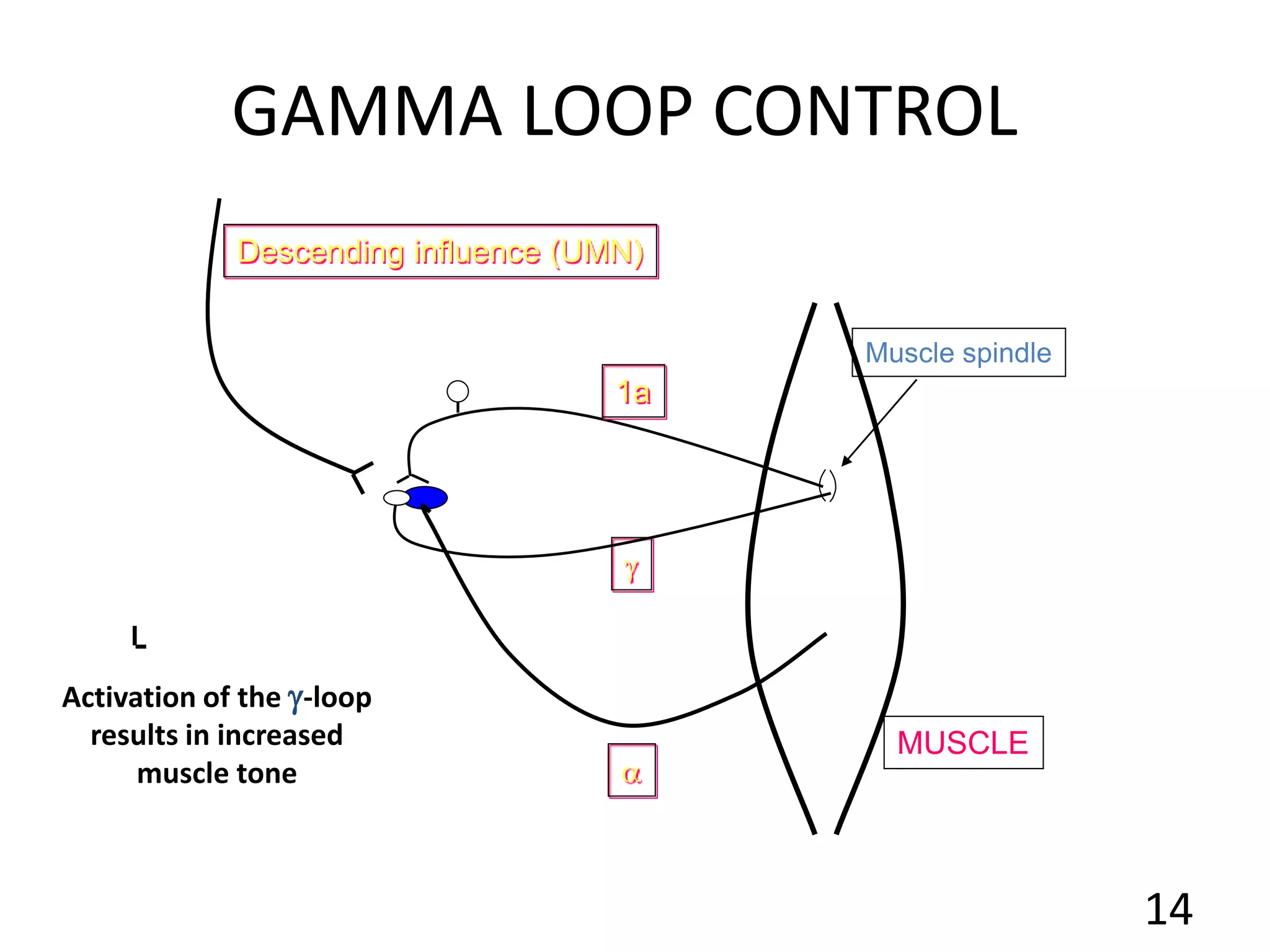
 Loop control
• Activating the  motor neurons that stimulate
the distal ends of the intrafusal fibers to contact
thus stretching the mid-portion of the spindle
(internal stretch)
• Whatever the stimulus, when the spindles are
activated their associated sensory neurons
transmit impulses at a higher frequency to the
spinal cord
9
10
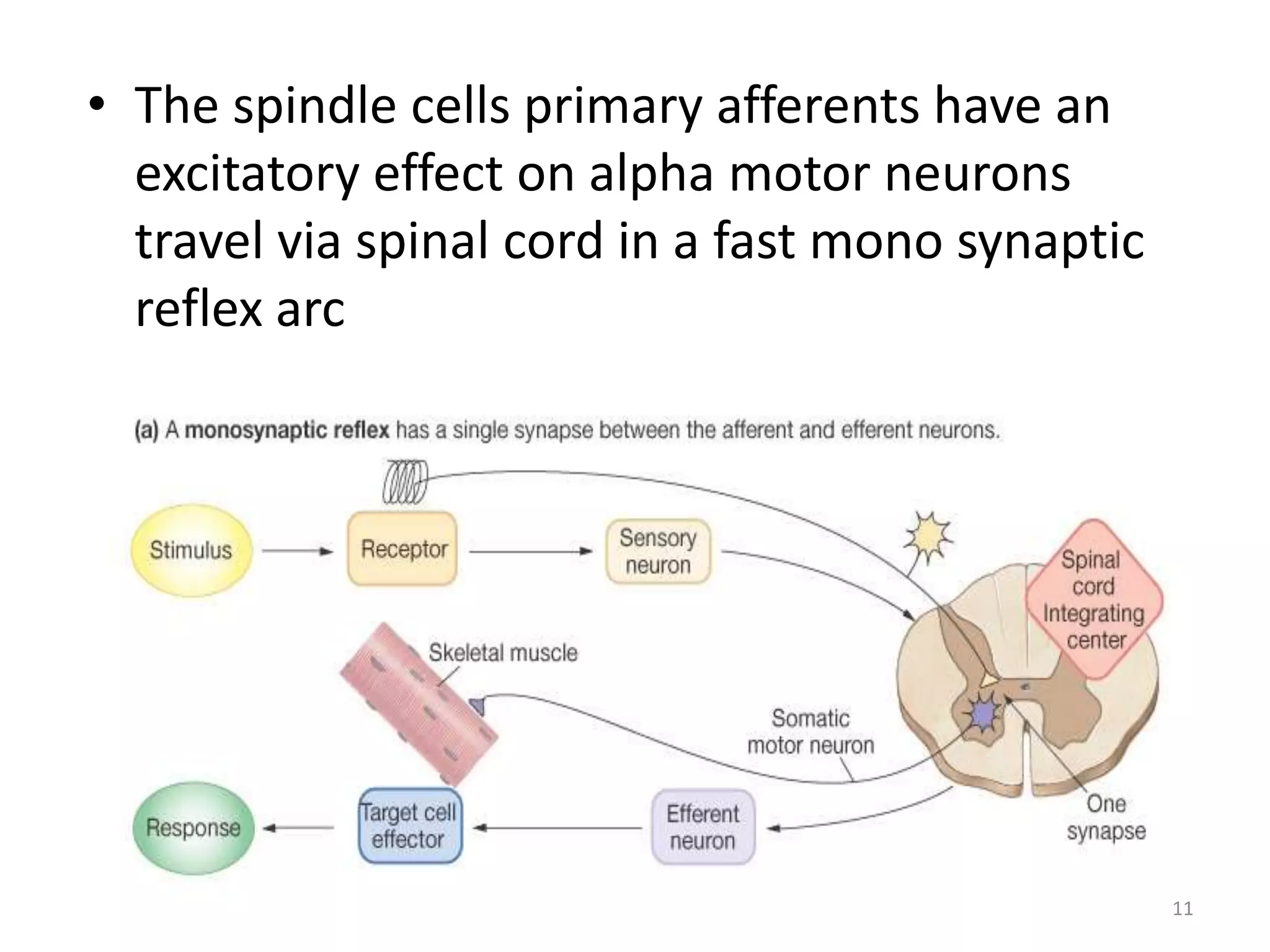
• The spindle cells primary afferents have an
excitatory effect on alpha motor neurons
travel via spinal cord in a fast mono synaptic
reflex arc
11
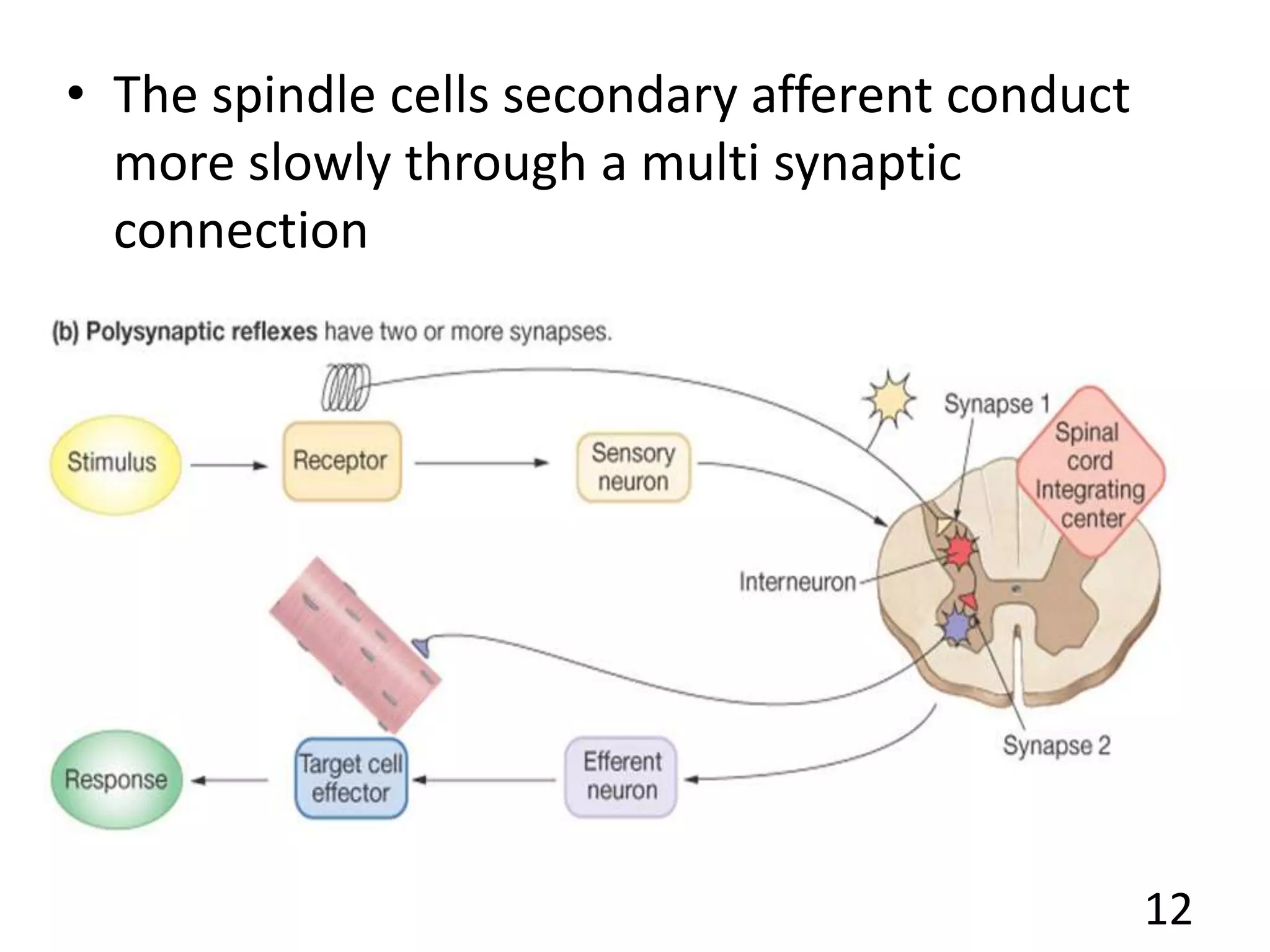
• The spindle cells secondary afferent conduct
more slowly through a multi synaptic
connection
12
• A local feedback loop exist in the spinal
cord called renshaw cell to the local motor
neuronal pool
• This feedback is inhibitory.
13

a
1a
Descending influence (UMN)
MUSCLE
Muscle spindle
GAMMA LOOP CONTROL
Activation of the -loop
results in increased
muscle tone
14
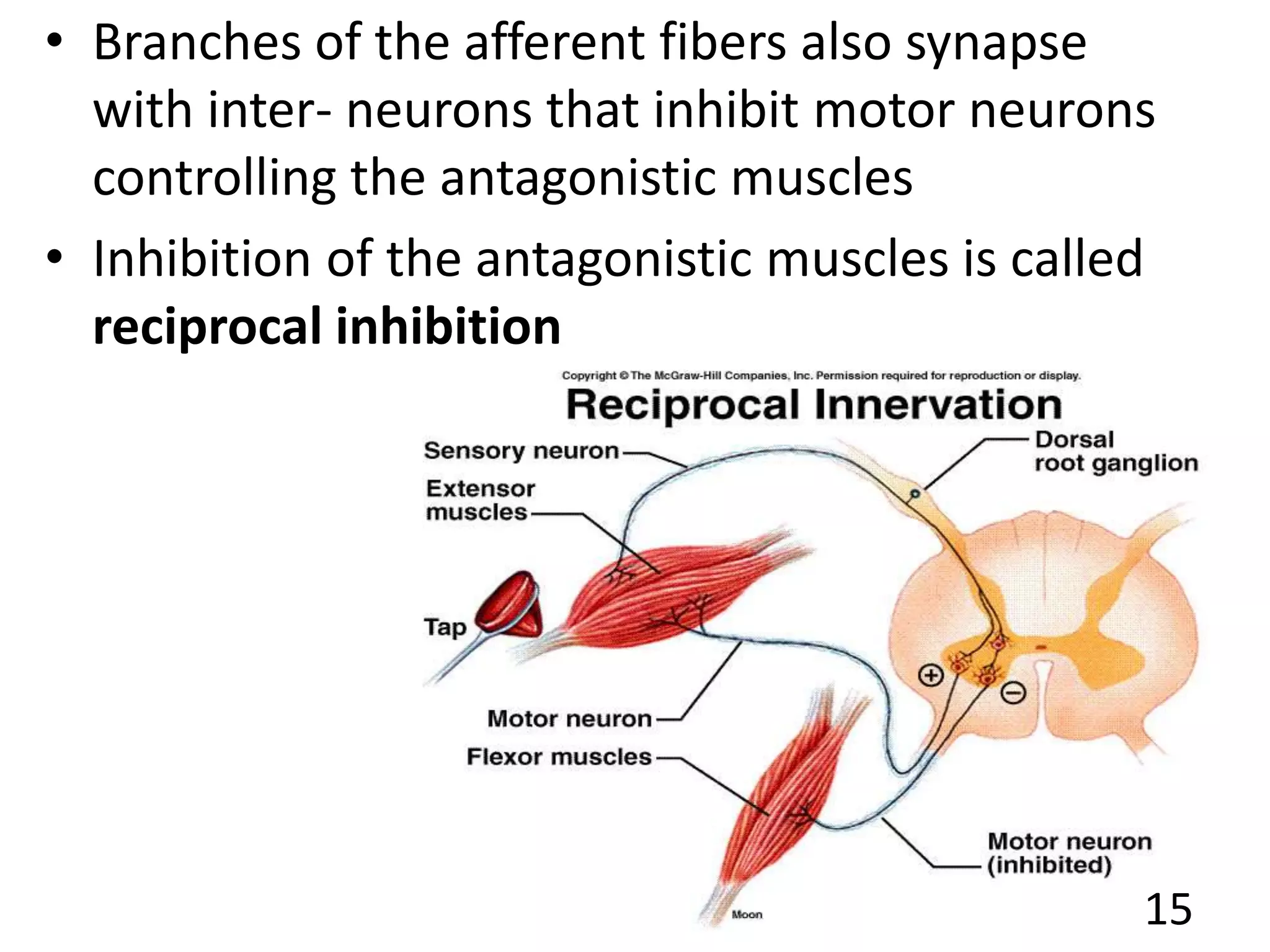
• Branches of the afferent fibers also synapse
with inter- neurons that inhibit motor neurons
controlling the antagonistic muscles
• Inhibition of the antagonistic muscles is called
reciprocal inhibition
15
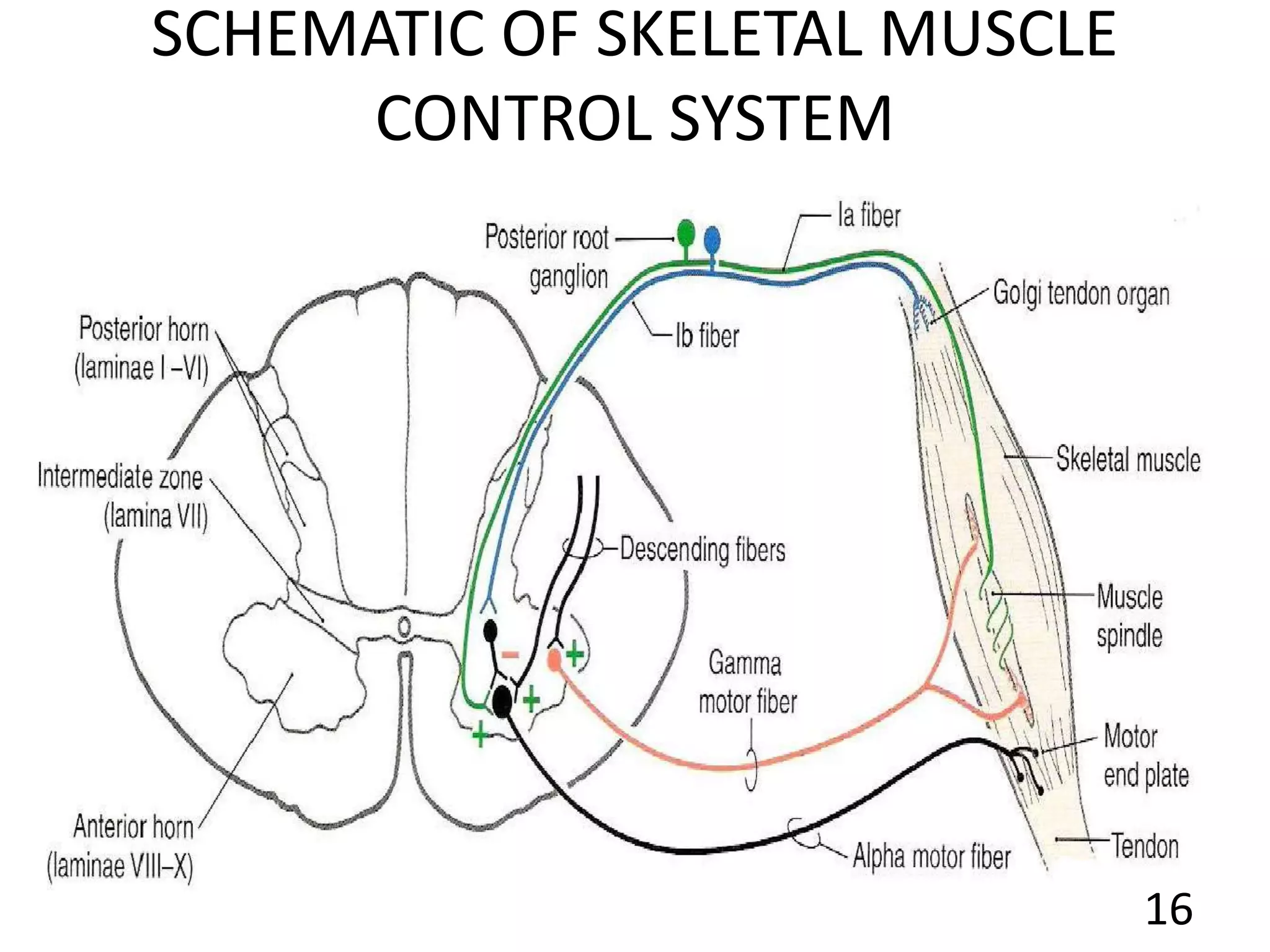
SCHEMATIC OF SKELETAL MUSCLE
CONTROL SYSTEM
16
CONCLUSION
• Servo mechanics can apparently be driven by
either of two reference command inputs from
higher nervous centers,so called as alpha and
gamma efferent pathways.
• Firing frequency of spindle’s primary afferent
in the steady state is approxiamately
propotional to muscle extension over the
physiological range.
17
18
References
• en.wikipedia.org/wiki/spindle mechanism
• www.slideshare.net
• John H.Milsum text book
19

skeletal servomechanism

  • 1.
    THE SKELETAL MUSCLESERVO MECHANISM 1
  • 2.
    CONTENTS • DEFINITION • ANATOMY •MECHANISM • ALPHA LOOP CONTROL • GAMMA LOOP CONTROL • SCHEMATIC DIAGRAM 2
  • 3.
    SERVO MECHANISM • servomechanism,automatic device used to correct the performance of a mechanism by means of an error-sensing feedback. The term servomechanism properly applies only to systems in which the feedback and error- correction signals control mechanical position or one of its derivatives such as velocity or acceleration. 3
  • 4.
    ANATOMY • EXTRAFUSAL CONTRACTINGFIBERS 1. Extra fusal muscle fibers is the term given to standard Muscle fibers 2. Extrafusal muscle fibers are innervated by alpha motor neurons and generate tension by contracting, thereby allowing for skeletal movement. 4
  • 5.
    INTRAFUSAL MUSCLE FIBER •Intrafusal muscle fibers are skeletal muscle fibers that comprise the muscle spindle and are innervated by gamma motor neurons. • These fibers are proprio- -ceptors that detect the amount and rate of change in length of a muscle. 5
  • 6.
    Intrafusal fibers arewrapped by two types of afferent endings that send sensory inputs to the CNS • Primary afferent endings (annulo-spiral endings) – group 1 fibers – Innervate the center of the spindle • Secondary afferent endings(flower spray endings) – Type II fibers – Associated with the ends of the spindle 6
  • 7.
    MECHANISM • The extrafusalfibres are attached to bone through tendons exhibit a finite spring stiffnesss,and which are embedded in golgi tendon organs • These organs are mechano receptors sensitive to the total muscle tension. 7
  • 8.
    Alpha loop control •The tendon organs provides inhibitory feedback to the alpha motor neuron but do not constitute the basic positive feedback element for this servomechanism 8
  • 9.
     Loop control •Activating the  motor neurons that stimulate the distal ends of the intrafusal fibers to contact thus stretching the mid-portion of the spindle (internal stretch) • Whatever the stimulus, when the spindles are activated their associated sensory neurons transmit impulses at a higher frequency to the spinal cord 9
  • 10.
  • 11.
    • The spindlecells primary afferents have an excitatory effect on alpha motor neurons travel via spinal cord in a fast mono synaptic reflex arc 11
  • 12.
    • The spindlecells secondary afferent conduct more slowly through a multi synaptic connection 12
  • 13.
    • A localfeedback loop exist in the spinal cord called renshaw cell to the local motor neuronal pool • This feedback is inhibitory. 13
  • 14.
     a 1a Descending influence (UMN) MUSCLE Musclespindle GAMMA LOOP CONTROL Activation of the -loop results in increased muscle tone 14
  • 15.
    • Branches ofthe afferent fibers also synapse with inter- neurons that inhibit motor neurons controlling the antagonistic muscles • Inhibition of the antagonistic muscles is called reciprocal inhibition 15
  • 16.
    SCHEMATIC OF SKELETALMUSCLE CONTROL SYSTEM 16
  • 17.
    CONCLUSION • Servo mechanicscan apparently be driven by either of two reference command inputs from higher nervous centers,so called as alpha and gamma efferent pathways. • Firing frequency of spindle’s primary afferent in the steady state is approxiamately propotional to muscle extension over the physiological range. 17
  • 18.
  • 19.
    References • en.wikipedia.org/wiki/spindle mechanism •www.slideshare.net • John H.Milsum text book 19