Electrophysiology topic
EDX evaluation of brachial plexus-An
approach
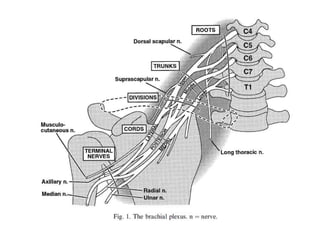
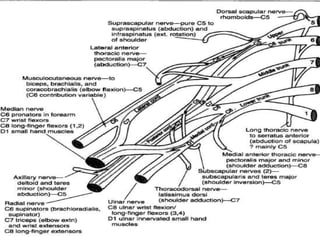
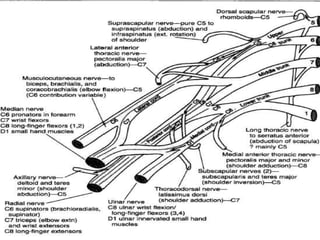
Brachial plexus
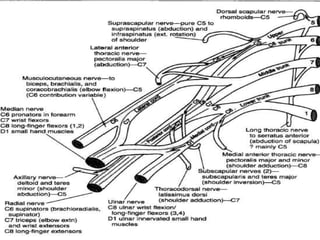
• One of the most complex and largest PNS
structure
• Highly vulnerable
• Extensive non routine NCS
• Time consuming
• Contra lateral asymptomatic limb also
needs to be studied
Anatomy
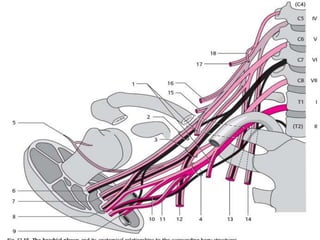
• 100,000-160,000 nerve fibers
• Intermingle to form various brachial plexus
elements
• Roots
• Trunks
• Divisions
• Cords
• Terminal nerves
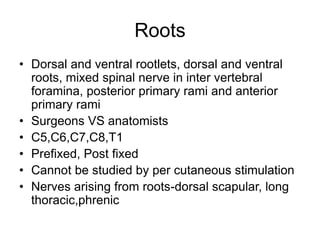
Roots
• Dorsal and ventral rootlets, dorsal and ventral
roots, mixed spinal nerve in inter vertebral
foramina, posterior primary rami and anterior
primary rami
• Surgeons VS anatomists
• C5,C6,C7,C8,T1
• Prefixed, Post fixed
• Cannot be studied by per cutaneous stimulation
• Nerves arising from roots-dorsal scapular, long
thoracic,phrenic
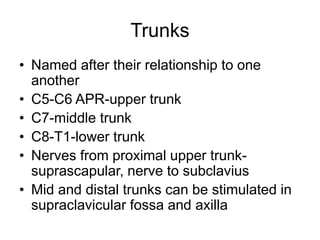
Trunks
• Named after their relationship to one
another
• C5-C6 APR-upper trunk
• C7-middle trunk
• C8-T1-lower trunk
• Nerves from proximal upper trunk-
suprascapular, nerve to subclavius
• Mid and distal trunks can be stimulated in
supraclavicular fossa and axilla
Divisions and cords
• Each trunk divides into two. lie behind clavicle
• Lateral cord-anterior divisions of upper and
middle trunk C5-7roots
• Medial cord-continuation of anterior division of
lower trunk C8-T1roots
• Posterior cord-posterior division of all trunks C5-
C8 roots
• Cord elements can be stimulated
percutaneously
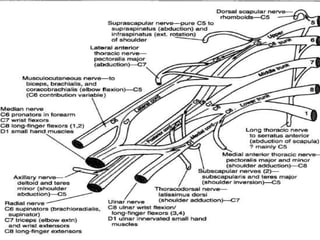
Nerves from cords
• Lateral cord-lateral pectoral, musculo
cutaneous, lateral head of median, lateral ante
brachial cutaneous.
• Posterior cord-sub scapular, thoraco dorsal,
axillary, radial
• Medial cord-medial pectoral, medial ante
brachial cutaneous, medial brachial cutaneous,
medial head of median nerve, ulnar
• Terminal nerve elements can be studied by
percutaneous stimulation
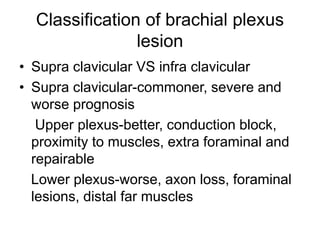
Classification of brachial plexus
lesion
• Supra clavicular VS infra clavicular
• Supra clavicular-commoner, severe and
worse prognosis
Upper plexus-better, conduction block,
proximity to muscles, extra foraminal and
repairable
Lower plexus-worse, axon loss, foraminal
lesions, distal far muscles
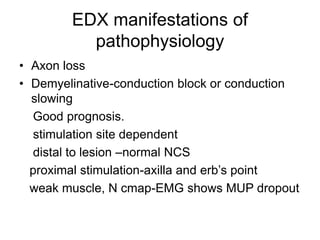
EDX manifestations of
pathophysiology
• Axon loss
• Demyelinative-conduction block or conduction
slowing
Good prognosis.
stimulation site dependent
distal to lesion –normal NCS
proximal stimulation-axilla and erb’s point
weak muscle, N cmap-EMG shows MUP dropout
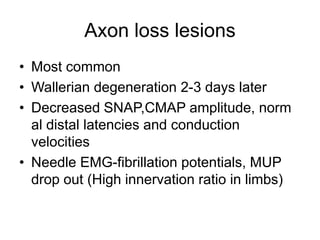
Axon loss lesions
• Most common
• Wallerian degeneration 2-3 days later
• Decreased SNAP,CMAP amplitude, norm
al distal latencies and conduction
velocities
• Needle EMG-fibrillation potentials, MUP
drop out (High innervation ratio in limbs)
Severity of lesion
• CMAP amplitudes correlate well with
amount of axonal loss in one to one ratio
• Minimal lesion-EMG fibrillations
Normal SNAP,CMAP
• More severe-SNAP amps decrease
• Greater severity-absent SNAP,CMAP amp
decreased, MUP dropout
Timing of EDX
• MUP dropout-immediately but severe
• CMAP amps-begin to decrease on day 2-
3,reach nadir by day -7
• SNAP amp-begins to drop on day 6 and
reach nadir on day 10-11
• Fibrillation potentials-may take10- 21 days
to appear
Prognostication
• Re innervation is by collateral sprouting and
proximo distal regeneration
• Depends on grade and completeness of injuries,
distance between site of injury and innervated
muscle
• Regeneration is at 1 inch/month, denervated
muscle fibers survive for 18-24 months. so
distance more than 2 feet bad prognosis
• Reinnervation normalises CMAP amps but alters
morphology and recruitment
prognosis
• No time limit for sensory nerve
regeneration
• End organs of sensory nerve fibers donot
undergo degeneration
• Reinnervation successful even after two
years
• SNAP amplitude decrement correlates
well with sensory loss
SNAPs -importance
• Sensory fibers are more sensitive to axon loss
than motor fibers. Isolated SNAPs abnormalities
do not rule our motor axon involvement
• Intra spinal lesions do not affect sensory
conduction. but affect motor NCS and EMG
• Pattern of sensory loss localises lesion to
brachial plexus elements much before motor
NCS.
• Motor anormalities with normal SNAPs are seen
in-myopathies, preganglionic lesions, NMJ, early
GBS, study before 6 days
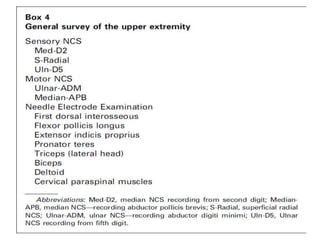
EDX assessment of brachial plexus
• Each brachial plexus element has-
Muscle domain/EMG domain
SNAP domain
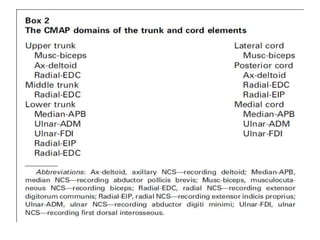
CMAP domain
Domains of a distal element is sum of
domains of all elements forming it minus
domains of elements departing prior to
formation of the element
Root domains
• C5 APR- no SNAP domain
CMAP domain-Musc-biceps,
Ax-deltoid
EMG domain-C5 myotome
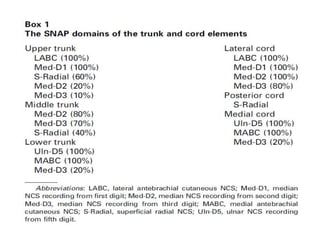
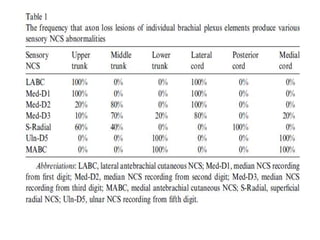
• C6 APR-SNAP domain-LABC(100%),Med-
D1(100%),s-radial(60%),Med-D2(20%),Med-
D3(10%)
CMAP domain-Musc-biceps, Ax-deltoid
EMG domain-C6 myotome
Root domains
• C7 APR:SNAP- Med-D2(80%),Med-D3(70%),S-
radial(40%)
No dependable CMAP domain
EMG-C7 myotome
• C8 APR:SNAP domain uln-D5
CMAP domain: uln-ADM, uln-FDI, Rad- EIP, Med-APB
EMG –C8 myotome
• T1 APR:SNAP-MABC
CMAP-Med-APB plus C8 cmap
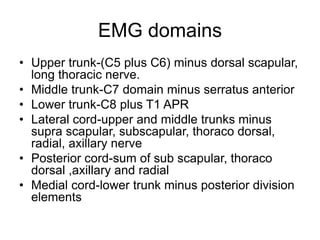
EMG domains
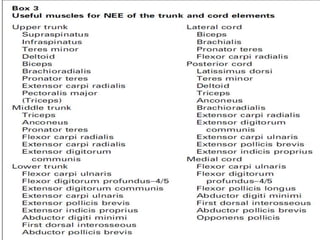
• Upper trunk-(C5 plus C6) minus dorsal scapular,
long thoracic nerve.
• Middle trunk-C7 domain minus serratus anterior
• Lower trunk-C8 plus T1 APR
• Lateral cord-upper and middle trunks minus
supra scapular, subscapular, thoraco dorsal,
radial, axillary nerve
• Posterior cord-sum of sub scapular, thoraco
dorsal ,axillary and radial
• Medial cord-lower trunk minus posterior division
elements
Nerve domains
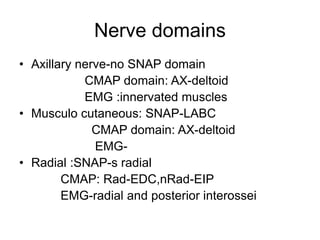
• Axillary nerve-no SNAP domain
CMAP domain: AX-deltoid
EMG :innervated muscles
• Musculo cutaneous: SNAP-LABC
CMAP domain: AX-deltoid
EMG-
• Radial :SNAP-s radial
CMAP: Rad-EDC,nRad-EIP
EMG-radial and posterior interossei
Nerve domains
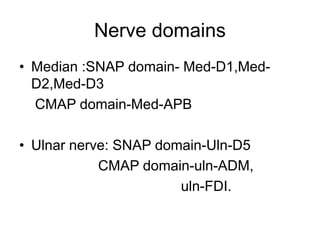
• Median :SNAP domain- Med-D1,Med-
D2,Med-D3
CMAP domain-Med-APB
• Ulnar nerve: SNAP domain-Uln-D5
CMAP domain-uln-ADM,
uln-FDI.
Thank you

Brachial plexus

  • 1.
    Electrophysiology topic EDX evaluationof brachial plexus-An approach
  • 2.
    Brachial plexus • Oneof the most complex and largest PNS structure • Highly vulnerable • Extensive non routine NCS • Time consuming • Contra lateral asymptomatic limb also needs to be studied
  • 4.
    Anatomy • 100,000-160,000 nervefibers • Intermingle to form various brachial plexus elements • Roots • Trunks • Divisions • Cords • Terminal nerves
  • 6.
    Roots • Dorsal andventral rootlets, dorsal and ventral roots, mixed spinal nerve in inter vertebral foramina, posterior primary rami and anterior primary rami • Surgeons VS anatomists • C5,C6,C7,C8,T1 • Prefixed, Post fixed • Cannot be studied by per cutaneous stimulation • Nerves arising from roots-dorsal scapular, long thoracic,phrenic
  • 8.
    Trunks • Named aftertheir relationship to one another • C5-C6 APR-upper trunk • C7-middle trunk • C8-T1-lower trunk • Nerves from proximal upper trunk- suprascapular, nerve to subclavius • Mid and distal trunks can be stimulated in supraclavicular fossa and axilla
  • 10.
    Divisions and cords •Each trunk divides into two. lie behind clavicle • Lateral cord-anterior divisions of upper and middle trunk C5-7roots • Medial cord-continuation of anterior division of lower trunk C8-T1roots • Posterior cord-posterior division of all trunks C5- C8 roots • Cord elements can be stimulated percutaneously
  • 12.
    Nerves from cords •Lateral cord-lateral pectoral, musculo cutaneous, lateral head of median, lateral ante brachial cutaneous. • Posterior cord-sub scapular, thoraco dorsal, axillary, radial • Medial cord-medial pectoral, medial ante brachial cutaneous, medial brachial cutaneous, medial head of median nerve, ulnar • Terminal nerve elements can be studied by percutaneous stimulation
  • 14.
    Classification of brachialplexus lesion • Supra clavicular VS infra clavicular • Supra clavicular-commoner, severe and worse prognosis Upper plexus-better, conduction block, proximity to muscles, extra foraminal and repairable Lower plexus-worse, axon loss, foraminal lesions, distal far muscles
  • 15.
    EDX manifestations of pathophysiology •Axon loss • Demyelinative-conduction block or conduction slowing Good prognosis. stimulation site dependent distal to lesion –normal NCS proximal stimulation-axilla and erb’s point weak muscle, N cmap-EMG shows MUP dropout
  • 16.
    Axon loss lesions •Most common • Wallerian degeneration 2-3 days later • Decreased SNAP,CMAP amplitude, norm al distal latencies and conduction velocities • Needle EMG-fibrillation potentials, MUP drop out (High innervation ratio in limbs)
  • 17.
    Severity of lesion •CMAP amplitudes correlate well with amount of axonal loss in one to one ratio • Minimal lesion-EMG fibrillations Normal SNAP,CMAP • More severe-SNAP amps decrease • Greater severity-absent SNAP,CMAP amp decreased, MUP dropout
  • 18.
    Timing of EDX •MUP dropout-immediately but severe • CMAP amps-begin to decrease on day 2- 3,reach nadir by day -7 • SNAP amp-begins to drop on day 6 and reach nadir on day 10-11 • Fibrillation potentials-may take10- 21 days to appear
  • 19.
    Prognostication • Re innervationis by collateral sprouting and proximo distal regeneration • Depends on grade and completeness of injuries, distance between site of injury and innervated muscle • Regeneration is at 1 inch/month, denervated muscle fibers survive for 18-24 months. so distance more than 2 feet bad prognosis • Reinnervation normalises CMAP amps but alters morphology and recruitment
  • 20.
    prognosis • No timelimit for sensory nerve regeneration • End organs of sensory nerve fibers donot undergo degeneration • Reinnervation successful even after two years • SNAP amplitude decrement correlates well with sensory loss
  • 21.
    SNAPs -importance • Sensoryfibers are more sensitive to axon loss than motor fibers. Isolated SNAPs abnormalities do not rule our motor axon involvement • Intra spinal lesions do not affect sensory conduction. but affect motor NCS and EMG • Pattern of sensory loss localises lesion to brachial plexus elements much before motor NCS. • Motor anormalities with normal SNAPs are seen in-myopathies, preganglionic lesions, NMJ, early GBS, study before 6 days
  • 22.
    EDX assessment ofbrachial plexus • Each brachial plexus element has- Muscle domain/EMG domain SNAP domain CMAP domain Domains of a distal element is sum of domains of all elements forming it minus domains of elements departing prior to formation of the element
  • 23.
    Root domains • C5APR- no SNAP domain CMAP domain-Musc-biceps, Ax-deltoid EMG domain-C5 myotome • C6 APR-SNAP domain-LABC(100%),Med- D1(100%),s-radial(60%),Med-D2(20%),Med- D3(10%) CMAP domain-Musc-biceps, Ax-deltoid EMG domain-C6 myotome
  • 24.
    Root domains • C7APR:SNAP- Med-D2(80%),Med-D3(70%),S- radial(40%) No dependable CMAP domain EMG-C7 myotome • C8 APR:SNAP domain uln-D5 CMAP domain: uln-ADM, uln-FDI, Rad- EIP, Med-APB EMG –C8 myotome • T1 APR:SNAP-MABC CMAP-Med-APB plus C8 cmap
  • 28.
    EMG domains • Uppertrunk-(C5 plus C6) minus dorsal scapular, long thoracic nerve. • Middle trunk-C7 domain minus serratus anterior • Lower trunk-C8 plus T1 APR • Lateral cord-upper and middle trunks minus supra scapular, subscapular, thoraco dorsal, radial, axillary nerve • Posterior cord-sum of sub scapular, thoraco dorsal ,axillary and radial • Medial cord-lower trunk minus posterior division elements
  • 29.
    Nerve domains • Axillarynerve-no SNAP domain CMAP domain: AX-deltoid EMG :innervated muscles • Musculo cutaneous: SNAP-LABC CMAP domain: AX-deltoid EMG- • Radial :SNAP-s radial CMAP: Rad-EDC,nRad-EIP EMG-radial and posterior interossei
  • 30.
    Nerve domains • Median:SNAP domain- Med-D1,Med- D2,Med-D3 CMAP domain-Med-APB • Ulnar nerve: SNAP domain-Uln-D5 CMAP domain-uln-ADM, uln-FDI.
  • 33.