Dr. Omneya Nagy Elmakhzangy
Special Fetal Care Unit
Ain Shams University
Symmetrical
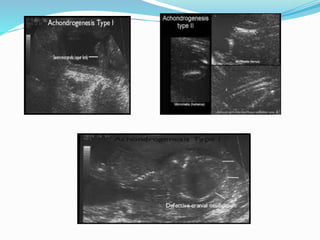
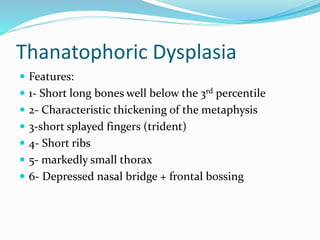
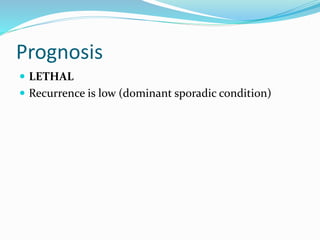
Achondrogenesis
 KEY Finding :
 1- Severe micromelia (shortened bones)
 2- Hypomineralization (bone unusally anechoic)
 3- Fetal hydrops + hydramnios (late)
Types
 Hint : All involve extremely short long bone and
severity is according to involvement of calvarium and
vertebral column.
 Type 1: Calvarium and Vertebral column severly
hypomineralized.
 Type 2 : Calvarium is ossified but veterbral column
may or may not be ossified
 Type 3: Mildest form where hypomineralization only
includes cervical and caudal vertebrae
Prognosis
 All 3 types are lethal at or before birth
 Recurrence is 1:4 in type1 and is a new Dominant
mutation in types 2 and 3 .
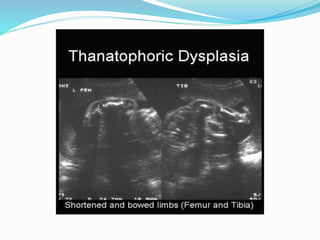
Thanatophoric Dysplasia
 Features:
 1- Short long bones well below the 3rd percentile
 2- Characteristic thickening of the metaphysis
 3-short splayed fingers (trident)
 4- Short ribs
 5- markedly small thorax
 6- Depressed nasal bridge + frontal bossing
Prognosis
 LETHAL
 Recurrence is low (dominant sporadic condition)
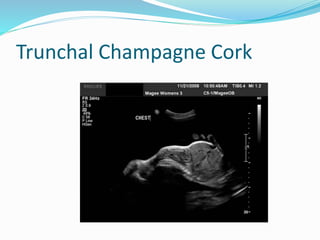
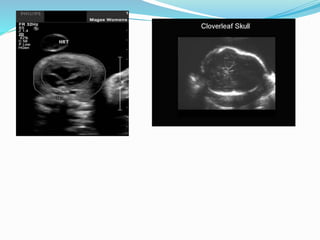
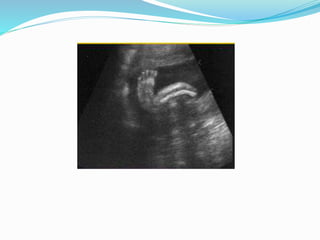
Trunchal Champagne Cork
Campomelic Dysplasia
 Features mainly in the lower limb :
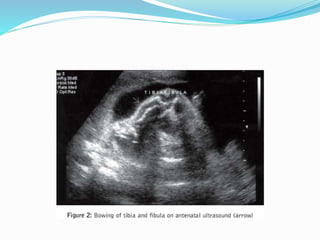
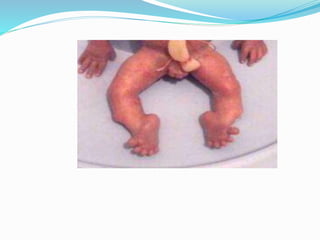
 1- Short bowed femur , tibia and Fibula + marked
Talipes
 2- The whole lower limb is bowed inwards hint the
name (Campomelia) derived from a greek word campo
or campto meaning BENT.
 3- marked association with soft tissue involvement
(cardiac, renal and Brain)
Prognosis
 ¾ of the cases die during neonatal period due to
associated pulmonary hypoplasia the prognosis is
mainly dependent on other organ involvement
 Recurrence is around 5%
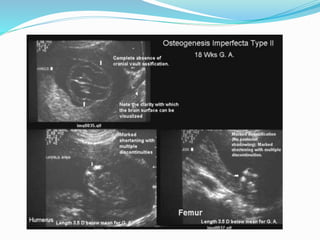
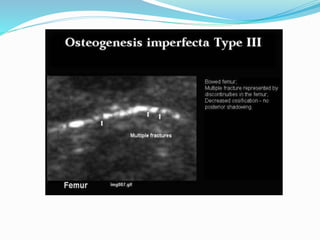
Osteogenesis imperfecta
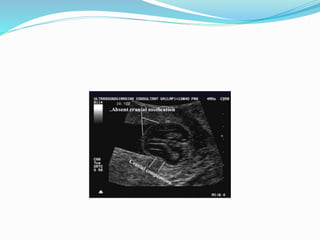
 Poor bone mineralization
 Types 1-4
 Most common types is type 2
 Short, hypomineralized crumpling bones with
multiple fractures
 Criteria of Diagnosis : 1- Multiple fractures ,
2-hypoechoic skull , 3- Femur length more than 3 SD
below G.A
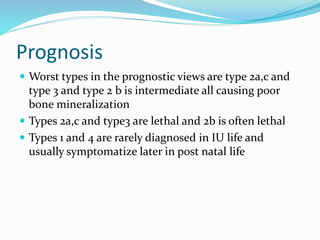
Prognosis
 Worst types in the prognostic views are type 2a,c and
type 3 and type 2 b is intermediate all causing poor
bone mineralization
 Types 2a,c and type3 are lethal and 2b is often lethal
 Types 1 and 4 are rarely diagnosed in IU life and
usually symptomatize later in post natal life
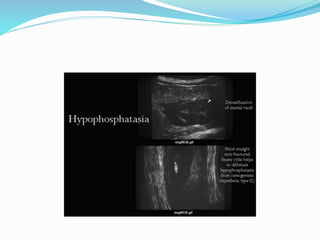
Hypophosphatasia
 Decreased bone mineralization due to deficiency in
alkaline phosphatase
 A spectrum of Severity from a lethal form close to
Osteogensis imperfecta with more severe angulation
in the fractures to a milder forms that can be
diagnosed later in early childhood.
Diagnosis
 Mainly by U/S finding of hypomineralization of bones
and confirmed by biochemical testing to the Amniotic
fluid for Alkaline Phosphatase , radiography , or
genetic testing of the parents.
Prognosis
 Autosomal recessive types are lethal
 Autosomal dominant types tend to be milder and
improve with age
Homoygous Achondroplasia
 Result from two parents who are heterogygous
achophondroplasia and the fetuses usually perish early
in gestation and so is rarely deen
MODERATE SYMMETRICAL
Asphyxiating thoracic Dystrophy
(Jeune)
 The main feature in this condition is a small chest in a
high risk family limb shortening is variable and may
not be apparent till 3rd trimester
 Soft tissue involvement renal , hepatic and pulmonary
with post axial polydactyly.
Prognosis
 70% of live born die from RDS
 Survivors are small in size and suffer from the
systemic complications associated with the disorder ,
intelligence is normal though
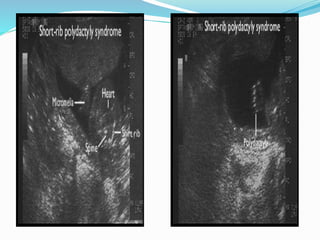
Short ribbed polydactyly
Syndromes
 Small Narrow thorax + short limbs + polydactyly +
specific feature for each type
 Type 1 : (SALDINO- NOONAN Syndrome)
- Micromelia with pointed ends in long bones
- Urogenital and anorectal anomalies
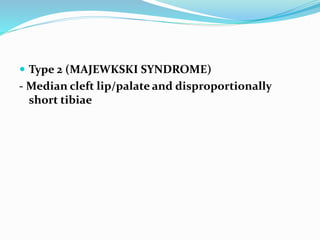
 Type 2 (MAJEWKSKI SYNDROME)
- Median cleft lip/palate and disproportionally
short tibiae
Prongnosis
 LETHAL Secondary to respiratory faliure
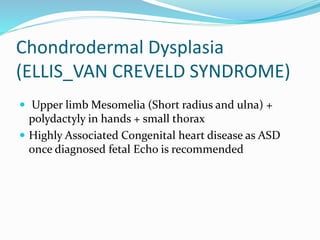
Chondrodermal Dysplasia
(ELLIS_VAN CREVELD SYNDROME)
 Upper limb Mesomelia (Short radius and ulna) +
polydactyly in hands + small thorax
 Highly Associated Congenital heart disease as ASD
once diagnosed fetal Echo is recommended
Prognosis
 Survivors have normal intelligence but final height
(105-150 cm)
 Inheritance is autosomal recessive recurrence of 25%
Diastrophic Dysplasia
 Rhizomelic shortening ( shortening of the proximal
long bones (humerus and femur) +bowing +
hitchhicker thumb + talipes
 Identification of a normal thumb can help exclude
diagnosis
Prognosis
 A significant number die of respiratory faliure and
pneumonia
 Those who survive have normal intellect but
progressive handicap.

Chondrodysplasia Punctata
 X-linked dominant : seen in females and lethal in
heterozygous males
 X-linked recessive : moderate shortening of long bones
+ EPIPHESYEAL ECHOGENICITES affected intellect
, heterozygous female carriers are clinically free and
rather short.
 Rhizomelic form : humerus is more affected
Prognosis
 Many Newborn die of respiratory faliure survivors fail
to thrive with microcephaly
Kniest Dysplasia
 Moderately short dumbbell- shaped long bones +
restricted joint mobility + depressed nasal bridge+
platyspondyly .
 Affected children have normal intellect but short
stature and limited joint mobility
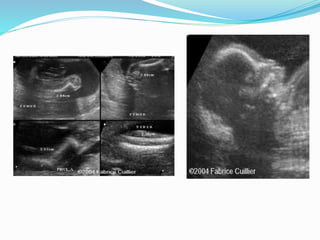
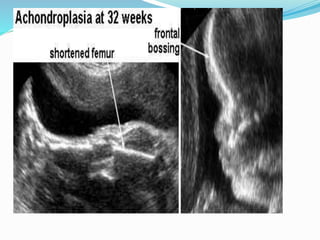
Heterozygous achondroplasia
(Dwarfism)
 The most well recognized dysplasia in general
population , with short stature but well integrated
members of the society.
 Acromesomelic limb shortening + stubby abducted
fingers (trident hand) + wide prominent forehead
(frontal bossing) + hypertelorism
Short long Bones : Asymmetrical
Isolated limb Reduction
 Asymmetrical reduction of a limb or part of a limb
 Majorly are non genetic but can occur as a part of
genetic syndrome or chromosomal abnormality.
Karyotyping and thorough sonography is
recommended.
 With no other associations prosthestics and
orthopedic surgery function and shape can be restored
Robert’s Syndrome
(pseudothalidomide Syndrome)
 All 4 limbs affected (tetraphocomelia)+ median facial
clefting+ microcephaly + talipes+ extremely short of
missing fingers or toes .
 Other assciated anomalies include hydrocephalus ,
encephalocele , renal anomalies.
 High perinatal mortality
 Severe IUGR
 Survivors are profoundly mentally retarded
Femur-Fibula-Ulna Syndrome
 From its name the Syndrome is mainly affection of
femur and fibula with varying degrees of ulnar
affection.
Holt-Oram Syndrome
 Upper limb and limb girdle reductions
 A cardinal feature is association with congenital heart
disease
 More in females and more on left than right.
 A Dominant condition 50% of affected inndividual’s
offsprings will be affected
Thrombocytopenia absent radius
symdrome
 TAR , could be confirmed by bilateral radial
aplasia/hypoplasia .
 Thrombocytopenia is a marker of heampoietic
abnormality.
 Autosomal recessive condition with 25% recurrence
Cleidocranial Dystosis
 Hypoplastic clavicles
 De novo presentations are usually missed as clavicle is
not routinely surveyed
 Affected skull mineralization
Thank You

Skeletal Dysplasia made easy

  • 1.
    Dr. Omneya NagyElmakhzangy Special Fetal Care Unit Ain Shams University
  • 2.
  • 3.
    Achondrogenesis  KEY Finding:  1- Severe micromelia (shortened bones)  2- Hypomineralization (bone unusally anechoic)  3- Fetal hydrops + hydramnios (late)
  • 4.
    Types  Hint :All involve extremely short long bone and severity is according to involvement of calvarium and vertebral column.  Type 1: Calvarium and Vertebral column severly hypomineralized.  Type 2 : Calvarium is ossified but veterbral column may or may not be ossified  Type 3: Mildest form where hypomineralization only includes cervical and caudal vertebrae
  • 5.
    Prognosis  All 3types are lethal at or before birth  Recurrence is 1:4 in type1 and is a new Dominant mutation in types 2 and 3 .
  • 7.
    Thanatophoric Dysplasia  Features: 1- Short long bones well below the 3rd percentile  2- Characteristic thickening of the metaphysis  3-short splayed fingers (trident)  4- Short ribs  5- markedly small thorax  6- Depressed nasal bridge + frontal bossing
  • 8.
    Prognosis  LETHAL  Recurrenceis low (dominant sporadic condition)
  • 9.
  • 12.
    Campomelic Dysplasia  Featuresmainly in the lower limb :  1- Short bowed femur , tibia and Fibula + marked Talipes  2- The whole lower limb is bowed inwards hint the name (Campomelia) derived from a greek word campo or campto meaning BENT.  3- marked association with soft tissue involvement (cardiac, renal and Brain)
  • 13.
    Prognosis  ¾ ofthe cases die during neonatal period due to associated pulmonary hypoplasia the prognosis is mainly dependent on other organ involvement  Recurrence is around 5%
  • 17.
    Osteogenesis imperfecta  Poorbone mineralization  Types 1-4  Most common types is type 2  Short, hypomineralized crumpling bones with multiple fractures  Criteria of Diagnosis : 1- Multiple fractures , 2-hypoechoic skull , 3- Femur length more than 3 SD below G.A
  • 18.
    Prognosis  Worst typesin the prognostic views are type 2a,c and type 3 and type 2 b is intermediate all causing poor bone mineralization  Types 2a,c and type3 are lethal and 2b is often lethal  Types 1 and 4 are rarely diagnosed in IU life and usually symptomatize later in post natal life
  • 21.
    Hypophosphatasia  Decreased bonemineralization due to deficiency in alkaline phosphatase  A spectrum of Severity from a lethal form close to Osteogensis imperfecta with more severe angulation in the fractures to a milder forms that can be diagnosed later in early childhood.
  • 22.
    Diagnosis  Mainly byU/S finding of hypomineralization of bones and confirmed by biochemical testing to the Amniotic fluid for Alkaline Phosphatase , radiography , or genetic testing of the parents.
  • 23.
    Prognosis  Autosomal recessivetypes are lethal  Autosomal dominant types tend to be milder and improve with age
  • 26.
    Homoygous Achondroplasia  Resultfrom two parents who are heterogygous achophondroplasia and the fetuses usually perish early in gestation and so is rarely deen
  • 27.
  • 28.
    Asphyxiating thoracic Dystrophy (Jeune) The main feature in this condition is a small chest in a high risk family limb shortening is variable and may not be apparent till 3rd trimester  Soft tissue involvement renal , hepatic and pulmonary with post axial polydactyly.
  • 29.
    Prognosis  70% oflive born die from RDS  Survivors are small in size and suffer from the systemic complications associated with the disorder , intelligence is normal though
  • 30.
    Short ribbed polydactyly Syndromes Small Narrow thorax + short limbs + polydactyly + specific feature for each type  Type 1 : (SALDINO- NOONAN Syndrome) - Micromelia with pointed ends in long bones - Urogenital and anorectal anomalies
  • 31.
     Type 2(MAJEWKSKI SYNDROME) - Median cleft lip/palate and disproportionally short tibiae
  • 32.
    Prongnosis  LETHAL Secondaryto respiratory faliure
  • 34.
    Chondrodermal Dysplasia (ELLIS_VAN CREVELDSYNDROME)  Upper limb Mesomelia (Short radius and ulna) + polydactyly in hands + small thorax  Highly Associated Congenital heart disease as ASD once diagnosed fetal Echo is recommended
  • 35.
    Prognosis  Survivors havenormal intelligence but final height (105-150 cm)  Inheritance is autosomal recessive recurrence of 25%
  • 36.
    Diastrophic Dysplasia  Rhizomelicshortening ( shortening of the proximal long bones (humerus and femur) +bowing + hitchhicker thumb + talipes  Identification of a normal thumb can help exclude diagnosis
  • 37.
    Prognosis  A significantnumber die of respiratory faliure and pneumonia  Those who survive have normal intellect but progressive handicap. 
  • 38.
    Chondrodysplasia Punctata  X-linkeddominant : seen in females and lethal in heterozygous males  X-linked recessive : moderate shortening of long bones + EPIPHESYEAL ECHOGENICITES affected intellect , heterozygous female carriers are clinically free and rather short.  Rhizomelic form : humerus is more affected
  • 39.
    Prognosis  Many Newborndie of respiratory faliure survivors fail to thrive with microcephaly
  • 41.
    Kniest Dysplasia  Moderatelyshort dumbbell- shaped long bones + restricted joint mobility + depressed nasal bridge+ platyspondyly .  Affected children have normal intellect but short stature and limited joint mobility
  • 43.
    Heterozygous achondroplasia (Dwarfism)  Themost well recognized dysplasia in general population , with short stature but well integrated members of the society.  Acromesomelic limb shortening + stubby abducted fingers (trident hand) + wide prominent forehead (frontal bossing) + hypertelorism
  • 45.
    Short long Bones: Asymmetrical
  • 46.
    Isolated limb Reduction Asymmetrical reduction of a limb or part of a limb  Majorly are non genetic but can occur as a part of genetic syndrome or chromosomal abnormality. Karyotyping and thorough sonography is recommended.  With no other associations prosthestics and orthopedic surgery function and shape can be restored
  • 47.
    Robert’s Syndrome (pseudothalidomide Syndrome) All 4 limbs affected (tetraphocomelia)+ median facial clefting+ microcephaly + talipes+ extremely short of missing fingers or toes .  Other assciated anomalies include hydrocephalus , encephalocele , renal anomalies.
  • 48.
     High perinatalmortality  Severe IUGR  Survivors are profoundly mentally retarded
  • 49.
    Femur-Fibula-Ulna Syndrome  Fromits name the Syndrome is mainly affection of femur and fibula with varying degrees of ulnar affection.
  • 50.
    Holt-Oram Syndrome  Upperlimb and limb girdle reductions  A cardinal feature is association with congenital heart disease  More in females and more on left than right.  A Dominant condition 50% of affected inndividual’s offsprings will be affected
  • 51.
    Thrombocytopenia absent radius symdrome TAR , could be confirmed by bilateral radial aplasia/hypoplasia .  Thrombocytopenia is a marker of heampoietic abnormality.  Autosomal recessive condition with 25% recurrence
  • 52.
    Cleidocranial Dystosis  Hypoplasticclavicles  De novo presentations are usually missed as clavicle is not routinely surveyed  Affected skull mineralization
  • 54.