Dr. Pankaj Kaira
JR-II Radiodiagnosis
SRMSIMS ,Bareilly India
 Skeletal dysplasias also termed as osteochondrodysplasias
are a large heterogeneous group of disorders comprising
of abnormalities of bone or cartilage growth or texture.
 They occur due to genetic mutations and their phenotype
continues to evolve throughout life.
 Their overall prevalence as a group has been reported to
be 2.3-7.6 per 10000 births in various epidemiologic
studies.
 Involvement of spine is commonly in the form of
flattening and decreased vertebral body height
termed as platyspondyly or there can be irregularity of
endplates
 There may also be abnormal vertebral hooking
or beaking which are characteristic for certain
dysplasias.
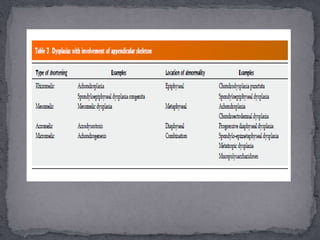
The appendicular skeleton has to be assessed for
 (1)type of bone shortening and
 (2) location of abnormality, i.e., epiphyseal, metaphyseal or
diaphyseal.
Shortening of the limbs can be
 (1) rhizomelic (involving proximal parts of limb, i.e.,
humerus and femur);
 (2) mesomelic (involving middle parts of limb, i.e.,
radius/ulna; tibia/fibula);
 (3) acromelic (involving hands and feet); or
 (4) micromelic (generalised shortening of entire limb).
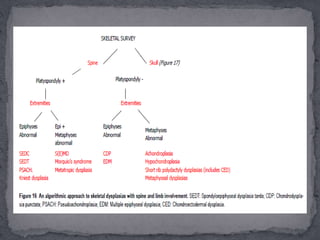
 The groups include:
(1) GROUP Ⅰ: Epiphyseal dysplasias with/without
spine involvement (Platyspondyly +/-);
(2) (2) GROUP Ⅱ: Metaphyseal dysplasias with limb
shortening/abnormal limb length;
(3) GROUP Ⅲ: Dysplasias with altered bone density;
and (4) and
GROUP Ⅳ: Miscellaneous dysplasias, i.e., those
which do not typicallyhave limb shortening or be
clearly bracketed anatomically into sponylo-
epi/metaphyseal dysplasias.
 The mode of inheritance is autosomal dominant
and is due to a mutation in COL2A1 gene on
chromosome locus 12q13.1 affecting Type Ⅱ collagen
protein.
 Age of manifestation: At birth with delayed
ossification of epiphyses as its hallmark.
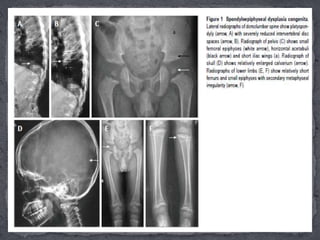
Essential radiographicfeatures:
 (1) Bulbous and pear-shaped vertebrae at birth which later flatten leading
to severe platyspondyly with thin intervertebral disc spaces.
 The ensuing complications include kyphoscoliosis, lumbar lordosis and
atlanto-axial instability. Atlanto-axial instability is secondary to odontoid
hypoplasia and it subsequently endows a greatly increased risk of cervical
myelopathy.
 (2) Absent pubic bones at birth with horizontal roofs of acetabula and short
and broad iliac wings;
 (3) Absent epiphyses of calcaneum and knee at birth. Later, there’s delay in
the ossification of the heads of femur
 While delayed ossification of carpals and tarsal bones are noted, the hands
and feet are typically not involved; and
 (4) Other features include large and dolicocephalic skull and rhizomelic
shortening of extremities, more in lower than upper limbs and metaphyseal
widening secondary to abnormal epiphyses.
Differential diagnoses of SEDC include
 (1) Spondyloepiphysealdysplasia tarda,
 (2) Morquio’s syndrome,
 (3)Kniest dysplasia and
 (4) Metatropic dysplasia.
 The classical spondyloepiphyseal dysplasia tarda
(SEDT) has a X-linked recessive inheritance and is
noted only in males. This is caused due to a mutation
of gene locus X.p22.2 affecting TRAPPC2 gene.
 Age of manifestation: The classic age of presentation
is between 5-10 years of age, though it can variable,
even first manifesting in the second decade of life.
However, unlike SEDC, the appearance at birth is
normal.
 Essential radiographic features:
 (1) Platyspondyly with heaping up and hyperostosis on the
posterior two-thirds of endplates giving rise to a heaped-
up or hump-shaped appearance
 (2) Small pelvis with mild-to-moderate epiphyseal
irregularity leading to early osteoarthritis at hips, knees
and ankles. However hands, feet and skull are typically not
involved; and
 (3) Other features: In addition to these findings,
progressive narrowing of interpedicular distance in
lumbar spine have also been described, similar to
achondroplasia, in the autosomal recessive forms of SEDT
Differential diagnoses of SEDT include
 (1) SEDC
 (2) Multiple epiphyseal dysplasia/Pseudochondroplasia.
 Multiple epiphyseal dysplasia (EDM) is a genetically
heterogeneous entity caused by mutations in multiple
genes.
 Most cases of EDM are inherited in autosomal
dominant manner while EDM4 has autosomal
recessive inheritance.
 Age of manifestation: Despite the genetic
heterogeneity, MED usually presents after the age of 2-
4 years when the child begins to walk.
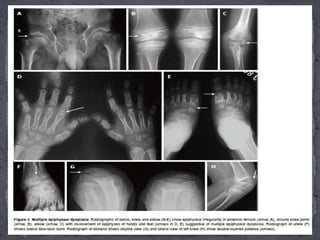
Essential radiographic features:
(1) Bilateral and symmetric involvement of epiphyses of hips, knees,
ankles, shoulders, elbows, wrists and hands and feet.
(2) Lateral tibio-talar slant wherein the lateral part of distal tibial
epiphyses is thinner than the medial and the trochlea of the talus is
shaped to conform to the abnormal ankle joint mortice
(3) Double-layered patella as seen on a lateral X-ray of knee is considered
highly pathognomic of EDM. However, more recently, the uncommon
occurrence of a double-layered patella is also seen in a patient with
pseudoachondroplasia.
(4) Mild involvement of spine with anterior wedging, mild end plate
irregularity and multiple Schmorl’s nodes mimicking Scheuermann’s
disease and typical absence of platyspondyly.
 Pseudoachondroplasia is an autosomal dominantly
inherited dysplasia caused due to mutation affecting
the COMP gene similar to EDM on gene locus 19p13.11.
Since both pseudoachondroplasia and EDM are
genotypic alleles, there is considerable overlap in age
of presentation and radiographic appearance in both
entities.
Essential radiographic features:
Vertebrae have a persistent oval shape in childhood with a
tongue-like protusion from the anterior aspect of vertebral
bodies giving rise to central anterior tongue appearance .
The central anterior tongue appearance is pathognomic of
this entity. However, this disappears at older age and is
replaced by platyspondyly giving rise to the short limbshort
trunk dwarfism.
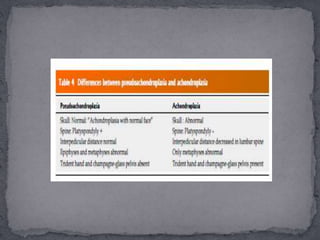
Differential diagnoses of pseudoachondroplasia include
(1) EDM and
(2) (2) achondroplasia
 Chondrodysplasia punctata (CDP) is another
genetically heterogeneous dysplasia. The most
common type is the X-linked dominant type also
termed as Conradi-Hunermann type due to mutation
on Xp11. Another type is the rhizomelic type
chondrodysplasia punctata (RCDP) associated with
peroxisomal enzyme disorder and has an autosomal
recessive inheritance.
 RCDP is further divided into 3 sub-types, namely
RCDP1,RCDP2 and RCDP3.
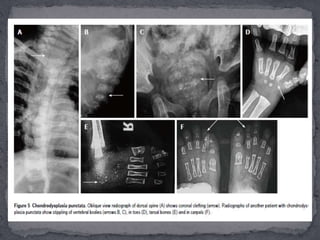
 Essentially, the hallmark of CDP is stippling of
epiphyses at birth. Later on, the stippling disappears
and epiphyses become irregular with limb asymmetry.
 Mucopolysaccharidoses (MPS) or lysosomal storage
disorders are associated with absence of lysososomal
enzymes required for degradation of glycosaminoglycans
(GAGs) or mucopolysaccharides.
 There is secondary deposition of GAGs in various tissues
causing coarse facies, mental retardation and
hepatosplenomegaly.
 These disorders are also called dysostoses multiplex as they
have multiple common skeletal abnormalities.
 The common skeletal features in this group include
epiphyseal abnormalities, proximal pointed metacarpals
and beaking in spine.
 Hurler’s syndrome is an autosomal recessive disorder
due to mutation on 4p16.3 causing deficiency of
alpha--Liduronidaseenzyme.
 Age of manifestation: Babies with MPS 1 appear
normal at birth with both clinical and radiographic
feature manifesting over first two years of life.
Specific non-skeletal features of MPS 1 include corneal
clouding, coronary artery narrowing, endocardial
fibroelastosis and cardiac valvular disease
Essential radiographic features:
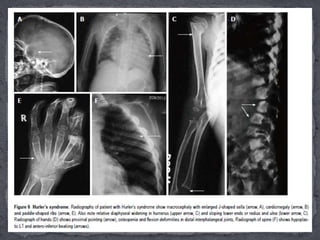
(1) Macrocephalic skull with frontal bossing and J-shaped sella .
The sinuses and facial bones are small and angle of mandible is increased.
The J-shaped sella is secondary to pituitary gland enlargement due to deposition of
GAGs in the gland;
(2) Paddle or oar-shaped ribs in which the ribs are thin posteriorly and broad
anteriorly ;
(3) The lateral ends of clavicles are hypoplastic with small scapulae are small and
there’s associated cardiomegaly
(4) While overall length of limbs is maintained, there is diaphyseal widening, more in
upper than lower limbs. In older children distal radius and ulna may slope towards
each other .
In hands, the tubular bones are typically short and wide and metacarpals
appear broad distally and tapered proximally. In addition, osteoporosis and flexion
deformities are noted.
(5) In spine, typically, the L2 or L1 vertebrais hypoplastic and set slightly posteriorly
giving rise to dorsolumbar kyphosis at that level with antero-inferior beaking of
vertebrae . Atlanto-axial instability is present while platyspondyly is absent; and
(6) Other features include flared out iliac wings with sloping, shallow
acetabular roofs and delayed ossification of femoral heads.
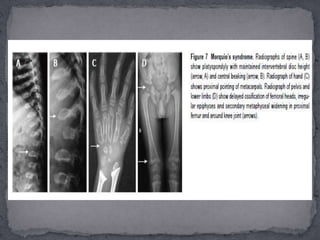
 Morquio’s syndrome of MPS IV is caused by mutations
in two genes,Type IVA ; mutation on 16q24.3; enzyme
galactosamine-6-sulfate sulfatase and type IVB;
mutation on 3p21.33; enzyme betagalactosidase.
MPS IV shows enlarged skull, dorsolumbar kyphosis in spine and
atlanto-axial instability,
Features specific to MPS Ⅳ include normal sized sella (unlike
MPS 1) and platyspondyly with maintained/ increased
intervertebral disc spaces with central beaking.
The hands typically show pointing of the base of second to fifth
metacarpals and distal ends of phalanges.
There is additional delayed and irregular ossification of carpals
and tarsals.
In limbs, along with epiphyseal irregularity, metaphyses are
widened to accommodate the enlarged epiphyses.
There is also delayed ossification of femoral heads with poorly
developed acetabula leading to premature arthropathy mimicking
SEDC.
 Achondroplasia is the most common non-lethal
dysplasia and is the prototype of rhizomelic dwarfism.
 It is inherited in an autosomal dominant fashion, with
80% occurring sporadically, attributable to
spontaneous mutation on locus4p16.3 affecting
Fibroblast Growth Factor Receptor 3(FGFR3) gene.
 Age of manifestation: The typical features of
achondroplasia are obvious at birth. The most
characteristic changes are found in the spine,
especially in the lumbar region, pelvis, limbs and skull.
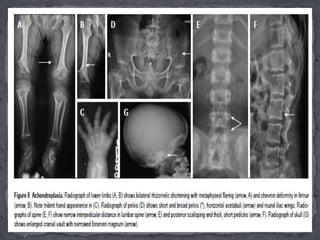
Essential radiological features:
(1) Symmetric shortening of all long bones, with proximal portions being more
affected and lower limb involvement being more than the upper limb
(rhizomelia). There’s relative flaring and splaying of metaphyses with normal
epiphyses .
(2) In children, the epiphysis is located closer to metaphyses leading to an
apparent increase in the depth of the articular cartilage space. The two limbs
of the V of metaphysis appear to embrace the epiphysis giving rise to a ball and
socket relationship/chevron deformity . This appearance is more common at
lower end of femur and tends to normalise with increasing age.
(3) The hand bones appear thick and tubular with widely separated 2nd and 3rd
digits of the hands and inability to approximate them in extension, leading to
appearance of trident hand.
(4) The pelvic cavity is short and broad, also called as champagne-glass
appearance. There’s squaring of iliac wings with some roundening of corners
on a frontal projection (elephant ear shaped iliac wings).
The inferior margins of iliac wings and the roofs of acetabulum are flat and
horizontal . The sacrosciatic notches are small with an exaggerated sacral tilt
and large, anteriorly protruding sacral promontory;
(5) In spine, there is progressive decrease in the interpedicular distance
cranio-caudally in the lumbar spine, the decrease in distance becoming more
conspicuous with age). Posterior scalloping of vertebral bodies is also
common while anteriorly they may appear rounded giving rise to a bullet-
shaped configuration. But the overall length of vertebral column and the
vertebral heights are normal. There’s associated dorso-lumbar kyphoscoliosis
in sitting position with exaggerated lumbar lordosis on standing up.
Achondroplasts are prone for premature and severe spinal canal stenosis;
(6) The skull shows narrowed skull base with narrowing of foramen
magnum. There is compensatory over-expansion of the skull vault and
frontal regions to accommodate the expanding brain. There’s relative mid-
face hypoplasia and depressed nasal bones.
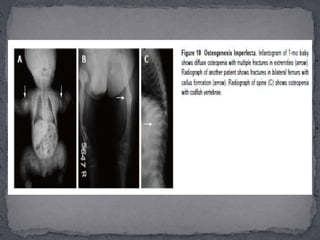
 Osteogenesis imperfecta (OI) is an autosomal dominantly or
recessively inherited genetic disorder due to mutations in type 1
procollagen genes, characterised by decreased bone mass and
increased bone fragility. Severity varies widely from perinatal lethality
(type Ⅱ) to milder forms with minimal fractures.
 Extraskeletal manifestations like blue sclerae, dentinogenesis
imperfecta and deafness are also seen.
 Initially, Sillence et al divided OI into four subtypes based on clinical
features and disease severity:
 OI type Ⅰ, with blue sclerae
 OI type Ⅱ, perinatal lethal or congenital type;
 OI type Ⅲ, a progressively deforming form with normal sclerae; and
 OI type Ⅳ, with normal sclerae which has been further expanded to
eight types.
 The bone fragility increases in severity from type Ⅰ < type < Ⅴ < Ⅵ <
Ⅶ < Type Ⅲ < Type Ⅷ < Type Ⅱ.
Essential radiological features:
 (1) Radiologically, OI is characterised by a triad of diffuse
osteopenia, pencil-thin cortices, and multiple bony fractures.
 The fractures are usually multiple and heal with exuberant callus
formation giving rise to “pseudotumour” formation.
Associated findings include deformities and pseudoarthrosis;
 (2) The vertebrae are also osteopenic, have a biconcave “codfish
vertebrae” appearance with areas of collapse.
 (3) The skull shows multiple wormian bones, lucent calvarium,
enlarged sinuses and platybasia.
 (4)The pelvis is also abnormal in shape with deformities like
protusio acetabuli and “shepherd crook” femurs.
 Differential diagnoses include
1)Battered baby syndrome,
2)Hypophosphatasia,
3) Juvenile idiopathic osteoporosis.
 The most severe form, termed as autosomal recessive
type is characterised by early onset of symptoms,
obliteration of medullary canals with bone marrow
failure leading to anemia, thrombocytopenia,
hepatosplenomegaly and early death.
 On other hand, in dominant form, the onset occurs in
adulthood with variable penetrance. These patients
have mild anemia and present more with fractures and
deformities.
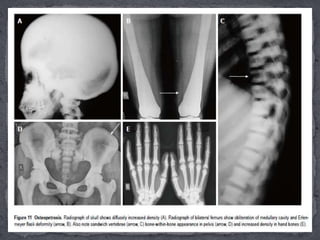
Essential radiological features:
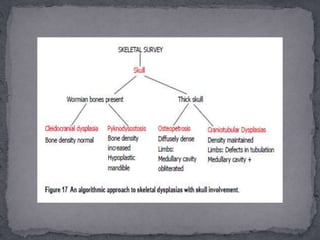
(1) There is diffuse sclerosis involving both the skull vault and
base with progressive narrowing of foramina causing cranial
nerve impingement, more so in the recessive type. In addition,
there is prognathism with predisposition to mandibular
osteomyelitis.
(2) In limbs, despite increased density, there are multiple
fractures. Fracture healing rate is normal but callus formation is
defective comprising of osteoporotic bone. In addition, there is
metaphyseal flaring leading to Erlenmeyer flask deformity.
(3) “Bone-within-bone” appearance typically noted in spine,
pelvis and short tubular bones. In spine, this is termed as a
sandwich vertebrae appearance due to endplate sclerosis and
relative lucency of centre of body. In pelvis, they appear as
multiple dense white lines parallel to the iliac crest .
Differential diagnoses include
 Pycnodysostosis.
 Craniotubular dysplasias.
 Pycnodysostosis (PKND) is an autosomal recessive
disorder due to mutation involving cathepsin K gene
on locus 1q21.
 Age of presentation: They present early in childhood
with a triad of increased bone density, short limb
dwarfism and increased propensity for fractures.
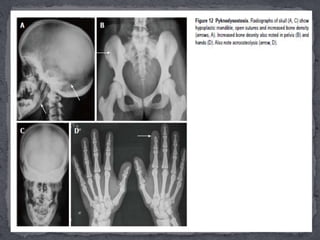
 Essential radiological features:
 (1) Skull shows widely open sutures and fontanelles with
multiple wormian bones, mandibular hypoplasia with obtuse
angle and increased sclerosis of vault, base and orbital rims ;
 (2) There is increased bone density involving both limb bones
and pelvis . The limb length is decreased and pelvis is also small
with shallow acetabulae .
 (3) In hands, there is typically acro-osteolysis, i.e., resorption
 and tufting of terminal phalanges and
 (4)In limbs, medullary cavity is maintained while bowing of
radius and Madelung’s deformity can be occasionally seen.
 Other radiological features include hypoplasia of lateral ends of
clavicles similar to cleidocranial dysplasia, and occasional spool-
shaped vertebrae.
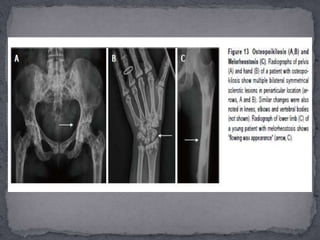
 It is a benign condition with autosomal dominant
inheritance, more common in males characterised by
multiple small (1-10 mm), symmetric, uniform
radiopaque densities located at ends of long bones,
carpals, tarsals and periacetabular and subglenoid
areas.
 An important differentialan be osteoblastic metastases
which can be differentiated by the variable size of
lesions and by radionuclide scintigraphy.
 Benign condition with a X-linked dominant inheritance.
 It is more commonly seen in females and is characterised
by bilateral symmetric involvement of long bones, pelvis
and scapulae in the form of multiple vertical radio opaque
lines in the metaphysis extending into the diaphysis.
In the pelvis, this gives a sunburst effect.
Other findings include osteosclerosis of long bones and
skull leading to foraminal narrowing and cranial nerve
compression.
 Melorheostosis can be both a sporadic, non-inherited disorder or
an inherited disorder presenting with melorheostosis and
osteopoikilosis .
 Melorheostosis is a benign condition characterised clinically by
pain and soft-tissue contractures.
 The distribution is asymmetric, can be monostotic
(involving single bone) or polyostotic (involving multiple
bones) or monomelic (involving one limb), most typically
the lower limb.
 Other bones like skull, ribs, spine and short tubular bones can be
affected at times. There is typically cortical thickening in a
streaky or wavy pattern extending from the proximal to distal
part of bone giving a “flowing wax candle appearance”. The
distribution in children is usually endosteal (which can mimic
bone islands and osteopoikilosis) but this evolves to a periosteal
pattern in adults.
 Progressive diaphyseal dysplasia, also called Camurati-
Engelmann’s disease is an autosomal dominant
disorder(locus 19q13).
 There is bilateral symmetric, fusiform enlargement
with increased density of diaphysis of long bones
beginning mid-shaft and progressing towards both
ends.
In severe cases metaphyses may also be involved
but typically, epiphyses are spared.
 Caffey’s disease is an inherited disorder with both autosomal
dominant and recessive inheritance characterized by a
clinical triad of
 (1) narrow age group of presentation (before 5th month of
age);
 (2) hyperirritability, soft tissue swelling, bone lesions;
 (3) mandible involvement.
 There is diffuse cortical thickening of mandible due to
subperiosteal new bone formation.
 Other bones such as ulna, tibia, clavicle, scapulae and ribs
can also be involved and radiographs show periosteal new
bone formation in diaphysis sparing epiphyses and
metaphyses.
 It is an autosomal dominant dysplasia with
predominant membranous bone involvement. Due to
its dominant mode of inheritance it can be seen in
multiple members of the same family and can present
in childhood to as late as 30 years of life.
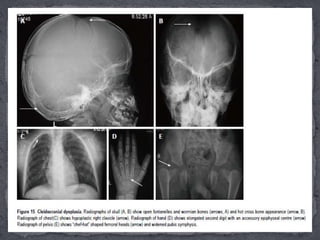
 Essential radiological features:
 (1) The skull shows delayed ossification of calvarium,
multiple wormian bones, persistently open sutures and
fontanelles giving a hot cross bun appearance. However the
mandible is normal with maintained angle .
 (2) The clavicles are either absent (10%) or hypoplastic
(90%), hypoplasia affecting the lateral ends more than
middle or medial ends. Also the scapulae may be small and
thoracic cage cone-shaped.
 (3) In hands and feet, the 2nd digit is elongated due to
presence of accessory epiphyses for the second metacarpal
while the distal phalanges are small and pointed.
 (4) The pelvis is small with widened symphysis pubis and
abnormal shape of femoral heads called “chef-hat”
appearance.
 The correct label of dysplasia is essential for
prognostication, clinical and orthopaedic management
of the present child and also to counsel
parents about future pregnancies and their outcome.
 A complete skeletal survey is an essential component of
workup and hence it is important for radiologists to
carefully analyse the bones, appearance and distribution
of abnormalities on the survey and be familiar with the
descriptions of common skeletal dysplasias.
THANK YOU

Skeletal dysplasia

  • 1.
    Dr. Pankaj Kaira JR-IIRadiodiagnosis SRMSIMS ,Bareilly India
  • 2.
     Skeletal dysplasiasalso termed as osteochondrodysplasias are a large heterogeneous group of disorders comprising of abnormalities of bone or cartilage growth or texture.  They occur due to genetic mutations and their phenotype continues to evolve throughout life.  Their overall prevalence as a group has been reported to be 2.3-7.6 per 10000 births in various epidemiologic studies.
  • 4.
     Involvement ofspine is commonly in the form of flattening and decreased vertebral body height termed as platyspondyly or there can be irregularity of endplates  There may also be abnormal vertebral hooking or beaking which are characteristic for certain dysplasias.
  • 5.
    The appendicular skeletonhas to be assessed for  (1)type of bone shortening and  (2) location of abnormality, i.e., epiphyseal, metaphyseal or diaphyseal. Shortening of the limbs can be  (1) rhizomelic (involving proximal parts of limb, i.e., humerus and femur);  (2) mesomelic (involving middle parts of limb, i.e., radius/ulna; tibia/fibula);  (3) acromelic (involving hands and feet); or  (4) micromelic (generalised shortening of entire limb).
  • 7.
     The groupsinclude: (1) GROUP Ⅰ: Epiphyseal dysplasias with/without spine involvement (Platyspondyly +/-); (2) (2) GROUP Ⅱ: Metaphyseal dysplasias with limb shortening/abnormal limb length; (3) GROUP Ⅲ: Dysplasias with altered bone density; and (4) and GROUP Ⅳ: Miscellaneous dysplasias, i.e., those which do not typicallyhave limb shortening or be clearly bracketed anatomically into sponylo- epi/metaphyseal dysplasias.
  • 8.
     The modeof inheritance is autosomal dominant and is due to a mutation in COL2A1 gene on chromosome locus 12q13.1 affecting Type Ⅱ collagen protein.  Age of manifestation: At birth with delayed ossification of epiphyses as its hallmark.
  • 9.
    Essential radiographicfeatures:  (1)Bulbous and pear-shaped vertebrae at birth which later flatten leading to severe platyspondyly with thin intervertebral disc spaces.  The ensuing complications include kyphoscoliosis, lumbar lordosis and atlanto-axial instability. Atlanto-axial instability is secondary to odontoid hypoplasia and it subsequently endows a greatly increased risk of cervical myelopathy.  (2) Absent pubic bones at birth with horizontal roofs of acetabula and short and broad iliac wings;  (3) Absent epiphyses of calcaneum and knee at birth. Later, there’s delay in the ossification of the heads of femur  While delayed ossification of carpals and tarsal bones are noted, the hands and feet are typically not involved; and  (4) Other features include large and dolicocephalic skull and rhizomelic shortening of extremities, more in lower than upper limbs and metaphyseal widening secondary to abnormal epiphyses.
  • 10.
    Differential diagnoses ofSEDC include  (1) Spondyloepiphysealdysplasia tarda,  (2) Morquio’s syndrome,  (3)Kniest dysplasia and  (4) Metatropic dysplasia.
  • 12.
     The classicalspondyloepiphyseal dysplasia tarda (SEDT) has a X-linked recessive inheritance and is noted only in males. This is caused due to a mutation of gene locus X.p22.2 affecting TRAPPC2 gene.  Age of manifestation: The classic age of presentation is between 5-10 years of age, though it can variable, even first manifesting in the second decade of life. However, unlike SEDC, the appearance at birth is normal.
  • 13.
     Essential radiographicfeatures:  (1) Platyspondyly with heaping up and hyperostosis on the posterior two-thirds of endplates giving rise to a heaped- up or hump-shaped appearance  (2) Small pelvis with mild-to-moderate epiphyseal irregularity leading to early osteoarthritis at hips, knees and ankles. However hands, feet and skull are typically not involved; and  (3) Other features: In addition to these findings, progressive narrowing of interpedicular distance in lumbar spine have also been described, similar to achondroplasia, in the autosomal recessive forms of SEDT
  • 14.
    Differential diagnoses ofSEDT include  (1) SEDC  (2) Multiple epiphyseal dysplasia/Pseudochondroplasia.
  • 16.
     Multiple epiphysealdysplasia (EDM) is a genetically heterogeneous entity caused by mutations in multiple genes.  Most cases of EDM are inherited in autosomal dominant manner while EDM4 has autosomal recessive inheritance.  Age of manifestation: Despite the genetic heterogeneity, MED usually presents after the age of 2- 4 years when the child begins to walk.
  • 17.
    Essential radiographic features: (1)Bilateral and symmetric involvement of epiphyses of hips, knees, ankles, shoulders, elbows, wrists and hands and feet. (2) Lateral tibio-talar slant wherein the lateral part of distal tibial epiphyses is thinner than the medial and the trochlea of the talus is shaped to conform to the abnormal ankle joint mortice (3) Double-layered patella as seen on a lateral X-ray of knee is considered highly pathognomic of EDM. However, more recently, the uncommon occurrence of a double-layered patella is also seen in a patient with pseudoachondroplasia. (4) Mild involvement of spine with anterior wedging, mild end plate irregularity and multiple Schmorl’s nodes mimicking Scheuermann’s disease and typical absence of platyspondyly.
  • 19.
     Pseudoachondroplasia isan autosomal dominantly inherited dysplasia caused due to mutation affecting the COMP gene similar to EDM on gene locus 19p13.11. Since both pseudoachondroplasia and EDM are genotypic alleles, there is considerable overlap in age of presentation and radiographic appearance in both entities.
  • 20.
    Essential radiographic features: Vertebraehave a persistent oval shape in childhood with a tongue-like protusion from the anterior aspect of vertebral bodies giving rise to central anterior tongue appearance . The central anterior tongue appearance is pathognomic of this entity. However, this disappears at older age and is replaced by platyspondyly giving rise to the short limbshort trunk dwarfism. Differential diagnoses of pseudoachondroplasia include (1) EDM and (2) (2) achondroplasia
  • 23.
     Chondrodysplasia punctata(CDP) is another genetically heterogeneous dysplasia. The most common type is the X-linked dominant type also termed as Conradi-Hunermann type due to mutation on Xp11. Another type is the rhizomelic type chondrodysplasia punctata (RCDP) associated with peroxisomal enzyme disorder and has an autosomal recessive inheritance.  RCDP is further divided into 3 sub-types, namely RCDP1,RCDP2 and RCDP3.
  • 24.
     Essentially, thehallmark of CDP is stippling of epiphyses at birth. Later on, the stippling disappears and epiphyses become irregular with limb asymmetry.
  • 27.
     Mucopolysaccharidoses (MPS)or lysosomal storage disorders are associated with absence of lysososomal enzymes required for degradation of glycosaminoglycans (GAGs) or mucopolysaccharides.  There is secondary deposition of GAGs in various tissues causing coarse facies, mental retardation and hepatosplenomegaly.  These disorders are also called dysostoses multiplex as they have multiple common skeletal abnormalities.  The common skeletal features in this group include epiphyseal abnormalities, proximal pointed metacarpals and beaking in spine.
  • 28.
     Hurler’s syndromeis an autosomal recessive disorder due to mutation on 4p16.3 causing deficiency of alpha--Liduronidaseenzyme.  Age of manifestation: Babies with MPS 1 appear normal at birth with both clinical and radiographic feature manifesting over first two years of life. Specific non-skeletal features of MPS 1 include corneal clouding, coronary artery narrowing, endocardial fibroelastosis and cardiac valvular disease
  • 29.
    Essential radiographic features: (1)Macrocephalic skull with frontal bossing and J-shaped sella . The sinuses and facial bones are small and angle of mandible is increased. The J-shaped sella is secondary to pituitary gland enlargement due to deposition of GAGs in the gland; (2) Paddle or oar-shaped ribs in which the ribs are thin posteriorly and broad anteriorly ; (3) The lateral ends of clavicles are hypoplastic with small scapulae are small and there’s associated cardiomegaly (4) While overall length of limbs is maintained, there is diaphyseal widening, more in upper than lower limbs. In older children distal radius and ulna may slope towards each other . In hands, the tubular bones are typically short and wide and metacarpals appear broad distally and tapered proximally. In addition, osteoporosis and flexion deformities are noted. (5) In spine, typically, the L2 or L1 vertebrais hypoplastic and set slightly posteriorly giving rise to dorsolumbar kyphosis at that level with antero-inferior beaking of vertebrae . Atlanto-axial instability is present while platyspondyly is absent; and (6) Other features include flared out iliac wings with sloping, shallow acetabular roofs and delayed ossification of femoral heads.
  • 31.
     Morquio’s syndromeof MPS IV is caused by mutations in two genes,Type IVA ; mutation on 16q24.3; enzyme galactosamine-6-sulfate sulfatase and type IVB; mutation on 3p21.33; enzyme betagalactosidase.
  • 32.
    MPS IV showsenlarged skull, dorsolumbar kyphosis in spine and atlanto-axial instability, Features specific to MPS Ⅳ include normal sized sella (unlike MPS 1) and platyspondyly with maintained/ increased intervertebral disc spaces with central beaking. The hands typically show pointing of the base of second to fifth metacarpals and distal ends of phalanges. There is additional delayed and irregular ossification of carpals and tarsals. In limbs, along with epiphyseal irregularity, metaphyses are widened to accommodate the enlarged epiphyses. There is also delayed ossification of femoral heads with poorly developed acetabula leading to premature arthropathy mimicking SEDC.
  • 34.
     Achondroplasia isthe most common non-lethal dysplasia and is the prototype of rhizomelic dwarfism.  It is inherited in an autosomal dominant fashion, with 80% occurring sporadically, attributable to spontaneous mutation on locus4p16.3 affecting Fibroblast Growth Factor Receptor 3(FGFR3) gene.  Age of manifestation: The typical features of achondroplasia are obvious at birth. The most characteristic changes are found in the spine, especially in the lumbar region, pelvis, limbs and skull.
  • 35.
    Essential radiological features: (1)Symmetric shortening of all long bones, with proximal portions being more affected and lower limb involvement being more than the upper limb (rhizomelia). There’s relative flaring and splaying of metaphyses with normal epiphyses . (2) In children, the epiphysis is located closer to metaphyses leading to an apparent increase in the depth of the articular cartilage space. The two limbs of the V of metaphysis appear to embrace the epiphysis giving rise to a ball and socket relationship/chevron deformity . This appearance is more common at lower end of femur and tends to normalise with increasing age. (3) The hand bones appear thick and tubular with widely separated 2nd and 3rd digits of the hands and inability to approximate them in extension, leading to appearance of trident hand. (4) The pelvic cavity is short and broad, also called as champagne-glass appearance. There’s squaring of iliac wings with some roundening of corners on a frontal projection (elephant ear shaped iliac wings).
  • 36.
    The inferior marginsof iliac wings and the roofs of acetabulum are flat and horizontal . The sacrosciatic notches are small with an exaggerated sacral tilt and large, anteriorly protruding sacral promontory; (5) In spine, there is progressive decrease in the interpedicular distance cranio-caudally in the lumbar spine, the decrease in distance becoming more conspicuous with age). Posterior scalloping of vertebral bodies is also common while anteriorly they may appear rounded giving rise to a bullet- shaped configuration. But the overall length of vertebral column and the vertebral heights are normal. There’s associated dorso-lumbar kyphoscoliosis in sitting position with exaggerated lumbar lordosis on standing up. Achondroplasts are prone for premature and severe spinal canal stenosis; (6) The skull shows narrowed skull base with narrowing of foramen magnum. There is compensatory over-expansion of the skull vault and frontal regions to accommodate the expanding brain. There’s relative mid- face hypoplasia and depressed nasal bones.
  • 38.
     Osteogenesis imperfecta(OI) is an autosomal dominantly or recessively inherited genetic disorder due to mutations in type 1 procollagen genes, characterised by decreased bone mass and increased bone fragility. Severity varies widely from perinatal lethality (type Ⅱ) to milder forms with minimal fractures.  Extraskeletal manifestations like blue sclerae, dentinogenesis imperfecta and deafness are also seen.  Initially, Sillence et al divided OI into four subtypes based on clinical features and disease severity:  OI type Ⅰ, with blue sclerae  OI type Ⅱ, perinatal lethal or congenital type;  OI type Ⅲ, a progressively deforming form with normal sclerae; and  OI type Ⅳ, with normal sclerae which has been further expanded to eight types.  The bone fragility increases in severity from type Ⅰ < type < Ⅴ < Ⅵ < Ⅶ < Type Ⅲ < Type Ⅷ < Type Ⅱ.
  • 39.
    Essential radiological features: (1) Radiologically, OI is characterised by a triad of diffuse osteopenia, pencil-thin cortices, and multiple bony fractures.  The fractures are usually multiple and heal with exuberant callus formation giving rise to “pseudotumour” formation. Associated findings include deformities and pseudoarthrosis;  (2) The vertebrae are also osteopenic, have a biconcave “codfish vertebrae” appearance with areas of collapse.  (3) The skull shows multiple wormian bones, lucent calvarium, enlarged sinuses and platybasia.  (4)The pelvis is also abnormal in shape with deformities like protusio acetabuli and “shepherd crook” femurs.
  • 40.
     Differential diagnosesinclude 1)Battered baby syndrome, 2)Hypophosphatasia, 3) Juvenile idiopathic osteoporosis.
  • 42.
     The mostsevere form, termed as autosomal recessive type is characterised by early onset of symptoms, obliteration of medullary canals with bone marrow failure leading to anemia, thrombocytopenia, hepatosplenomegaly and early death.  On other hand, in dominant form, the onset occurs in adulthood with variable penetrance. These patients have mild anemia and present more with fractures and deformities.
  • 43.
    Essential radiological features: (1)There is diffuse sclerosis involving both the skull vault and base with progressive narrowing of foramina causing cranial nerve impingement, more so in the recessive type. In addition, there is prognathism with predisposition to mandibular osteomyelitis. (2) In limbs, despite increased density, there are multiple fractures. Fracture healing rate is normal but callus formation is defective comprising of osteoporotic bone. In addition, there is metaphyseal flaring leading to Erlenmeyer flask deformity. (3) “Bone-within-bone” appearance typically noted in spine, pelvis and short tubular bones. In spine, this is termed as a sandwich vertebrae appearance due to endplate sclerosis and relative lucency of centre of body. In pelvis, they appear as multiple dense white lines parallel to the iliac crest .
  • 44.
    Differential diagnoses include Pycnodysostosis.  Craniotubular dysplasias.
  • 46.
     Pycnodysostosis (PKND)is an autosomal recessive disorder due to mutation involving cathepsin K gene on locus 1q21.  Age of presentation: They present early in childhood with a triad of increased bone density, short limb dwarfism and increased propensity for fractures.
  • 47.
     Essential radiologicalfeatures:  (1) Skull shows widely open sutures and fontanelles with multiple wormian bones, mandibular hypoplasia with obtuse angle and increased sclerosis of vault, base and orbital rims ;  (2) There is increased bone density involving both limb bones and pelvis . The limb length is decreased and pelvis is also small with shallow acetabulae .  (3) In hands, there is typically acro-osteolysis, i.e., resorption  and tufting of terminal phalanges and  (4)In limbs, medullary cavity is maintained while bowing of radius and Madelung’s deformity can be occasionally seen.  Other radiological features include hypoplasia of lateral ends of clavicles similar to cleidocranial dysplasia, and occasional spool- shaped vertebrae.
  • 49.
     It isa benign condition with autosomal dominant inheritance, more common in males characterised by multiple small (1-10 mm), symmetric, uniform radiopaque densities located at ends of long bones, carpals, tarsals and periacetabular and subglenoid areas.  An important differentialan be osteoblastic metastases which can be differentiated by the variable size of lesions and by radionuclide scintigraphy.
  • 50.
     Benign conditionwith a X-linked dominant inheritance.  It is more commonly seen in females and is characterised by bilateral symmetric involvement of long bones, pelvis and scapulae in the form of multiple vertical radio opaque lines in the metaphysis extending into the diaphysis. In the pelvis, this gives a sunburst effect. Other findings include osteosclerosis of long bones and skull leading to foraminal narrowing and cranial nerve compression.
  • 51.
     Melorheostosis canbe both a sporadic, non-inherited disorder or an inherited disorder presenting with melorheostosis and osteopoikilosis .  Melorheostosis is a benign condition characterised clinically by pain and soft-tissue contractures.  The distribution is asymmetric, can be monostotic (involving single bone) or polyostotic (involving multiple bones) or monomelic (involving one limb), most typically the lower limb.  Other bones like skull, ribs, spine and short tubular bones can be affected at times. There is typically cortical thickening in a streaky or wavy pattern extending from the proximal to distal part of bone giving a “flowing wax candle appearance”. The distribution in children is usually endosteal (which can mimic bone islands and osteopoikilosis) but this evolves to a periosteal pattern in adults.
  • 53.
     Progressive diaphysealdysplasia, also called Camurati- Engelmann’s disease is an autosomal dominant disorder(locus 19q13).  There is bilateral symmetric, fusiform enlargement with increased density of diaphysis of long bones beginning mid-shaft and progressing towards both ends. In severe cases metaphyses may also be involved but typically, epiphyses are spared.
  • 55.
     Caffey’s diseaseis an inherited disorder with both autosomal dominant and recessive inheritance characterized by a clinical triad of  (1) narrow age group of presentation (before 5th month of age);  (2) hyperirritability, soft tissue swelling, bone lesions;  (3) mandible involvement.  There is diffuse cortical thickening of mandible due to subperiosteal new bone formation.  Other bones such as ulna, tibia, clavicle, scapulae and ribs can also be involved and radiographs show periosteal new bone formation in diaphysis sparing epiphyses and metaphyses.
  • 56.
     It isan autosomal dominant dysplasia with predominant membranous bone involvement. Due to its dominant mode of inheritance it can be seen in multiple members of the same family and can present in childhood to as late as 30 years of life.
  • 57.
     Essential radiologicalfeatures:  (1) The skull shows delayed ossification of calvarium, multiple wormian bones, persistently open sutures and fontanelles giving a hot cross bun appearance. However the mandible is normal with maintained angle .  (2) The clavicles are either absent (10%) or hypoplastic (90%), hypoplasia affecting the lateral ends more than middle or medial ends. Also the scapulae may be small and thoracic cage cone-shaped.  (3) In hands and feet, the 2nd digit is elongated due to presence of accessory epiphyses for the second metacarpal while the distal phalanges are small and pointed.  (4) The pelvis is small with widened symphysis pubis and abnormal shape of femoral heads called “chef-hat” appearance.
  • 61.
     The correctlabel of dysplasia is essential for prognostication, clinical and orthopaedic management of the present child and also to counsel parents about future pregnancies and their outcome.  A complete skeletal survey is an essential component of workup and hence it is important for radiologists to carefully analyse the bones, appearance and distribution of abnormalities on the survey and be familiar with the descriptions of common skeletal dysplasias.
  • 62.