
Study on Textile Sizing
Presented by:
Md: Fahimuzzaman
Department of Textile Engineering
Mawlana Bhashani Science and Technology University
Sizing
• The process of applying a protective adhesive coating upon the yarns
surface is called sizing.
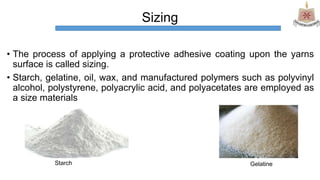
• Starch, gelatine, oil, wax, and manufactured polymers such as polyvinyl
alcohol, polystyrene, polyacrylic acid, and polyacetates are employed as
a size materials
Starch Gelatine
Objects of Sizing
• To protect the yarn from abrasion
• To improve the breaking strength of the yarn
• To increase smoothness of yarn
• To increase yarn elasticity
• To decrease hairiness
• To decrease the generation of static electricity
Types of Sizing
• Pure sizing: when the size pick up % is about 3 – 10 %
• Light sizing: when the size pick up % is about 11 -16%
• Medium sizing: when the size pick up % is about 17 – 40 %
• Heavy sizing: when the size pick up % is above 40 %
Size Ingredients & Their Functions
1. Gums:
There are two types of gum:
Natural: Wheat flour, corn flour.
Synthetic: Polyvinyl alcohol, Carboximethyl cellulose, Polyacryloamide.
Functions:
Coat the warp yarn with a film.
Impart smoothness.
Blind the protruding fibres to the yarn surface.
Increase elasticity.
Size Ingredients & Their Functions
2. Lubricants or Softeners
Vegetable & animal fats, Japan
wax, tallow, cotton seed & castor
oils, stearine, glycerin, soap,
TRO etc.
Function:
To give a softer feel to the
sized yarn.
To reduce stickiness of yarn.
To smoothen the yarn.
3. Antiseptic or Anti Mildew Agent:
Phenol, boric acid, carboxylic acid,
zinc chloride, sodium silicofluoride,
cresol etc. The quantity used is very
low 0.1 to 2%.
Function:
To prevent the growth of mildew.
To prevent spoiling of the size mix
during storing it for long time.
To help to store the sized yarn.
Size Ingredients & Their Functions
4. Wetting Agent:
Sulphanol A, soap, avirol, alizarin oil
etc. The amount of wetting agents
introduced into the size should not
exceed 0.1 to 0.15 gm/ltr.
Function:
To improve the size wet ability.
Improve the penetration of the size
between the fibres.
Uniform distribution of the sizing
solution on the yarn surface is
obtained.
5. Antifoaming Agent:
Silicones, stearine-paraffin
emulsions, benzene, pyridine. The
antifoaming agents in amounts of
0.05 to 0.1 gm/ltr are stirred in a
small quantity of warm water.
Function:
To prevent formation of foam.
Size Ingredients & Their Functions
6. Tinting Agent:
Blue is used as tinting agent.
Function:
To increase the brightness &
remove yellowish color of
yarn.
To prevent dusting off.
To form a particular shade.
7. Weighting Agent:
The most commonly used substances
are soluble inorganic powders such as
china clay, talc, barium or calcium
sulfate.
Function:
To give additional weights to the
goods.
To prevent opening of cloth.
Properties of sized yarn:
Higher elasticity
Higher yarn strength
Lower flexibility
Lower extension or elongation
Lower frictional resistance
Increased smoothness
Less weakness
Insensible to over drying
Less hairiness
Disadvantages of Sizing
Cost of land and machine is high
Requires lot of labors
Requires utility like gas, electricity etc and their cost is high
Cost of ingredients
The process is long and it takes time
There is a risk of degradation of yarn
The yarn diameter is increased
Requires robust loom
Sizing in textile industry

Sizing in textile industry

  • 1.
    Study on TextileSizing Presented by: Md: Fahimuzzaman Department of Textile Engineering Mawlana Bhashani Science and Technology University
  • 2.
    Sizing • The processof applying a protective adhesive coating upon the yarns surface is called sizing. • Starch, gelatine, oil, wax, and manufactured polymers such as polyvinyl alcohol, polystyrene, polyacrylic acid, and polyacetates are employed as a size materials Starch Gelatine
  • 3.
    Objects of Sizing •To protect the yarn from abrasion • To improve the breaking strength of the yarn • To increase smoothness of yarn • To increase yarn elasticity • To decrease hairiness • To decrease the generation of static electricity
  • 4.
    Types of Sizing •Pure sizing: when the size pick up % is about 3 – 10 % • Light sizing: when the size pick up % is about 11 -16% • Medium sizing: when the size pick up % is about 17 – 40 % • Heavy sizing: when the size pick up % is above 40 %
  • 5.
    Size Ingredients &Their Functions 1. Gums: There are two types of gum: Natural: Wheat flour, corn flour. Synthetic: Polyvinyl alcohol, Carboximethyl cellulose, Polyacryloamide. Functions: Coat the warp yarn with a film. Impart smoothness. Blind the protruding fibres to the yarn surface. Increase elasticity.
  • 6.
    Size Ingredients &Their Functions 2. Lubricants or Softeners Vegetable & animal fats, Japan wax, tallow, cotton seed & castor oils, stearine, glycerin, soap, TRO etc. Function: To give a softer feel to the sized yarn. To reduce stickiness of yarn. To smoothen the yarn. 3. Antiseptic or Anti Mildew Agent: Phenol, boric acid, carboxylic acid, zinc chloride, sodium silicofluoride, cresol etc. The quantity used is very low 0.1 to 2%. Function: To prevent the growth of mildew. To prevent spoiling of the size mix during storing it for long time. To help to store the sized yarn.
  • 7.
    Size Ingredients &Their Functions 4. Wetting Agent: Sulphanol A, soap, avirol, alizarin oil etc. The amount of wetting agents introduced into the size should not exceed 0.1 to 0.15 gm/ltr. Function: To improve the size wet ability. Improve the penetration of the size between the fibres. Uniform distribution of the sizing solution on the yarn surface is obtained. 5. Antifoaming Agent: Silicones, stearine-paraffin emulsions, benzene, pyridine. The antifoaming agents in amounts of 0.05 to 0.1 gm/ltr are stirred in a small quantity of warm water. Function: To prevent formation of foam.
  • 8.
    Size Ingredients &Their Functions 6. Tinting Agent: Blue is used as tinting agent. Function: To increase the brightness & remove yellowish color of yarn. To prevent dusting off. To form a particular shade. 7. Weighting Agent: The most commonly used substances are soluble inorganic powders such as china clay, talc, barium or calcium sulfate. Function: To give additional weights to the goods. To prevent opening of cloth.
  • 9.
    Properties of sizedyarn: Higher elasticity Higher yarn strength Lower flexibility Lower extension or elongation Lower frictional resistance Increased smoothness Less weakness Insensible to over drying Less hairiness
  • 10.
    Disadvantages of Sizing Costof land and machine is high Requires lot of labors Requires utility like gas, electricity etc and their cost is high Cost of ingredients The process is long and it takes time There is a risk of degradation of yarn The yarn diameter is increased Requires robust loom