1
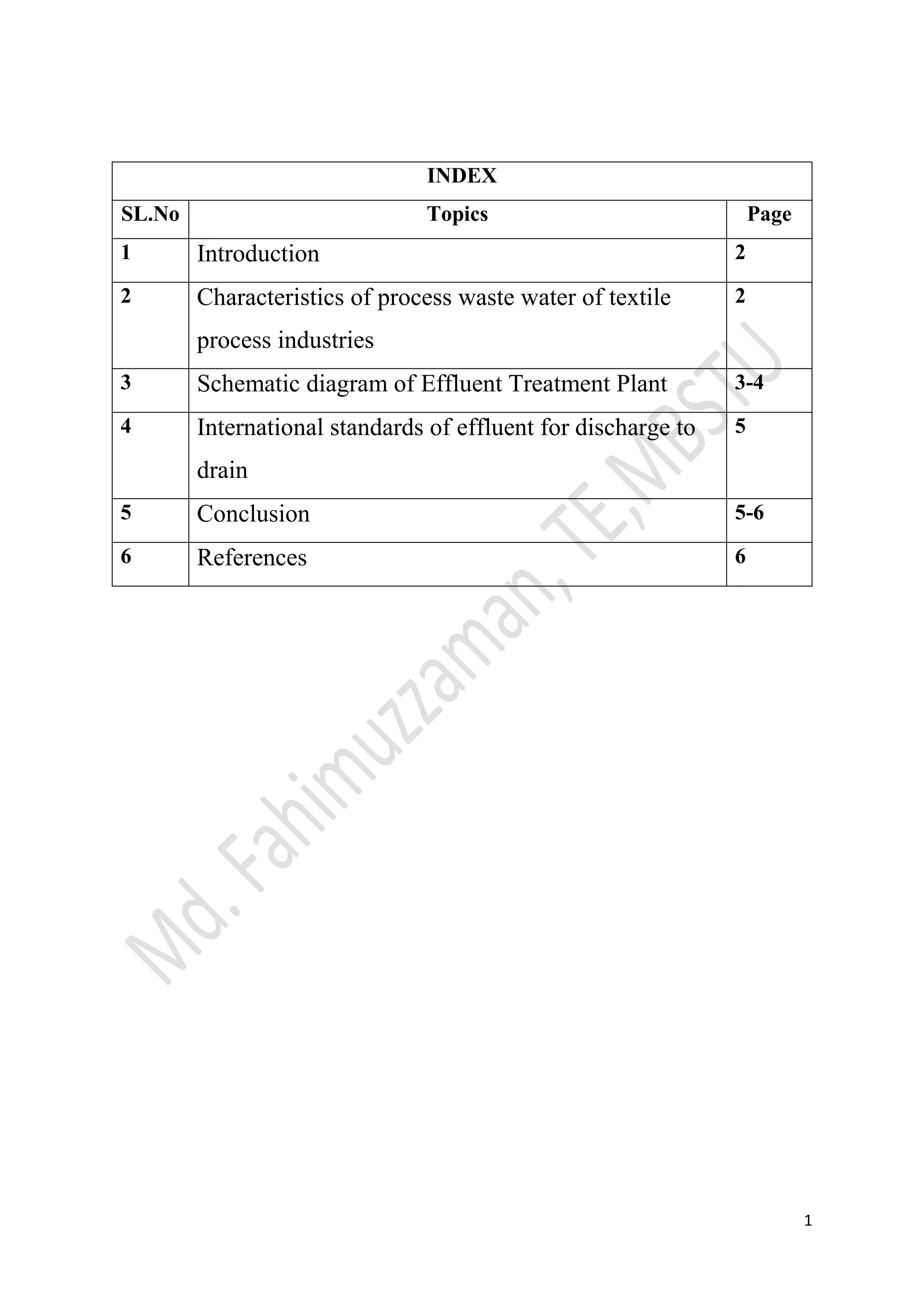
INDEX
SL.No Topics Page
1 Introduction 2
2 Characteristics of process waste water of textile
process industries
2
3 Schematic diagram of Effluent Treatment Plant 3-4
4 International standards of effluent for discharge to
drain
5
5 Conclusion 5-6
6 References 6
2
Introduction:
Effluent is the stream of excess chemical liquor from an industry after using in original
operation. For example, the excess dye liquor extracted from the textile industry after dyeing
is an effluent of that dyeing industry. Effluent Treatment Plant or ETP is a waste water
treatment method which is particularly designed to purify industrial waste water for its reuse
and it’s aim is to release safe water to environment from the harmful effect caused by the
effluent. Textile industry uses numerous hazardous chemicals during processing such as heavy
metals, salts, surfactants, sulphite, and formaldehyde, which can cause major pollution in the
effluents’ receiving waters. Since textile waste water contains a diversity of impurities and
therefore specific treatment technology called ETP is required. The ETP Plant works at various
levels and involves various physical, chemical, biological and membrane processes to treat
waste water from different industrial sectors like chemicals, drugs, pharmaceutical, refineries,
dairy, ready mix plants & textile etc.
CHAREACTERISTICS OF PROCESS WASTE WATER OF TEXTILE PROCESSING
INDUSTRIES [1]:
Unit process Possible pollutants in the waste water Nature of the waste water
Desizing Starch, glucose, CMC, PVA, resin, fats
and waxes.
High BOD (35-50% of total)
Scouring NaOH, waxes, greases, Na2CO3 and
fragments of cloth.
Strongly alkaline weak color.
High BOD (30% of total)
Bleaching Na(OCl),Cl2, NaOH, H2O2, acid etc. Alkaline 5% of total BOD
Mercerisation NaOH Strongly alkaline low BOD
(less than 1%)
Dyeing Various dyes, salts, alkali, acid, Na2S,
Na2S2O4 and soaps, detergent etc.
Strongly colored fairly BOD
(6% of the total)
Printing Colors, starch, china clay, gum, oil,
mordents, acid, alkali, various metallic
salts etc.
Highly colored and oily
appearance BOD, (6-10% of
total)
3
Finishing Traces of starch, tallow and different
finishing agents.
Low BOD (2-4% of total)
Schematic diagram of Effluent Treatment Plant [2]
Step-1: Primary Filtration
It is the first stage of effluent treatment plant, where effluent is come from weav-ing, dyeing,
printing or finishing unit. Here primary filtration is performed to remove the Coarse suspended
matters such as rags, pieces of fabric, fibres, yarns and lint are removed. Bar screens and
mechanically cleaned fine screens remove most of the fibres..
Step-2: Cooling and mixing
In this stage, different types of effluent are mixed and cool down by rotating agitators or by blowing
compressed air from below.
Step-3: Neutralization by Acid/Alkali Dossing
Most of the effluent are alkaline some are acidic acidic which are comes from dyeing section. After
cooling and mixing; effluent is transferred to neutralization tank by the help of pump. Here, acid or
alkali is mixed to neutralize the effluent. A pH meter is placed in the neutralization tank.
4
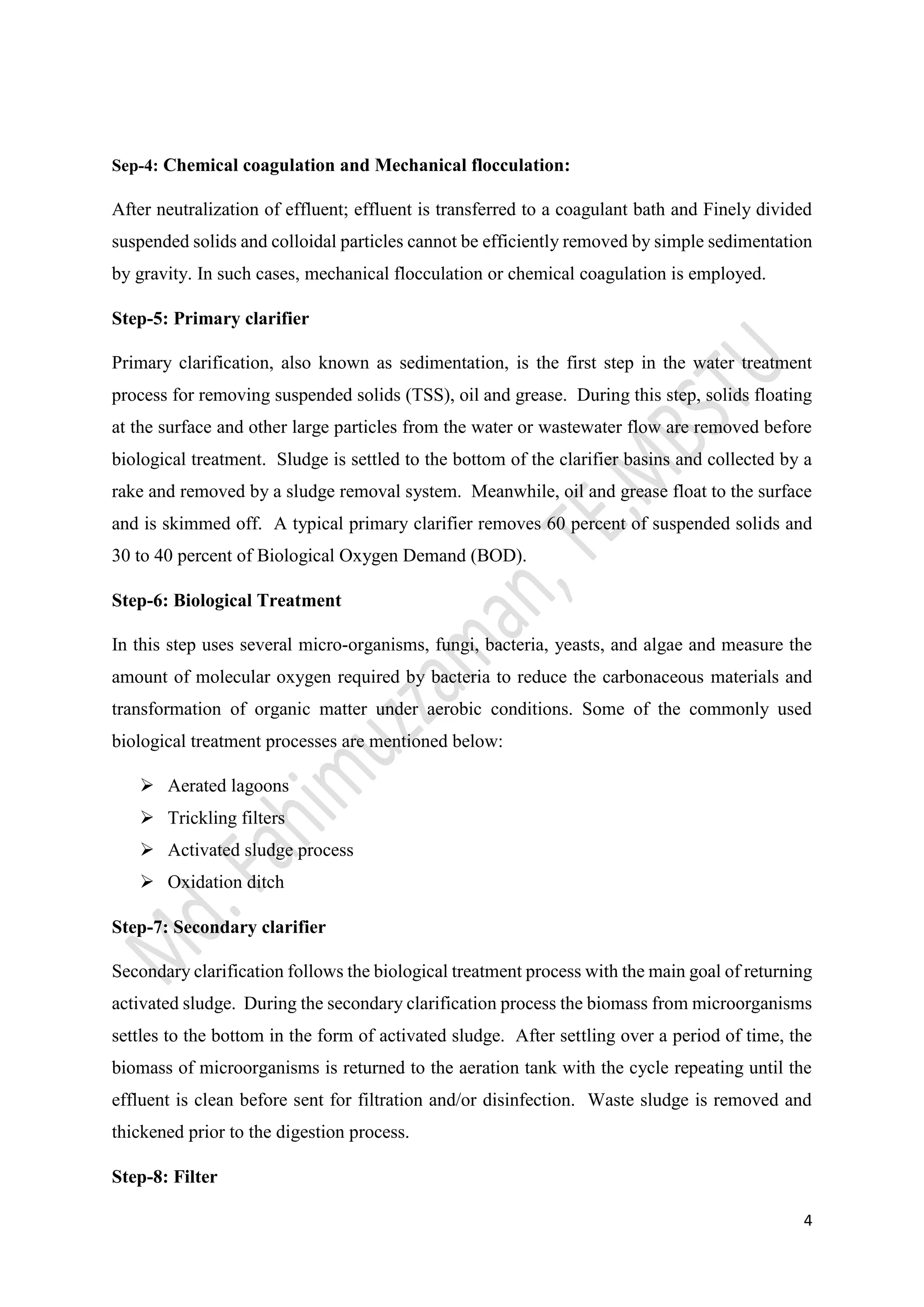
Sep-4: Chemical coagulation and Mechanical flocculation:
After neutralization of effluent; effluent is transferred to a coagulant bath and Finely divided
suspended solids and colloidal particles cannot be efficiently removed by simple sedimentation
by gravity. In such cases, mechanical flocculation or chemical coagulation is employed.
Step-5: Primary clarifier
Primary clarification, also known as sedimentation, is the first step in the water treatment
process for removing suspended solids (TSS), oil and grease. During this step, solids floating
at the surface and other large particles from the water or wastewater flow are removed before
biological treatment. Sludge is settled to the bottom of the clarifier basins and collected by a
rake and removed by a sludge removal system. Meanwhile, oil and grease float to the surface
and is skimmed off. A typical primary clarifier removes 60 percent of suspended solids and
30 to 40 percent of Biological Oxygen Demand (BOD).
Step-6: Biological Treatment
In this step uses several micro-organisms, fungi, bacteria, yeasts, and algae and measure the
amount of molecular oxygen required by bacteria to reduce the carbonaceous materials and
transformation of organic matter under aerobic conditions. Some of the commonly used
biological treatment processes are mentioned below:
 Aerated lagoons
 Trickling filters
 Activated sludge process
 Oxidation ditch
Step-7: Secondary clarifier
Secondary clarification follows the biological treatment process with the main goal of returning
activated sludge. During the secondary clarification process the biomass from microorganisms
settles to the bottom in the form of activated sludge. After settling over a period of time, the
biomass of microorganisms is returned to the aeration tank with the cycle repeating until the
effluent is clean before sent for filtration and/or disinfection. Waste sludge is removed and
thickened prior to the digestion process.
Step-8: Filter
5
After completing all process before discharging drain final filtration done here and separate the
sludge and water.
Step-9: Discharge to drain
After completion of all the process, the effluent becomes purify and it becomes safe to drain to
the environment.
INTERNATIONAL STANDARD OF EFFLUENT FOR DISCHARGE TO DRAIN[1]:
Serial No Characteristics Average quantity of
the effluent
Required limit to
discharge
01 BOD 250-500 mg/L 20-40 mg/L
02 COD 800-1200 mg/L 120-160 mg/L
03 Suspended solid 200-300 mg/L 20-40 mg/L
04 Settle able solid 0-5 mg/L Traces
05 Ammonia 20-30 mg/L 4-8 mg/L
06 Phosphate 3-5 mg/L 3-5 mg/L
07 Surfactant 30-40 mg/L 0.5-2 mg/L
08 Chloride 1000-1500 mg/L 1000-1500 mg/L
09 Sulphate 1000-1500 mg/L 1000-1500 mg/L
10 Color Colored Not perceptible
11 Oil and fat 30-40 mg/L < 5 mg/L
12 Phenol 3-5 mg/L < 0.05 mg/L
13 Temp. 45-0
500
C ≥450
C
Conclusion:
Effluent Treatment Plant (ETP) is essential to purify the waste water which is come from different stage
of textile industry like weaving, knitting, Scouring, bleaching, dyeing, finishing etc. It consists several
steps which sued to reduce hazardous effect by subsequent primary, secondary and tertiary treatment.
6
Primary treatment used to remove of a portion of the suspended solids and organic matter from
wastewater, Removal of biodegradable organic matter and suspended solids uses secondary
treatment alt last uses tertiary and advanced treatment for reuses of waste water. It is necessary
for all manufacturing industry to build a properly active ETP plant to safe our Environment.
References
[1] A. A. Mamun, “Study materials,” 2016.
[2] A. katiyar, “Working Procedure Of Effluent TreatmentPlant (ETP),” Textile Fashion Study, 2012.

Plan an ETP with detail process discussion following the instructions

  • 1.
    1 INDEX SL.No Topics Page 1Introduction 2 2 Characteristics of process waste water of textile process industries 2 3 Schematic diagram of Effluent Treatment Plant 3-4 4 International standards of effluent for discharge to drain 5 5 Conclusion 5-6 6 References 6
  • 2.
    2 Introduction: Effluent is thestream of excess chemical liquor from an industry after using in original operation. For example, the excess dye liquor extracted from the textile industry after dyeing is an effluent of that dyeing industry. Effluent Treatment Plant or ETP is a waste water treatment method which is particularly designed to purify industrial waste water for its reuse and it’s aim is to release safe water to environment from the harmful effect caused by the effluent. Textile industry uses numerous hazardous chemicals during processing such as heavy metals, salts, surfactants, sulphite, and formaldehyde, which can cause major pollution in the effluents’ receiving waters. Since textile waste water contains a diversity of impurities and therefore specific treatment technology called ETP is required. The ETP Plant works at various levels and involves various physical, chemical, biological and membrane processes to treat waste water from different industrial sectors like chemicals, drugs, pharmaceutical, refineries, dairy, ready mix plants & textile etc. CHAREACTERISTICS OF PROCESS WASTE WATER OF TEXTILE PROCESSING INDUSTRIES [1]: Unit process Possible pollutants in the waste water Nature of the waste water Desizing Starch, glucose, CMC, PVA, resin, fats and waxes. High BOD (35-50% of total) Scouring NaOH, waxes, greases, Na2CO3 and fragments of cloth. Strongly alkaline weak color. High BOD (30% of total) Bleaching Na(OCl),Cl2, NaOH, H2O2, acid etc. Alkaline 5% of total BOD Mercerisation NaOH Strongly alkaline low BOD (less than 1%) Dyeing Various dyes, salts, alkali, acid, Na2S, Na2S2O4 and soaps, detergent etc. Strongly colored fairly BOD (6% of the total) Printing Colors, starch, china clay, gum, oil, mordents, acid, alkali, various metallic salts etc. Highly colored and oily appearance BOD, (6-10% of total)
  • 3.
    3 Finishing Traces ofstarch, tallow and different finishing agents. Low BOD (2-4% of total) Schematic diagram of Effluent Treatment Plant [2] Step-1: Primary Filtration It is the first stage of effluent treatment plant, where effluent is come from weav-ing, dyeing, printing or finishing unit. Here primary filtration is performed to remove the Coarse suspended matters such as rags, pieces of fabric, fibres, yarns and lint are removed. Bar screens and mechanically cleaned fine screens remove most of the fibres.. Step-2: Cooling and mixing In this stage, different types of effluent are mixed and cool down by rotating agitators or by blowing compressed air from below. Step-3: Neutralization by Acid/Alkali Dossing Most of the effluent are alkaline some are acidic acidic which are comes from dyeing section. After cooling and mixing; effluent is transferred to neutralization tank by the help of pump. Here, acid or alkali is mixed to neutralize the effluent. A pH meter is placed in the neutralization tank.
  • 4.
    4 Sep-4: Chemical coagulationand Mechanical flocculation: After neutralization of effluent; effluent is transferred to a coagulant bath and Finely divided suspended solids and colloidal particles cannot be efficiently removed by simple sedimentation by gravity. In such cases, mechanical flocculation or chemical coagulation is employed. Step-5: Primary clarifier Primary clarification, also known as sedimentation, is the first step in the water treatment process for removing suspended solids (TSS), oil and grease. During this step, solids floating at the surface and other large particles from the water or wastewater flow are removed before biological treatment. Sludge is settled to the bottom of the clarifier basins and collected by a rake and removed by a sludge removal system. Meanwhile, oil and grease float to the surface and is skimmed off. A typical primary clarifier removes 60 percent of suspended solids and 30 to 40 percent of Biological Oxygen Demand (BOD). Step-6: Biological Treatment In this step uses several micro-organisms, fungi, bacteria, yeasts, and algae and measure the amount of molecular oxygen required by bacteria to reduce the carbonaceous materials and transformation of organic matter under aerobic conditions. Some of the commonly used biological treatment processes are mentioned below:  Aerated lagoons  Trickling filters  Activated sludge process  Oxidation ditch Step-7: Secondary clarifier Secondary clarification follows the biological treatment process with the main goal of returning activated sludge. During the secondary clarification process the biomass from microorganisms settles to the bottom in the form of activated sludge. After settling over a period of time, the biomass of microorganisms is returned to the aeration tank with the cycle repeating until the effluent is clean before sent for filtration and/or disinfection. Waste sludge is removed and thickened prior to the digestion process. Step-8: Filter
  • 5.
    5 After completing allprocess before discharging drain final filtration done here and separate the sludge and water. Step-9: Discharge to drain After completion of all the process, the effluent becomes purify and it becomes safe to drain to the environment. INTERNATIONAL STANDARD OF EFFLUENT FOR DISCHARGE TO DRAIN[1]: Serial No Characteristics Average quantity of the effluent Required limit to discharge 01 BOD 250-500 mg/L 20-40 mg/L 02 COD 800-1200 mg/L 120-160 mg/L 03 Suspended solid 200-300 mg/L 20-40 mg/L 04 Settle able solid 0-5 mg/L Traces 05 Ammonia 20-30 mg/L 4-8 mg/L 06 Phosphate 3-5 mg/L 3-5 mg/L 07 Surfactant 30-40 mg/L 0.5-2 mg/L 08 Chloride 1000-1500 mg/L 1000-1500 mg/L 09 Sulphate 1000-1500 mg/L 1000-1500 mg/L 10 Color Colored Not perceptible 11 Oil and fat 30-40 mg/L < 5 mg/L 12 Phenol 3-5 mg/L < 0.05 mg/L 13 Temp. 45-0 500 C ≥450 C Conclusion: Effluent Treatment Plant (ETP) is essential to purify the waste water which is come from different stage of textile industry like weaving, knitting, Scouring, bleaching, dyeing, finishing etc. It consists several steps which sued to reduce hazardous effect by subsequent primary, secondary and tertiary treatment.
  • 6.
    6 Primary treatment usedto remove of a portion of the suspended solids and organic matter from wastewater, Removal of biodegradable organic matter and suspended solids uses secondary treatment alt last uses tertiary and advanced treatment for reuses of waste water. It is necessary for all manufacturing industry to build a properly active ETP plant to safe our Environment. References [1] A. A. Mamun, “Study materials,” 2016. [2] A. katiyar, “Working Procedure Of Effluent TreatmentPlant (ETP),” Textile Fashion Study, 2012.