Faults in the Knitted Fabrics: 
A defect of the knitted fabric is an abnormality which spoils the aesthetics i.e. the 
clean & uniform appearance of the fabric & effects the performance parameters, 
like; dimensional stability etc. 
There are various types of defects which occur in the Knitted fabrics of all types 
caused by a variety of reasons. The same type of defects may occur in the fabric 
due to a variety of different causes e.g. Drop Stitches, Spirality etc. 
Category of Defects: 
1. Yarn Related Defects: 
Almost all the defects appearing in the horizontal direction in the knitted fabric are 
yarn related. These defects are mainly; 
Barriness 
Thick & Thin lines 
Dark or Light horizontal lines (due to the difference in dye pick up) 
Imperfections 
Contaminations 
Snarling 
Spirality 
2. Knitting Elements Related Defects: 
Almost all the defects appearing in the vertical direction in the knitted fabrics are as a cause of bad 
Knitting Elements. These defects are mainly; 
Needle & Sinker Lines 
Drop Stitches etc.
3. Machine Settings Related Defects: 
These defects appear randomly in the knitted fabrics due to the wrong knitting 
machine settings &that of the machine parts. The defects are mainly; 
Drop Stitches 
Yarn Streaks 
Bariness 
Fabric press off 
4. Dyeing Related Defects: 
The Dyeing related defects are as follows; 
Dyeing patches 
Softener Marks 
Shade variation 
Tonal variation 
Color fading (Poor Color Fastness) 
Dull shade 
Crease or rope Marks 
Finishing Related Defects: 
Defects caused mainly due to the wrong process parameters are; 
High Shrinkage 
Skewing 
Spirality 
Surface Hairiness & Pilling 
Tonal variation 
Snagging (Sharp points in the dyeing machine or trolley etc) 
Fold Marks 
Wet Squeezer Marks 
GSM variation 
Fabric Width variation 
Curling of S.J. Fabrics
Some common Fault of knitted fabrics are given below 
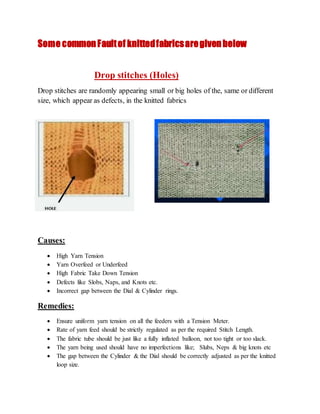
Drop stitches (Holes) 
Drop stitches are randomly appearing small or big holes of the, same or different 
size, which appear as defects, in the knitted fabrics 
Causes: 
 High Yarn Tension 
 Yarn Overfeed or Underfeed 
 High Fabric Take Down Tension 
 Defects like Slobs, Naps, and Knots etc. 
 Incorrect gap between the Dial & Cylinder rings. 
Remedies: 
 Ensure uniform yarn tension on all the feeders with a Tension Meter. 
 Rate of yarn feed should be strictly regulated as per the required Stitch Length. 
 The fabric tube should be just like a fully inflated balloon, not too tight or too slack. 
 The yarn being used should have no imperfections like; Slubs, Neps & big knots etc 
 The gap between the Cylinder & the Dial should be correctly adjusted as per the knitted 
loop size.
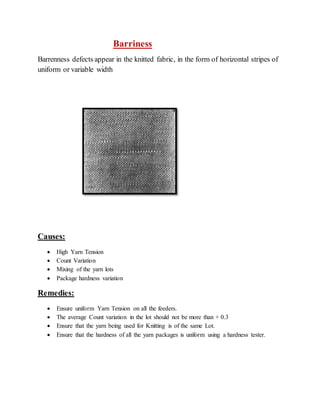
Barriness 
Barrenness defects appear in the knitted fabric, in the form of horizontal stripes of 
uniform or variable width 
Causes: 
 High Yarn Tension 
 Count Variation 
 Mixing of the yarn lots 
 Package hardness variation 
Remedies: 
 Ensure uniform Yarn Tension on all the feeders. 
 The average Count variation in the lot should not be more than + 0.3 
 Ensure that the yarn being used for Knitting is of the same Lot. 
 Ensure that the hardness of all the yarn packages is uniform using a hardness tester.
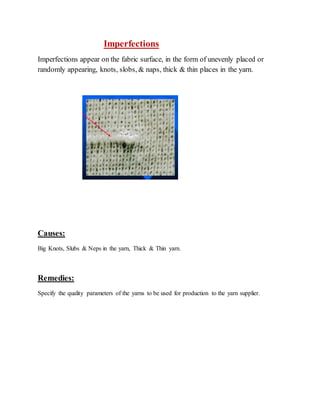
Imperfections 
Imperfections appear on the fabric surface, in the form of unevenly placed or 
randomly appearing, knots, slobs, & naps, thick & thin places in the yarn. 
Causes: 
Big Knots, Slubs & Neps in the yarn, Thick & Thin yarn. 
Remedies: 
Specify the quality parameters of the yarns to be used for production to the yarn supplier.
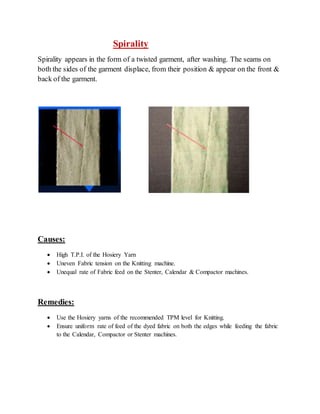
Spirality 
Spirality appears in the form of a twisted garment, after washing. The seams on 
both the sides of the garment displace, from their position & appear on the front & 
back of the garment. 
Causes: 
 High T.P.I. of the Hosiery Yarn 
 Uneven Fabric tension on the Knitting machine. 
 Unequal rate of Fabric feed on the Stenter, Calendar & Compactor machines. 
Remedies: 
 Use the Hosiery yarns of the recommended TPM level for Knitting. 
 Ensure uniform rate of feed of the dyed fabric on both the edges while feeding the fabric 
to the Calendar, Compactor or Stenter machines.
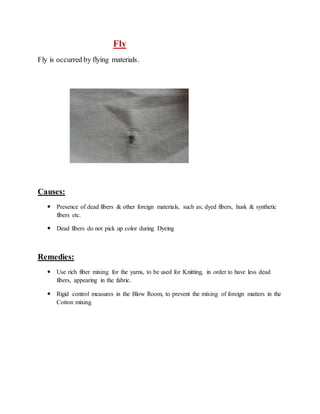
Fly 
Fly is occurred by flying materials. 
Causes: 
 Presence of dead fibers & other foreign materials, such as; dyed fibers, husk & synthetic 
fibers etc. 
 Dead fibers do not pick up color during Dyeing 
Remedies: 
 Use rich fiber mixing for the yarns, to be used for Knitting, in order to have less dead 
fibers, appearing in the fabric. 
 Rigid control measures in the Blow Room, to prevent the mixing of foreign matters in the 
Cotton mixing
Broken Needle 
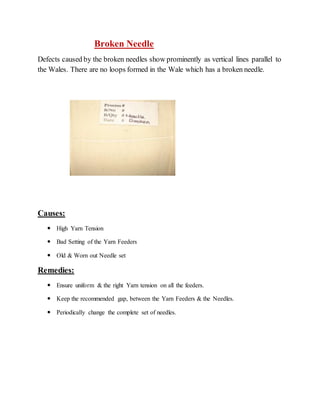
Defects caused by the broken needles show prominently as vertical lines parallel to 
the Wales. There are no loops formed in the Wale which has a broken needle. 
Causes: 
 High Yarn Tension 
 Bad Setting of the Yarn Feeders 
 Old & Worn out Needle set 
Remedies: 
 Ensure uniform & the right Yarn tension on all the feeders. 
 Keep the recommended gap, between the Yarn Feeders & the Needles. 
 Periodically change the complete set of needles.
Sinker Lines 
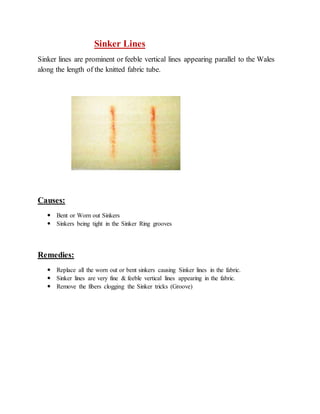
Sinker lines are prominent or feeble vertical lines appearing parallel to the Wales 
along the length of the knitted fabric tube. 
Causes: 
 Bent or Worn out Sinkers 
 Sinkers being tight in the Sinker Ring grooves 
Remedies: 
 Replace all the worn out or bent sinkers causing Sinker lines in the fabric. 
 Sinker lines are very fine & feeble vertical lines appearing in the fabric. 
 Remove the fibers clogging the Sinker tricks (Groove)
Fabric Press Off 
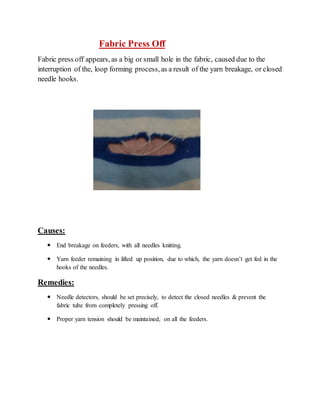
Fabric press off appears, as a big or small hole in the fabric, caused due to the 
interruption of the, loop forming process, as a result of the yarn breakage, or closed 
needle hooks. 
Causes: 
 End breakage on feeders, with all needles knitting. 
 Yarn feeder remaining in lifted up position, due to which, the yarn doesn’t get fed in the 
hooks of the needles. 
Remedies: 
 Needle detectors, should be set precisely, to detect the closed needles & prevent the 
fabric tube from completely pressing off. 
 Proper yarn tension should be maintained, on all the feeders.
Needle lines 
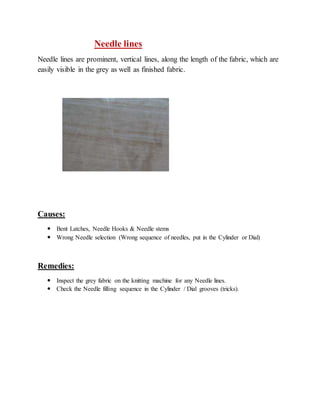
Needle lines are prominent, vertical lines, along the length of the fabric, which are 
easily visible in the grey as well as finished fabric. 
Causes: 
 Bent Latches, Needle Hooks & Needle stems 
 Wrong Needle selection (Wrong sequence of needles, put in the Cylinder or Dial) 
Remedies: 
 Inspect the grey fabric on the knitting machine for any Needle lines. 
 Check the Needle filling sequence in the Cylinder / Dial grooves (tricks).
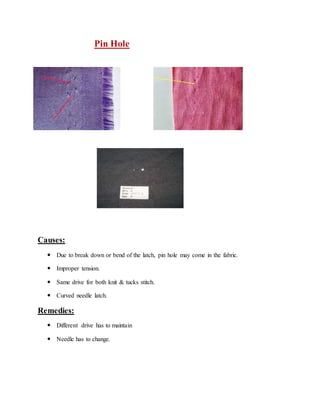
Pin Hole 
Causes: 
 Due to break down or bend of the latch, pin hole may come in the fabric. 
 Improper tension. 
 Same drive for both knit & tucks stitch. 
 Curved needle latch. 
Remedies: 
 Different drive has to maintain 
 Needle has to change.
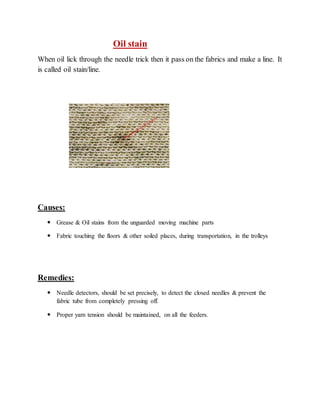
Oil stain 
When oil lick through the needle trick then it pass on the fabrics and make a line. It 
is called oil stain/line. 
Causes: 
 Grease & Oil stains from the unguarded moving machine parts 
 Fabric touching the floors & other soiled places, during transportation, in the trolleys 
Remedies: 
 Needle detectors, should be set precisely, to detect the closed needles & prevent the 
fabric tube from completely pressing off. 
 Proper yarn tension should be maintained, on all the feeders.
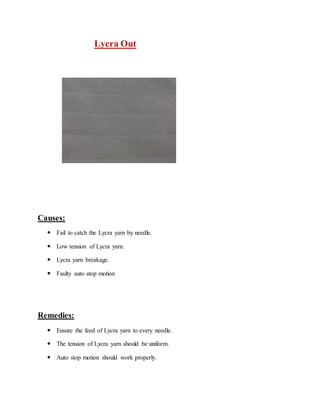
Lycra Out 
Causes: 
 Fail to catch the Lycra yarn by needle. 
 Low tension of Lycra yarn. 
 Lycra yarn breakage. 
 Faulty auto stop motion 
Remedies: 
 Ensure the feed of Lycra yarn to every needle. 
 The tension of Lycra yarn should be uniform. 
 Auto stop motion should work properly.
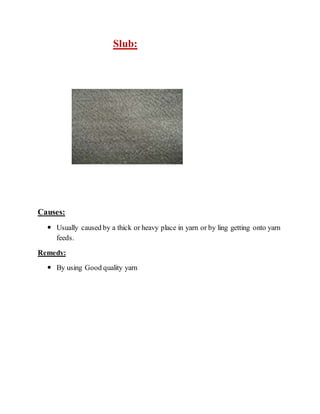
Slub: 
Causes: 
 Usually caused by a thick or heavy place in yarn or by ling getting onto yarn 
feeds. 
Remedy: 
 By using Good quality yarn
Measurement Problems 
The measurements of the garments totally change after, a few hours of relaxation 
& after the first wash. The arm lengths or the front & back lengths of the garments 
may vary, due to the mix up of the parts. 
Causes: 
 Shrinkage caused due to the inadequate relaxation of the knitted fabrics, before cutting. 
 Mixing of the garment parts cut from, different layers or different rolls of the knitted 
fabric. 
Remedies: 
 Use a trolley, for laying the fabric on the table, to facilitate a tension free, laying. 
 Let the fabric relax for a few hours, before cutting, especially the Lycra fabrics. 
 Ensure the numbering of the different layers of the fabric, to prevent the mix up of the 
components. 
Conclusion 
Detection of faults during production of knitted fabric is crucial for improved quality and 
productivity. 
This presentation will present and discuss the detection of faults and malfunctions during the 
production remedies of knitted fabric. 
We believe that our work will help the knitters to identify the source of detected faults & 
proposes specific solutions for theses faults causes. So Knitters can take necessary remedial steps 
to overcome the faults. 
______________THE END_____________

Faults in the Knitted Fabrics

  • 1.
    Faults in theKnitted Fabrics: A defect of the knitted fabric is an abnormality which spoils the aesthetics i.e. the clean & uniform appearance of the fabric & effects the performance parameters, like; dimensional stability etc. There are various types of defects which occur in the Knitted fabrics of all types caused by a variety of reasons. The same type of defects may occur in the fabric due to a variety of different causes e.g. Drop Stitches, Spirality etc. Category of Defects: 1. Yarn Related Defects: Almost all the defects appearing in the horizontal direction in the knitted fabric are yarn related. These defects are mainly; Barriness Thick & Thin lines Dark or Light horizontal lines (due to the difference in dye pick up) Imperfections Contaminations Snarling Spirality 2. Knitting Elements Related Defects: Almost all the defects appearing in the vertical direction in the knitted fabrics are as a cause of bad Knitting Elements. These defects are mainly; Needle & Sinker Lines Drop Stitches etc.
  • 2.
    3. Machine SettingsRelated Defects: These defects appear randomly in the knitted fabrics due to the wrong knitting machine settings &that of the machine parts. The defects are mainly; Drop Stitches Yarn Streaks Bariness Fabric press off 4. Dyeing Related Defects: The Dyeing related defects are as follows; Dyeing patches Softener Marks Shade variation Tonal variation Color fading (Poor Color Fastness) Dull shade Crease or rope Marks Finishing Related Defects: Defects caused mainly due to the wrong process parameters are; High Shrinkage Skewing Spirality Surface Hairiness & Pilling Tonal variation Snagging (Sharp points in the dyeing machine or trolley etc) Fold Marks Wet Squeezer Marks GSM variation Fabric Width variation Curling of S.J. Fabrics
  • 3.
    Some common Faultof knitted fabrics are given below Drop stitches (Holes) Drop stitches are randomly appearing small or big holes of the, same or different size, which appear as defects, in the knitted fabrics Causes:  High Yarn Tension  Yarn Overfeed or Underfeed  High Fabric Take Down Tension  Defects like Slobs, Naps, and Knots etc.  Incorrect gap between the Dial & Cylinder rings. Remedies:  Ensure uniform yarn tension on all the feeders with a Tension Meter.  Rate of yarn feed should be strictly regulated as per the required Stitch Length.  The fabric tube should be just like a fully inflated balloon, not too tight or too slack.  The yarn being used should have no imperfections like; Slubs, Neps & big knots etc  The gap between the Cylinder & the Dial should be correctly adjusted as per the knitted loop size.
  • 4.
    Barriness Barrenness defectsappear in the knitted fabric, in the form of horizontal stripes of uniform or variable width Causes:  High Yarn Tension  Count Variation  Mixing of the yarn lots  Package hardness variation Remedies:  Ensure uniform Yarn Tension on all the feeders.  The average Count variation in the lot should not be more than + 0.3  Ensure that the yarn being used for Knitting is of the same Lot.  Ensure that the hardness of all the yarn packages is uniform using a hardness tester.
  • 5.
    Imperfections Imperfections appearon the fabric surface, in the form of unevenly placed or randomly appearing, knots, slobs, & naps, thick & thin places in the yarn. Causes: Big Knots, Slubs & Neps in the yarn, Thick & Thin yarn. Remedies: Specify the quality parameters of the yarns to be used for production to the yarn supplier.
  • 6.
    Spirality Spirality appearsin the form of a twisted garment, after washing. The seams on both the sides of the garment displace, from their position & appear on the front & back of the garment. Causes:  High T.P.I. of the Hosiery Yarn  Uneven Fabric tension on the Knitting machine.  Unequal rate of Fabric feed on the Stenter, Calendar & Compactor machines. Remedies:  Use the Hosiery yarns of the recommended TPM level for Knitting.  Ensure uniform rate of feed of the dyed fabric on both the edges while feeding the fabric to the Calendar, Compactor or Stenter machines.
  • 7.
    Fly Fly isoccurred by flying materials. Causes:  Presence of dead fibers & other foreign materials, such as; dyed fibers, husk & synthetic fibers etc.  Dead fibers do not pick up color during Dyeing Remedies:  Use rich fiber mixing for the yarns, to be used for Knitting, in order to have less dead fibers, appearing in the fabric.  Rigid control measures in the Blow Room, to prevent the mixing of foreign matters in the Cotton mixing
  • 8.
    Broken Needle Defectscaused by the broken needles show prominently as vertical lines parallel to the Wales. There are no loops formed in the Wale which has a broken needle. Causes:  High Yarn Tension  Bad Setting of the Yarn Feeders  Old & Worn out Needle set Remedies:  Ensure uniform & the right Yarn tension on all the feeders.  Keep the recommended gap, between the Yarn Feeders & the Needles.  Periodically change the complete set of needles.
  • 9.
    Sinker Lines Sinkerlines are prominent or feeble vertical lines appearing parallel to the Wales along the length of the knitted fabric tube. Causes:  Bent or Worn out Sinkers  Sinkers being tight in the Sinker Ring grooves Remedies:  Replace all the worn out or bent sinkers causing Sinker lines in the fabric.  Sinker lines are very fine & feeble vertical lines appearing in the fabric.  Remove the fibers clogging the Sinker tricks (Groove)
  • 10.
    Fabric Press Off Fabric press off appears, as a big or small hole in the fabric, caused due to the interruption of the, loop forming process, as a result of the yarn breakage, or closed needle hooks. Causes:  End breakage on feeders, with all needles knitting.  Yarn feeder remaining in lifted up position, due to which, the yarn doesn’t get fed in the hooks of the needles. Remedies:  Needle detectors, should be set precisely, to detect the closed needles & prevent the fabric tube from completely pressing off.  Proper yarn tension should be maintained, on all the feeders.
  • 11.
    Needle lines Needlelines are prominent, vertical lines, along the length of the fabric, which are easily visible in the grey as well as finished fabric. Causes:  Bent Latches, Needle Hooks & Needle stems  Wrong Needle selection (Wrong sequence of needles, put in the Cylinder or Dial) Remedies:  Inspect the grey fabric on the knitting machine for any Needle lines.  Check the Needle filling sequence in the Cylinder / Dial grooves (tricks).
  • 12.
    Pin Hole Causes:  Due to break down or bend of the latch, pin hole may come in the fabric.  Improper tension.  Same drive for both knit & tucks stitch.  Curved needle latch. Remedies:  Different drive has to maintain  Needle has to change.
  • 13.
    Oil stain Whenoil lick through the needle trick then it pass on the fabrics and make a line. It is called oil stain/line. Causes:  Grease & Oil stains from the unguarded moving machine parts  Fabric touching the floors & other soiled places, during transportation, in the trolleys Remedies:  Needle detectors, should be set precisely, to detect the closed needles & prevent the fabric tube from completely pressing off.  Proper yarn tension should be maintained, on all the feeders.
  • 14.
    Lycra Out Causes:  Fail to catch the Lycra yarn by needle.  Low tension of Lycra yarn.  Lycra yarn breakage.  Faulty auto stop motion Remedies:  Ensure the feed of Lycra yarn to every needle.  The tension of Lycra yarn should be uniform.  Auto stop motion should work properly.
  • 15.
    Slub: Causes: Usually caused by a thick or heavy place in yarn or by ling getting onto yarn feeds. Remedy:  By using Good quality yarn
  • 16.
    Measurement Problems Themeasurements of the garments totally change after, a few hours of relaxation & after the first wash. The arm lengths or the front & back lengths of the garments may vary, due to the mix up of the parts. Causes:  Shrinkage caused due to the inadequate relaxation of the knitted fabrics, before cutting.  Mixing of the garment parts cut from, different layers or different rolls of the knitted fabric. Remedies:  Use a trolley, for laying the fabric on the table, to facilitate a tension free, laying.  Let the fabric relax for a few hours, before cutting, especially the Lycra fabrics.  Ensure the numbering of the different layers of the fabric, to prevent the mix up of the components. Conclusion Detection of faults during production of knitted fabric is crucial for improved quality and productivity. This presentation will present and discuss the detection of faults and malfunctions during the production remedies of knitted fabric. We believe that our work will help the knitters to identify the source of detected faults & proposes specific solutions for theses faults causes. So Knitters can take necessary remedial steps to overcome the faults. ______________THE END_____________