Study on Report Writing
Presented by:
Md. Fahimuzzaman
Department of Textile Engineering
Mawlana Bhashani Science and Technology University
Types of report
1. Formal or Informal reports
2. Informational or Analytical reports
3. Proposal reports
4. Vertical or lateral reports
5. Internal or External reports
6. Periodic reports
24/03/2022 2
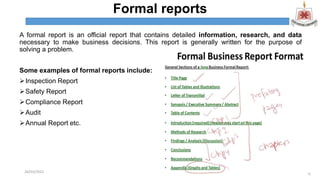
Formal reports
A formal report is an official report that contains detailed information, research, and data
necessary to make business decisions. This report is generally written for the purpose of
solving a problem.
Some examples of formal reports include:
Inspection Report
Safety Report
Compliance Report
Audit
Annual Report etc.
24/03/2022 3
Informal reports
Informal reports are only a few paragraphs in length and have only the
important details, and follow a certain structure:
An introduction
A body
And a Conclusions
24/03/2022 4
Informational reports
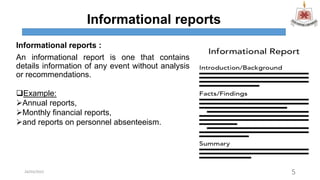
Informational reports :
An informational report is one that contains
details information of any event without analysis
or recommendations.
24/03/2022 5
Example:
Annual reports,
Monthly financial reports,
and reports on personnel absenteeism.
Analytical reports
An analytical report is a type of business report
that uses qualitative and quantitative company
data to analyse as well as evaluate a business
strategy
Example:
Scientific research,
Feasibility reports,
And real-estate appraisals
24/03/2022 6
Proposal reports
A documents that propose an idea or an approach to solving a
problem or issue.
It also describe the how one organization can meet the need and
requirements
24/03/2022 7
Vertical or lateral reports
This classification refers to the direction a report travels.
Vertical reports:
• Upward or downward the hierarchy reports
• Example: Report for management or mentees, it’s a vertical
report.
Lateral reports:
• Assist in coordination in the organization traveling between
units of the same organization level.
• Example: a report among the administration, production and
finance departments.
24/03/2022 8
Internal or External reports
Internal report :
• within a certain organization or group of people in the case of
office settings.
• Example: Annual reports of companies
External reports:
• Called public reports outside the organization.
• Example: A news report in the newspaper about an incident or
the annual reports of companies.
24/03/2022 9
Periodic reports
• Issued on regularly scheduled dates (annual or quarterly or
half-yearly).
• Preprinted forms with pre-set the structure
• Computer-generated data by just filling up at every period.
• Example: Annual report is a Government mandate.
24/03/2022 10
Structure of typical reports
A simple report is likely to include at least the following:
Simple report sections
Introduction, including aims and objectives
Methodology
Findings/results
Discussion
Conclusions and recommendations
References
24/03/2022 11
State what your research/project/enquiry is about.
What are you writing about, why and for whom?
What are your objectives?
What are you trying to show or prove (your hypothesis)?
24/03/2022 12
Introduction
State how you did your research/enquiry and the methods you
used.
How did you collect your data?
For example, if you conducted a survey, say how many people
were included and how you selected them. Say whether you
used interviews or questionnaires and how you analysed the
data.
24/03/2022 13
Methodology
Give the results of your research.
This section may include graphs, charts, diagrams etc. (clearly
labelled).
 Be very careful about copyright if you are using published
charts, tables, illustrations etc.
24/03/2022 14
Findings/results
Interpret your findings.
What do they show?
Were they what you expected?
Could your research have been done in a better way?
24/03/2022 15
Discussion
These should follow on logically from the Findings and
Discussion sections.
Summarise the key points of your findings and show whether
they prove or disprove your hypothesis.
If you have been asked to, you can make recommendations
arising from your research.
24/03/2022 16
Conclusions and recommendations
List all your sources in alphabetical order, using the appropriate
University of Hull style. You might find our referencing pages
useful.
24/03/2022 17
References
Thank You
24/03/2022 18

Study on Report Writing.pptx

  • 1.
    Study on ReportWriting Presented by: Md. Fahimuzzaman Department of Textile Engineering Mawlana Bhashani Science and Technology University
  • 2.
    Types of report 1.Formal or Informal reports 2. Informational or Analytical reports 3. Proposal reports 4. Vertical or lateral reports 5. Internal or External reports 6. Periodic reports 24/03/2022 2
  • 3.
    Formal reports A formalreport is an official report that contains detailed information, research, and data necessary to make business decisions. This report is generally written for the purpose of solving a problem. Some examples of formal reports include: Inspection Report Safety Report Compliance Report Audit Annual Report etc. 24/03/2022 3
  • 4.
    Informal reports Informal reportsare only a few paragraphs in length and have only the important details, and follow a certain structure: An introduction A body And a Conclusions 24/03/2022 4
  • 5.
    Informational reports Informational reports: An informational report is one that contains details information of any event without analysis or recommendations. 24/03/2022 5 Example: Annual reports, Monthly financial reports, and reports on personnel absenteeism.
  • 6.
    Analytical reports An analyticalreport is a type of business report that uses qualitative and quantitative company data to analyse as well as evaluate a business strategy Example: Scientific research, Feasibility reports, And real-estate appraisals 24/03/2022 6
  • 7.
    Proposal reports A documentsthat propose an idea or an approach to solving a problem or issue. It also describe the how one organization can meet the need and requirements 24/03/2022 7
  • 8.
    Vertical or lateralreports This classification refers to the direction a report travels. Vertical reports: • Upward or downward the hierarchy reports • Example: Report for management or mentees, it’s a vertical report. Lateral reports: • Assist in coordination in the organization traveling between units of the same organization level. • Example: a report among the administration, production and finance departments. 24/03/2022 8
  • 9.
    Internal or Externalreports Internal report : • within a certain organization or group of people in the case of office settings. • Example: Annual reports of companies External reports: • Called public reports outside the organization. • Example: A news report in the newspaper about an incident or the annual reports of companies. 24/03/2022 9
  • 10.
    Periodic reports • Issuedon regularly scheduled dates (annual or quarterly or half-yearly). • Preprinted forms with pre-set the structure • Computer-generated data by just filling up at every period. • Example: Annual report is a Government mandate. 24/03/2022 10
  • 11.
    Structure of typicalreports A simple report is likely to include at least the following: Simple report sections Introduction, including aims and objectives Methodology Findings/results Discussion Conclusions and recommendations References 24/03/2022 11
  • 12.
    State what yourresearch/project/enquiry is about. What are you writing about, why and for whom? What are your objectives? What are you trying to show or prove (your hypothesis)? 24/03/2022 12 Introduction
  • 13.
    State how youdid your research/enquiry and the methods you used. How did you collect your data? For example, if you conducted a survey, say how many people were included and how you selected them. Say whether you used interviews or questionnaires and how you analysed the data. 24/03/2022 13 Methodology
  • 14.
    Give the resultsof your research. This section may include graphs, charts, diagrams etc. (clearly labelled).  Be very careful about copyright if you are using published charts, tables, illustrations etc. 24/03/2022 14 Findings/results
  • 15.
    Interpret your findings. Whatdo they show? Were they what you expected? Could your research have been done in a better way? 24/03/2022 15 Discussion
  • 16.
    These should followon logically from the Findings and Discussion sections. Summarise the key points of your findings and show whether they prove or disprove your hypothesis. If you have been asked to, you can make recommendations arising from your research. 24/03/2022 16 Conclusions and recommendations
  • 17.
    List all yoursources in alphabetical order, using the appropriate University of Hull style. You might find our referencing pages useful. 24/03/2022 17 References
  • 18.